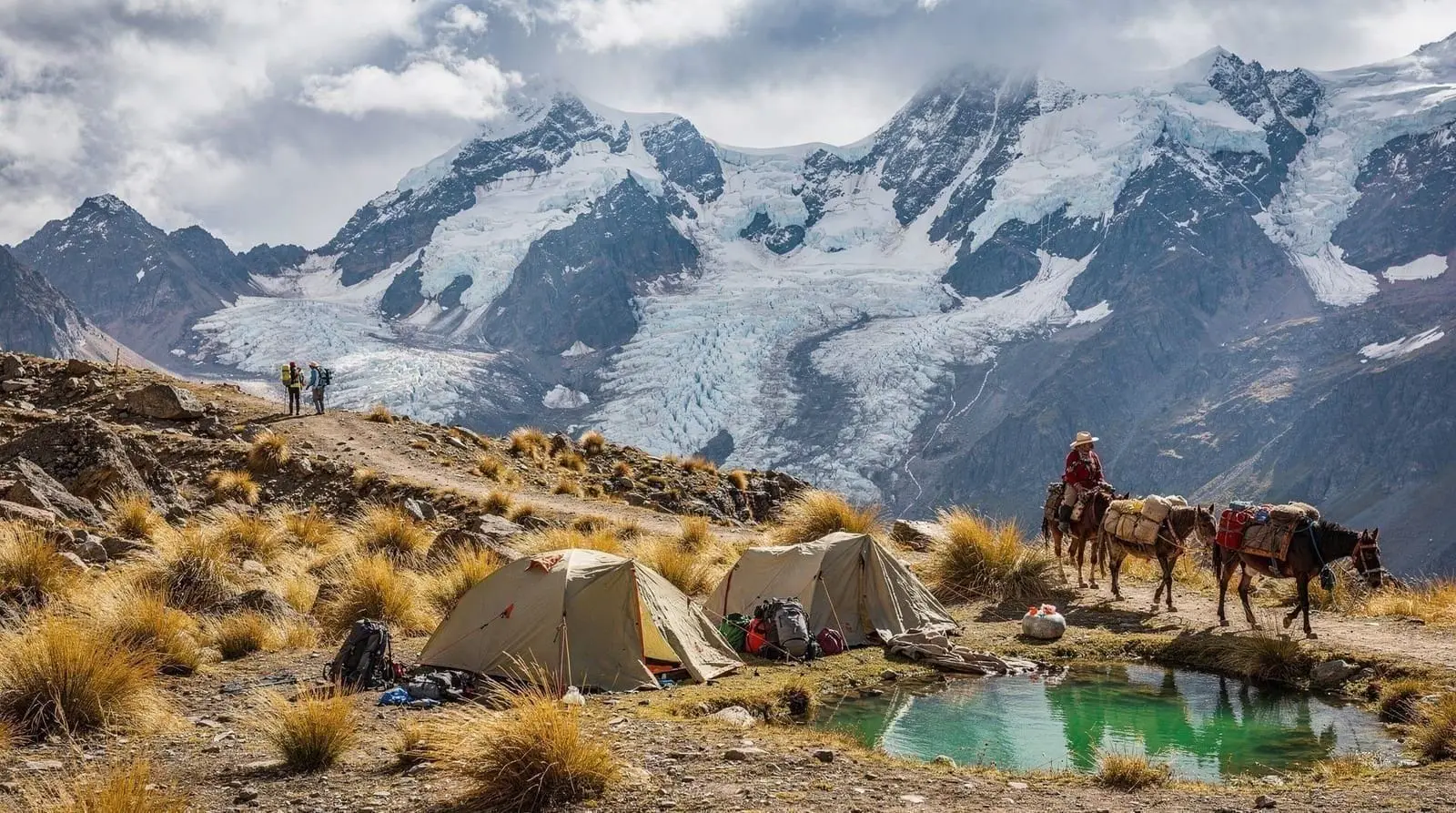
Huayhuash circuit guide: the great Andean trek done right
From Huaraz: Huayhuash Circuit 9-Day Budget Trek
What is the Huayhuash circuit and how long does it take?
The Cordillera Huayhuash circuit is a 110–130 km high-altitude loop around a compact range of 6,000 m peaks south of Huaraz. The full classic loop takes 8–10 days and crosses multiple passes above 4,700 m, making it one of the most demanding treks in the Americas.
A trek that doesn’t pretend to be easy
The Cordillera Huayhuash is the serious one. Where the Santa Cruz trek is a glorious long weekend, the Huayhuash circuit is an expedition: eight to ten days of camping above 4,000 m, a new pass to cross most days, no road access for the middle of the route, and weather that can change from sun to sleet in twenty minutes. It is also, by wide consensus among people who have walked the great trekking routes of the world, one of the most spectacular. The range is tiny — barely 30 km long — but packed with a startling density of glaciated 6,000 m peaks, including Yerupajá (6,617 m), Peru’s second-highest mountain, and Siula Grande, made famous by Joe Simpson’s book and film Touching the Void.
This guide assumes you are a fit, experienced hiker considering a real commitment. If you are not yet sure you have the conditioning or the altitude experience, start with the Santa Cruz trek guide and the Huaraz acclimatisation guide — Huayhuash is not a route to learn high-altitude trekking on.
| Distance / duration | 110–130 km, 8–10 days (mini version: 4–6 days) |
| Start/end | Chiquián, Llamac, or Cuartelhuain, ~3hrs from Huaraz |
| High point | Optional San Antonio pass, near 5,000 m |
| Cost | Around S/1,800–3,500 ($480–950), guided group trek |
| Best time | Mid-May to mid-September, June–August most stable |
How long, how far, how high
The trek begins and ends near Chiquián, a small town about three hours south of Huaraz by road, or sometimes from the village of Llamac or Cuartelhuain depending on the operator. The full classic circuit is roughly 110–130 km and is usually walked in 8 to 10 days, with shorter “mini” loops of 4 to 6 days that skip the eastern side for those with less time.
The defining feature is the relentless succession of high passes. Over the full loop you cross eight or more passes above 4,600 m, several above 4,800 m, and the optional San Antonio pass tops out near 5,000 m. You camp every night between roughly 4,000 m and 4,750 m. There is essentially no low ground to recover on — your body works hard around the clock. This is why acclimatisation before you start is not advice but a hard requirement.
Route options to know before you book
The full classic circuit (8–10 days) loops the entire range, taking in the famous viewpoints over Siula Grande and the Carnicero peaks, the thermal springs at Viconga, and the dramatic San Antonio or Santa Rosa pass. This is the complete experience.
The “mini Huayhuash” or Alpine circuit (4–6 days) covers the western and southern highlights — including some of the best viewpoints — but skips the longer eastern traverse. A reasonable compromise if you cannot spare ten days but still want the range’s signature scenery.
Direction and variants differ between operators. The two trickiest sections are the high optional passes (San Antonio and Cuyoc), which reward you with the most dramatic views but add serious effort. Discuss with your operator whether these are included or optional, because they materially change the difficulty.
Huayhuash circuit 9-day trek from HuarazDaily rhythm and what the walking is actually like
A typical day starts early — porters and arrieros break camp while you eat breakfast, then you walk four to seven hours, usually climbing to a pass mid-morning and descending to the next valley camp by mid-afternoon, before the weather turns. The passes are the work; the valleys are the reward, with glacial lakes (Carhuacocha, Mitucocha, Viconga, Jahuacocha) that rival anything in the Cordillera Blanca and far fewer people to share them with.
The terrain is non-technical — no ropes or crampons on the standard route — but the cumulative effect of crossing a 4,800 m pass with a daypack, day after day, on thin air and broken sleep, is what separates Huayhuash from a normal trek. Nights are cold; expect frost and occasionally snow on the high camps even in dry season.
Guides, arrieros, and the cost of doing it properly
Almost nobody does Huayhuash fully self-supported, and for good reason: carrying ten days of food and gear across eight high passes is brutal, and there is no resupply. The standard model is a supported trek with a guide, cook, and a team of arrieros with donkeys or mules carrying group gear and food, while you walk with a daypack.
Costs are higher than Santa Cruz because the logistics are bigger:
- Guided group trek, 8–10 days: typically S/1,800–3,500 (about $480–950 USD) per person, depending on group size, length, and operator quality.
- Communal entry/camping fees: several villages along the route charge local fees (often S/20–50 each, totalling S/150–250 across the circuit). These fund the communities that maintain the trail and provide arrieros; a good operator includes or clearly itemises them.
- Tips: the crew works extremely hard. Budget S/200–350 per trekker for guide, cook, and arrieros combined.
Always confirm in writing what the price includes — transport to Chiquián, all village fees, food, tents, and emergency provision. Cheap quotes usually mean cut corners on food quantity, gear quality, or crew pay.
Acclimatisation: do not skip the lead-up
You should arrive at the trailhead already adapted to at least 4,500 m. The standard preparation is to base in Huaraz for several days, walking progressively higher day hikes — the Laguna 69 climb to 4,600 m, the Laguna Churup trek, or a night at higher elevation — before starting. Trying to acclimatise on the Huayhuash circuit is the most common reason people abandon it on day two or three with debilitating AMS.
For the protocol, see the Huaraz acclimatisation guide and consider the best day hikes near Huaraz as your warm-up sequence. A sensible plan is four to five days of acclimatisation hikes before committing to the circuit.
Altitude medicine and emergencies
At these elevations, AMS is near-universal in mild form and the serious forms — HAPE and HACE — are real risks because you cannot easily descend to low altitude mid-route. The defining symptoms to act on immediately: breathlessness at rest with a wet, bubbling cough (HAPE), or confusion, stumbling, and a crushing headache (HACE). The treatment is descent, and on Huayhuash descent can mean a long evacuation.
This is precisely why a competent guide, a means of communication (radio or satellite messenger), and ideally supplementary oxygen or a portable hyperbaric chamber matter so much. Ask your operator what emergency provision they carry. Acetazolamide (Diamox), available over the counter in Huaraz, is worth carrying as a preventive and treatment aid, but it does not make descent unnecessary.
Gear: this is where it gets serious
Huayhuash demands genuine cold-weather and wet-weather gear, not the lightweight kit that suffices for a summer day hike:
- Sleeping bag rated to at least −15 °C — this is not the place for an optimistic rental. Rentals run S/20–30 per day in Huaraz; inspect the loft and zip carefully.
- A four-season-capable tent if not supplied; supported treks usually provide these.
- Insulated jacket, full waterproof shell, warm gloves, hat, and a buff or balaclava.
- Properly broken-in waterproof boots and gaiters for boggy valley sections.
- Sun protection — UV at altitude is fierce; high-factor sunscreen, lip balm, and proper sunglasses are essential.
- Water treatment — filter, tablets, or boiling; do not rely on stream water untreated.
You can rent the bulk of this around Jirón Luzuriaga in Huaraz, but bring your own boots, base layers, and anything that touches your skin.
Choosing an operator
The stakes are higher here than on shorter treks, so operator quality is not a place to economise. The cheapest options sold by touts near the Huaraz bus terminals frequently underpay arrieros, skimp on food over a ten-day trip (which matters enormously when you are burning thousands of calories a day), and lack proper emergency kit. Look for a certified mountain guide, a clearly itemised inclusion list covering all village fees, evidence of emergency communications and oxygen, and a track record. Booking through an established platform in advance lets you confirm what you are actually getting.
When to go
The season is narrow and firm: mid-May to mid-September, with June to August the most stable. Outside this window the high passes can be snowed in or storm-bound, river crossings swell, and the access roads to Chiquián are prone to landslides. There is no realistic wet-season option for the full circuit — the Andean rains make it dangerous. Plan within the dry-season window and pad your itinerary with a spare day for weather.
The day-by-day shape of the classic loop
Operators vary the exact stages, but a typical 8–9 day clockwise loop from Llamac or Cuartelhuain runs roughly as follows. Day one walks in to a first camp around Quartelhuain or Mitucocha (~4,200 m). Day two crosses the first pass — often Cacanapunta (~4,700 m) — to Laguna Mitucocha or Carhuacocha. Day three is many trekkers’ favourite: a high traverse past the Tres Lagunas viewpoint over Carhuacocha, Siula, and Quesillococha, with the great east faces of Yerupajá and Siula Grande filling the sky, crossing Siula pass (~4,800 m).
The middle days work through Huayhuash and Trapecio passes, reaching the Viconga thermal springs — a genuine hot soak at altitude that does wonders for tired legs. The later days tackle the optional San Antonio or Santa Rosa pass (near 5,000 m) for the most dramatic panorama of the trip, before descending past Laguna Jahuacocha — arguably the most beautiful camp of the whole circuit — and out to the road. Each operator sequences these differently, so ask for a stage-by-stage itinerary with altitudes when you book.
| Day | Rough stage | Camp altitude | Highlight |
|---|---|---|---|
| 1 | Walk in from Llamac/Cuartelhuain | ~4,200 m | Settling in, first views of the range |
| 2 | Cross Cacanapunta pass | ~4,400 m | First high pass, Mitucocha valley |
| 3 | Siula pass, Tres Lagunas viewpoint | ~4,300 m | Yerupajá and Siula Grande east faces |
| 4–5 | Huayhuash and Trapecio passes | ~4,400–4,600 m | Viconga thermal springs |
| 6–7 | Optional San Antonio/Santa Rosa pass | ~4,600 m | Most dramatic panorama of the trek |
| 8–9 | Descend via Jahuacocha | ~4,000 m | Most photogenic camp of the circuit |
Training and fitness before you commit
Huayhuash is not a route to show up for undertrained. Aim for several months of consistent cardio, ideally with hill or stair repeats to build the specific leg and lung endurance that consecutive passes demand, plus multi-day hikes with a loaded daypack if you can arrange them.
Prior experience at altitude matters more than raw fitness: someone who has done the Santa Cruz trek or a demanding Huaraz day hike like Laguna 69 knows how their body responds above 4,000 m, which is worth more on Huayhuash than a marathon time at sea level. If you have never been above 3,500 m, do not make Huayhuash your first attempt — build up through Llanganuco and Laguna Parón first, both accessible day trips from Huaraz.
What a quote should actually include
Because so much can be quietly omitted, ask any operator for a written, itemised breakdown before you pay a deposit. It should cover transport to and from Chiquián or the trailhead, all communal village and camping fees along the route, a cook and full board (three meals plus tea stops), tents and camp equipment, arrieros and pack animals for group gear, a certified guide, and a clear statement of emergency provision — radio or satellite communicator, first-aid kit, and evacuation plan.
What it should not silently exclude: your personal gear rental if you need it, tips (budgeted separately), and travel insurance, which is always your responsibility. A quote that is dramatically cheaper than the S/1,800–3,500 range in this guide is worth interrogating line by line before you sign up, not after you are two days in with an underfed crew.
Food, camps, and daily comforts
Supported Huayhuash treks run a full camp kitchen: a cook produces three hot meals a day plus tea stops, and the food is better than most people expect — soups, stews, fresh-baked items, and plenty of carbohydrate to fuel the passes. Over ten days, food quantity and quality genuinely matter, which is one more reason the cheapest operators are a false economy. Camps include a mess tent, sleeping tents, and a toilet tent. There is essentially no mobile signal for most of the circuit, no electricity, and no resupply, so carry a power bank, keep batteries warm in your sleeping bag, and bring everything you will need from Huaraz.
Water comes from glacial streams; treat it even if your crew boils the cooking water. The Viconga hot springs are a highlight worth timing your energy for. Nights are genuinely cold — frost is normal and snow is possible — so a warm bag and a hot-water bottle (ask the cook) make the difference between sleeping and shivering. Bring earplugs and an eye mask too: shared camps, donkeys, and the bright high-altitude moon all conspire against the deep sleep your body needs to recover for the next pass.
Common mistakes that end Huayhuash trips early
The recurring failures are predictable. Insufficient acclimatisation is the number-one reason people abandon the circuit in the first three days. Choosing a tout’s bargain trek that underfeeds you over ten brutal days, or lacks emergency communications and oxygen, is the most dangerous. Underestimating the cold — bringing a summer sleeping bag for a route with sub-freezing nights at 4,700 m — turns the trip into an ordeal. And inadequate insurance is a serious gamble: many policies exclude trekking above 4,500 m or do not cover helicopter evacuation, which on Huayhuash could be the only way out of a medical emergency. Read your policy’s altitude clause before you go.
How Huayhuash fits a Peru trip
Huayhuash is a commitment that essentially defines a Peru trip rather than slotting into one. Allow roughly two weeks total — several days acclimatising in Huaraz, 8–10 days on the circuit, and recovery time. If you also want Cusco and Machu Picchu, you are looking at three weeks-plus; the Peru 2-week itinerary guide and the north vs south Peru comparison help you decide whether to combine or choose.
If Huayhuash sounds like more than you want, the Santa Cruz trek guide is the obvious step down in commitment for the same range of scenery, and the Huaraz vs Cusco for hiking guide helps if you are still deciding which range to prioritise at all. For a first-person sense of what a demanding Cordillera Blanca day feels like before you commit to ten of them back to back, the Laguna 69 diary is a useful gut check.
Not ready for Huayhuash yet? Santa Cruz trek 4-day guided tourFrequently asked questions about the Huayhuash circuit
How hard is the Huayhuash circuit compared to other treks?
It is one of the harder non-technical treks in the world. The difficulty comes from eight to ten consecutive days at altitude, a high pass nearly every day (several above 4,800 m), constant cold, and no road access through the middle. It is significantly more demanding than the Santa Cruz trek, the Inca Trail, or Salkantay.
Do I need a guide for the Huayhuash circuit?
In practice, yes. The route is remote, navigation is non-trivial, village fees and arriero arrangements are complex, and emergencies are hard to handle alone. Nearly everyone walks it as a supported trek with a guide, cook, and arrieros. A handful of very experienced expedition hikers do it self-supported, but it is not recommended.
How much does the Huayhuash circuit cost?
A guided 8–10 day circuit typically costs S/1,800–3,500 (about $480–950 USD) per person, plus village fees of roughly S/150–250 across the route and crew tips of S/200–350. Cheaper quotes usually mean reduced food, lower-quality gear, or underpaid crew.
How high is the Huayhuash circuit?
You cross eight or more passes above 4,600 m, several above 4,800 m, and the optional San Antonio pass reaches near 5,000 m. Camps sit between roughly 4,000 m and 4,750 m. You should be acclimatised to at least 4,500 m before starting.
Can I do a shorter version of Huayhuash?
Yes. The “mini Huayhuash” or Alpine circuit of 4–6 days covers the western and southern highlights, including some of the best viewpoints, while skipping the longer eastern traverse. It is a good option if you cannot spare the full 8–10 days.
When is the best time to trek Huayhuash?
Mid-May to mid-September, with June to August the most reliable for stable weather and clear passes. Outside the dry season the high passes can be snowbound and the access roads to Chiquián are prone to landslides, so the full circuit is not advisable.
How long do I need to acclimatise before Huayhuash?
Plan four to five days of progressive acclimatisation hikes based in Huaraz, reaching at least 4,500 m, before starting. Attempting to acclimatise on the circuit itself is the most common reason trekkers abandon it early with altitude sickness.
What should an operator’s quote include?
A proper quote covers transport to the trailhead, all communal village and camping fees, a cook with full board, tents and camp gear, arrieros with pack animals, a certified guide, and stated emergency provision such as radio communication and a first-aid kit. It typically excludes tips, personal gear rental, and travel insurance. Get this in writing before paying a deposit.
Is the Huayhuash circuit safer with a guide than solo?
Yes, substantially. The route is remote with no resupply and limited mobile signal, and altitude emergencies need fast, informed decisions about descent. A guide, cook, and arrieros also mean someone is watching for symptoms of HAPE or HACE in you and your group, which is much harder to self-monitor accurately at altitude.
Top experiences
Bookable activities with verified prices and instant confirmation on GetYourGuide.
