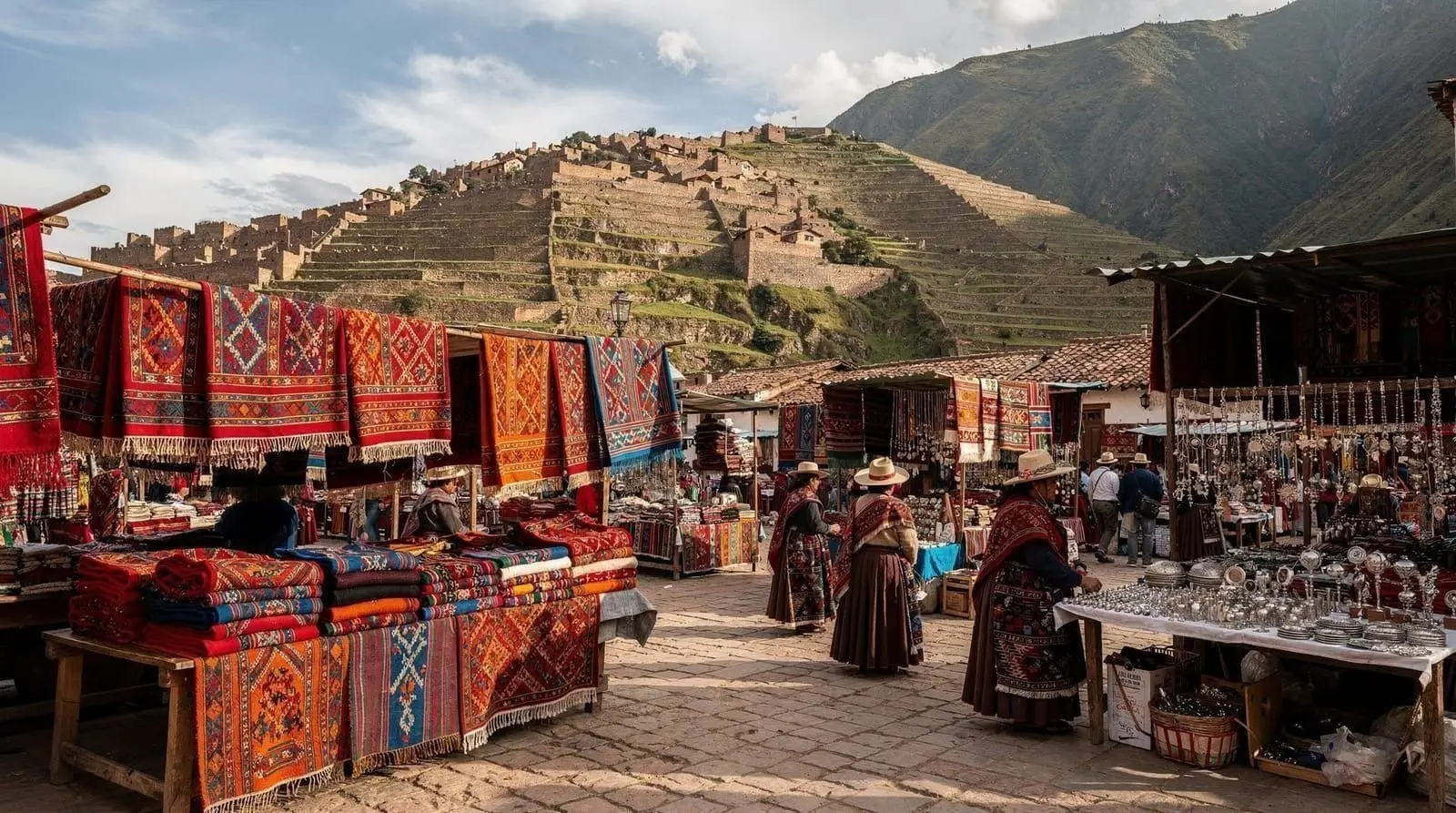
Pisac market and ruins in one day
From Cusco: Sacred Valley Tour with Pisac and Ollantaytambo
Can you do Pisac market and the ruins in one day?
Yes, comfortably. Take an early colectivo from Cusco (about an hour, S/5–8), walk or taxi up to the ruins for the cool morning, then come down to the market for lunch and shopping by midday. The ruins need the boleto turístico; the market is free to wander. Sunday is the famous market day, but Tuesday and Thursday are quieter and the stalls are still up.
Two attractions stacked on one hillside
Pisac confuses first-time planners because the name covers two completely different things in two different places. There is the modern town of Pisac, sitting at 2,970 m on the floor of the Sacred Valley, known almost entirely for its handicraft market. And there is the Pisac archaeological park, a sprawl of Inca terraces, temples, and cliff tombs draped across the steep ridge several hundred metres above the town. The two are connected by a switchbacking road and a steep footpath, and the smart move is to treat them as a single day rather than choosing between them.
This guide is about doing exactly that: ruins in the cool of the morning, market and a long lunch afterwards, all on a sensible budget and without falling for the standard traps. If you want the full archaeology — the building phases, the agricultural terraces, the Intihuatana sun-stone, the cliff cemetery — read the dedicated Pisac ruins guide, which goes deeper into the site itself. Here the focus is the logistics of the combined day trip.
| Where | Pisac, Sacred Valley, about 1 hour from Cusco |
| Cost | Around S/60–100/person for a full independent day |
| Time needed | Half a day minimum, full day comfortably |
| Getting there | Colectivo from Calle Puputi, Cusco (S/5–8) |
| Best time | Ruins early morning; market late morning |
When the market actually happens
The single most common piece of bad advice about Pisac is “go on Sunday.” It is true that Sunday is the biggest market day, but that needs unpacking.
Pisac has some form of tourist market open every single day. The handicraft stalls in the main square and the surrounding lanes are a permanent fixture, run for the steady stream of visitors who come up from Cusco. So you will never arrive to a closed market, whatever the day.
The traditional market days — when the scale grows and a little more authenticity creeps in — are Sunday, Tuesday, and Thursday. Of these:
- Sunday is the largest, the most famous, and by some distance the most crowded. It is the only day with the morning Quechua-language Catholic Mass in the church on the square, and the only day you reliably see highland villagers in traditional dress coming down to trade produce in a small section at the back. By mid-morning it is also shoulder-to-shoulder with tour groups, and the photo you imagined of a quiet Andean market is gone.
- Tuesday and Thursday offer most of the same craft stalls with a fraction of the crowds. If your priority is browsing and buying in relative calm, these are the better days.
If you are chasing the authentic produce-trading scene specifically, Sunday early morning — before about 9am — is the only realistic window, and even then it is a modest corner of a heavily touristed event. Manage your expectations.
Market days at a glance
| Day | Crowds | Highlights |
|---|---|---|
| Sunday | Heaviest | Quechua Mass, produce-trading corner, biggest stall count |
| Tuesday | Light | Most of the same craft stalls, far fewer tour buses |
| Thursday | Light | Same as Tuesday, good alternative if Sunday is impossible |
| Other days | Light–moderate | Permanent tourist stalls, always open, no special events |
The honest day plan
Get there early
Shared colectivo vans to Pisac leave from Calle Puputi in Cusco (near the corner with Avenida de la Cultura) as soon as they fill, from around 6am. The fare is S/5–8 and the ride takes roughly an hour, climbing out of Cusco and dropping into the valley. They run constantly through the morning, so there is no fixed timetable to catch — just turn up. A private taxi for the same trip runs S/60–90 one way.
Aim to be in Pisac by 8 or 8:30am. The reason is the ruins: they are far better early, both for temperature and for crowds.
Ruins first, while it is cool
From the town, you have three ways up to the archaeological park:
- Taxi up, walk down. A taxi from the square to the upper entrance is S/25–40 for the car (negotiate, and ask for the upper gate, “puerta de arriba”). You then walk the ruins downhill back toward town — by far the most popular and least punishing option.
- Walk both ways. The footpath from town climbs steeply for 60–90 minutes through the lower terraces. Rewarding, but hard work at altitude and in sun.
- Tour transport. If you arrive on an organised Sacred Valley tour, the bus takes you to the upper gate and gives you a fixed window inside.
You will need the boleto turístico to enter — there is no ruins-only ticket sold at the gate. See the boleto turístico explained guide for which version to buy; in short, the full S/130 pass pays off if you are also doing other Sacred Valley sites and the ruins above Cusco, while a partial S/70 circuit covers just the valley cluster.
Walking the ruins downhill takes most people 1.5–2.5 hours with stops. You pass the upper military and ceremonial sectors, the famous Intihuatana temple complex, the long sweep of agricultural terraces, and — across the gorge — the honeycomb of Inca tombs cut into the cliff face. By the time you reach the bottom it should be late morning, the sun is up, and you are ready to eat.
Market and lunch, when it is busiest
Coming down into town around 11am to midday puts you in the market at its liveliest. This is the right order: you do the strenuous part early and cool, then browse and eat when the day has warmed and you have nothing left to climb.
For lunch, Pisac’s genuine specialty is empanadas and bread from the wood-fired clay ovens (hornos) dotted around town — look for the empanadas de horno, often filled with cheese and herbs, for a few soles each. They are cheap, fresh, and the most honest food in town. Beyond that, the square and the lanes off it have cafés and set-menu restaurants; a menú del día runs S/15–25, while the more polished tourist cafés charge S/35–60 for mains. The New-Age-leaning town also has a cluster of vegan and “superfood” cafés if that is your thing.
Getting back
Return colectivos to Cusco leave from near the bridge on the main road through town, running until early evening for the same S/5–8. There is no need to pre-book; just walk to the stop and wait for the next van to fill. If you would rather not backtrack to Cusco at all, some travellers instead continue deeper into the valley toward Urubamba or Ollantaytambo from Pisac’s colectivo stop, using Pisac as the first stop of a multi-day Sacred Valley loop rather than a there-and-back day trip.
Shopping the market without getting fleeced
The Pisac market is overwhelmingly a tourist handicraft market, and you should buy with that framing in mind.
- “Alpaca” is usually not alpaca. A genuine baby-alpaca scarf is soft, slightly heavier than it looks, and does not squeak when rubbed. Most of what is sold as alpaca in the Sacred Valley markets is acrylic or an alpaca-acrylic blend. That is fine if the price reflects it — a S/15 “alpaca” hat is obviously acrylic and perfectly serviceable — but do not pay genuine-alpaca prices for it. For serious textile shopping, the weaving cooperatives in Chinchero and the dedicated Andean textiles guide are far more reliable.
- Haggling is expected but polite. Opening prices are inflated for tourists. A counter of 50–60 percent of the asking price is normal; meet somewhere in the middle. Walk away calmly if it stalls — you will often be called back, and if not, the next stall sells the same thing.
- The produce corner is the real one. On Sunday especially, the small section where villagers trade potatoes, corn, herbs, and dried goods is the genuine market underneath the souvenir layer. It is not for buying souvenirs; it is for seeing what the market actually was before tourism.
Doing it as part of a wider Sacred Valley day
Many travellers fold Pisac into a fuller Sacred Valley circuit rather than visiting it alone — typically Pisac in the morning, then Maras and Moray, and Ollantaytambo before returning to Cusco. The trade-off is honest: you see more, but the market and ruins each get a fixed, shortish window and you lose the freedom to linger. The one-day Sacred Valley itinerary lays out exactly how that fuller day fits together hour by hour.
If you would rather not juggle colectivos and timing, an organised tour handles the transport and the boleto-gate logistics. The Sacred Valley tour with Pisac and Ollantaytambo pairs the two headline sites in a single day, while the Pisac, Maras, Moray and Ollantaytambo small-group tour adds the salt terraces and the circular agricultural terraces for travellers who want the full valley in one go.
For self-guided planners, the getting around the Sacred Valley guide covers the colectivo network in detail, and full multi-day routings are at /itineraries/. If you would rather take the valley slowly over two or three days instead of racing through it in one, the Sacred Valley slow travel diary makes the case for a more relaxed pace, with Pisac and Chinchero as easy add-ons along the way.
Using Pisac to acclimatise
Here is a planning trick worth knowing. Pisac sits at 2,970 m, more than 400 m lower than Cusco’s 3,400 m. Spending a night here — there are guesthouses in town and lodges up the valley — is genuinely easier on a body fresh off the plane than sleeping in Cusco. Travellers worried about altitude often build their first night or two into the Sacred Valley for exactly this reason; the Cusco altitude vs Sacred Valley guide lays out the logic. Even as a day trip, the lower elevation makes the ruins climb noticeably more bearable than the same exertion would be up in the city.
What it actually costs
A bare-bones combined day from Cusco, doing it independently:
- Colectivo there and back: S/10–16
- Taxi up to the upper ruins gate: S/25–40 (split between two or more people)
- Boleto turístico: S/70 partial or S/130 full (often already bought for the wider trip)
- Lunch: S/15–40
So beyond whatever you have already spent on the boleto, the day itself runs roughly S/60–100 per person including a decent lunch — one of the better-value outings from Cusco.
Frequently asked questions about Pisac market and ruins in one day
What days is the Pisac market on?
Do I need the boleto turístico for Pisac ruins?
How do I get from Cusco to Pisac?
Is the Pisac market a tourist trap?
Should I visit the ruins or the market first?
How long do you need in Pisac?
Can I visit Pisac without a boleto turístico if I only want the market?
Top experiences
Bookable activities with verified prices and instant confirmation on GetYourGuide.

