Ollantaytambo village guide
Cusco: Pisac, Maras, Moray, Ollantaytambo Small Group Tour
Is Ollantaytambo worth staying overnight, or just a stop?
Stay the night. Ollantaytambo is the only living Inca town in the valley, the fortress empties after the tour buses leave around 16:00, and you can catch an early Machu Picchu train without a pre-dawn drive from Cusco.
A town people still live inside
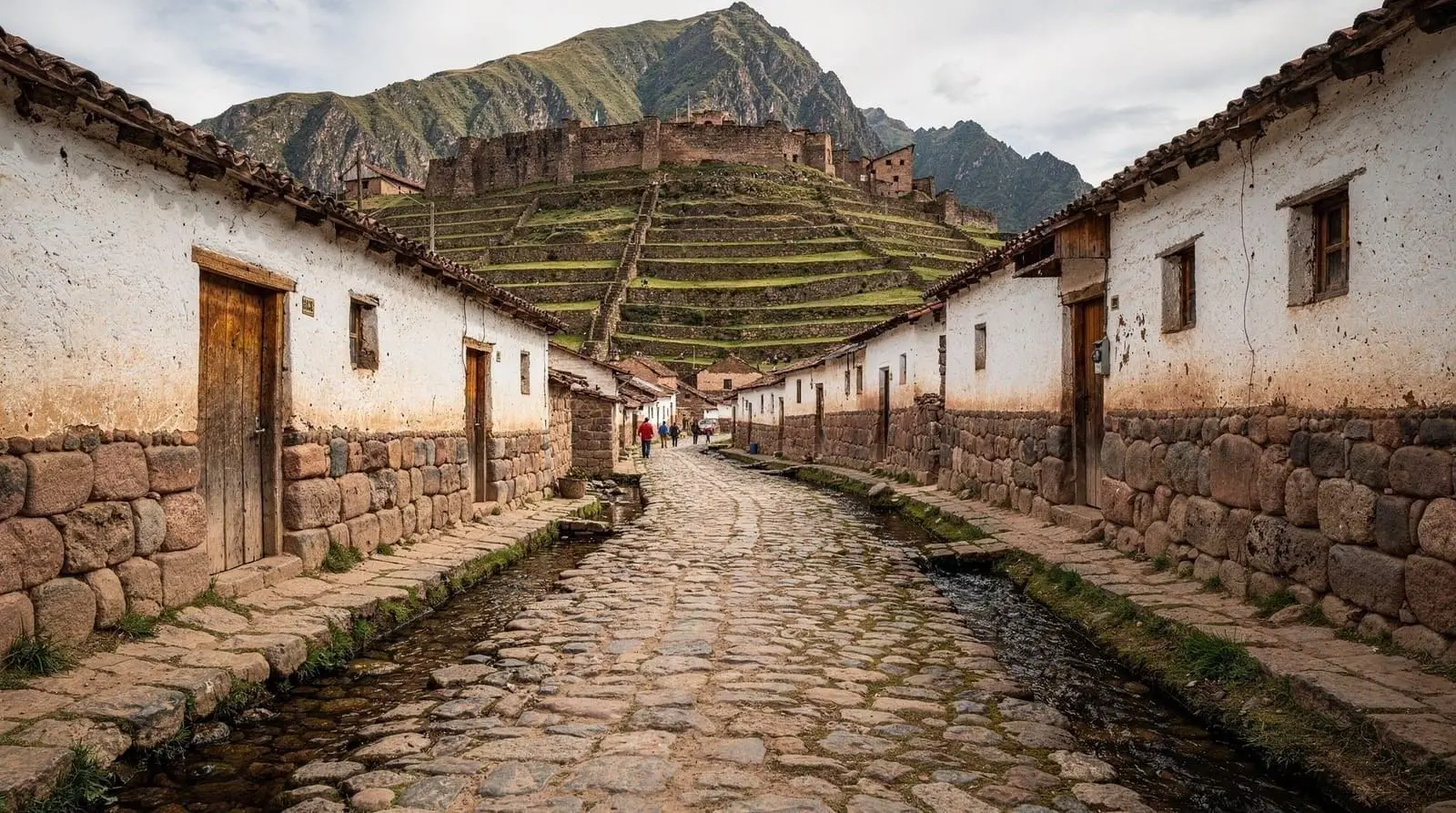
Most Inca sites in Peru are ruins you walk through and leave. Ollantaytambo is different: it is a working town built on the original Inca grid, where families cook dinner behind walls laid five centuries ago and irrigation channels still run down the cobbled lanes. The settlement was the royal estate of the emperor Pachacuti, and after his death it kept its function as an administrative and ceremonial centre. When the Spanish came, it became the one place where the Inca briefly fought back and won.
Because almost every visitor passes through to catch the train to Machu Picchu, Ollantaytambo gets treated as a transit point — a 90-minute fortress stop wedged into a packed Sacred Valley day tour. That is the version most people see, and it is the wrong one. The fortress is genuinely impressive, but the town itself, the granaries on the opposite hillside, and the rhythm of the place after the buses leave are what make it the most rewarding overnight stop in the whole valley.
This guide covers the fortress and the boleto, the free sites that day-trippers skip, how the train station works, where to sleep, and the honest warnings worth knowing before you arrive. For the full overview of how the town fits the valley, see the Sacred Valley destination page and the Ollantaytambo destination guide.
| Where | Lower Sacred Valley, ~1h45 from Cusco |
| Ticket | Boleto Turístico — Circuit III S/70 or full S/130 |
| Time needed | Half day for a stop; overnight for the full experience |
| Getting there | Colectivo ~S/15, private taxi S/120-180, or tour |
| Best time | Arrive afternoon before, do the fortress at 7am opening |
| Altitude | ~2,800 m — a smart first-night acclimatisation base |
The fortress: what you are actually looking at
The terraced hillside above the town is universally called the “fortress,” but that name only tells part of the story. It was a temple and ceremonial complex that also happened to be defensible, and the steepness that makes the climb a workout is exactly what helped the Inca hold it against Spanish cavalry in 1537.
The climb up the main terraces takes most people 20 to 30 minutes at altitude, with plenty of pauses for breath and photographs. At the top sits the Temple of the Sun, an unfinished wall of six colossal pink rhyolite monoliths, each weighing many tonnes, fitted together with thin spacer stones. What stops engineers in their tracks is the source: the quarry lies on the opposite mountainside, across the Urubamba River, several kilometres away and hundreds of metres up. The Inca moved these blocks down one mountain, across a river, and up another. Some of the stones still sit abandoned on the route, known locally as the “tired stones.”
Look across the valley from the top and you will spot the Pinkuylluna granaries — stone storehouses built high on the shaded slope, where cool mountain air kept grain and potatoes dry. With a little imagination you can also pick out the supposed profile of Tunupa, an Andean deity, carved or eroded into the rock face above them.
Allow 1.5 to 2 hours for the fortress without rushing. Go first thing (it opens at 07:00) or in the last hour before closing to dodge the tour-bus crush that peaks from roughly 11:00 to 14:00.
The Boleto Turístico, briefly
You cannot buy a ticket just for Ollantaytambo at the gate. Entry is only via the Boleto Turístico del Cusco:
- Boleto General: S/130 (about $35), valid 10 days, covers 16 sites across Cusco and the valley.
- Boleto Parcial Circuito III: S/70 (about $19), valid 2 days, covers the four Sacred Valley ruins — Ollantaytambo, Pisac, Chinchero and Moray.
If you are doing the valley over a day or two and skipping the Cusco-city ruins, the partial Circuit III ticket is the better value. Bring cash; card readers at the gate are unreliable. The full breakdown is in the Cusco tourist ticket guide.
A guided day tour folds the ticket logistics and transport into one booking, which matters because the valley sites are too spread out to chain easily by public van in a day. The Pisac, Maras, Moray and Ollantaytambo small-group tour ends here, giving you the option to peel off and stay the night while your group heads back to Cusco — just confirm that flexibility when you book.
The free sites the day tours skip
Here is the planning insight that changes a visit: some of the best things in Ollantaytambo cost nothing and are not on the boleto at all.
The Pinkuylluna granaries
The steep climb to the storehouses on the eastern slope is free, and it is the photograph almost nobody on a tour gets — you look straight down on the fortress and the geometric street grid below. The path is unmarked, rough, and exposed in places, so wear proper shoes and skip it if heights bother you. Budget 45 minutes up and back.
The old town grid
The blocks north of the main plaza are the best-preserved Inca urban layout in Peru. Wander the narrow lanes (the canchas), notice the trapezoidal doorways, and watch the water channels still doing their job. It is a living neighbourhood, so be quiet and respectful around doorways.
The Inca quarry and “tired stones”
If you have a half-day spare, the path across the valley toward the Cachicata quarry passes several of the abandoned monoliths the Inca were dragging when work stopped. It is a quiet, ruins-free walk with big views. Very few day-tour itineraries include this walk at all, so it is one of the more reliable ways to have a piece of Ollantaytambo’s story entirely to yourself, even in high season.
The train station: how it really works
Ollantaytambo is the main railhead for Machu Picchu. There is no road to Aguas Calientes — the train (or a multi-day trek) is the only way in. Both operators run from here:
- PeruRail and Inca Rail depart for Aguas Calientes throughout the day; the ride takes about 1 hour 45 minutes.
- The station is a 10-minute walk or a S/5 mototaxi ride from the plaza.
- Arrive at least 30 minutes early. This is the busiest station in the valley and the platform gets crowded.
- Bring your passport — it is checked against your ticket.
If you are deciding between operators and classes, the comparison is laid out in the dedicated train guide (linked from the guides hub). Book trains well ahead in dry season; the cheaper departure times sell out first.
Where to sleep and the altitude advantage
At roughly 2,800 m, Ollantaytambo sits about 600 m lower than Cusco, which makes it one of the smartest first-night bases in the Andes for acclimatisation. Sleeping low here before going up to Cusco measurably cuts your odds of altitude sickness — see the Cusco acclimatisation plan for the full strategy.
- El Albergue sits literally on the station platform — unbeatable for an early train, with a good restaurant and its own organic farm.
- Apu Lodge and Kamma Guest House are reliable mid-range options a short walk from the plaza.
- Budget travellers will find clean hostels and family-run hospedajes in the lanes around the main square.
The town is small enough to walk end to end in 15 minutes, and dinner options cluster around the plaza. Try the trout and the cuy if you want to eat local — more on regional dishes in the cuy and Andean food guide.
Booking ahead matters more here than in Cusco: Ollantaytambo has only a modest number of rooms for a town that sees this much through-traffic, and the platform-side properties in particular fill early in dry season. If you know your train time, book your room to match it rather than the other way round — arriving and hunting for a bed near a busy departure window is a needless stress the town’s small size makes easy to avoid with a little planning.
A realistic half-day and full-day plan
Half day (most people): Arrive late morning with a Sacred Valley tour, climb the fortress, grab lunch on the plaza, and either catch an afternoon train to Machu Picchu or continue back to Cusco.
Full day done right: Arrive the afternoon before, drop your bag, and climb Pinkuylluna for sunset. Next morning, do the fortress at opening when it is empty and cool, wander the old town, eat an early lunch, and walk to the station for an afternoon train — or loop back through Maras and Moray if you have your own driver.
For how Ollantaytambo connects to the rest of the region, the getting around the Sacred Valley guide covers colectivos, taxis and timings, and the itineraries hub shows where it fits in a multi-day trip.
Tourist traps and honest warnings
The 90-minute drive-by. Budget Sacred Valley loops give you barely an hour at the fortress and zero time in the town. If the town is why you are coming, build in an overnight or come independently by colectivo.
Train-station price gouging. Snacks, water and taxis near the platform cost more than in town. Buy supplies in the plaza shops before you head to the station.
“Guides” at the fortress gate. Freelance guides hover at the entrance. Some are excellent and licensed; others are not. Agree the price and language up front, and check for an official MINCETUR credential.
Pinkuylluna is genuinely steep. It is not a casual stroll. The drop-offs are real, the path is loose, and there are no railings. Good footwear only, and turn back if you feel uneasy.
Underestimating the altitude. It is lower than Cusco, but the fortress climb still leaves people winded. Go slowly, hydrate, and do not schedule it for your first hour off the plane.
Half-day stop vs overnight, compared
| Half-day stop | Overnight stay | |
|---|---|---|
| Fortress crowds | Peak (mid-morning tour buses) | Empty (opening or last hour) |
| Free sites | Usually skipped | Pinkuylluna, old town, quarry walk all fit |
| Machu Picchu train | Same-day rush | Calm early departure, no pre-dawn Cusco drive |
| Acclimatisation benefit | Minimal | A full night at 2,800 m before going higher |
Frequently asked questions about Ollantaytambo village
How do I get from Cusco to Ollantaytambo?
Do I need the Boleto Turístico for Ollantaytambo?
How long do I need at the Ollantaytambo fortress?
Where does the train to Machu Picchu leave from?
Is Ollantaytambo a good place to acclimatise?
What is there to do in Ollantaytambo besides the fortress?
Top experiences
Bookable activities with verified prices and instant confirmation on GetYourGuide.


