Maras salt mines guide
Cusco: Pisac, Maras, Moray, Ollantaytambo Small Group Tour
What are the Maras salt mines?
The Salineras de Maras are around 5,000 shallow salt-evaporation ponds cascading down a ravine above the Sacred Valley, fed by a naturally salty spring and worked by hand by local families since pre-Inca times. Entry is S/18 cash, not on the Boleto Turístico, and they open from about 7am to mid-afternoon.
A working salt farm, not a museum
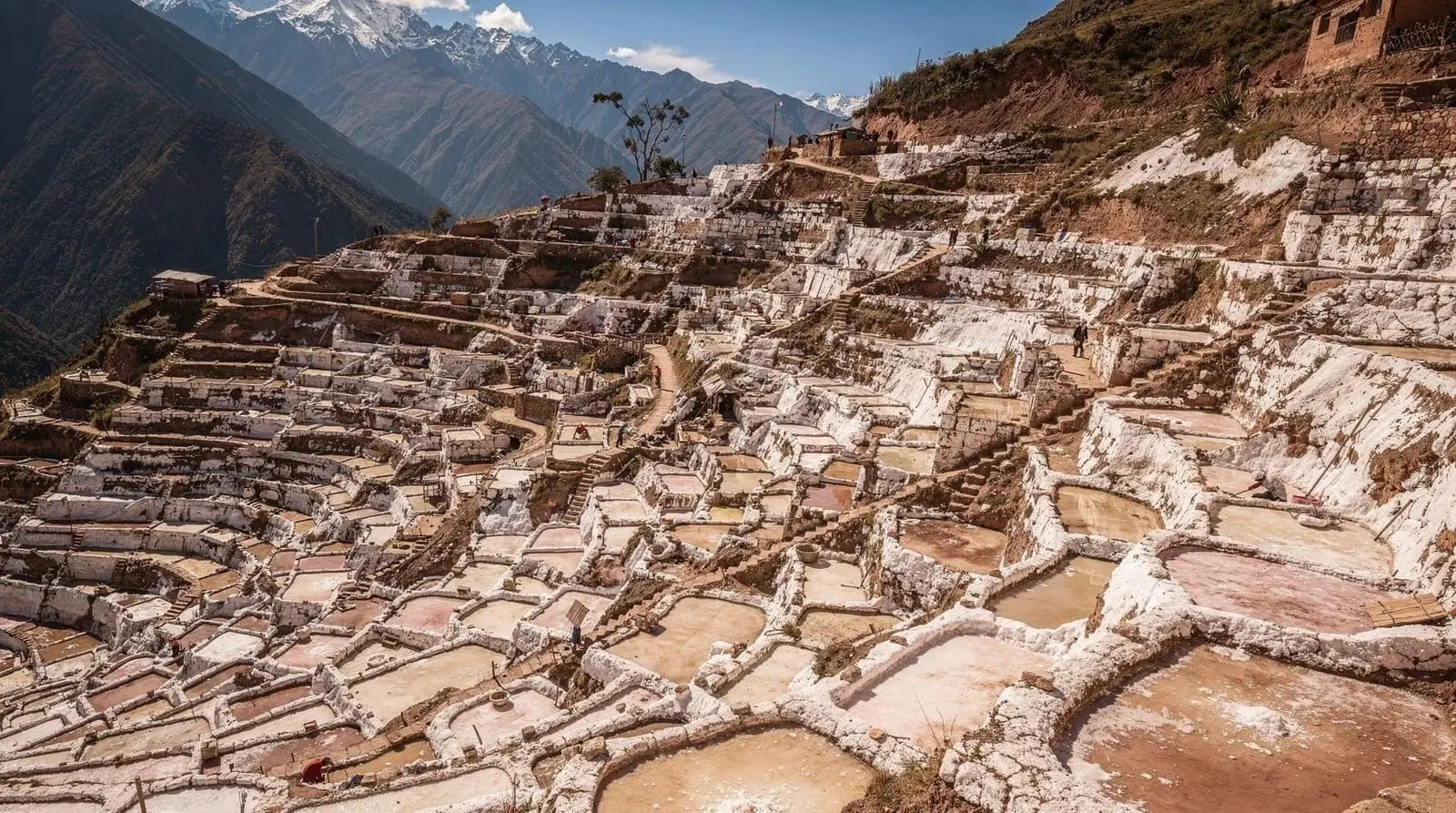
The first thing to understand about the Salineras de Maras is that it is not a monument or an archaeological park. It is a living salt farm that has operated continuously for well over five hundred years, predating the Inca and still run today by hundreds of families from the nearby village of Maras. When you look down on the dazzling staircase of ponds, you are looking at a community’s livelihood, much of it being actively worked while you watch.
That changes how you visit. The white-and-ochre spectacle is genuinely one of the most photogenic sights in the Sacred Valley, but it is also somebody’s workplace, which is why access has tightened in recent years. This guide explains how the salt is actually made, the real price and hours, when to come for the best light, the access rules as they now stand, and what salt is worth buying. For the practical logistics of pairing it with the nearby terraces, see the Maras and Moray day-trip guide; for the terraces themselves, the Moray guide.
| Entry | S/18 cash only, not on the Boleto Turístico |
| Hours | about 7am to 4-5pm |
| Best light | early morning or late afternoon |
| Best season | dry season (May-Oct) for the brightest white |
| Pair with | Moray terraces, 15 min away |
How the salt is actually made
High above the valley floor, a natural underground spring emerges carrying water so saturated with salt that it is undrinkable. The Maras families channel this brine through a network of small canals into roughly 5,000 shallow ponds, each only a few centimetres deep and a few square metres across, terraced down the ravine.
The process from there is pure physics and patience. The fierce high-altitude sun and the dry Andean air evaporate the water over several days. As it goes, salt crystallises and settles. A worker then rakes and scrapes the crusted salt from the pond floor, dries it further, and the cycle begins again. The top layer yields the finest, whitest salt; lower grades are used for cooking and for animals.
The ownership system is the remarkable part. Each pond belongs to a specific family, passed down across generations, and the whole operation is coordinated by a local cooperative that manages the shared canals and the tourist access. There is no machinery in the salt-making itself — it is the same hand process the Inca inherited from whoever dug the first ponds. Production is strongest in the dry season (roughly May to October), when evaporation is fastest and the ponds are at their brightest white.
Prices, hours and tickets
Entry is about S/18 (around $5), cash only in soles, paid at the gate. This is the detail that catches people out: the salt pans are not on the Boleto Turístico. Because the site is community-managed rather than run by the regional tourist authority, your Cusco tourist ticket does not cover it, and tour sellers occasionally imply otherwise. Always carry cash. There is no ATM up on the plateau — the nearest are down in Urubamba. Our Cusco tourist ticket guide confirms exactly what the boleto does and does not include.
Opening hours run from about 7am to the mid-to-late afternoon, commonly closing or stopping ticket sales around 4-5pm depending on the season. Allow about an hour for a relaxed visit along the viewing path, plus photos and a look at the stalls.
A nearby second viewpoint and the access road can both get congested with tour vehicles by late morning, which is the practical argument for arriving early.
The best time to visit and photograph
The salt pans reward timing more than almost any site in the valley.
Go early or late. Arrive soon after the 7am opening, before the Cusco buses roll in, and you get the ponds in soft light with space to compose photographs. Late afternoon offers similar light and thinning crowds. Midday is the worst combination of harsh overhead sun, flat glare on the white salt, and peak crowds.
Season matters for colour. In the dry season the ponds are at their crisp, brilliant white and the working surfaces are at their busiest. In the heavy rains of January and February, water dilutes and discolours the pans, the access track turns slick, and the spectacle dims. The shoulder months of April and October are the sweet spot — green hills, decent light, fewer people. The getting around the Sacred Valley guide covers seasonal road conditions on the Maras turnoff.
Mind the altitude for photography. At roughly 3,380 m the light is intense and the air thin. Bring a polarising filter if you shoot seriously — it cuts the salt glare — and don’t rush the walk back up, which is steeper than it feels.
Access rules as they now stand
If you have seen older photographs of tourists strolling between the individual salt ponds, set that expectation aside. To protect the working pans, prevent contamination, and reduce accidents on the slick, narrow dividing walls, access has been restricted to a designated viewing path along the upper edge of the site. You can no longer freely wander among all the ponds.
This is a reasonable change — the pans are a food-production site and a workplace — and the panorama from the path is still extraordinary. Some lower or peripheral pond areas may be accessible at certain times, but treat free roaming as the exception, not the norm, and follow whatever the on-site signage and staff indicate. Respect the workers; do not climb onto pond walls or touch the drying salt.
A licensed guide adds a lot here, explaining the canal system, the family ownership and the harvesting cycle, which transform the visit from a photo stop into something you understand.
What surprises first-time visitors
A few things about the Salineras catch first-time visitors off guard, beyond the ticketing. The scale is bigger than photos suggest — the cascade of ponds covers a substantial hillside, not a small roadside curiosity, and the walk along the viewing path takes longer than the quick 10-minute stop some tour itineraries allocate. The smell is also unexpected: a faint mineral, slightly sulphurous note carries on the wind near the ponds, entirely natural and not unpleasant, but not something photographs prepare you for.
Finally, the sheer number of individual pond owners means the site never looks uniform — some ponds are actively being harvested, others sit full and glassy, and others are drained and drying, which is part of what makes the visual texture so interesting compared to a static monument. Give it closer to an hour than the ten minutes some rushed tours allow, since the scale rewards a slower walk along the path rather than a quick photo stop.
Getting there and combining with Moray
The Salineras sit on the plateau above Urubamba, reached via the Maras turnoff that climbs from the valley floor. The site is about 15 minutes by road from the Moray terraces, so the two pair naturally into a half-day. Most visitors do Moray first while it is quiet, then drop to the salt pans.
By tour, the salt pans feature on the classic valley loops. The Pisac, Maras, Moray and Ollantaytambo small-group tour packages the salt pans with the terraces and the headline ruins in one day with transport sorted — the easiest way to see everything without a car.
The Sacred Valley tour with lunch is a comparable full-day option. Always check whether the S/18 salt entry is included or paid separately. By taxi from Urubamba, budget roughly S/80-120 round trip for the Maras-Moray pair; the day-trip guide and day trips from Cusco guide lay out the routes.
What salt to buy, and the honest warnings
The on-site community stalls sell the salt that makes Maras a genuinely good souvenir: it is light, cheap, useful and tied to the place.
- Coarse cooking salt and fine table salt are the staples, sold in small cloth or plastic bags.
- “Sal rosada” (pink salt) is the rose-tinted finer grade; the colour comes from the spring minerals and is natural but subtle, not the vivid pink of imported Himalayan rock salt. Do not overpay expecting the latter.
- Salt-based soaps, scrubs and bath salts are also sold.
Buy from the community stalls at the site to put money directly with the harvesting families. Prices are negotiable and the first quote is usually padded for tourists; a small bag should cost very little.
The community behind the salt
It is worth pausing on who actually owns and works the Salineras, because it shapes both the visit and the ethics of it. The salt pans are not run by a company or the state but by a cooperative of families from the village of Maras, who hold inherited rights to specific ponds. This communal system long predates the Inca and survived the Spanish conquest, the colonial era, and the modern tourism boom largely intact. When you pay the S/18 entry and buy a bag of salt at the stalls, the money goes toward maintaining the shared canal infrastructure and supporting the harvesters directly.
That continuity is the reason the site feels different from a polished tourist attraction. The pond walls are repaired by hand, the brine canals are cleared communally, and during harvest you may see families raking and bagging salt while you walk the viewing path. Tourism has become an important income stream, but salt remains the working purpose, and the cooperative’s tightening of access in recent years reflects a genuine tension between welcoming visitors and protecting a food-production site and livelihood. Respecting the rules — staying on the path, not touching the drying salt, not climbing the walls — is not box-ticking; it protects someone’s harvest and the long-term survival of the place.
There is also a small canyon walking route, used by some independent visitors and the occasional tour, that descends from the village of Maras toward the salt pans through the ravine, emerging above the ponds from below rather than the standard upper entrance. It is a quieter, more atmospheric approach that most bus groups never see, and it gives a better sense of how the brine spring feeds the whole cascade. Ask locally about current conditions and access before attempting it.
How Maras fits a Sacred Valley day
Few people visit the salt pans in isolation, and you should not plan to. The natural pairing is the Moray terraces 15 minutes away, which together make a tidy half-day on the plateau. Folded into the classic Sacred Valley loop, the salt pans become one stop among Pisac, Moray and Ollantaytambo on a full day out from Cusco.
If you are using the valley to acclimatise before Machu Picchu or a high trek, a morning at Maras and Moray is an ideal low-intensity activity — scenic, walkable, and at a moderate altitude that helps your body adjust without overexertion. The day-trip guide lays out the timing and transport options in full, and the day trips from Cusco guide shows how it slots into a Cusco-based plan. For the wider valley picture, start with the Sacred Valley destination guide.
Honest warnings to keep in mind:
It is not on the boleto. Carry the S/18 in cash and don’t be talked into thinking your tourist ticket covers it.
Midday crowds and light disappoint. The single biggest letdown is arriving at noon. Come early.
Don’t walk on the pans. Beyond the rules, the dividing walls are narrow, slippery and someone’s harvest. Stay on the path.
Altitude. At over 3,300 m, do not attempt this on your first day off the plane without acclimatising; the altitude sickness guide explains why the Sacred Valley is the place to adjust before pushing higher.
Extending the plateau day
Travellers with more than a half-day free often add Chinchero on the way back toward Cusco, where Inca terracing meets a living weaving tradition — the Chinchero weaving guide covers the community textile visits that pair naturally with a morning of salt and terraces. For a fuller comparison of how much altitude the valley itself offers versus Cusco, see Cusco altitude versus Sacred Valley, and if you are still building your acclimatisation plan around the whole trip, the Cusco acclimatization plan explains how a morning here fits before anything more demanding.
Frequently asked questions about Maras salt mines
How is Maras salt made?
How much does it cost to enter the Maras salt mines?
Why is Maras salt pink?
Can you walk among the salt ponds at Maras?
When is the best time to photograph Maras?
Is Maras salt worth buying?
Top experiences
Bookable activities with verified prices and instant confirmation on GetYourGuide.


