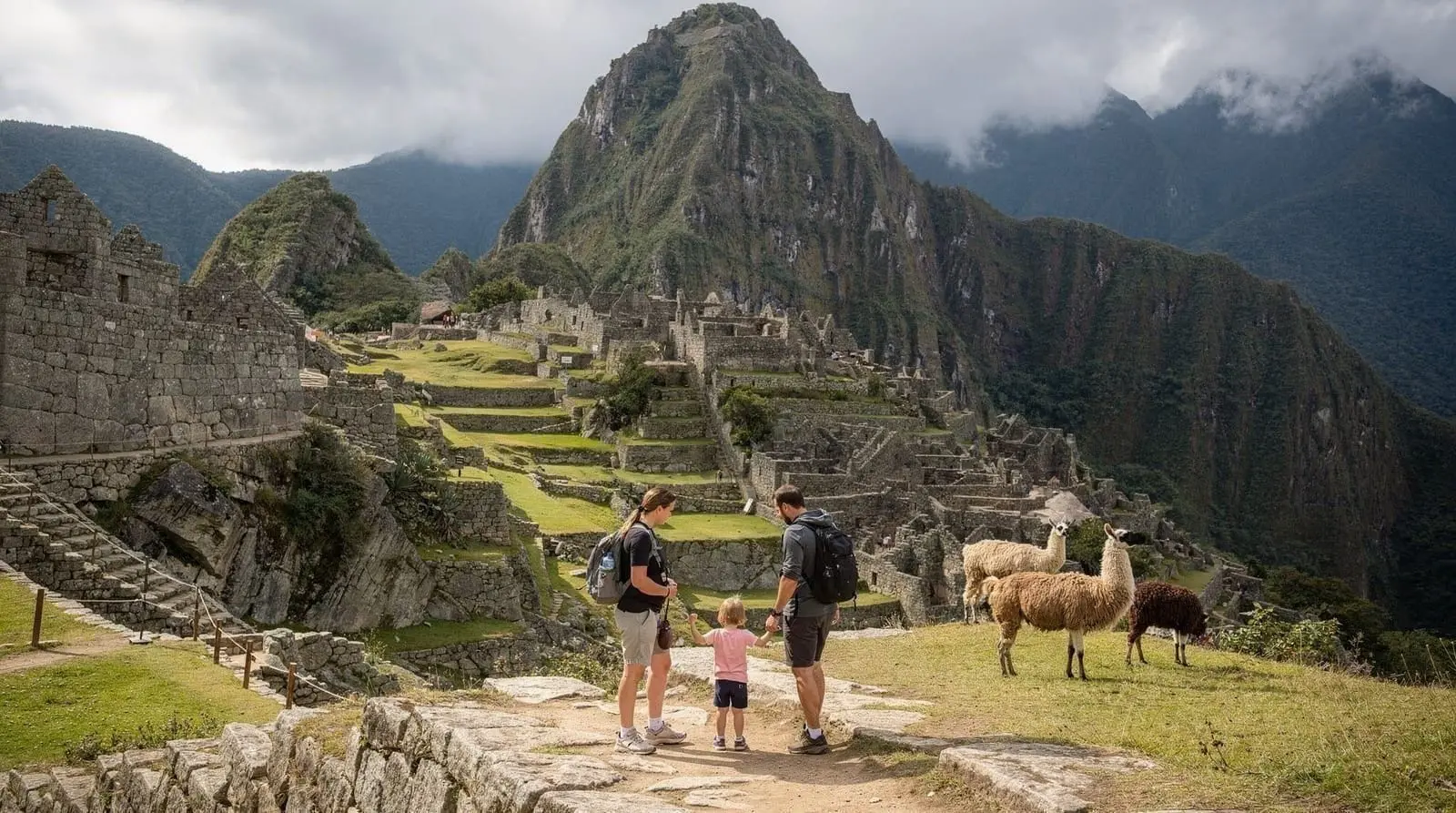
Machu Picchu with kids
Machu Picchu: Entry & Exclusive Guided Experience
Is Machu Picchu doable with children?
Yes, from roughly age five upward if you respect the altitude and pick the flatter Circuit 2. Children under three are carried free, but the citadel is steep, has no shade, no toilets inside, and no stroller access. Sleep in the Sacred Valley first to acclimatise.
Whether to bring the children at all
The honest answer is that Machu Picchu rewards families who plan around their children rather than dragging children through an adult itinerary. The citadel is a steep, sun-exposed site with uneven Inca stairs, sheer terrace edges, no shade, no toilets inside, and no way to push a stroller. None of that makes it off-limits for kids. It simply means the trip needs to be slower, shorter, and built around a real acclimatisation plan.
Children from about five years old usually manage the standard route well, especially if they are used to walking. Younger toddlers can come too, but you will be carrying them for most of the visit, so a proper hiking carrier is non-negotiable. The most common mistake families make is treating Machu Picchu like a theme park you arrive at fresh and conquer in a morning. It is a 2,430 m archaeological site at the end of a long travel chain that starts in thin Andean air. Get the chain right and it becomes one of the best days of a family trip. Get it wrong and you spend it managing meltdowns at altitude.
This guide covers the parts that actually matter with kids: altitude, which circuit to choose, how to handle the train and bus, food and toilets, and the traps that catch families specifically.
| Minimum practical age | around 5, under-3s carried free |
| Best circuit for kids | Circuit 2 (classic route, manageable stairs) |
| Toilets inside site | none — only at the entrance gate |
| Train time | about 1h45 from Ollantaytambo |
| Acclimatise first | 2-3 nights in the Sacred Valley before Cusco |
Altitude is the real challenge, not the ruins
Here is the fact that reframes the whole trip: Machu Picchu sits at 2,430 m (7,970 ft), which is lower than Cusco at 3,400 m (11,150 ft). The citadel is rarely where altitude problems start. The problem is usually the days before it, when families land in Cusco and try to sightsee immediately.
The single best thing you can do for children is to skip sleeping in Cusco on arrival and instead transfer straight down to the Sacred Valley at 2,800-3,000 m. Spend two or three nights there. Kids acclimatise, sleep better at the lower altitude, and arrive at Machu Picchu adjusted rather than wiped out. Our Cusco altitude versus Sacred Valley guide lays out the numbers, and the altitude sickness guide covers symptoms in children, which often show up as crankiness, poor appetite and broken sleep rather than the textbook headache.
Practical altitude rules for the family:
- Push fluids hard. Dehydration mimics and worsens altitude symptoms in kids.
- Build a rest day into the valley before the big day out.
- Skip the heavy buffet lunches on travel days; light food sits better at altitude.
- Diamox (acetazolamide) dosing for children is a conversation for your paediatrician before you leave, not a pharmacy in Cusco. Be wary of the over-the-counter altitude remedies pushed to tourists, covered in our altitude medicine scams guide.
Which circuit suits short legs
Since 2024, Machu Picchu uses a circuit system, and your ticket locks you into one route with a fixed entry time. For families this choice matters more than anything else, because the circuits differ sharply in how much climbing they involve.
Circuit 2 (the “classic” route) is the one most families should book. It includes the iconic upper viewpoint for the postcard photo, then descends through the main urban sector. It has the famous picture and a manageable amount of stairs, and it is the route most guides default to.
Circuit 1 is shorter and stays high, good for very young children or anyone who tires fast, though it covers less of the site.
Circuit 3 (lower) spends more time among the lower buildings with less of the panoramic drama. The Circuit 3 entry ticket is sometimes the only one left at short notice.
Avoid the Huayna Picchu and Machu Picchu Mountain add-on climbs with younger children entirely. Both are steep, exposed, vertigo-inducing climbs with significant drop-offs, sold as separate tickets, and they are genuinely unsuitable for kids and nervous adults.
A licensed guide is now effectively required for first entry and is worth it with children, who get far more from a story-led visit than a self-guided wander. The Machu Picchu entry with a guided experience bundles the entrance and a guide, which removes the gate-day logistics that fray everyone’s patience.
Getting there: train, not trek
Forget the multi-day treks to Machu Picchu with young children. The 4-day Inca Trail involves high passes, cold camping and a minimum-age reality that rules out little kids. The family route is the train.
From Ollantaytambo in the Sacred Valley, both PeruRail and Inca Rail run to Aguas Calientes in about 1 hour 45 minutes. The ride hugs the Urubamba River through dramatic scenery, which most kids enjoy, and there are panoramic windows. Bring snacks and something to occupy younger children, as the carriages have no play space.
A few train realities with kids:
- Book months ahead in dry season (May-September). Seats sell out.
- Child fares exist; carry passports, as names are checked.
- The earliest trains mean very early wake-ups, which can backfire with small children. A mid-morning train and an overnight in Aguas Calientes is often gentler than a one-day round trip.
From Aguas Calientes, a shuttle bus zigzags up to the entrance in about 25 minutes. The alternative is a steep hour-plus climb on foot that is not fun with tired kids. Buy bus tickets in advance and expect a queue. The Machu Picchu day trip with the tourist train and entrance packages the train, bus and ticket together, which spares you assembling three separate bookings.
For families who want to slow the pace, the 2-day, 1-night Machu Picchu tour with an Aguas Calientes overnight splits the journey so nobody is racing a train timetable on visit day.
Food, water and toilets: the unglamorous essentials
This is where families get caught out, so plan it deliberately.
Toilets. There are none inside the citadel. The only facilities are at the entrance gate, costing about S/2 (under $1). Take everyone before you go in, because the circuit ticket restricts re-entry, and a child needing the bathroom mid-circuit is a real problem.
Food. Large bags, hard-sided backpacks and outside food are officially restricted inside the site, and rules are enforced unevenly. The pragmatic move is to feed everyone a proper meal in Aguas Calientes beforehand, carry a small bag with water and a couple of discreet snacks, and accept you may be asked to finish food before entering. Prices for water and snacks at the gate and in Aguas Calientes are inflated; stock up in Ollantaytambo or Urubamba where it is cheaper.
Sun and rain. There is almost no shade. Sun hats, high-factor sunscreen and refillable water bottles are essential; the altitude makes the UV fierce even when it feels cool. In the wet season carry light rain ponchos for everyone.
Carriers, not strollers. A soft hiking carrier for under-threes is the only realistic way to handle the stairs.
The traps that catch families
Trying to do it as a single day from Cusco. It is a punishing 14-hour-plus day for adults, let alone children. The acclimatisation-friendly version is to base in the Sacred Valley, take a relaxed train, and consider an Aguas Calientes overnight.
Fake and resold tickets. Machu Picchu entries are named, capped and tied to a date and circuit. Street sellers and dodgy websites promising last-minute family blocks are a known scam, detailed in our fake Machu Picchu tickets guide. Book through official channels or a reputable operator.
Add-on mountain climbs sold to families. Sellers may upsell Huayna Picchu tickets as “the best part”. With young kids it is the wrong call: steep, exposed and timed.
Over-scheduling the day. Pairing Machu Picchu with another big excursion the same day is how trips unravel. One headline thing per day is plenty with children at altitude. Use the gentler family day trips from Cusco and things to do in Cusco with kids to balance the rest of the trip.
Assuming everywhere takes cards. Bus tickets, gate toilets, water and many small vendors want cash in soles. Carry small notes.
A realistic family day plan
A version that works with primary-school-age children, assuming you are based in the Sacred Valley:
The day before: Sleep in Ollantaytambo. Buy snacks and water. Early night.
Morning: Mid-morning train to Aguas Calientes so nobody is dragged out at dawn. Lunch in town. Toilets and a top-up of water.
Early afternoon: Bus up, enter on a Circuit 2 ticket with a guide, take the visit at a child’s pace with frequent water and photo stops. Aim for one to two hours inside rather than forcing the full loop if energy fades.
Late afternoon: Bus down, relaxed dinner in Aguas Calientes, overnight or an evening train back.
The point is not to see everything. It is to let children experience one of the world’s great places without burning them out at altitude. For how the day slots into a wider trip, see the itineraries hub and the broader Machu Picchu destination guide.
Building the rest of the trip around children
Machu Picchu is one day. The success of a family trip to Peru usually hinges on the days around it, and the biggest lever is where you sleep when you first arrive. Flying into Cusco at 3,400 m and trying to entertain children immediately is the classic recipe for sick, miserable kids and a wasted first 48 hours. The far better plan is to transfer straight from the airport down to the Sacred Valley, where the lower altitude of 2,800-3,000 m lets the whole family sleep and adjust more gently before anything demanding.
A child-friendly shape for a valley-first trip might look like this. Spend the first two or three nights in the valley around Urubamba or Ollantaytambo, keeping the first day deliberately gentle — an easy lunch, a short walk, early to bed.
Use the second day for low-effort sightseeing that kids actually enjoy, such as the open terraces and salt pans of the Maras and Moray plateau, where there is space to move and plenty to look at. Take the train to Machu Picchu on a well-rested day, ideally with an Aguas Calientes overnight to remove the dawn-to-dusk pressure. Only then move up to Cusco, by which point everyone is acclimatised and the city’s altitude is far less of a shock.
In Cusco itself, lean on the activities designed for younger visitors. Our things to do in Cusco with kids guide and the family day trips from Cusco guide cover the gentler options — the chocolate museum, llama and alpaca encounters, the open ruins at the edge of the city — that fill the non-Machu-Picchu days without overtaxing children. The golden rule throughout is one headline activity per day. Stacking two big excursions in a single day at altitude is the most reliable way to trigger a family meltdown.
Easier alternatives if the full trip feels like too much
Not every family needs to attempt Machu Picchu on a first trip to Cusco, especially with very young children or a short window. The Sacred Valley alone — Pisac’s market, the Maras and Moray terraces, Ollantaytambo’s ruins — fills several gentle days without the train, the altitude swing, or the early wake-ups, and is a reasonable way to introduce younger kids to Peru before committing to the citadel.
If a shorter, lower-effort alternative to Rainbow Mountain style scenery appeals more than a full Machu Picchu day, Humantay Lake is closer to Cusco, though still a real hike and not stroller-friendly either. Families building a full Cusco itinerary around children specifically will find the pacing advice there consistent with everything in this guide.
A family packing list that actually gets used
Beyond the general Peru packing advice, a few items earn their space specifically for a family Machu Picchu day. A soft-structured hiking carrier, not a stroller, for any child under about four. A wide-brim hat and stick sunscreen for each child, since reapplying spray sunscreen on a moving toddler at altitude is a losing battle. A small dry bag or zip pouch for wet clothes if you are visiting in rainy season, plus a lightweight poncho per person rather than a bulky rain jacket that takes up pack space. Two refillable water bottles per child, since one empties faster than expected in the dry mountain air.
A few familiar snack bars from home, because the gate and Aguas Calientes vendors sell mostly chips and soda at inflated prices. Finally, a printed or offline copy of every ticket and passport photo page — mobile signal around Machu Picchu is unreliable, and a dead phone battery should never be the reason a family cannot prove a booking at the gate. A small portable battery pack for phones and cameras is worth the extra weight, since a full day of photos on a cold morning drains batteries faster than at home.
Managing money, health and the small stuff
A few practical family logistics that smooth the trip:
Cash and cards. Carry small soles notes. The gate toilets, the shuttle bus, water, snacks and many small vendors do not take cards, and being caught short with tired children is avoidable stress. ATMs are reliable in Cusco and Urubamba but not in the smaller valley towns or at the site.
Passports for everyone. Machu Picchu entries, train tickets and bus fares are named and age-checked, and children’s discounts and free under-three entry are verified against ID. Keep passports accessible at the gate and on the train.
Health basics. Pack a small kit with child paracetamol or ibuprofen, rehydration sachets, plasters, and any regular medication, since pharmacies in the smaller towns have limited stock. Bottled or filtered water only — do not let kids drink the tap water. Discuss altitude and any medication, including whether Diamox is appropriate for your children, with your own paediatrician before you travel rather than relying on advice on the ground. Our altitude medicine scams guide explains why to be wary of the remedies pushed to tourists.
Food that works for kids. Peruvian food is generally child-friendly — grilled chicken, rice, potatoes, soups and fresh fruit are everywhere — but spice levels and unfamiliar dishes can put younger ones off. Aguas Calientes and the valley towns all have restaurants with simple options. Carry familiar snacks for the inevitable refusals and for the train and bus, where there is nothing geared to children.
Energy management. The single most useful parenting skill on this trip is reading the tank. At altitude children tire suddenly and without much warning. Build in rest, keep them fed and watered, and be willing to cut a visit short rather than push into the danger zone of an overtired child on uneven Inca stairs above steep drops.
Frequently asked questions about Machu Picchu with kids
What is the minimum age for Machu Picchu?
Is the altitude a problem for kids at Machu Picchu?
Can you bring a stroller to Machu Picchu?
Are there toilets inside Machu Picchu?
Train or trek with children?
Do children pay full price at Machu Picchu?
Top experiences
Bookable activities with verified prices and instant confirmation on GetYourGuide.
