Best time to visit the Peruvian Amazon
From Iquitos: 3-Day Pacaya-Samiria National Reserve Tour
When is the best time to visit the Peruvian Amazon?
The low-water season, roughly June to October, is the best all-round time for most visitors — wildlife concentrates around shrinking water, river beaches emerge, trails are walkable, and mosquitoes are fewer. High water (December to May) floods the forest for atmospheric canoe travel and excellent birding but disperses wildlife. The Amazon is a year-round destination; the seasons simply offer different experiences.
Forget wet and dry — think high water and low water
The most common mistake travellers make when planning a Peruvian Amazon trip is thinking in terms of “rainy season” and “dry season.” The rainforest is, by definition, rainy: it rains in every month, in every season, sometimes hard. What actually changes through the year — and what shapes your trip far more than rainfall — is the water level of the rivers. The Amazon basin runs on a vast annual flood cycle, with the rivers rising and falling by several metres between the high-water and low-water periods. Once you understand that cycle, the question of when to visit becomes much clearer.
The short answer for most people: the low-water season, roughly June to October, is the best all-round time to visit. But “best” depends entirely on what you want from the jungle, and the high-water season has genuine advantages of its own. This guide explains both seasons honestly — what each offers, what each costs you, and how the picture shifts between the northern Amazon around Iquitos and the southern Amazon around Tambopata and Manu — so you can match the timing to the trip you actually want.
| Best overall | Low water, June–October (July–September sweet spot) |
| Best for birding | High water, December–May |
| Watch for | Friaje cold snaps, southern Amazon, May–August |
| Health prep | Yellow fever vaccination, repellent, malaria advice year-round |
| Regions | Iquitos/Loreto (north), Tambopata/Manu (south) |
Low water: roughly June to October
During the low-water months the rivers recede, lagoons shrink, and white-sand riverbanks and beaches emerge along the channels. For wildlife viewing, this is usually the better window, and here is why: as the water contracts, fish, caiman, dolphins, and the animals that hunt them are all forced to concentrate around the remaining water. That concentration makes wildlife far easier to find.
Trails that are underwater for half the year become walkable, opening up forest hiking. Mosquito pressure tends to be lower, because there is less standing water for breeding (though never zero — see below). And in places like the Pacaya-Samiria reserve, the oxbow lakes become accessible by canoe, putting you within reach of giant otters and dense birdlife.
The trade-offs are modest. Low water is the busier tourist season, so lodges and cruises fill earlier and prices can be higher — book ahead for July and August in particular. Some narrow channels that canoes float through at high water are too shallow to enter. And the exposed mud of receded riverbanks is less photogenic than the flooded forest. But for a first-time visitor whose priority is seeing animals, the low-water season is the safe, sensible choice.
Best for: first-time visitors, wildlife sightings, jungle trekking, river beaches, and reaching the interior of reserves by canoe.
High water: roughly December to May
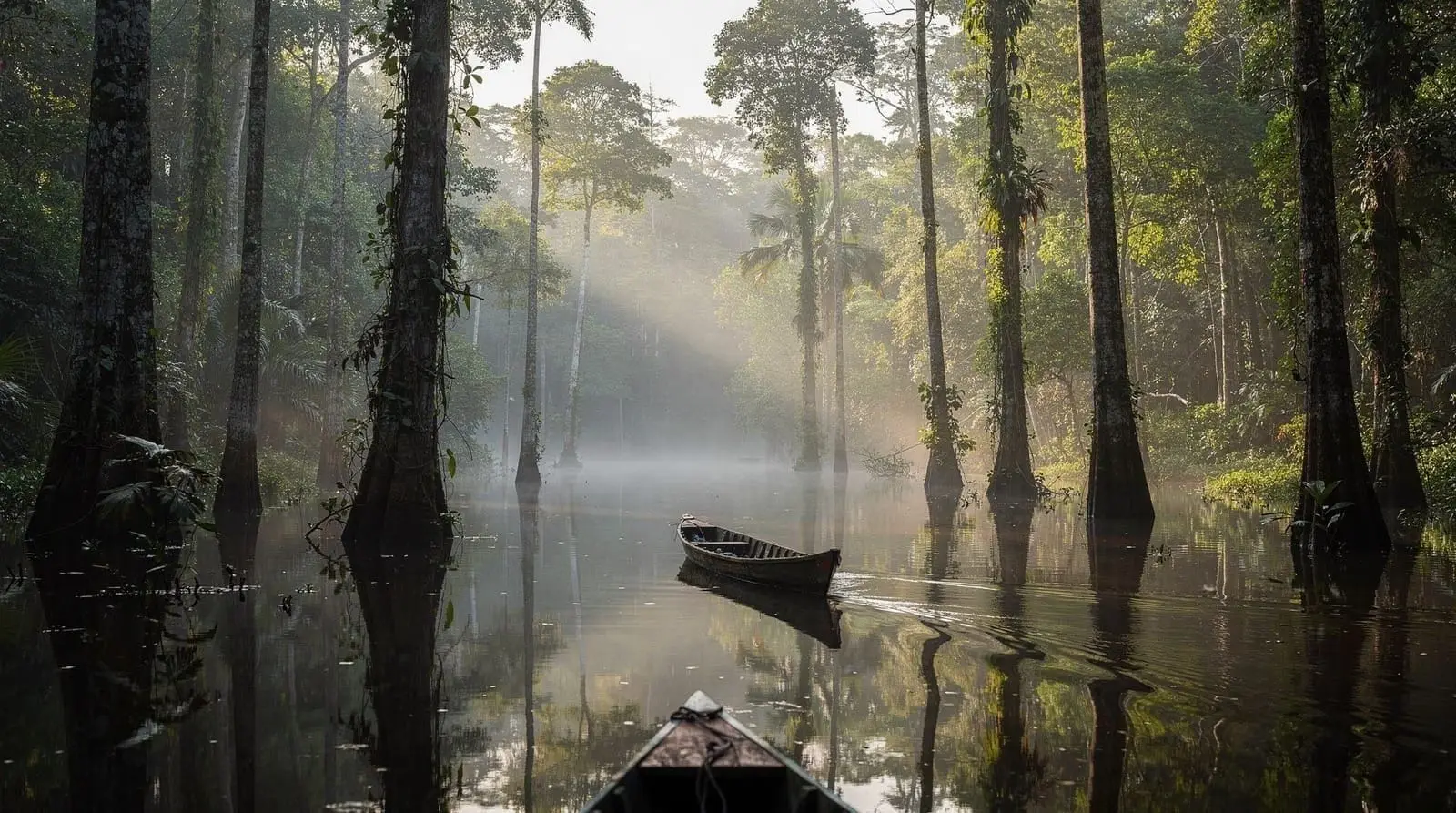
During the high-water months the rivers swell and flood the surrounding forest, sometimes by several metres, until trees stand in deep water and the boundary between river and land dissolves. This transforms how you explore. Skiffs and paddle canoes can glide directly into the flooded forest, drifting among the crowns of trees and into channels that are dry land in other months. It is atmospheric, beautiful, and unlike anything in the low-water season.
For birding, high water is arguably the best time of all — many species are breeding and active, and the canopy is suddenly at eye level from a canoe. The forest is at its lushest and greenest, the light has a particular quality, and there are noticeably fewer tourists, which means quieter lodges and sometimes better prices.
The honest trade-off is mammals. When the forest floods, terrestrial and aquatic animals disperse across an enormous flooded area rather than concentrating around shrinking water, which makes them harder to find. Forest trails may be underwater entirely. And mosquito pressure rises with the standing water. For a photographer, birder, or atmosphere-seeker, high water can be the more rewarding season; for someone whose dream is reliably spotting monkeys, otters, and caiman, it is the riskier bet.
Best for: birders, photographers, canoe-based exploration of the flooded canopy, lush scenery, fewer crowds, and travellers wanting atmosphere over guaranteed mammal sightings.
The transitional months
November and May sit between the two regimes and can offer a blend of both worlds — and a bit of unpredictability. November, as the rains build toward high water, can still see good wildlife concentration while the forest begins to flood. May, as the water recedes, can combine accessible trails with high-water atmosphere. These shoulder months are worth considering for travellers who want a middle path, with the caveat that conditions vary year to year and are harder to predict.
North versus south: how the season shifts
The broad flood cycle holds across the Peruvian Amazon, but there are regional differences worth knowing.
The northern Amazon (Iquitos, Loreto) is the wettest region overall, with a pronounced flood cycle and high humidity year-round. Low water (June to October) is the recommended window here, particularly for cruises and lodge trips into Pacaya-Samiria. The Pacaya-Samiria guide and Amazon river cruises guide cover the northern season in more detail.
The southern Amazon (Tambopata, Manu, around Puerto Maldonado) has a more clearly defined drier season from roughly May to October, which is the peak time for lodge trips and macaw clay-lick activity. It is also the region affected by the friaje — see below. The Iquitos versus Puerto Maldonado guide compares the two regions for trip planning.
In practice, the same logic applies everywhere: low water and the drier months are the easier, more reliable choice for wildlife, while the wetter, high-water months suit those after atmosphere and birds.
The friaje: a southern surprise
One quirk catches travellers off guard. In the southern Peruvian Amazon — Tambopata and Manu — a weather phenomenon called the friaje can strike between roughly May and August, when a mass of cold Antarctic air pushes north over the continent. Temperatures that normally sit in the low thirties Celsius can plunge for two or three days, sometimes into single digits at night, with grey skies and a damp chill. It is brief and intermittent, but real, and it routinely surprises people who packed only for tropical heat. If you are visiting the southern Amazon in those months, throw a warm layer and a light waterproof into your bag. The friaje barely affects the northern Amazon around Iquitos.
Month by month at a glance
For quick planning, here is how the year tends to play out across the Peruvian Amazon. Treat these as tendencies, not guarantees — the rainforest does not read calendars.
| Months | Water level | Highlights | Watch for |
|---|---|---|---|
| Jan–Mar | Deep high water | Flooded-forest canoeing, birding, thin crowds | Frequent rain, dispersed mammals |
| Apr–May | Transition (falling) | Blend of both regimes, reappearing trails | Friaje risk begins in the south (May) |
| Jun–Aug | Prime low water | Best wildlife concentration, dry trails | Peak season — book lodges ahead; friaje in the south |
| Sep–Oct | Late low water | Lowest water, most concentrated wildlife, easing crowds | Still warm and mostly dry |
| Nov–Dec | Transition (rising) | Good wildlife early, quieter and cheaper | Rains build steadily through December |
January to March is deep high water. Rivers are near their peak, the flooded forest is at its most navigable by canoe, birding is excellent, and crowds are thin. Expect frequent rain and dispersed mammals. A fine window for atmosphere-seekers and birders, less so for guaranteed wildlife.
April to May is the transition out of high water. Rivers begin to recede, trails start to reappear, and you can sometimes catch the best of both regimes. May in the southern Amazon marks the start of the friaje risk. A good shoulder option for travellers wanting a balance.
June to August is prime low-water and the peak tourist season. Wildlife concentrates, beaches emerge, trails are dry, and this is the most reliable window for seeing animals — book lodges and cruises well ahead, especially for July and August. The southern Amazon can see friaje cold snaps in these months.
Iquitos and Pacaya-Samiria 3-day jungle tourSeptember to October is late low water and, for many guides, the single best stretch: water levels are at or near their lowest, wildlife is most concentrated, the weather is settling, and crowds ease slightly after the August peak. A strong all-round recommendation.
November to December is the build toward high water. November can still offer good wildlife as the flood begins; by December the rains are well established. A quieter, often cheaper window with decent conditions early in the period.
If your Amazon time is focused on Tambopata rather than Iquitos, the low-water months line up well with a shorter southern lodge stay.
Tambopata 3-day, 2-night Amazon lodge tourMosquitoes, health, and timing
Whatever the season, the Amazon requires real preparation — the timing affects the degree of insect pressure, not the need for protection. Mosquitoes are present in every month and carry genuine health risks: yellow fever, malaria, and dengue are all factors in the Peruvian lowlands.
Low water generally means fewer mosquitoes than high water, but “fewer” is not “none.” Yellow fever vaccination is recommended for all Amazon travel in Peru regardless of season, malaria prophylaxis should be discussed with a travel doctor, and strong repellent plus covering clothing are non-negotiable year-round. The Amazon packing guide covers the full kit, and the Peru travel safety guide the broader health picture.
So, when should you go?
If you want a single recommendation: June to October, with July to September the sweet spot, for the best balance of wildlife, accessible trails, river beaches, and manageable insects. This is the default for first-time visitors and anyone whose main goal is seeing animals. Choose December to May instead if you are a keen birder or photographer, want to paddle into the flooded forest canopy, value quiet over crowds, and are relaxed about mammals being harder to spot. And consider May or November for a shoulder-season blend.
Crucially, there is no bad time to visit the Peruvian Amazon. The rainforest is extraordinary in every season — the seasons simply hand you different versions of it. Fit your Amazon leg around the rest of your trip using the two-week and three-week itinerary guides, cross-reference the national picture in the best time to visit Peru guide, and browse full routes on the itineraries hub.
Choosing where in the Amazon to go
Timing is only half the decision — which gateway you fly into matters just as much. The Iquitos complete guide covers the northern Amazon in full, including the Belén market and the region’s jungle lodges.
For the south, the Tambopata guide and the Tambopata vs Manu comparison explain the trade-offs between the more accessible Tambopata reserve and the wilder, harder-to-reach Manu National Park. If you are combining the Amazon with a Cusco-based trip, the Cusco to Amazon 7-day itinerary shows how the timing and the flight logistics fit together.
A note on temperature year-round
Unlike the Andes, the Amazon’s temperature barely shifts with the seasons — expect daytime highs in the low thirties Celsius and high humidity in every month, with the main variable being rainfall and river level rather than heat. The one exception is the southern Amazon’s occasional friaje, described above, which can drop temperatures sharply for a few days regardless of the calendar month. Pack light, breathable, quick-dry clothing as your baseline in any season, and add the warm layer only if you are visiting Tambopata or Manu within the May-to-August friaje window.
Frequently asked questions about Best time to visit the Peruvian Amazon
What are the high and low water seasons in the Peruvian Amazon?
Which season has fewer mosquitoes in the Amazon?
Is it worth visiting the Amazon in the rainy season?
When is the best time to see wildlife in the Peruvian Amazon?
Does the Amazon season differ between Iquitos, Tambopata, and Manu?
What is a friaje in the Amazon?
Top experiences
Bookable activities with verified prices and instant confirmation on GetYourGuide.

