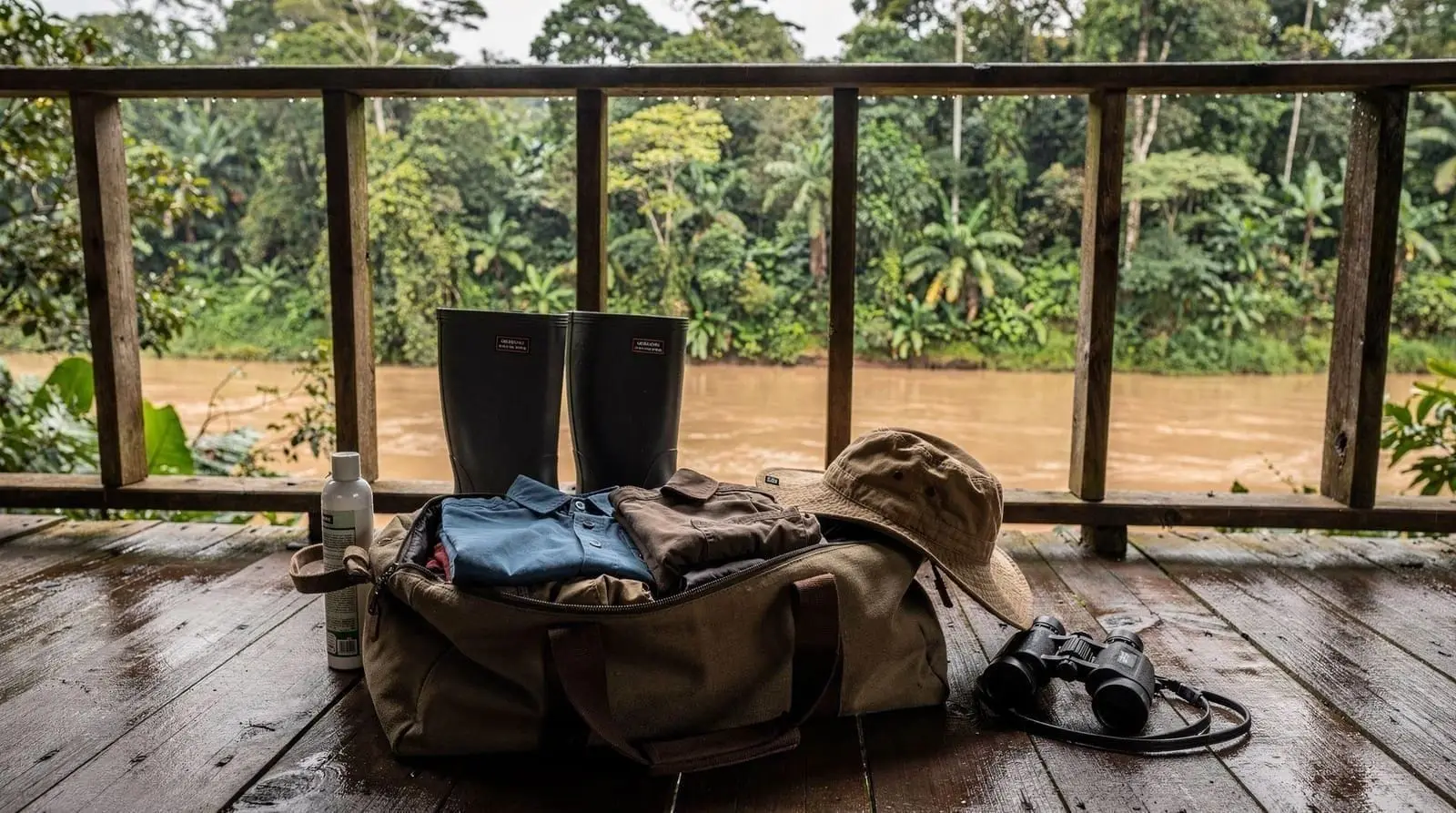
What to pack for the Peruvian Amazon
What should I pack for the Peruvian Amazon?
Pack lightweight long-sleeved shirts and trousers in muted colours, strong insect repellent (30%+ DEET or picaridin), a yellow fever vaccination certificate, quick-dry clothing, sturdy closed shoes plus sandals, a headlamp, a dry bag, and any malaria medication your doctor advises. Lodges supply rubber boots and ponchos. Pack light — most lodges and cruises have luggage limits.
Pack for the climate you’re actually going to
The Peruvian Amazon defeats the instincts of most travellers, who picture sweltering heat and pack like they’re heading to a beach. The heat is real — typically the low thirties Celsius (high eighties to low nineties Fahrenheit) with crushing humidity — but the right kit for the jungle is the opposite of beachwear. You want to cover up, not strip down: long sleeves and long trousers in breathable fabric are your single best defence against the two constant threats, biting insects and the equatorial sun. Add genuine health preparation, the right footwear, and a few pieces of kit that make the difference between comfortable and miserable, and you are most of the way there.
This is a practical, no-padding checklist for the Peruvian Amazon, whether you are heading to a river cruise out of Iquitos, a Pacaya-Samiria expedition, or a lodge in the southern jungle near Puerto Maldonado. It also flags what you can safely leave at home, because nearly every lodge and cruise sets a luggage limit and the golden rule of jungle packing is: pack light. Check your operator’s specific advice too, since lodges supply some items (rubber boots, ponchos) that you would otherwise waste money and weight on.
| Climate | Low 30s°C (high 80s–90s°F), high humidity year-round |
| Key items | Long sleeves, 30%+ DEET, yellow fever certificate |
| Luggage | Soft duffel/backpack, not a hard suitcase |
| Provided by lodges | Rubber boots, ponchos (confirm with operator) |
| Best time | Year-round; drier June–October, wetter Dec–May |
Clothing: cover up, go neutral, dry fast
Your clothing strategy rests on three principles — cover up, choose muted colours, and pick fabrics that dry fast.
- Long-sleeved shirts (2–3), lightweight and breathable. Loose, thin, long-sleeved shirts protect against bites and sun while staying cool. Synthetic quick-dry or thin cotton both work.
- Long trousers (2 pairs), quick-dry. Convertible zip-off trousers are popular but optional. Avoid jeans — they’re heavy, hot, and take days to dry.
- Muted, neutral colours. Khaki, olive, grey, and beige. Bright colours and white attract insects and show every speck of mud; dark navy and black can attract certain biting flies. Earth tones are the practical choice.
- A few T-shirts and shorts for downtime at the lodge or on the boat, where insect cover matters less.
- One warm layer (fleece or light jumper). Essential for the southern Amazon (Tambopata, Manu), where a cold front called a friaje can drop temperatures sharply between roughly May and August — see the best time to visit the Amazon guide. Useful anywhere for early-morning boat rides and air-conditioned cabins.
- A wide-brimmed hat for sun, and a swimsuit for lodge pools or river swims where safe.
- A light rain jacket or poncho. It’s a rainforest; rain is guaranteed. Many lodges and cruises provide ponchos, so a packable lightweight layer is enough.
- Underwear and socks in quick-dry fabric, more than you think — humidity means nothing dries overnight without help.
A note on quantity: you will not be doing laundry mid-trip, and damp jungle air dries clothes slowly, so bring enough to rotate, but resist over-packing. Two or three of each core item is plenty for a typical four-to-six-day trip.
Insect protection: the non-negotiable category
Insects are the defining challenge of the Amazon, and getting this right matters for comfort and health alike (the Peru travel safety guide covers the disease risks).
- Repellent with 30%+ DEET, or 20%+ picaridin if you prefer a less aggressive alternative. Bring more than you expect to use; it’s expensive and inconsistent to buy locally.
- Permethrin-treated clothing. Treat your shirts and trousers at home before you travel (spray, let dry; it survives several washes). Permethrin kills insects on contact with the fabric and is a genuinely effective extra layer — do not apply it to skin.
- After-bite relief — antihistamine cream or tablets for the bites you’ll inevitably get.
- A mosquito head net is rarely needed if lodges have screened rooms and bed nets (most do), but it’s cheap, tiny, and worth tucking in for the worst high-water conditions.
The combination of covering clothing, permethrin-treated fabric, and DEET on exposed skin is far more effective than any single measure. Dawn and dusk are the high-risk windows — be most diligent then.
Health and documents
This category is not optional and should be sorted weeks before departure, not the night before.
- Yellow fever vaccination certificate. The vaccine is recommended for all Peruvian Amazon travel and should be administered at least 10 days before arrival. Carry the international certificate (the yellow card); some onward Amazon borders request it.
- Malaria prophylaxis as advised by a travel doctor — Loreto (Iquitos) and parts of Madre de Dios carry malaria risk, and the recommended medication varies. Have this conversation early.
- Routine vaccines up to date — tetanus, hepatitis A, and typhoid are standard recommendations for Peru.
- A personal first-aid kit: rehydration salts, anti-diarrhoeal medication, painkillers, plasters, antiseptic, blister care, and any prescription medication in its original packaging with enough for the whole trip plus spare. There is no pharmacy in the reserve interior.
- Travel insurance that covers remote-area medical evacuation — read the policy. The Amazon interior is genuinely remote.
- Sun protection: high-SPF sunscreen and lip balm with SPF. The equatorial sun is fierce even through cloud and reflects off the water.
Footwear
- Rubber boots (gum boots): most lodges and cruises provide knee-high rubber boots for the muddy trails, so you usually do not need to buy your own — but confirm with your operator and check they carry your size. If you have very large or very small feet, consider bringing your own.
- Sturdy closed walking shoes for travel days, drier trails, and general use.
- Quick-dry sandals or water shoes for the lodge, the boat, and river edges.
- Skip white trainers and anything you’d mind ruining — mud is a certainty.
Gear and electronics
- Headlamp or torch with spare batteries — essential for night walks, caiman-spotting excursions, and lodges with limited or generator-only electricity. A headlamp beats a handheld torch for keeping hands free.
- A dry bag (or two) to protect electronics, documents, and a change of clothes on boat excursions and river spray. Inexpensive and invaluable.
- Power bank. Many lodges run electricity only for set hours on a generator, and the reserve interior may have none. A charged power bank keeps your phone and camera alive.
- Binoculars — genuinely transformative for wildlife and birding, and not something to rely on borrowing. Even a modest pair changes the experience.
- Camera with a zoom if wildlife photography matters to you, plus protection against humidity (silica gel packs, a dry bag). A phone is fine for casual snaps.
- Reusable water bottle. Lodges and cruises provide purified water; a refillable bottle cuts plastic waste.
- A small daypack for excursions, big enough for water, repellent, rain layer, and camera.
Money and miscellaneous
- Cash in soles, plus small USD notes. Lodges, tips, drinks, and the reserve interior are cash-only with no ATMs; cards are often not accepted. Withdraw what you need in Iquitos or your departure city beforehand — town ATMs can run dry on busy weekends. Tips for guides and crew are customary; budget for them.
- Photocopies of your passport and vaccination certificate, plus digital copies stored online.
- Earplugs — the jungle is gloriously, relentlessly noisy at night.
- Ziplock bags for keeping documents, electronics, and snacks dry and organised.
- A book or downloaded entertainment for the long, hot midday hours when wildlife rests and so do you.
- Biodegradable toiletries where possible — you’re in a fragile ecosystem.
What to leave at home
Packing light is half the skill, and these are the usual offenders. Leave behind the hard-shell suitcase (a soft duffel or backpack handles boats and boardwalks far better), expensive jewellery and valuables (no use in the jungle, a liability in the city), a full hairdryer-and-cosmetics regime (lodges are rustic and humidity defeats it), heavy jeans and cotton-heavy bulk (they never dry), and white or brightly coloured clothing (insect magnets and mud showcases). Most lodges and cruises set a luggage weight limit, especially where small aircraft or boats are involved, so check yours and pack to it.
Final word
The Peruvian Amazon rewards travellers who prepare properly and punishes those who wing it — not dramatically, but in steady increments of bites, sunburn, ruined shoes, and dead phone batteries. Get the covering clothing, the repellent strategy, the health documents, and the dry bag right, confirm what your specific lodge or cruise supplies, and pack everything into a soft bag you can carry over a muddy boardwalk one-handed.
Then you can stop thinking about logistics and start watching for pink dolphins. Pair this with the best time to visit the Amazon guide for seasonal nuance, the Pacaya-Samiria guide for reserve specifics, and the Iquitos destination guide for the gateway city.
Northern versus southern Amazon: does the list change?
Peru’s Amazon splits broadly into two accessible regions, and while the packing list is nearly identical, a few real differences matter. Iquitos and the Pacaya-Samiria reserve in the north are reached by river rather than road, so lodges and cruises there lean harder on boat-based excursions — a dry bag and quick-access rain layer matter even more.
Puerto Maldonado and Tambopata in the south sit closer to the Andes foothills, and from roughly May to August a cold front called a friaje can drop temperatures sharply for a day or two even in the heart of the rainforest — the one scenario where a proper warm layer in the Amazon genuinely earns its place, not just for dawn boat rides but for an entire uncomfortably cool day. Otherwise, the core kit — insect protection, health documents, footwear, dry bags — applies equally to both regions, and the choice between north and south is better made on wildlife and logistics grounds than on packing differences.
A packing timeline: when to buy and prepare each item
Spreading preparation over weeks rather than scrambling the night before avoids the two most common Amazon-trip mistakes: an unprotected yellow fever certificate and unworn boots or shoes.
- 6+ weeks before: Book a travel-doctor appointment for yellow fever vaccination (needs 10 days’ lead time but book early for availability) and discuss malaria prophylaxis. Order permethrin spray if treating your own clothing.
- 3–4 weeks before: Treat clothing with permethrin at home and let it fully dry and cure. Confirm with your lodge or cruise operator exactly what they supply (boots, ponchos, sleeping arrangements) so you don’t duplicate heavy items.
- 1–2 weeks before: Assemble the first-aid kit, buy insect repellent in bulk (cheaper and more reliable at home than in Iquitos or Puerto Maldonado), and test your headlamp and power bank.
- Final days: Pack into a soft duffel or backpack, photocopy your passport and vaccination certificate, and withdraw Peruvian soles for the trip, since ATMs are unreliable once you leave the gateway city.
Full routes are on the itineraries hub.