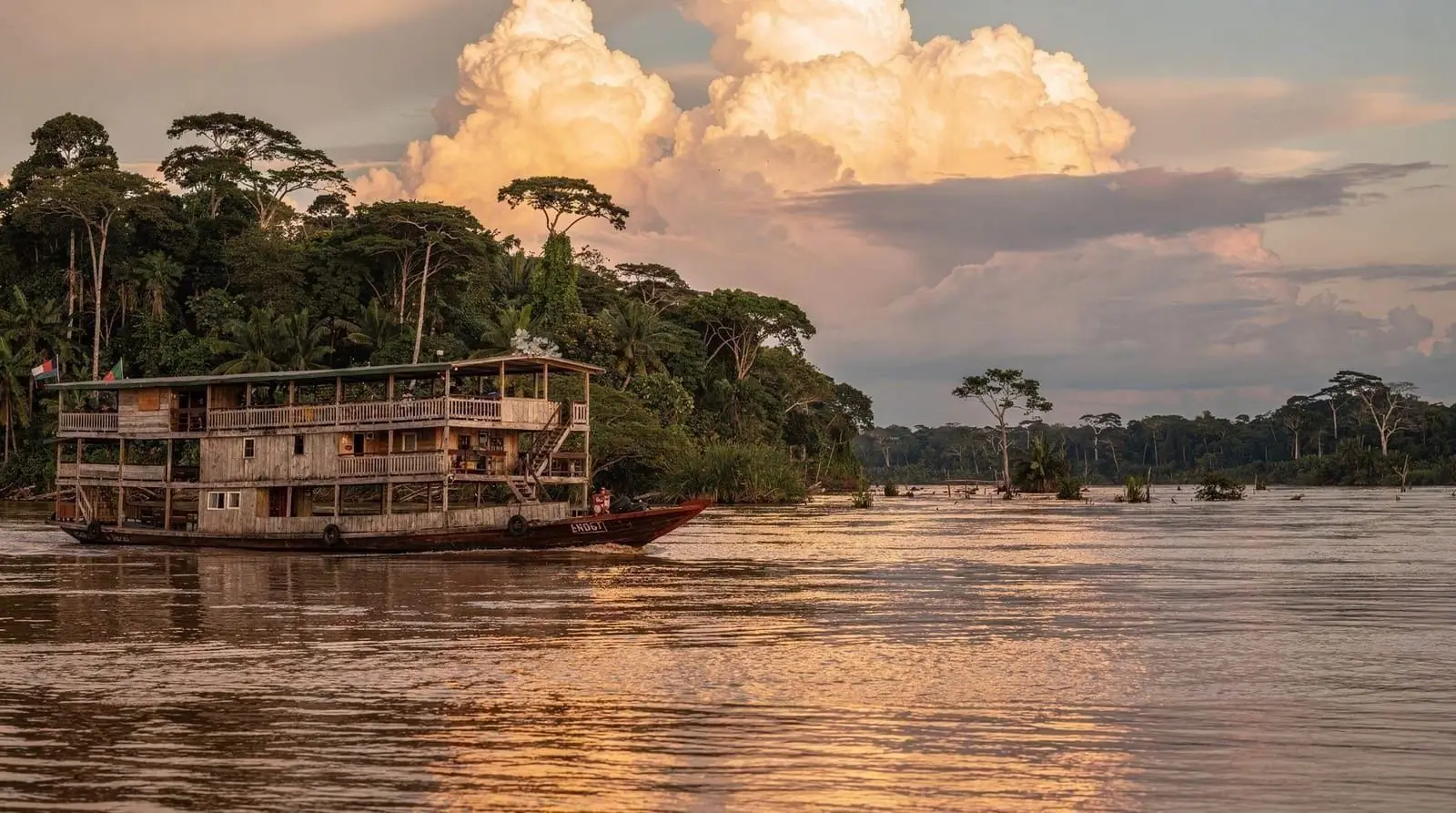
Amazon river cruises from Iquitos
Iquitos: Amazon-Ucayali 4-Day Cruise
Are Amazon river cruises from Iquitos worth it?
Yes, if you want to reach the wildlife-rich interior of the Pacaya-Samiria reserve and have the budget. Cruises move through the river system each day, accessing waters a fixed lodge cannot. Prices run from about USD 250 per person per day on comfortable expedition boats to over USD 1,200 on luxury vessels. Three to four nights is the practical minimum.
Why people cruise the Amazon instead of staying put
The classic image of an Amazon trip is a wooden lodge on stilts, hammocks, and walks into the forest with a machete-carrying guide. That experience exists and is worth having. But the single best wildlife in the Peruvian Amazon — the giant otters, the dense bird life, the deep oxbow lakes of the Pacaya-Samiria reserve — sits far up the river system, well beyond the reach of any fixed lodge. A river cruise solves that problem by being the lodge that moves. You sleep aboard, the boat travels overnight, and each morning you wake somewhere new and explore it by motorised skiff or paddle canoe.
Iquitos is the launch point for nearly every Amazon cruise in Peru. Reachable only by air or river, it sits at the confluence of the Nanay, Itaya, and Amazon rivers in the Loreto region; the Iquitos destination guide covers getting there. From its port, vessels head up the Marañón and Ucayali into the flooded forest of the Pacaya-Samiria reserve, the heartland of Amazon cruising in Peru.
This guide is deliberately honest about a category of travel where marketing runs hot. Cruises are excellent and they are expensive, and the gap between a good-value expedition boat and an overpriced one is wide. Here is how to tell them apart.
| Where | Departs Iquitos, up the Marañón/Ucayali into Pacaya-Samiria |
| Cost | Around $130–500/person/day (budget–mid-range); $600–1,200+ luxury |
| Time needed | 3–4 nights minimum; 5–7 nights for the deep reserve |
| Getting there | Fly to Iquitos from Lima, then board at the river port |
| Best time | Low water (Jun–Oct) concentrates wildlife; high water (Dec–May) floods the canopy |
The three tiers of Amazon cruise
Cruises from Iquitos fall into three rough tiers, and understanding them prevents both overpaying and disappointment.
Budget boat tours (from ~USD 130 per person per day). These are simple wooden or metal-hull boats, often with shared facilities or basic cabins, run by local operators. They tend to stay in or near the reserve’s buffer zone, where wildlife is thinner. They are honest value for budget travellers who understand the trade-off, but they are not the polished “Amazon cruise” experience the glossy brochures sell.
Mid-range expedition cruises (~USD 250 to 500 per person per day). This is the sweet spot for most travellers. These purpose-built river vessels carry roughly 16 to 40 passengers, with private en-suite cabins, air conditioning, proper meals, and — crucially — professional naturalist guides. They reach the interior sectors of Pacaya-Samiria and deliver the wildlife you came for. Boats such as the Delfin III and various expedition-class vessels sit here.
Luxury cruises (~USD 600 to 1,200+ per person per day). The top tier — vessels like the Aria Amazon, Delfin I and II, and Zafiro — are floating boutique hotels with panoramic suites, plunge pools, gourmet dining, and a high crew-to-guest ratio. They are genuinely lovely. But here is the honest part: they reach the same lakes and use the same calibre of naturalist guide as a good mid-range boat. You are paying for comfort, food, and exclusivity, not for better animals. If those things matter to you, the experience is superb; if wildlife is your only goal, mid-range is far smarter spending.
4-day Amazon-Ucayali cruise from IquitosWhat a day on board actually looks like
The rhythm of a cruise is dictated by wildlife, which means early starts. A typical day runs something like this: a pre-dawn wake-up for the dawn skiff excursion when birds and animals are most active, back to the boat for breakfast, a mid-morning canoe trip or jungle walk, lunch and a rest during the hot midday hours when wildlife goes quiet, an afternoon excursion as it cools, dinner, and an optional night skiff to spot caiman and nocturnal life by torchlight. In between, the boat repositions along the river.
Excursions happen in small skiffs (motorised launches) carrying eight to twelve people with a naturalist guide, peeling off from the main vessel to nose into narrow channels and flooded forest. The better operators keep groups small and guides expert. Activities typically include dolphin spotting, piranha fishing (catch-and-release), birding, visits to riverside communities, and — at high water — paddling directly among the treetops.
What is not on a reputable cruise: feeding or handling of wildlife, swimming with dolphins, or any baiting for photo opportunities. If an itinerary advertises those, treat it as a red flag rather than a perk.
Cruise versus lodge: which to choose
This is the central decision, and it is worth getting right.
Choose a cruise if your priority is the best wildlife the Peruvian Amazon offers, you want to reach the interior of Pacaya-Samiria, and you have the budget. A cruise covers far more ground than a lodge and accesses waters a fixed base never can. For the reserve specifically, a cruise is almost always the superior option.
Choose a lodge if you are on a tighter budget, have only two or three days, or prefer a grounded, immersive sense of one stretch of forest over constant movement. Lodges around Iquitos run from rustic to genuinely comfortable, and a good one with an expert guide delivers a fine Amazon experience at a fraction of cruise prices. The Iquitos jungle lodges guide covers the lodge options in detail.
Iquitos jungle trip with premium lodgeFor the full picture of the reserve these cruises target, see the Pacaya-Samiria guide. If you are still deciding between the northern Amazon and the easier-to-reach south, the Iquitos versus Puerto Maldonado guide lays out the choice.
How long, and how much it really costs
The honest minimum is three nights. Because the first day from Iquitos is largely travel, a three-night cruise gives you roughly two full days of exploration, enough to see dolphins, abundant birds, and caiman. Four nights is more comfortable and reaches better waters. Five to seven nights penetrates the remote core of Pacaya-Samiria where the wildlife is densest and the riverbanks emptiest of other tourists. Anything under three nights spends more time travelling than exploring.
Cruise prices are almost always quoted all-inclusive — cabin, all meals, all excursions, naturalist guides, and reserve entrance fees — which makes comparison easier than it first appears. Watch for a few things that are sometimes not included: airfare to Iquitos, alcoholic drinks, gratuities (budget roughly USD 15 to 25 per guest per day for crew and guides), and any pre- or post-cruise hotel nights in Iquitos.
A rough 2026 budget for a couple on a four-night mid-range cruise lands around USD 2,000 to 4,000 total before flights; the same on a luxury vessel can be USD 5,000 to 10,000. Flights from Lima add roughly USD 60 to 200 each way per person — the Peru domestic flights guide explains how to find the cheaper fares.
When to cruise
Cruises run year-round and adjust their routes to the water level. Low water (roughly June to October) concentrates wildlife around shrinking lagoons, exposes white-sand river beaches, and is generally the easier season for seeing animals. High water (December to May) floods the forest so skiffs and canoes glide directly among the treetops — atmospheric, excellent for birding, and favoured by photographers, but with wildlife more dispersed and harder to find. The transitional months blend both. The best time to visit the Peruvian Amazon guide breaks the seasons down in full.
Booking, health, and avoiding the traps
A few practical notes to close. Book direct or through a reputable agent, and read what a fare actually includes — the gap between a “3-day cruise” and a “3-night cruise” is a full day of exploration. Be wary of touts at Iquitos airport and in the Plaza de Armas pushing impossibly cheap jungle deals; the genuine operators do not need to hustle arrivals.
On health, the Loreto lowlands require real preparation. Yellow fever vaccination is recommended for all Amazon travel in Peru and should be given at least 10 days before departure; carry the international certificate. Malaria is present in the region, so discuss prophylaxis with a travel doctor, and bring strong insect repellent (30%-plus DEET or picaridin) regardless. Pack long sleeves and trousers for dawn and dusk excursions; the full kit list is in the Amazon packing guide.
Slotted into a wider trip, an Amazon cruise is usually a self-contained four-to-six-day extension flown out of Lima. The two-week and three-week itinerary guides show how it fits, and the itineraries hub has full routes. Done right, a river cruise is the most rewarding way to experience the Peruvian Amazon — provided you cruise long enough, and deep enough, to reach the wild heart of it.
Choosing between the named vessels
Once you start comparing quotes, the same handful of vessel names come up repeatedly, and knowing roughly where each sits helps you compare like with like. The Delfin III and similar mid-range expedition boats deliver the core experience — comfortable cabins, professional naturalist guides, and full access to Pacaya-Samiria’s interior — at a meaningfully lower price than the flagship names.
At the luxury end, the Aria Amazon and Delfin I/II are the boutique-hotel-on-water tier, with panoramic suites and a high staff ratio, while Zafiro sits in similar territory. None of these differences change what wildlife you see; they change how comfortable the days between sightings feel. If a quote does not name the specific vessel, ask — “expedition cruise” alone tells you little about which tier you are actually booking.
Booking through an agent versus direct
Most travellers book through a specialist agent or the platform bundling flights and cruise together, and for a category this expensive that is usually the safer route: agents know which operators run to schedule, which cabins have engine noise, and what the fine print on cancellations looks like. Booking direct with the cruise line can save a percentage but puts the research burden on you — read recent, specific reviews (not just star ratings) and confirm exactly which nights and excursions are included before paying a deposit. Either way, avoid any offer that seems to undercut the tiers above significantly; on a boat days from the nearest town, the corners that get cut are guide quality, safety equipment, and food.
Frequently asked questions about Amazon river cruises from Iquitos
How much does an Amazon river cruise from Iquitos cost?
How many nights should an Amazon cruise be?
Are luxury Amazon cruises worth the extra money?
When is the best time for an Amazon cruise from Iquitos?
What's the difference between a cruise and a jungle lodge?
Do I need vaccinations for an Amazon cruise?
Top experiences
Bookable activities with verified prices and instant confirmation on GetYourGuide.
