Tambopata guide: clay licks, Lake Sandoval and choosing a lodge
Tambopata: Multi-Day Amazon Rainforest Tour with Local Guide
Is Tambopata worth visiting?
Yes, especially if you are already going to Cusco. Tambopata is the most accessible serious Amazon in Peru — a 35-minute flight to Puerto Maldonado, then a boat up the Tambopata River. It delivers macaw clay licks, Lake Sandoval's giant otters, and world-class birdlife, with lodges from 30 minutes to five hours upriver depending on how wild you want to go.
The Amazon that fits a Cusco trip
Of all the ways to see the Peruvian Amazon, Tambopata is the one that asks the least of you. A 35-minute flight from Cusco drops you in Puerto Maldonado, and a boat ride up the Tambopata River carries you into one of the most biodiverse reserves on Earth. You can wrap up Machu Picchu in the morning and be listening to the night chorus from a lodge hammock the same evening. Nothing else in the Peruvian jungle is that easy to reach, and that accessibility — not any compromise on the forest itself — is why Tambopata is the default Amazon for most southern-circuit travellers.
The numbers behind the reserve are almost unhelpfully large: well over 600 bird species, more than 1,200 butterflies, hundreds of trees, and a mammal list that runs from giant otters to jaguars across the Tambopata National Reserve’s 274,690 hectares and the adjoining Bahuaja-Sonene National Park. What that means on the ground is that a single morning’s walk with a sharp guide turns up more life than a week in most ecosystems, even when the headline animals stay hidden.
This guide covers how to actually plan a Tambopata trip — the clay licks, Lake Sandoval, how deep into the reserve to base yourself, what the lodges cost, when to go, and what you can honestly expect to see. For the gateway logistics (flights, town, transfers), the Puerto Maldonado guide goes further, and for the bigger picture, the Peru Amazon complete guide sets Tambopata against Manu and Iquitos.
| Getting there | 35-min flight Cusco–Puerto Maldonado, then boat |
| Time needed | 3 days/2 nights (close lodge) to 4-5 days (deep reserve) |
| Cost | ~$80/day budget to $200-350+/day deep-reserve, plus flight |
| Best time | Dry season, roughly May-September |
| Signature sights | Colorado clay lick, Lake Sandoval’s giant otters |
The clay licks: Tambopata’s signature spectacle
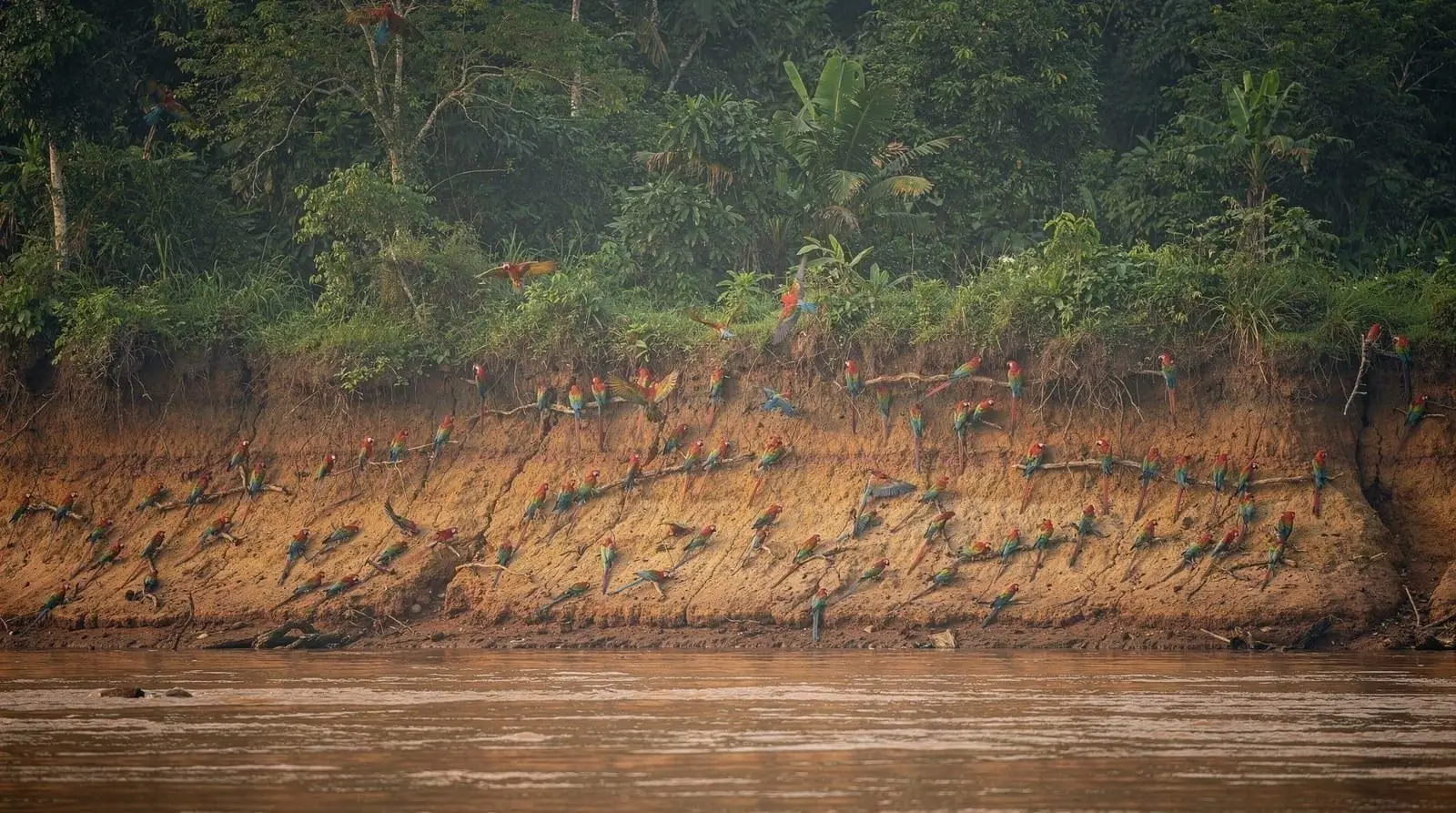
The reason many serious wildlife travellers choose Tambopata over the rest of the Peruvian Amazon is the collpas, or clay licks — exposed riverbank clay where parrots, parakeets, and macaws gather at first light to eat the mineral-rich soil. The behaviour is thought to help neutralise toxins in the seeds and fruit the birds eat, and on a good morning the result is extraordinary: dozens or hundreds of birds wheeling and settling against a red clay bank in a chaos of green, blue, red, and gold.
The largest and most famous is the Colorado clay lick (Collpa Colorado), deep in the reserve and reached only from the interior lodges — principally Rainforest Expeditions’ Tambopata Research Center. It ranks among the biggest known macaw licks in the world and is the entire reason the deepest, most expensive lodges exist. Closer to Puerto Maldonado, smaller licks such as Chuncho and various parrot licks are within reach of mid-range lodges and even some day trips.
A clear-eyed note on expectations: clay-lick activity is weather-dependent and seasonal. The big macaw shows are most reliable in the dry season, broadly May to September; rain or an overcast dawn can keep the birds away entirely. Even in perfect conditions, no operator can promise a spectacular morning. The deeper you go and the more dawns you allow, the better your odds — which is the central argument for the longer, pricier programmes.
Tambopata: multi-day Amazon rainforest tour with a local guideLake Sandoval and the giant otters
If the clay licks are Tambopata’s signature, Lake Sandoval is its most beloved single excursion. This oxbow lake, formed where the Madre de Dios River long ago changed course, lies within the reserve about an hour downriver from Puerto Maldonado, reached by a short boat ride and then a walk through palm forest — often muddy, so rubber boots (usually provided by the lodge) earn their keep.
The lake’s celebrities are its resident family of giant river otters, an endangered species reaching nearly two metres that hunts fish in noisy, social groups. Sightings are likely but never guaranteed; patience and an early or late visit improve the odds. The lake also holds black caiman, several monkey species in the surrounding trees, hoatzins clattering in the lakeside vegetation, and an enormous variety of birds. A dawn or dusk paddle across the still water, forest reflected and otters surfacing, is for many visitors the high point of the whole trip.
Because Sandoval sits relatively close to town, it fits shorter programmes or even a long day trip, which makes it the realistic Amazon highlight for travellers short on time.
Tambopata Peruvian Amazon jungle: 3 days / 2 nightsHow deep should you go?
The single biggest planning decision in Tambopata is how far up the Tambopata River to base yourself, because it directly determines what you can see and how much you pay.
Closer lodges (30 minutes to about 2 hours upriver) are cheaper, easier, and ideal for shorter stays. They offer forest walks, night excursions, canopy towers, and access to Lake Sandoval and smaller parrot licks. The forest is good and the wildlife real, though these areas see more visitors and the animals are somewhat more used to people. Lodges in this band include Posada Amazonas and similar mid-range operations.
Deep-reserve lodges (3 to 5+ hours upriver) — principally the Tambopata Research Center — sit in far wilder forest with direct access to the great Colorado macaw lick. This is where the odds of rarer mammals and the full clay-lick spectacle are highest. The cost is significant and the journey is long, so these programmes need four to five days minimum to be worthwhile; spending two of those days mostly on a boat to reach a lodge you only sleep in twice makes no sense.
Puerto Maldonado: 3-day Amazon jungle tour with lodging in TambopataAs a rough guide: a three-day, two-night programme at a closer lodge suits travellers folding the Amazon into a busy Peru itinerary; a four- or five-day programme reaching the deeper reserve and the Colorado lick suits travellers for whom the rainforest, and birds especially, are a primary reason for the trip.
Choosing a lodge: what actually matters
Lodge marketing leans heavily on comfort — private bathrooms, hot water, the bar, the dining room. Those things are pleasant, but they are not what makes or breaks an Amazon trip. The single most important variable is the quality of the naturalist guide, and it is the one thing lodge websites say least about.
Before booking, ask specifically: Are the guides certified naturalists with real knowledge of Amazonian ecology, or boat drivers with some wildlife familiarity? How many guests per guide on excursions (smaller is better — large groups scare wildlife and limit your time)? What is the lodge’s distance from town, and therefore how much day-tripper traffic does its forest see? What are the lodge’s environmental practices around waste, generator hours, and wildlife interaction?
A second honest point concerns the cheaper end of the market. Puerto Maldonado has a tier of budget operators selling jungle packages at very low prices, and some deliver perfectly decent trips. Others cut corners — oversized groups, rushed itineraries, guides with thin knowledge, and questionable practices like baiting animals. The reviews that matter most are the ones that mention the guide by name and describe the wildlife realistically. Be wary of anything promising guaranteed jaguar sightings; that is a marketing red flag, not a feature.
Honest expectations on wildlife
It is worth saying plainly what Tambopata is and is not. It is one of the richest ecosystems on the planet, and with a good guide you will see a remarkable quantity of life. It is not a place where charismatic mammals parade past on cue.
Highly likely: abundant birds (parrots, macaws, toucans, hoatzins, raptors), caiman on night trips, several monkey species, and — at Lake Sandoval — giant otters. Active clay licks, in season and with luck on the weather.
Possible with time and luck: capybara, peccary herds, sloths, and a long catalogue of frogs, snakes, and insects that the smaller-scale naturalist gets genuinely excited about.
Rare: jaguar, tapir, giant anteater, and the big cats generally. These exist here, and a lucky few see them, but planning your trip around them is a recipe for disappointment.
The travellers who come away happiest tune into the smaller scale — the leafcutter ant columns, the poison frogs, the bird diversity, the night sounds — rather than waiting for a jaguar that almost never comes. A good guide unlocks all of it; this matters more than the lodge’s comfort level, and it is the one thing worth asking hard questions about before you book.
When to visit Tambopata
The reserve follows the broader Madre de Dios pattern. The dry season (roughly April to October) offers walkable trails, moderate river levels, easier wildlife access, and the most reliable clay-lick activity from May to September — this is the recommended window. Expect occasional friaje cold snaps, brief southern wind events that drop temperatures for a day or two, so pack one warm layer even in the heat.
The wet season (November to March) brings heavy rain, high rivers, lush forest, and quieter, cheaper lodges, but some trails flood and clay-lick activity is less predictable. It is a fine time for travellers who prioritise the dramatic, alive forest over guaranteed trail access, and prices can be appreciably lower.
For the broader seasonal context across Peru, the best time to visit Peru guide sets these Amazon windows against the highlands and coast.
Health and what to pack
On health: yellow fever vaccination is recommended for Peru’s Amazon lowlands (get it at least 10 days ahead and carry the certificate), malaria risk exists in Madre de Dios and antimalarial prophylaxis is a decision for a travel-health doctor, and dengue is present — so high-DEET repellent, long sleeves at dawn and dusk, and permethrin-treated clothing all matter. None of this is scaremongering; it is the actual preparation the region requires.
For packing, prioritise: lightweight long-sleeved shirts and trousers in muted colours, a wide-brimmed hat, high-strength insect repellent, a quick-dry towel, a headlamp for night walks, a dry bag for the boat, binoculars (the difference between seeing the birds and not), and a refillable water bottle. Most lodges provide rubber boots; confirm sizes in advance. Leave the heavy luggage in Cusco — most lodges have a left-luggage option and you only need a small bag for the jungle.
How Tambopata fits a Peru trip
Because of its short flight from Cusco, Tambopata is the Amazon that slots most easily into the classic southern circuit. A common shape is Cusco and the Sacred Valley, then Machu Picchu, then a short flight down to the lowlands for three to five days in Tambopata before flying home from Puerto Maldonado or back via Cusco or Lima.
Travellers wanting a wilder, harder-to-reach Amazon sometimes weigh Tambopata against Manu National Park — wilder and more pristine, but far more committing — a decision the Tambopata vs Manu guide addresses head-on. Others compare it to the river-cruise world of Iquitos in the north, covered in the Iquitos complete guide. For suggested routes that combine the highlands with the jungle, see the itineraries section, and for flight search and planning resources, the tools page.
Puerto Maldonado itself: worth a look, not a stop
Most travellers pass through Puerto Maldonado without a second thought on the way to and from the airport and the boat dock, and that is broadly the right call — the jungle upriver is why you came. That said, if a flight delay or an early transfer leaves you with a few spare hours in town, the riverside market and the views over the Madre de Dios river are a reasonable way to pass the time, and it is worth having a little cash on hand for last-minute supplies your lodge does not stock. The full logistics of the gateway town, including transfer timing and what to do if you have a layover, are in the Puerto Maldonado guide.
Combining Tambopata with the rest of the Amazon
Some travellers with extra time weigh adding a second Amazon region rather than choosing just one. Comparing Tambopata against Iquitos directly is worth doing before you book if you are unsure which gateway suits you, since the two access completely different parts of the rainforest and are not usually combined on a single trip due to the travel time between them. For travellers who want the option to compare the wilder, harder-to-reach alternative in the same southern region, the Tambopata vs Manu guide lays out exactly where each wins.
A note on connectivity and disconnecting
Most Tambopata lodges run on generator power for a few hours a day and have limited or no wifi, especially the further upriver you go. Treat this as a feature rather than a drawback: the point of the trip is the forest and the night sounds, not a screen. Tell anyone who needs to reach you urgently that you will be offline, charge devices and cameras fully before you leave Puerto Maldonado, and bring spare batteries or a power bank for camera gear, since charging opportunities at the lodge may be limited to set hours around dinner.
Frequently asked questions about Tambopata guide: clay licks, Lake Sandoval and choosing a lodge
How many days do I need in Tambopata?
When is the best time to visit Tambopata?
Will I actually see giant otters at Lake Sandoval?
How much does a Tambopata trip cost?
Do I need vaccinations for Tambopata?
What is a clay lick and why does Tambopata have famous ones?
How do I get from Cusco or Lima to Tambopata?
Is Tambopata safe?
Top experiences
Bookable activities with verified prices and instant confirmation on GetYourGuide.

