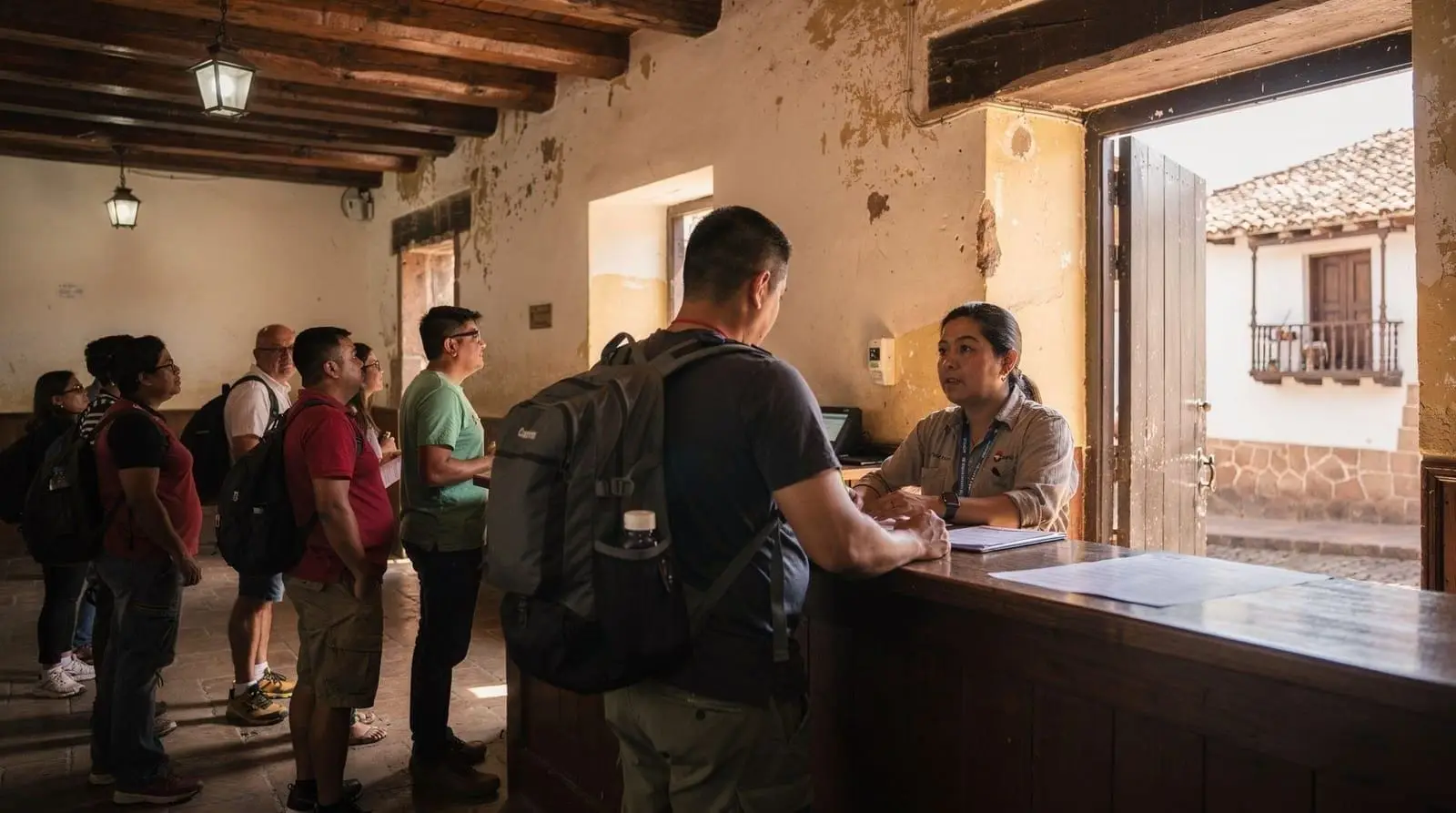
Where to buy tickets in Cusco: official sources, no scams
Where do I buy tickets in Cusco?
Buy the boleto turístico at the official COSITUC office on Avenida El Sol or at a covered site's gate. Buy Machu Picchu entry from the government site or the Cusco Ministry of Culture office, and train tickets from PeruRail and IncaRail directly. Avoid street touts, flyer-pushers, and unofficial resale sites, which charge mark-ups or sell fakes.
Why ticket-buying in Cusco trips people up
Few cities pack as many separate, confusingly named ticketing systems into one place as Cusco. There is the boleto turístico, the standalone Qorikancha ticket, the cathedral’s religious-circuit pass, the entirely separate Machu Picchu entry system, the trains run by two private companies, and the permit-only Inca Trail. Each has its own price, its own official seller, and its own crop of touts, resellers, and lookalike websites trying to slot themselves between you and the genuine source. The result is that travellers routinely overpay, buy the wrong ticket, or in the worst cases hand money to someone selling a fake.
| Boleto turístico | COSITUC office or covered-site gate, S/130 (BTG) |
| Machu Picchu entry | Official government site or Ministry of Culture office |
| Trains | PeruRail / IncaRail direct, book early in high season |
| Inca Trail permit | Licensed operator only, months ahead |
| Pay in | Soles, cash where required |
This guide does one thing: it tells you the official place to buy each ticket and names the traps clustered around it. It is deliberately practical rather than exhaustive on prices, which shift; for the deeper breakdown of what each pass covers, lean on the linked specialist guides. The single principle to carry through all of it is simple — buy from the official seller, in soles, and never from someone who approached you on the street or sent you an unsolicited link.
For the wider pattern of how visitors get parted from their money here, our Cusco tourist traps guide is a useful companion to this one.
The boleto turístico: buy it at COSITUC or the gate
The boleto turístico del Cusco (BTC) is the bundled pass covering sixteen sites in and around the city, including Sacsayhuamán, the ruins above town, several Sacred Valley sites, and a cluster of museums. Crucially, most of those sites have no individual ticket, so the boleto is the only legitimate way in.
Where to buy it: The official COSITUC office on Avenida El Sol, smaller authorised booths, or the gate of the first covered site you visit. There is no need for any intermediary — the queue at the gate or office is the official channel.
What it costs: The full boleto turístico general (BTG) is S/130 (about $35) for adults, valid 10 days. Partial circuit tickets are S/70 (about $19) each, valid 1 to 2 days, each covering a sub-group. A student discount (S/70 full) applies to ISIC holders under 26.
The honest mechanics: Bring cash in soles; many booths do not take cards, and exact change speeds the line. The boleto does not cover Qorikancha (around S/15 separately), the cathedral (around S/40, religious-circuit ticket), or Machu Picchu (a wholly separate system). Anyone telling you otherwise is confused or working an angle. Our boleto turístico explained guide breaks down which circuit suits which itinerary.
The trap: Avoid “agents” near the sites offering to sell you a boleto with a convenience fee. The official price is fixed; a mark-up means you are overpaying for something you could buy yourself ten metres away.
Machu Picchu entry: government site or Ministry office
Machu Picchu uses a timed-entry, circuit-based ticketing system run by the Peruvian Ministry of Culture, and it is entirely separate from the boleto and the trains. This is the ticket most worth getting right in advance.
Where to buy it: The official government ticketing website is the primary channel, and the Dirección Desconcentrada de Cultura (Ministry of Culture) office in Cusco sells in person for any remaining same-week availability. The add-on climbs of Huayna Picchu and Machu Picchu Mountain have small daily quotas that sell out earliest.
Why advance matters: In the dry season and around major festivals, popular dates and the add-on circuits sell out weeks ahead. Turning up in Cusco hoping to buy a next-day ticket frequently fails in high season. The Machu Picchu tickets explained guide covers the circuits in detail.
The traps: Street sellers offering Machu Picchu tickets, and lookalike websites with names and layouts mimicking the official one. Fake and resold tickets are a real problem; our fake Machu Picchu tickets coverage and the official site are your defence. Your passport name must match the ticket exactly, and it is checked at entry, so a reseller who cannot put your real name on it is selling you a problem.
Train tickets: PeruRail and IncaRail, directly
You cannot reach Machu Picchu without either trekking the Inca Trail or taking a train, and the train is run by two licensed private operators.
Where to buy: PeruRail and IncaRail, through their own websites, offices, and stations. Both serve the main Ollantaytambo to Aguas Calientes route; some PeruRail services also start from Poroy or San Pedro depending on the season and track works.
The honest mechanics: Prices vary widely by service class and time of day, with the cheapest seats and most convenient departures going first. Book early in the dry season. The Machu Picchu train tickets guide explains the classes and timings.
The traps: Third-party resellers that bundle trains into pricier packages, and — again — lookalike websites. Buying direct gives you the real fare and a ticket tied to your passport. Be especially wary of any site found through a sponsored search result that is not the operator’s own domain.
The Inca Trail permit: licensed operators only, months ahead
The Inca Trail is not a ticket you buy on arrival. Permits are strictly limited, allocated through licensed trekking operators, and routinely sell out months in advance for the dry-season months. You cannot legally walk it independently; you must book with a registered operator who secures the permit in your passport name.
Where to buy: A licensed Inca Trail operator, well ahead of your dates. The Inca Trail permits guide explains the quota system and timing, and the trail closes every February for maintenance.
The trap: Operators promising last-minute permits in peak season are either misinformed or selling an alternative trek under the Inca Trail name. Confirm in writing that your permit is for the classic Inca Trail and registered to your passport.
The lookalike-website problem, in detail
Online ticket scams have largely moved from crude fakes to convincing impersonation, and Cusco’s three quota-limited tickets — Machu Picchu entry, the trains, and Inca Trail permits — are the prime targets because demand outstrips supply and travellers book in a hurry from abroad.
The pattern is consistent. A site appears high in search results, often as a paid advertisement, with a domain that resembles the official one (an extra word, a different suffix, a hyphen) and a layout that mimics the government or operator branding. It sells you a real-looking confirmation at an inflated price, or in the worst cases a ticket that does not exist or cannot be tied to your passport. Because Machu Picchu entry, trains, and permits are all checked against your passport name at the gate, a confirmation that cannot carry your real name is worthless no matter how official it looks.
Three habits defend you. First, reach the official seller by typing the known address or going through a trusted, named source rather than clicking a search advertisement. Second, be suspicious of any site that takes payment but is vague about whose name appears on the ticket. Third, treat urgency and “only two left” pressure as a red flag rather than a reason to rush — genuine quota scarcity is real, but high-pressure sales pages exploiting it are exactly where impersonators operate. When in doubt, the Ministry of Culture office and the rail operators’ own offices in Cusco let you buy in person from a physical desk, which removes the website risk entirely for anything still available.
Tickets you can safely buy on the day
Not everything needs advance planning. The following are reliably available in person in Cusco:
- Qorikancha — at the gate, around S/15.
- Cusco Cathedral — religious-circuit ticket at the entrance, around S/40.
- The boleto turístico — at COSITUC or any covered site’s gate.
- City and Sacred Valley day tours — bookable a day or two ahead in Cusco, though high-season Rainbow Mountain trips can fill.
The dividing line is simple: anything with a fixed daily quota (Machu Picchu, Huayna Picchu, trains, the Inca Trail) needs advance booking; anything sold continuously can wait.
A short anti-scam checklist
- Buy from the official seller for each ticket — never from a street tout or unsolicited message.
- Pay in soles, in cash where booths require it, and decline dynamic currency conversion on cards.
- Check that any passport-linked ticket (Machu Picchu, trains, Inca Trail) carries your exact name.
- Verify website domains before paying; lookalike sites are the commonest online trap.
- Treat “free” workshop flyers near the Plaza de Armas as sales funnels, not gifts.
- Refuse any “convenience fee” on a fixed-price ticket like the boleto.
For the broader catalogue of overcharging tactics, including the balcony-restaurant premium and unofficial taxis, see Cusco tourist traps.
Booking from home versus buying on arrival
A practical question this guide has not directly answered yet: how much should you lock down before you land in Peru? The honest split is by scarcity, not by ticket type in general. Anything with a fixed daily quota — Machu Picchu entry, the Huayna Picchu and Machu Picchu Mountain add-ons, PeruRail and IncaRail seats in high season, and the Inca Trail permit — should be booked from home, ideally weeks or months ahead depending on the season, because same-week availability in Cusco is genuinely unreliable during the dry season.
Everything else — the boleto turístico, Qorikancha, the cathedral, day tours to the Sacred Valley or Rainbow Mountain — can wait until you arrive, since supply is continuous and there is no benefit to pre-booking beyond convenience.
This matters because over-booking from home has its own cost: locking in fixed dates for flexible-supply tickets removes the freedom to adjust your itinerary around weather, energy levels, or altitude symptoms. Book the scarce, quota-limited items early and firmly; leave the abundant ones loose and decide once you are in Cusco and can read how your trip is actually going.
A realistic sequence for a first Cusco visit
Putting the guide’s advice into an order that mirrors how most trips actually unfold:
- Months ahead: Secure your Inca Trail permit through a licensed operator if trekking, and book Machu Picchu entry (plus any add-on climb) for your target date.
- Weeks ahead: Book PeruRail or IncaRail train tickets for your Machu Picchu day, especially in the June–September dry season.
- On arrival in Cusco: Buy the boleto turístico at COSITUC or your first covered site, and book Sacred Valley or Rainbow Mountain day tours a day or two ahead through your hotel or a reputable operator.
- Day of, or spontaneously: Qorikancha, the cathedral, and most museum entries can be bought at the gate without any planning at all.
Following this sequence removes almost all the scarcity risk from your trip while leaving genuine flexibility in the parts of your itinerary that do not need to be locked down months in advance.