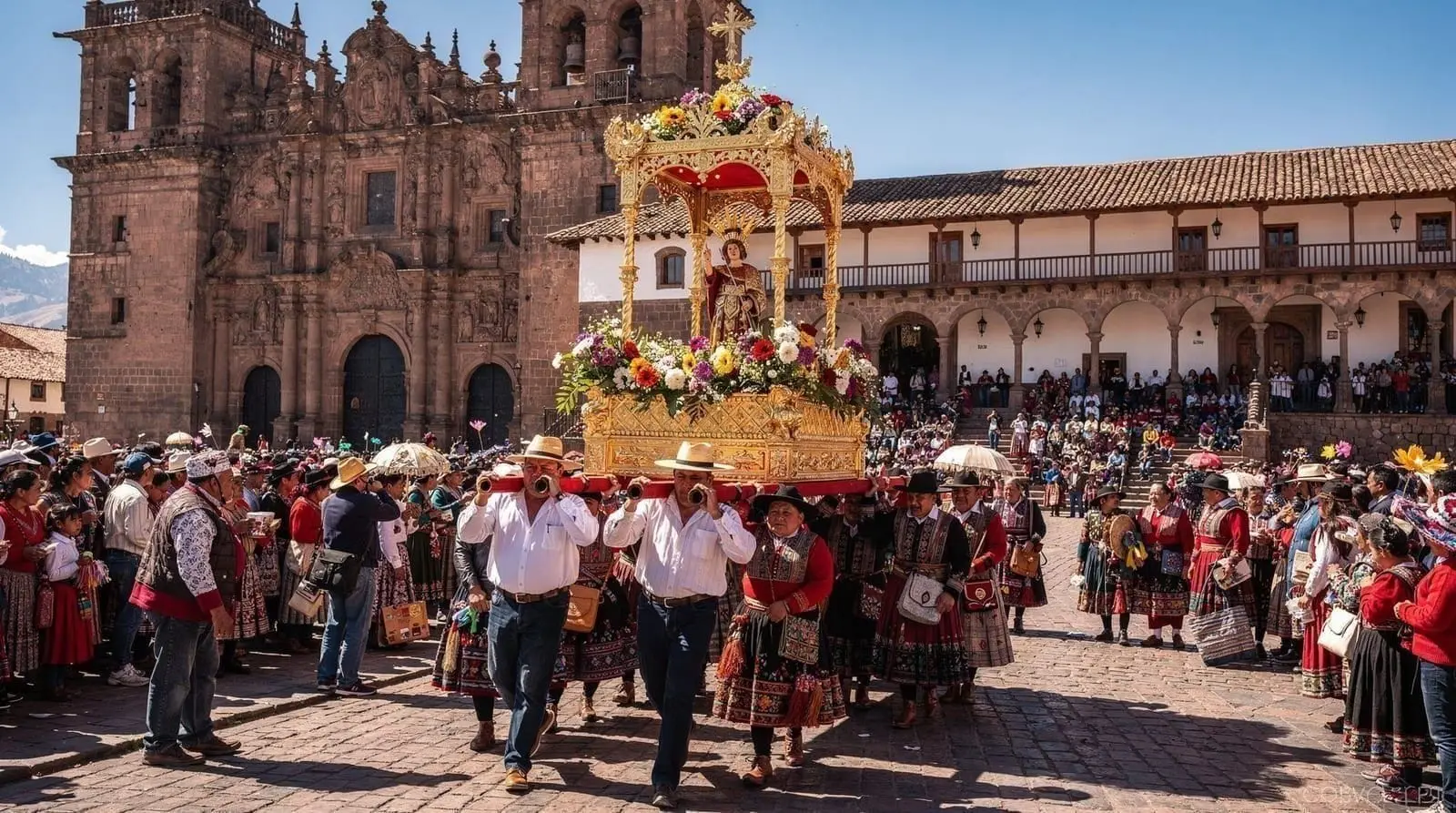
Corpus Christi in Cusco: the procession of fifteen saints
Cusco: City Center and San Blas Walking Tour
When is Corpus Christi celebrated in Cusco?
Corpus Christi falls on the Thursday after Trinity Sunday, sixty days after Easter, so the date moves each year. In 2026 the main procession is on Thursday 4 June, with the entrada (entry of the saints) the evening before and the octava procession eight days later.
A Catholic feast carried on Inca shoulders
On the morning of the festival, fifteen towering statues — saints in gilded robes, virgins crowned with silver — are shouldered through the streets of Cusco by hundreds of bearers, swaying to bands and the smoke of incense, until they converge on the Plaza de Armas and process into the cathedral. To a first-time visitor it reads as a Catholic feast, and it is.
But the form of it, the parading of figures to a central plaza, is older than the Spanish church. Before the conquest, Cusqueños carried the mummified bodies of their ancestors and rulers through this same square in seasonal rites. The colonial authorities replaced the mummies with saints and kept the procession, and the result is one of the most distinctive festivals in the Andes — neither purely European nor purely Inca, but unmistakably Cusqueño.
This guide explains what actually happens across the festival days, when it falls in 2026, what to eat, where to stand, and the honest trade-off of visiting Cusco during one of its busiest, priciest stretches of the year.
| Where | Plaza de Armas, Cusco historic centre |
| Cost | Free to watch; chiriuchu plate around S/30-50 |
| 2026 dates | Entrada 3 June, main day 4 June, octava 12 June |
| Time needed | Half a day for the main procession |
| Best time to arrive | 1-2 hours early for a good spot |
The dates: a moving feast
Corpus Christi is tied to Easter, not the calendar. It falls on the Thursday after Trinity Sunday, which is sixty days after Easter Sunday, so the date shifts every year. In 2026 the main procession lands on Thursday 4 June.
The celebration is not a single day, though:
- The entrada (Wednesday evening, 3 June 2026): the fifteen saints and virgins are carried from their home parishes into the cathedral the night before, an arrival full of bands, fireworks, and crowds. Many locals consider this the most atmospheric moment.
- The main day (Thursday 4 June 2026): the saints emerge and process around the Plaza de Armas in a set order of precedence before re-entering the cathedral, where they remain on display together.
- The octava (eight days later): a second, smaller procession sends the saints back toward their parishes, closing the cycle.
Crucially, Corpus Christi sits in the run-up to Inti Raymi on 24 June, the Inca festival of the sun and Cusco’s single biggest event. The whole of June is therefore the city’s peak festival season, with consequences for prices and crowds that the last section of this guide does not sugar-coat.
The fifteen saints and what they mean
The procession’s emotional core is the fifteen statues, each the patron of a parish in or around Cusco. They include the Virgen de Belén, the Virgen de la Almudena, San Sebastián, San Jerónimo, San Cristóbal, Santiago, and others, alongside the Blessed Sacrament itself, which is the formal reason for the feast. There is an established order of precedence, and locals follow the rivalries and pairings between saints with the attention others give to sport.
Each statue is staggeringly heavy, dressed in embroidered cloth and precious metal, and carried on a wooden platform by teams of bearers from its parish. The effort is part of the devotion. If you have seen Cusco’s colonial paintings — including the famous Corpus Christi canvases in the Museo de Arte Religioso — you will recognise the scene; the festival has been depicted by Cusqueño artists for centuries.
A focused walking tour of the historic core and San Blas is a good way to read the churches these saints come from and the layered Inca-and-colonial city they pass through; the Cusco city centre and San Blas walking tour covers that ground with context you would miss on your own.
Chiriuchu: the dish you only eat now
No Cusco festival is more bound to a single food than Corpus Christi is to chiriuchu. The name is Quechua for “cold chilli,” and the dish is a cold composite platter eaten almost exclusively around this feast. A full chiriuchu typically piles together roast guinea pig (cuy), chicken, dried sausage (chorizo), cheese, fish roe (huevera), toasted corn, a thin corn pancake (torreja), seaweed (cochayuyo), and rocoto pepper, all served at room temperature. It is meant to be shared, picked at, and washed down with chicha.
During the festival, stalls selling chiriuchu cluster around the Plaza de Armas and near San Pedro market. A plate runs roughly S/30 to S/50 depending on how generous the cuy portion is. It is genuinely a once-a-year food for many Cusqueños, so trying it during Corpus Christi is the real thing rather than a tourist re-creation. If you would rather learn to handle Andean ingredients yourself, the San Pedro market and Peruvian cooking class is a good complement on a non-procession day.
Where to stand, and when to arrive
The Plaza de Armas is the stage. The saints circle the square before entering the cathedral, so the plaza perimeter and the cathedral steps offer the best sightlines — and fill earliest. Practical advice:
- For the main Thursday, arrive at least an hour or two before the procession to claim a spot along the arcades, on the cathedral steps, or at a balcony café (which charge a premium for the view, as everywhere on the plaza).
- Consider the Wednesday entrada instead or as well. The evening arrival of the saints is often less suffocating than the main day and arguably more atmospheric, with fireworks and bands.
- Watch the streets, not just the square. The bearers process in from the parishes, so catching a saint being carried through a narrow lane toward the plaza can be more intimate than the crush of the centre.
- Mind your belongings. Dense festival crowds are prime territory for pickpockets; keep your phone and wallet out of sight.
The procession is free to watch. You do not need a ticket, a tour, or a reservation to stand in the plaza — only patience and an early start.
The honest trade-off of visiting in June
Here is the part the festival marketing skips. Corpus Christi falls in the busiest, most expensive month of the Cusco year. June combines Corpus Christi, the wider build-up to Inti Raymi on 24 June, and the peak of the dry-season tourist wave. The consequences are concrete:
- Accommodation fills and prices climb. Mid-range hotels that ask $50 in April can double in June, and the best places sell out months ahead. Book early or you will be left with the dregs.
- Trains and tours to Machu Picchu are at their fullest. If your trip also includes the citadel, lock in those tickets well in advance.
- The city centre is genuinely crowded on the festival days, which is part of the experience but worth knowing if you dislike crush.
The flip side: the dry-season weather is reliably clear, the cultural energy is unmatched, and if you have come this far for Andean culture, Corpus Christi is close to the pinnacle of it. If, on the other hand, you want a calmer, cheaper Cusco, the shoulder months of April, May, and October give you the city without the festival premium — see the best time to visit Peru for the wider seasonal picture.
Practicalities and acclimatisation
Corpus Christi is a long day on your feet at 3,400 m, much of it standing in sun then cold as the afternoon turns. If you are newly arrived, do not let festival excitement override sensible acclimatisation — plan a quiet first day or two before the procession, hydrate, and pace yourself. Our Cusco acclimatization plan lays out a day-by-day approach, and if your itinerary allows, arriving via the lower Sacred Valley first eases the adjustment, as covered in Cusco altitude vs the Sacred Valley.
Bring layers, sun protection, cash in soles, and comfortable shoes for the cobbles. Dress modestly if you intend to enter the cathedral, where the saints are displayed together after the main procession.
How Corpus Christi fits a Cusco trip
If your travel dates fall on or near 4 June 2026, build the festival into your plan as a centrepiece rather than a surprise: arrive a couple of days early to acclimatise and settle in, secure accommodation and any Machu Picchu logistics far ahead, and keep the procession day clear of strenuous excursions. Around it, the usual Cusco rhythm still works — the historic core, the ruins above town, the Sacred Valley, and Machu Picchu. For broader routing, browse /itineraries/ and the two-week Peru itinerary guide.
Corpus Christi versus Inti Raymi: which to prioritise
If you can only build your trip around one June festival, the two feel quite different:
- Corpus Christi (4 June 2026) — a free street procession centred on the Plaza de Armas, intimate and religious in tone, with chiriuchu as the culinary anchor.
- Inti Raymi (24 June) — a large staged re-enactment of the Inca sun festival at Sacsayhuamán, with paid grandstand seating and a much bigger production.
Many visitors time a June trip to catch both, since they sit only three weeks apart; if you can only manage one, Corpus Christi is the more spontaneous, lower-cost experience, while Inti Raymi is the bigger spectacle worth planning and booking around.
Frequently asked questions about Corpus Christi in Cusco: the procession of fifteen saints
What date is Corpus Christi in Cusco in 2026?
Why are there fifteen saints carried through Cusco?
What is chiriuchu and why is it tied to Corpus Christi?
Is Corpus Christi a good or bad time to visit Cusco?
Where is the best place to watch the procession?
Do I need to book accommodation far ahead for Corpus Christi?
Is the octava procession worth attending too?
Top experiences
Bookable activities with verified prices and instant confirmation on GetYourGuide.


