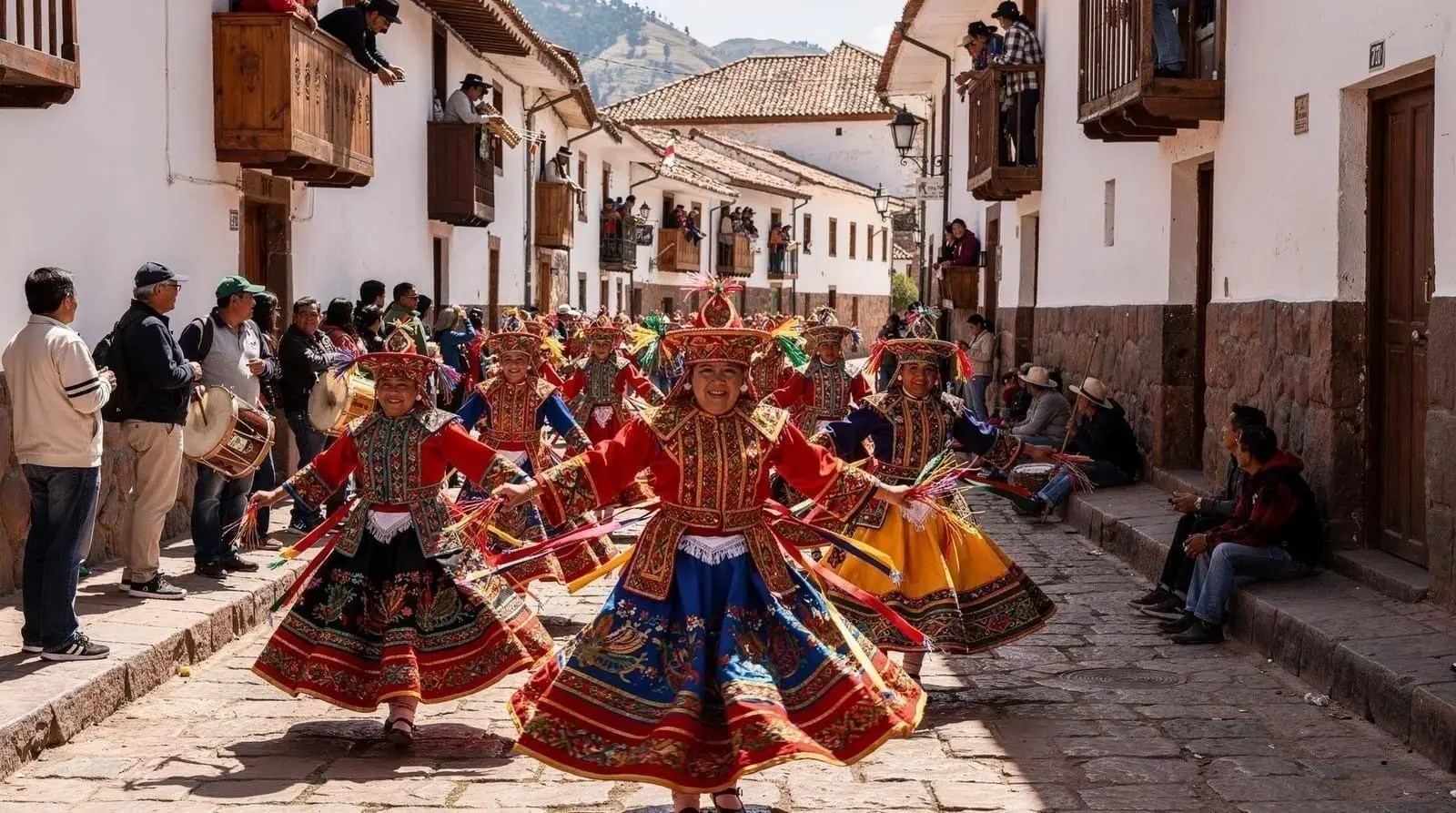
Cusco festivals calendar: what's on, month by month
What is the biggest festival in Cusco?
Inti Raymi, the Inca Festival of the Sun, held every 24 June, is by far the largest — a grand reenactment at Sacsayhuamán that fills the city and spikes prices. But Cusco's calendar is dense year-round, with Corpus Christi in June, the mountain pilgrimage of Qoyllur Rit'i in May–June, and the moving Holy Week procession of the Señor de los Temblores.
Why Cusco’s calendar is one of the fullest in the Andes
Few cities pack their year with festivals the way Cusco does. The reason is its history: as the ceremonial capital of the Inca empire later overlaid with Spanish Catholicism, the city inherited two ritual calendars and never quite chose between them. The result is a year-round procession of feast days, pilgrimages and reenactments where Andean cosmology and colonial Catholicism are braided together so tightly that the seams barely show. A saint’s statue is paraded with the same fervour once given to the sun; a glacier pilgrimage shares the season with Corpus Christi.
This calendar walks you through the year so you can decide whether to time your visit around a festival — or deliberately around the gaps. It’s honest about the trade-off: the biggest events are spectacular but coincide with Cusco at its most crowded and expensive, in the heart of the dry season.
| Biggest event | Inti Raymi, 24 June, at Sacsayhuamán |
| Also major | Corpus Christi (June), Qoyllur Rit’i (May–June) |
| Ticket needed | Only for the Sacsayhuamán grandstand at Inti Raymi |
| Quietest months | January, September, October |
| Book ahead by | Months, for Inti Raymi accommodation |
Festival crowd and price impact, month by month
| Month | Main event | Crowd impact | Price impact |
|---|---|---|---|
| January | Bajada de Reyes (minor) | Low | Low |
| February | Carnival | Moderate (+ rain) | Low-moderate |
| March/April | Semana Santa, Señor de los Temblores | Moderate | Moderate |
| May | Qoyllur Rit’i begins, Cruz Velacuy | Low-moderate | Low-moderate |
| June | Corpus Christi, Inti Raymi | Highest | Highest |
| July | Virgen del Carmen (Paucartambo) | High (dry season) | High |
| August | Pachamama offerings | Moderate | High |
| September/October | Minor local feasts | Low | Low-moderate |
| November | Todos los Santos | Low-moderate | Low |
| December | Santurantikuy, Christmas | Moderate (holiday spike) | Moderate |
The festival year, month by month
January — Adoration of the Magi and a quiet start
The year opens quietly in festival terms, in the depths of the wet season. On 6 January, smaller communities mark the Bajada de Reyes (Epiphany). It’s a low-key month — green, rainy, and well off the tourist peak — making it a good time to feel the city without festival crowds.
February — Carnival and water fights
Carnival (movable, usually February) is playful chaos: water balloons, foam and good-humoured ambushes fill the streets, with the rural communities of the Sacred Valley often hosting the liveliest celebrations. It overlaps with the wettest stretch of the year and the February closure of the Inca Trail for maintenance, so it’s a festival-with-rain proposition.
March / April — Holy Week and the Señor de los Temblores
Semana Santa (Holy Week, movable, March or April) is one of Cusco’s most moving events. On Holy Monday, the blackened crucifix known as the Señor de los Temblores (Lord of the Earthquakes) — credited by locals with halting the devastating 1650 earthquake — is carried through the streets in a vast procession, showered with red ñucchu flower petals from balconies. It’s solemn, deeply local, and far less touristic than the June spectacles. A genuinely affecting time to be in the city.
May — Qoyllur Rit’i begins and the Cruz Velacuy
Late May into June brings Qoyllur Rit’i (the Snow Star festival), one of the great Andean pilgrimages: tens of thousands trek to a glacier sanctuary at over 4,600 m near Ausangate, fusing pre-Columbian mountain worship with Catholic devotion. It’s not a city event — it’s a strenuous high-altitude pilgrimage — but it’s culturally extraordinary. Early May also brings Cruz Velacuy (3 May), when communities decorate and vigil over their crosses. May is also a shoulder-season weather sweet spot, covered in the best time to visit Cusco guide.
June — the festival peak: Corpus Christi and Inti Raymi
June is the crown of the calendar and the busiest month of the year.
Corpus Christi (movable, usually early-to-mid June) sees fifteen statues of saints and virgins carried from their parish churches into Cusco Cathedral in a blaze of color and brass bands, where they “visit” the body of Christ before returning home. The traditional festival dish, chiriuchu — a cold platter of guinea pig, chicken, sausage, cheese, fish roe and seaweed — is sold around the Plaza de Armas.
Inti Raymi, on 24 June, is the headline act: the Inca Festival of the Sun, a grand theatrical reenactment of the winter-solstice ceremony staged in three acts across the Qorikancha, the Plaza de Armas, and finally the great fortress of Sacsayhuamán above the city, where hundreds of costumed performers fill the terraces. It draws enormous crowds, and the seated grandstand at Sacsayhuamán requires a paid ticket bought well ahead. The surrounding days mark Cusco’s broader anniversary celebrations, so the whole late-June window is festive — and fully booked.
July — Virgen del Carmen in Paucartambo
In mid-July (around the 15th–16th), the town of Paucartambo, a few hours from Cusco, erupts for the Virgen del Carmen, with masked dancers, processions and rituals that spill across several days in one of the region’s most vivid and least sanitised celebrations. It’s a trek to reach and accommodation is scarce, but for festival travellers willing to go beyond the city, it’s a highlight. July is also peak dry-season tourism, so the city itself stays busy.
August — Pachamama and the earth offerings
August is the month of Pachamama (Mother Earth). Across the Andes, communities and families make despachos — ceremonial offerings of coca leaves, seeds and symbolic items — to give thanks to the earth before the planting season. It’s quieter and more domestic than the June pageantry, woven through daily life rather than staged in the plaza, and you may encounter ceremonies if you’re in rural areas or on treks.
September / October — quieter shoulder months
The post-peak shoulder is light on major city festivals, which makes it appealing for travellers who want Cusco’s sights without the June density. Smaller religious feasts dot the calendar, but this is more a sightseeing window than a festival one — and the weather is still largely dry, as the dry season guide explains.
November — Day of the Dead and All Saints
Early November brings Todos los Santos (All Saints, 1 November) and the Day of the Dead, when families visit cemeteries with food and remembrance. Bakeries fill with t’anta wawa — bread shaped like swaddled babies. It’s an intimate, family-centred observance rather than a tourist spectacle, marking the start of the wet-season transition.
December — Santurantikuy and Christmas
On Christmas Eve (24 December), the Plaza de Armas hosts Santurantikuy, one of the largest artisan markets in the Americas, where craftspeople sell nativity figures and carvings. It’s a warm, atmospheric end to the year, deep in the wet season, with the city quieter than its June peak.
How to plan around (or into) the festivals
If a festival is the reason for your trip, build everything around its date. For Inti Raymi (24 June), lock accommodation and any Sacsayhuamán grandstand ticket months ahead — it’s the single hardest booking window of the year, compounded by peak dry-season demand. For Corpus Christi, check the movable date early (it shifts with Easter) and expect the cathedral and plaza to be packed.
If, on the other hand, you want Cusco’s monuments without festival crowds, deliberately avoid the June cluster. The shoulder months of May (before the peak) and September (after it) give you near-identical dry weather with a fraction of the people and lower prices — the planning logic is laid out in the best time to visit Cusco guide.
A practical safety note for any big event: dense festival crowds raise the risk of pickpocketing. Keep valuables zipped and out of sight, carry only the cash you need, and use app-based taxis after late-night celebrations rather than flagging unmarked cars.
Understanding Inti Raymi before you go
Because Inti Raymi is the festival most travellers build a trip around, it’s worth understanding what you’re actually seeing — and what the ticket really buys. The festival recreates the Inca winter-solstice ceremony that honoured Inti, the sun god, at the moment of the year when the sun is “weakest” and needs encouragement to return. The modern reenactment dates from 1944, staged annually since, with a script drawn from the chronicles of the Spanish-era writer Garcilaso de la Vega, who recorded the original rites.
The day unfolds in three acts. It opens at the Qorikancha, the Inca Temple of the Sun, where the Sapa Inca (the emperor figure) invokes the sun. It moves to the Plaza de Armas for a ceremony in the colonial heart of the city. And it culminates in the early afternoon at Sacsayhuamán, the great fortress above town, where hundreds of costumed performers fill the terraces for the main spectacle, including a symbolic offering. The first two acts are free to watch from the public crowds; the Sacsayhuamán finale is where the paid grandstand seating applies.
Two honest notes for prospective attendees. First, it’s a long, crowded day in the cold, thin air at altitude — dress in layers, bring water and sun protection, and be ready to stand and wait. Second, much of the spoken ceremony is in Quechua, so without a guide or program the narrative can be hard to follow; some travellers find the spectacle moving regardless, others find it more pageant than profound. Knowing which kind of traveller you are will tell you whether to pay for the grandstand or simply soak up the free city-wide atmosphere of the surrounding festival week.
The syncretism that defines Cusco’s festivals
What makes Cusco’s calendar more than a list of dates is the way Andean and Catholic traditions have fused into something neither purely indigenous nor purely European. When the Spanish imposed Catholicism in the sixteenth century, they often layered Christian feasts onto existing Inca observances rather than erasing them — Corpus Christi absorbed the timing and some of the spirit of pre-Columbian agricultural festivals, and the saint statues paraded into the cathedral occupy a role not unlike the mummified ancestors the Inca once processed.
You see this blend everywhere once you know to look for it. Qoyllur Rit’i is nominally a Catholic pilgrimage to an image of Christ painted on a rock, yet its heart is unmistakably an Andean glacier and mountain-spirit (apu) veneration. The Pachamama offerings of August thank Mother Earth in a tradition with no Christian origin at all. Even the festival foods — chiriuchu, t’anta wawa — carry pre-Columbian roots. Understanding this layering turns the festivals from colourful spectacle into a living record of how two worldviews collided and merged in Cusco, which is, in the end, the same story told by the Inca stonework beneath the colonial churches.
Festival food worth seeking out
Cusco’s festivals come with their own dishes, and tasting them is half the point. Chiriuchu appears around Corpus Christi — the elaborate cold platter is genuinely a once-a-year specialty. T’anta wawa breads show up for All Saints in early November. During Inti Raymi week, street vendors sell everything from anticuchos (grilled skewers) to chicha (fermented corn drink). Eating where locals eat — a block or two off the Plaza de Armas, or at San Pedro market — is both cheaper and more authentic than the balcony restaurants overlooking the processions.
Building a trip around a festival vs. avoiding one
The calendar splits travellers into two honest camps, and it’s worth being clear about which one you are before you book. Festival-seekers should target late June without hesitation — Corpus Christi and Inti Raymi within days of each other is the single richest festival window in the Andes, and no other month comes close for pageantry. Book accommodation, the Sacsayhuamán grandstand ticket, and flights the better part of a year out; this is the least flexible booking window on Cusco’s entire calendar.
Festival-avoiders, who want the ruins, the Sacred Valley and Machu Picchu without a layer of crowds and inflated prices on top, should deliberately steer around the June cluster — January, and September through October, give you Cusco’s core sights with none of the festival premium, though January sits in the wet season’s rainiest stretch, so weigh that trade against the rainy season guide.
A middle path exists too: May and early July let you catch a genuine, smaller-scale event (Qoyllur Rit’i’s build-up, or the run-up to Paucartambo’s Virgen del Carmen) without the full crush of the June peak, combining decent weather with a taste of festival atmosphere at a fraction of the crowd and price premium.