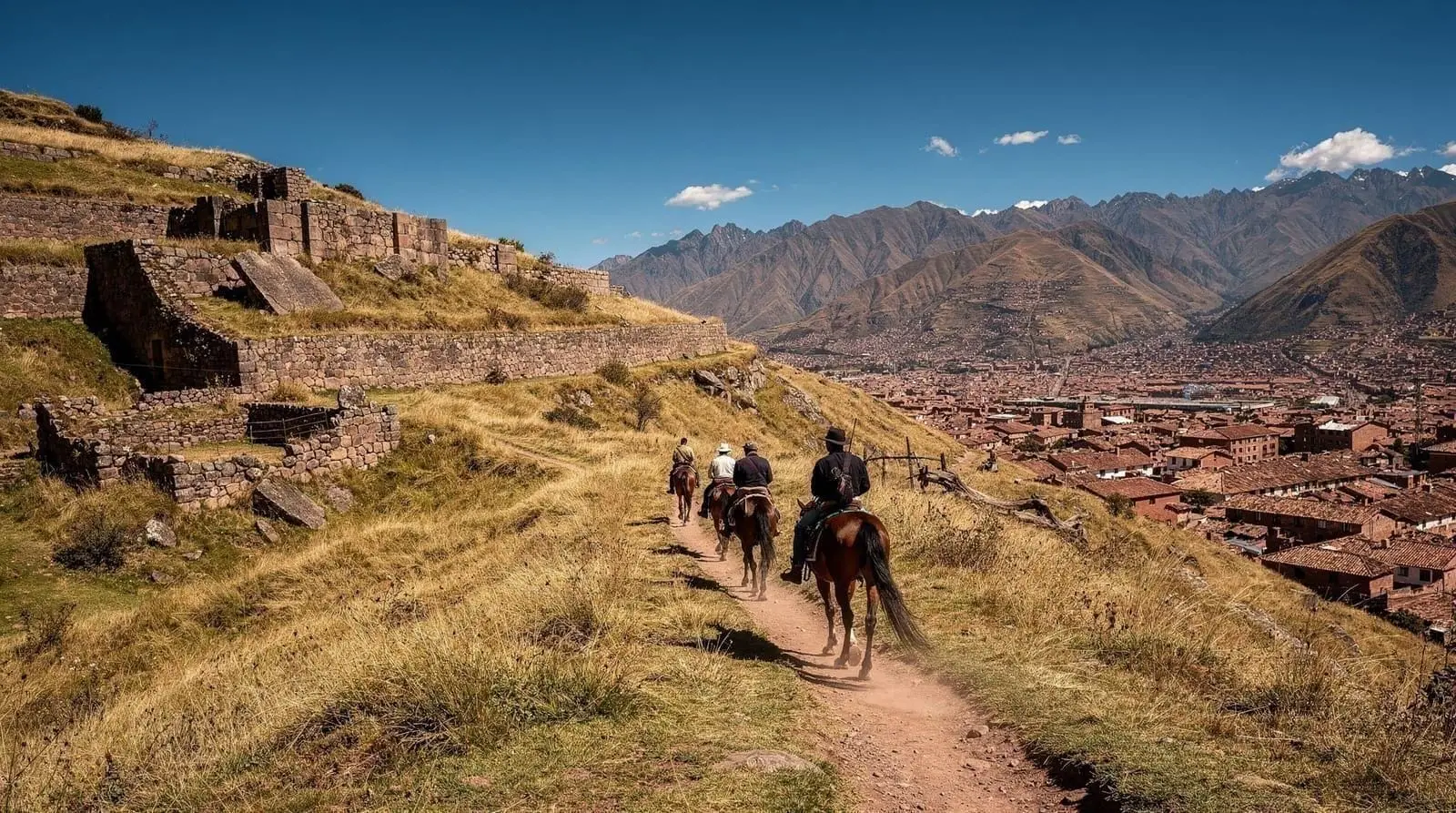
Horseback riding around Cusco
Trujillo: Peruvian Paso Horse & Marinera Show with Lunch
Is horseback riding around Cusco worth it?
Yes, if you choose carefully. The best rides reach the upper ruins (Sacsayhuamán, Qenqo, Tambomachay) or wind through the Sacred Valley on Peruvian Paso horses. Half-day rides run roughly S/120–250 (about $32–68); the variable is welfare, so vet the stable before you book.
What a Cusco ride actually involves
Horseback riding around Cusco is sold two ways, and the gap between them is wide. At the honest end are real trail rides — a couple of hours up to the ruins above town, or a half-day looping through the Sacred Valley on a well-kept horse with a guide who can pace the group. At the other end are the curbside touts near Sacsayhuamán who wave a tired animal at you, quote S/40 for “one hour,” and deliver a ten-minute shuffle on hard ground.
This guide is about telling the two apart, getting fair value, and not contributing to the worst of the welfare problems that dog cheap Andean horse tourism. Riding here is genuinely rewarding when the operator runs a tight ship: the high grassland above Cusco is open and dramatic, and a Peruvian Paso — bred for a smooth four-beat gait — is a comfortable horse to spend a morning on. But it pays to choose deliberately rather than grabbing the first offer at the trailhead.
A note on expectations first. These are not the long, fast trail rides of Patagonia or the American West. The standard product is a walk with the occasional trot, on calm horses, suited to people who have never ridden. If you want canter, distance, and a horse that responds to a confident rider, that exists too — but you have to ask for it and pay for it, and you should ride with an operator who grades horses and routes by ability.
| Where | Above Cusco (Sacsayhuamán/Tambomachay) or the Sacred Valley (Maras/Urubamba) |
| Cost | around S/120–300 ($32–81) for a half-day ride |
| Time needed | 2–4 hours, including the transfer |
| Best for | beginners on a calm, guided walk-and-trot ride |
| Avoid | curbside “S/40 one hour” touts near Sacsayhuamán |
The classic routes
Ruins above the city
The most popular ride climbs from the edge of Cusco up into the belt of Inca sites above town: Sacsayhuamán, Qenqo, and on toward Puka Pukara and Tambomachay. Most rides actually start near the Cristo Blanco statue or the Sacsayhuamán esplanade, having driven you up first — you save your legs the steep climb and your lungs the worst of the altitude gain. From the saddle you get the eucalyptus woods, the open puna grassland, and long views back down over the city’s red roofs.
Honest caveat: you generally ride between and around these sites rather than into them. The boleto turístico and the ruins themselves are visited on foot, so a ride here is about the landscape and the approach, not a substitute for the archaeology. Budget two to three hours including the transfer up. Many people pair a morning ride with an afternoon walking the ruins on the same tourist ticket.
The Devil’s Balcony and the temple of the moon
A longer ruins variant pushes past Sacsayhuamán to the lesser-visited rock shrines — the so-called Temple of the Moon (Amaru Machay) and the Devil’s Balcony (Balcón del Diablo), carved caves and a natural rock arch that see a fraction of the crowds. This is a better half-day if you want quiet trails and a bit more saddle time, and it is the route where a real trot or short canter is plausible on the open stretches. It typically runs three to four hours.
Sacred Valley trails
Down in the Sacred Valley — around Maras, the salt terraces, and the Moray agricultural circles, or out from Urubamba — rides run lower (about 2,800–3,500 m), which means easier breathing and warmer afternoons. The footing is a mix of farm tracks and open pampa, with the valley’s snow peaks as a backdrop. A Sacred Valley ride pairs naturally with a visit to Maras and Moray by car, and it is the gentlest option for nervous first-timers because the terrain is less steep than the ruins ride above Cusco.
What it costs in 2026
Prices are quoted in soles; the dollar figures use roughly S/3.70 to the dollar.
- Short ruins ride (2–3 hrs, with transfer up): S/120–180, about $32–49.
- Half-day ruins/Sacred Valley ride (3–4 hrs): S/200–300, about $54–81.
- Private or ability-graded ride with a quality stable: S/300–450, about $81–122.
- Curbside “one hour” touts at Sacsayhuamán: S/30–50 — and not recommended (see welfare, below).
What should be included on a fair price: a helmet, a guide who rides with you (not one who waves you off down a path alone), padded saddles, and round-trip transfer from your hotel or a central meeting point on the half-day products. Water is sometimes included, often not — carry your own.
Animal welfare: the part most guides skip
This is the uncomfortable core of the topic. A share of Cusco’s horse tourism runs thin, overworked animals on hard, rocky ground for too many hours a day, with ill-fitting tack that leaves girth and bit sores. You are not obliged to police every stable, but you can avoid funding the worst of it with a few checks.
Before you mount, look at the horse you are given:
- Body condition. You should not be able to count every rib at a glance. A visibly bony horse on a hot trailhead is a red flag.
- Tack. Saddles should sit on a pad, girths should not be cutting into raw skin, and there should be no blood or open sores at the bit corners of the mouth.
- Behaviour. A horse that is dull, head-low, and unresponsive may simply be exhausted.
- Hours. Ask, plainly, how many rides this horse does in a day. A stable that limits it (and can answer) is run by someone who thinks about the animals. One that shrugs is not.
The cheapest curbside offers are cheap for a reason: the margins come out of the horses. Spending S/120 with a stable that has a fixed base, named guides, and a published itinerary is both a better ride and a more humane one. If a horse you are assigned looks unwell, you are entitled to ask for another or to walk away.
Riding the Peruvian Paso
If you want to understand why horses matter so much in coastal and northern Peru, the Peruvian Paso is the answer. Bred over centuries for a smooth, lateral four-beat gait, it carries a rider without the jolt of a normal trot — a comfort animal for long days on hacienda land. You will see Pasos in the Sacred Valley, but the heartland of the breed and its showmanship is the north coast around Trujillo, where the marinera dance is traditionally performed alongside a chalán and his Paso horse.
If a Paso demonstration interests you more than a trail ride, the north-coast options are the real thing. The Trujillo Peruvian Paso horse and marinera show with lunch pairs the breed with the dance it accompanies, and the broader Trujillo full-day tour with the Huacas, Chan Chan and horses folds a Paso element into the region’s archaeology — both a different proposition from a Cusco saddle morning, but worth knowing if the horse is the draw rather than the ruins.
How to fold a ride into a Cusco trip
A morning ruins ride works best on your second or third day in Cusco, once you have a day of acclimatisation behind you — see the acclimatisation plan for pacing your first 48 hours. It slots neatly alongside the city’s other above-town options and is gentler on the lungs than the Rainbow Mountain day trip, which means it makes a good “active but not brutal” day for travellers still adjusting.
For a fuller picture of what else fills a Cusco week, the best day trips from Cusco guide ranks the ride against the heavier hitters like Humantay Lake and the Ausangate lakes. And if the archaeology is your priority, read the Cusco archaeological sites guide and walk the ruins on foot — a horse gets you the views, not the stonework up close.
Half-day vs full-day: which to book
Most operators sell a half-day product (transfer up, two to three hours in the saddle, back by lunch), and that is the right length for the great majority of riders. The ruins above town and the shorter Sacred Valley loops fit comfortably into a morning, and a morning is about as long as most non-riders want to spend on a horse before the novelty turns to saddle-soreness.
A full day exists — typically the extended ruins route past the Temple of the Moon and the Devil’s Balcony, or a Sacred Valley ride combined with a visit to a hacienda — but it is a lot of saddle time for a body that may also be adjusting to altitude. Unless you ride regularly at home, the half-day leaves you wanting a little more rather than aching for a week, which is the better outcome on a trip with other walking-heavy days ahead. Save your legs for the Rainbow Mountain and Machu Picchu days that are likely on the same itinerary.
One genuine advantage of a horse worth flagging: for travellers who find walking at altitude a struggle but still want to reach the upper ruins and the open puna, a guided ride is a far gentler way to cover the ground than hiking it. The horse does the climbing; you breathe a little easier than you would on foot. That makes it a quietly good option for older travellers or anyone whose lungs are still catching up with the elevation.
Multi-day and hacienda-based riding
Beyond the standard half- and full-day products, a smaller number of operators run multi-day riding trips based out of a working hacienda in the Sacred Valley, combining trail riding with farm life, home-cooked meals, and sometimes a night or two under the stars away from the tourist circuit. These are a different proposition entirely from a Cusco saddle morning: they suit experienced riders who want real distance and pace, rather than the walk-and-occasional-trot format aimed at beginners.
Expect to pay considerably more per day than a half-day ride, but also to get a horse graded to your ability and a guide who can push the pace if you want it. If this appeals more than a short ruins outing, ask specifically for a “multi-day” or “hacienda” program when you enquire — the standard tourist-office offerings rarely list them, and you will usually need to book through a specialist stable rather than a general tour agency.
Riding with a disability or limited mobility
Horseback riding can be a genuinely good option for travellers with certain mobility limitations, since a horse does the walking that a hiking trail would otherwise demand. That said, mounting and dismounting requires functional use of both legs and reasonable core balance, and most Cusco stables are not set up with mounting blocks or adapted tack for wheelchair users.
If you have a specific mobility need, call the stable ahead rather than turning up on the day — a good operator will tell you honestly whether they can accommodate you, and some can arrange assisted mounting with advance notice. This is one of the areas where booking through a reputable, established stable rather than a curbside offer pays off: the same stables that maintain healthy horses tend to be the ones equipped to handle a rider with additional needs safely.
Where the stables actually are
You will not generally find the better stables in central Cusco. They cluster at the edges and up at the trailheads:
- Above the city, near Sacsayhuamán, the Cristo Blanco, and along the road toward Tambomachay — the start point for the ruins rides.
- In the Sacred Valley, around Urubamba, Maras, and toward Maras and Moray — for the lower, warmer valley rides.
Book through a reputable operator or your hotel rather than rocking up at a trailhead and taking the first offer; the curbside horses at Sacsayhuamán are precisely the ones with the welfare problems described above. A booked ride means a known stable, a named guide, transport sorted, and a horse that has not been standing saddled in the sun all day waiting for a walk-up customer.
Practical kit and tips
- Wear long trousers. Shorts and bare calves rub raw against the saddle and stirrup leathers within an hour.
- Closed shoes with a small heel stop your foot sliding through the stirrup. Hiking boots are fine.
- Sun is fierce at altitude. A brimmed hat under (not instead of) the helmet, plus high-factor sunscreen and sunglasses.
- Layers. Mornings above Cusco are cold; midday is warm. A packable shell handles the squally afternoons.
- Don’t ride hungover or on day one. The combination of alcohol, altitude, and a horse is a poor one.
- Tip the guide and groom S/10–20 if the ride was good — wages in this trade are low.
Ruins ride vs Sacred Valley ride: which suits you
Both routes are sold as “horseback riding around Cusco,” but they answer different needs. Use this to decide before you book:
| Ruins ride (above Cusco) | Sacred Valley ride | |
|---|---|---|
| Altitude | 3,400–3,700 m | 2,800–3,500 m |
| Terrain | Puna grassland, eucalyptus woods, some slope | Farm tracks and open pampa, gentler |
| Best for | Seeing Sacsayhuamán/Tambomachay from the saddle | Nervous first-timers, warmer afternoons |
| Length | 2–4 hours | 3–4 hours with transfer |
| Pairs well with | An afternoon walking the tourist ticket sites | A day visiting Maras and Moray |
If breathing at altitude is already a concern on day two or three of your trip, the Sacred Valley ride is the more forgiving choice — it also makes a sensible add-on to a Sacred Valley day you were already planning by car.
Booking directly vs a package that includes the ride
Most travellers book a stand-alone half-day ride through their hotel or a stable directly, but a handful of multi-activity Cusco itineraries fold a short ride in alongside other excursions. If you are already comparing best day trips from Cusco options, weigh whether a dedicated ride justifies its own morning against a day trip like Humantay Lake that reaches scenery a horse cannot. For most first-time visitors, a single half-day ride slotted between acclimatisation and the bigger excursions is the right amount — repeating it on a second day rarely adds much beyond saddle soreness, unless you specifically love riding.