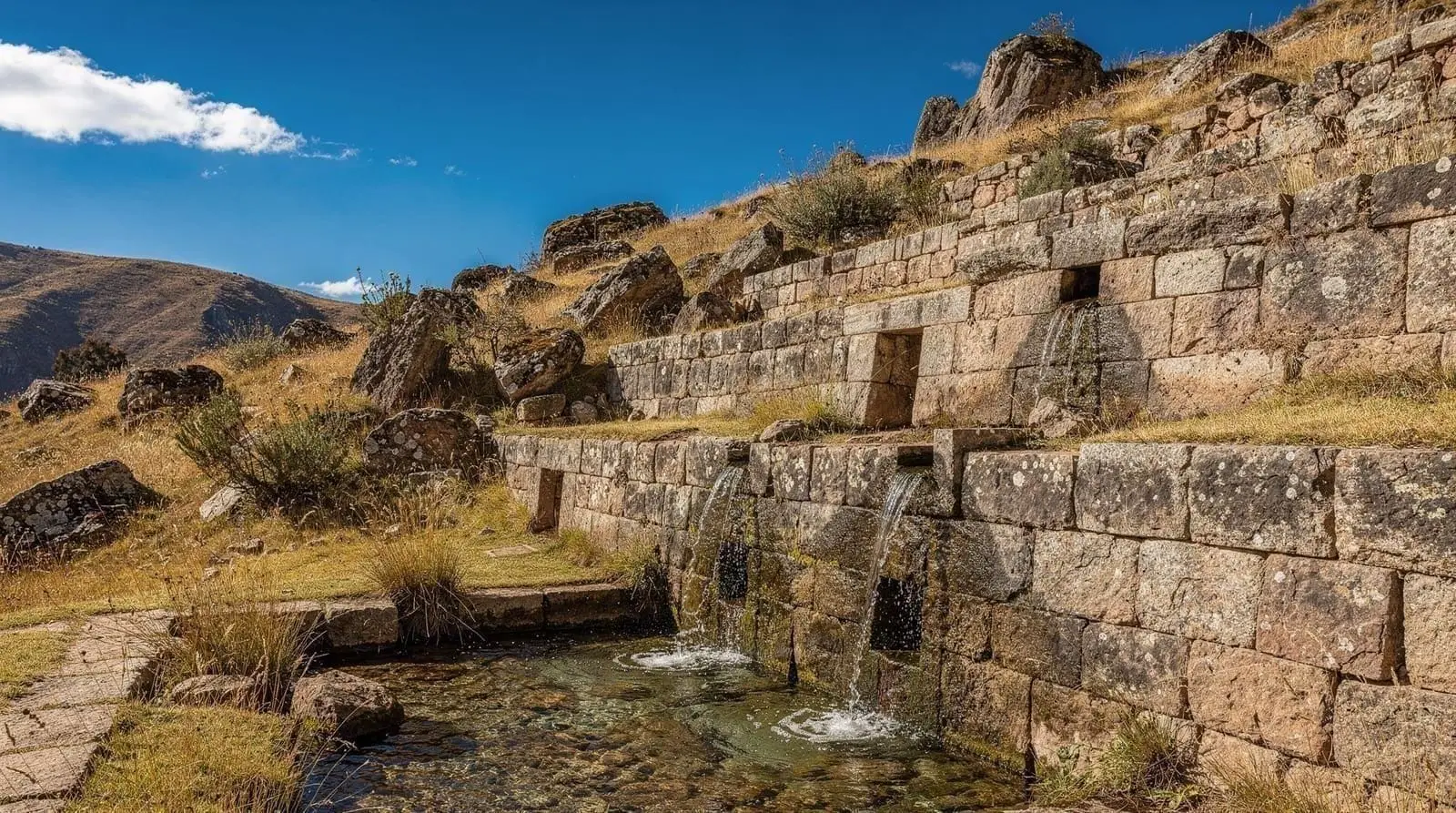
Tambomachay, Qenqo and Puka Pukara
Honest guide to the four ruins above Cusco — Sacsayhuamán, Qenqo, Puka Pukara, Tambomachay: boleto turístico, hours, how to combine them, what to skip.
Cusco: Half-Day City Tour with Sacsayhuaman and Q’enco
Quick facts
- Location
- Along the Cusco-Pisac road, 4-8 km north of the Plaza de Armas
- Altitude
- 3,650-3,800 m / 11,980-12,470 ft (higher than Cusco)
- Entry
- Covered by the boleto turístico (no separate tickets)
- Hours
- Roughly 7 am-5:30 pm daily
- Best for
- Inca water shrines, half-day archaeology, scenic walk back to Cusco
The four ruins on the hill above Cusco
A short drive up the Pisac road from the centre of Cusco lies a string of four Inca sites that almost everyone visits together, usually on the same afternoon city tour: the vast fortress-temple of Sacsayhuamán, the carved rock shrine of Qenqo, the small lookout of Puka Pukara, and the spring-fed terraces of Tambomachay. They share one ticket, one road, and a few hours of your time, and together they are the easiest way to grasp how the Inca organised the landscape immediately around their capital — with ceremonial water sources, sun-aligned shrines, control points, and the colossal walls that guarded the city above.
Sacsayhuamán is the headline act and has its own dedicated page; this guide covers the three smaller, often-rushed sites that share the circuit with it — Qenqo, Puka Pukara and Tambomachay — and explains how to combine all four sensibly. None of the three is large. Visited as a box-ticking convoy they can feel anticlimactic. Visited with a little context, and ideally on a downhill walk in the morning light, they are a quietly rewarding half-day and a gentle way to acclimatise to the altitude.
| Where | Pisac road, 4-8 km north of Cusco’s Plaza de Armas |
| Cost | Covered by the boleto turístico (Circuit I, around S/70) |
| Time needed | Half a day, or a morning if walking downhill |
| Getting there | Taxi to Tambomachay (around S/30-40), walk down |
| Best time | Morning, dry season (May-September) |
All four share one ticket: the boleto turístico
This is the key logistics point. Qenqo, Puka Pukara, Tambomachay, and Sacsayhuamán are all covered by the boleto turístico — Cusco’s bundled tourist ticket. None of them sells a standalone entry ticket at the gate, so you cannot just turn up and pay per site; you need the boleto in hand.
The relevant options are:
- Full boleto turístico (Boleto General): around S/130 (about $35), valid 10 days, covering all 16 sites including these four ruins plus the Sacred Valley sites at Pisac, Ollantaytambo and others.
- Partial Circuit I: around S/70 (about $19), valid 1 day, covering exactly these four ruins above Cusco and nothing else — the cheapest legal way to do just this circuit.
Buy the boleto at the official COSITUC office on Avenida El Sol in Cusco, or at the gate of the first site you reach. Bring your passport. Note that Qorikancha is NOT on the boleto — that temple charges its own separate entry. See the boleto turístico guide for the full site list and which partial circuit makes sense for your plans.
The four sites, briefly
Sacsayhuamán — the headline
The enormous zigzag megalithic walls above the city, with single stones weighing many tonnes fitted without mortar, plus wide ceremonial esplanades. It is by far the largest and most impressive of the four, and it has its own full guide at /destinations/sacsayhuaman/. Most tours start here. Allow 1 to 1.5 hours.
Qenqo (Q’enqo)
About 1 km past Sacsayhuamán, Qenqo is a carved limestone outcrop riddled with channels, niches, and an underground chamber thought to have been used for rituals — possibly involving libations of chicha (corn beer) or even blood poured down the zigzag channels (q’enqo means “zigzag” in Quechua). The standout feature is the subterranean cut-rock “altar” inside the natural rock. It is small — 20 to 30 minutes is plenty — but it is the most atmospheric of the three minor sites and the carved-rock craftsmanship is genuinely strange and impressive.
Puka Pukara
A few kilometres further up the road, Puka Pukara (“red fortress,” for the reddish hue of the stone at sunset) is a compact complex of walls, terraces, and chambers overlooking the valley. Despite the “fortress” name, archaeologists generally read it as a control point, waystation, or guard post on the road to the Sacred Valley rather than a military stronghold. It is the slightest of the four — 15 to 20 minutes — and the main reward is the view rather than the ruin itself. Be honest with yourself: this is the one most people walk through quickly.
Tambomachay
Directly across the road from Puka Pukara, Tambomachay is the most refined of the smaller sites: a series of finely built terraces and a still-functioning spring-fed water channel that feeds cascading stone fountains. It is widely interpreted as a shrine to water — an Inca water cult site, sometimes romantically called the “Inca baths.” The masonry is excellent and the water still runs after five centuries, which is the quiet wonder of the place. Allow 20 to 30 minutes.
The best way to do the circuit
The default is the afternoon city tour out of Cusco, which buses you between the four sites in a few hours. It is efficient and cheap but tends to herd everyone through in convoy, and the three small sites blur together.
A better version, if you have the legs and a morning free: take a taxi (around S/30-40 / about $8-11) or a colectivo from Cusco up to Tambomachay, the highest site, and then walk downhill back toward the city, hitting Puka Pukara, Tambomachay’s neighbour, then Qenqo and Sacsayhuamán in turn before descending into San Blas and the historic centre. The whole walk is roughly 8 km, mostly downhill, with big valley views, and it lets you linger where you want rather than where the bus stops. Carry water, sun protection, and small soles for any roadside snacks; there is no shade and the sun at 3,700 m is fierce.
For a guided version that handles the transport and explains each site, the half-day Cusco city tour with Sacsayhuamán and Qenqo is the standard option and covers all four ruins in one afternoon. If you would rather pair the ruins circuit specifically with the in-town Temple of the Sun, the city tour combining Qorikancha and Sacsayhuamán bundles the most essential Inca masonry in Cusco into a single half-day.
If you only have time for one of the three minor sites
Not everyone has a spare morning, and tour schedules sometimes squeeze the three small sites into thirty rushed minutes. If you have to prioritise, go with your interest: Qenqo rewards anyone drawn to the strange and ceremonial — the subterranean carved altar is unlike anything else on the standard Cusco circuit, and its proximity to Sacsayhuamán (about 1 km) makes it the easiest add-on.
Tambomachay rewards anyone who cares about Inca hydraulic engineering — the fact that water still runs through five-century-old channels is the kind of detail that sticks with you longer than the site’s modest size suggests. Puka Pukara is the one to skip first if you are pressed for time; its interest is almost entirely the view and the road-network logic, which a guide can explain in two sentences from the vehicle window.
Combining the circuit with the rest of Cusco’s Inca sites
The four ruins above the city are only part of Cusco’s archaeological picture. In town, Qorikancha — the Inca sun temple with a colonial church built directly on top of its foundations — is the essential complement, and it is not on the boleto, so budget separately for it. A short walk from Qorikancha through San Blas and the historic centre fills the rest of a day nicely.
Travellers with more time and a taste for lesser-visited Inca sites sometimes continue to the South Valley circuit at Tipón and Pikillacta, which is covered by the same boleto turístico and sees a fraction of the visitors. For a fuller run-down of what the boleto covers and which partial circuit suits different itineraries, see the boleto turístico explained guide and the wider Cusco archaeological sites overview.
If you are building a longer Cusco stay, the best day trips from Cusco guide situates this half-day circuit alongside the Sacred Valley options at Pisac and Ollantaytambo, which deserve a full day each rather than being squeezed in alongside these four ruins.
Weather, light and photography
Because the circuit sits higher than Cusco and is largely open, unshaded hillside, conditions change fast. Morning light (before around 10 am) is the most flattering for photographs at Puka Pukara and Tambomachay, both of which face open valley views that wash out under the flat midday sun. Afternoon cloud builds quickly in the wet season (November-March), sometimes with short, sharp downpours — not a reason to avoid the circuit, but a reason to carry a light rain layer even on an apparently clear morning. In the dry season (May-September) skies are more reliable but the UV at 3,700 m is intense even when the air feels cool.
Honest watch-outs
Manage your expectations on the three small sites. Qenqo, Puka Pukara and Tambomachay are minor sites individually. Their value is cumulative and contextual — the water cult, the road network, the rock shrines — not in any single jaw-dropping monument. Sacsayhuamán carries the circuit.
Altitude is real here. Tambomachay sits around 3,700 m, higher than Cusco itself. If you have just arrived, this circuit is a fine gentle acclimatisation day — but do not turn the downhill walk into a brisk hike on day one. Go slow.
The “Inca baths” framing. Tambomachay is sometimes sold as a bathing complex; it is far more likely a ceremonial water shrine. Lovely either way, but don’t expect anything you’d actually bathe in.
Persistent vendors and photo llamas. At the roadside stops, especially near Sacsayhuamán, you’ll meet women in traditional dress offering photos with llamas for a tip (S/3-5 is fair) and stalls selling crafts. It’s harmless but constant; a polite “no, gracias” works.
Don’t double-pay. Because all four are on the boleto, never pay a “site fee” at the gate beyond showing your ticket. If anyone asks for cash entry at these four ruins, it’s not legitimate.
Practical information
Getting there: Taxi from Cusco to Tambomachay is about S/30-40 (around $8-11) one way; colectivos run the Pisac road for a few soles. Most visitors arrive on an organised city tour.
Hours: Roughly 7 am to 5:30 pm daily. Arrive before 9:30 am to beat the tour-bus waves.
Tickets: Boleto turístico only — full (S/130, 10 days) or Partial Circuit I (S/70, 1 day, these four sites). Bring your passport.
Time needed: Half a day for all four, including Sacsayhuamán. The three small sites together take only about an hour of actual visiting.
What to bring: Water, hat, high-SPF sunscreen, layers (mornings are cold, midday sun is intense), small soles for tips and snacks. No food sold inside the sites beyond roadside stalls.
Frequently asked questions about the Cusco ruins circuit
Are Tambomachay, Qenqo and Puka Pukara worth visiting?
Visited together with Sacsayhuamán and with a little context, yes — they make a satisfying, acclimatisation-friendly half-day. Individually the three small sites are minor: Qenqo is an atmospheric carved-rock shrine, Tambomachay a fine water-cult site with running fountains, and Puka Pukara a small lookout that’s mostly about the view. Sacsayhuamán is the genuine highlight of the four.
Do I need a separate ticket for each ruin?
No — and you can’t buy one. All four sites (Sacsayhuamán, Qenqo, Puka Pukara, Tambomachay) are covered by the boleto turístico, which you buy once. The cheapest legal option for just these four is the Partial Circuit I ticket (about S/70, valid one day). The full boleto (about S/130, ten days) also covers the Sacred Valley sites.
How long does the Cusco ruins circuit take?
About half a day. The three small sites take only 15-30 minutes each; Sacsayhuamán deserves an hour or more. A typical afternoon city tour covers all four in three to four hours. If you walk the downhill route from Tambomachay back to Cusco independently, allow the better part of a morning.
Can I walk the ruins circuit from Cusco?
Yes, and it’s the nicest way to do it. Take a taxi up to Tambomachay (the highest site) and walk roughly 8 km downhill past Puka Pukara, Qenqo and Sacsayhuamán into the city. It’s mostly downhill with big valley views. Carry water and sun protection — there’s no shade and the high-altitude sun is intense.
What does Qenqo mean and what is it?
Q’enqo means “zigzag” in Quechua, named for the carved channels cut into a limestone outcrop. It was a ritual site, with an underground cut-rock chamber thought to have been used for ceremonies, possibly involving libations poured down the zigzag grooves. It’s small but the carved stonework and subterranean altar are the most atmospheric of the three minor ruins.
Is Tambomachay really the “Inca baths”?
Probably not in the bathing sense. The nickname comes from the still-running spring-fed fountains, but archaeologists read it as a ceremonial water shrine — part of an Inca water cult — rather than a bathing complex. The marvel is that the channels still carry water after five centuries, fed by springs the Inca engineered into the hillside.
Top experiences
Bookable activities with verified prices and instant confirmation on GetYourGuide.
