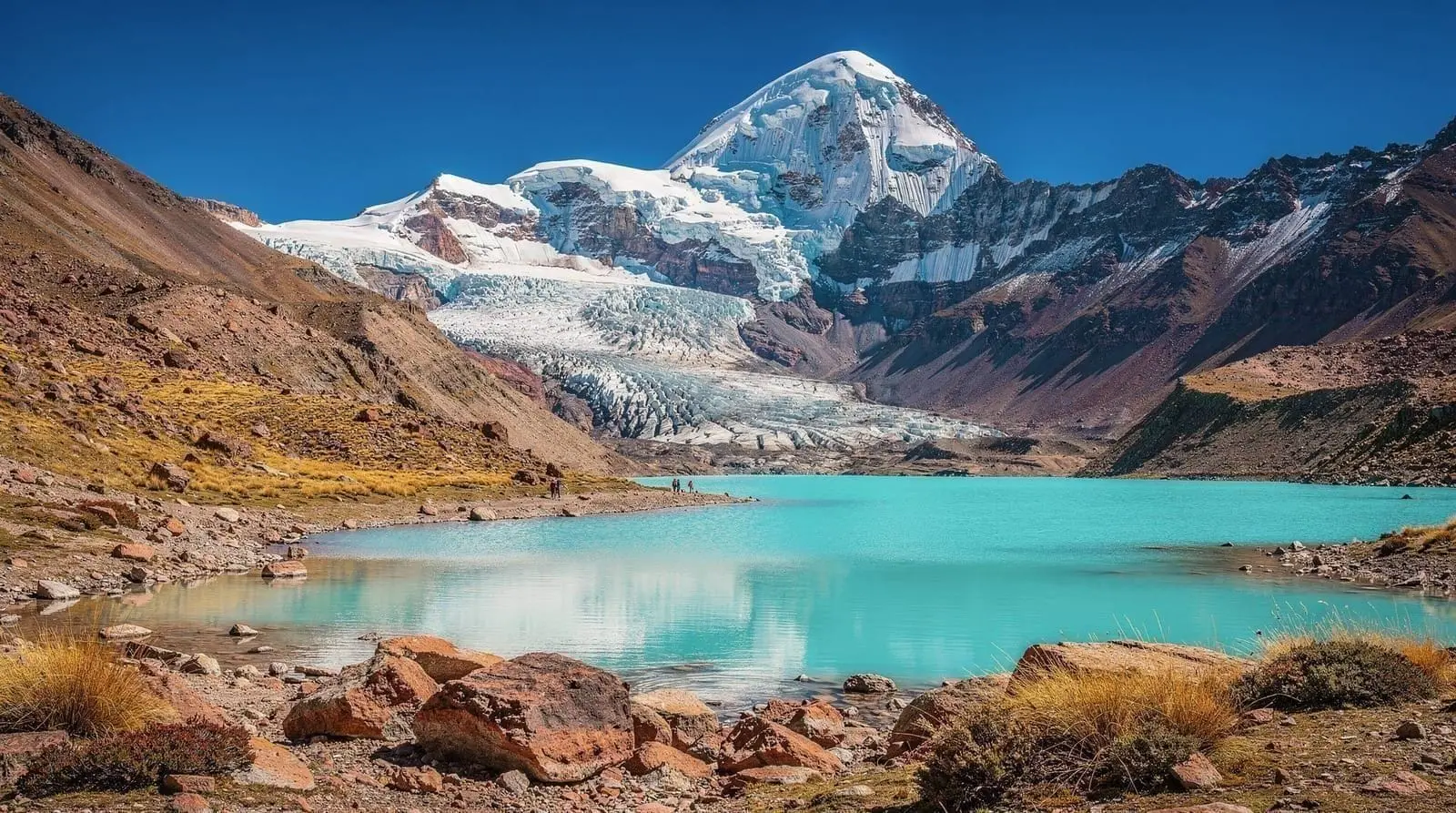
Ausangate lakes day trip from Cusco
From Cusco: Ausangate Lakes and Glaciers ATV Tour
Can you visit Ausangate's lakes on a day trip from Cusco?
Yes. A long single day (roughly 14–16 hours, leaving Cusco around 4:30 am) reaches the turquoise lagoons of the Seven Lakes circuit at 4,400–4,700 m. Expect S/120–200 per person and a demanding day at altitude. The full multi-day trek is a separate, far harder undertaking.
The day trip most Cusco visitors have never heard of
Almost everyone who flies into Cusco knows about Rainbow Mountain. Far fewer have heard of the Ausangate lakes, and that gap is precisely why the trip is worth your attention. The Seven Lakes (Siete Lagunas) circuit threads a string of glacial lagoons across the lower flanks of Nevado Ausangate, the 6,384 m peak that is the holiest mountain (apu) in the southern Andes. The water shifts from milky turquoise to deep emerald to almost-black depending on the mineral load and the angle of the light, and on a clear dry-season morning the whole basin sits under a wall of glacier and snow with — unusually for the Cusco region — almost nobody else around.
This guide is for the realistic day-tripper: someone based in Cusco who wants to see the lakes and the mountain without committing to the multi-day Ausangate trek. It is honest about what a single day demands. The lakes sit higher than Rainbow Mountain, the drive is long, and the walking is more than a casual stroll. Done with proper acclimatisation, it is one of the most rewarding days you can have out of Cusco. Done on your first morning off the plane, it can be miserable or genuinely dangerous.
| Where | Nevado Ausangate, ~100 km southeast of Cusco via Urcos and Tinki |
| Cost | Around S/120–200/person, plus a S/10–20 community fee |
| Time needed | 14–16 hours door to door, 4–5 hours walking |
| Altitude | Trailhead ~4,300 m, lakes up to ~4,700 m — higher than Rainbow Mountain |
| Best time | Dry season, May–September, for clear skies and vivid lake colour |
Where Ausangate is and how long the drive takes
Nevado Ausangate rises about 100 km southeast of Cusco in the Vilcanota range of the Cordillera Vilcanota. The driving route runs through Urcos and the high pampa town of Tinki (also spelled Tinqui), at around 3,800 m, which is the staging point for almost every Ausangate excursion. The road is paved most of the way and then turns to a rough dirt track for the final climb to the trailheads.
Plan on three to four hours each way by road. That is why the day starts brutally early: most operators collect you from your Cusco hotel between 4:00 am and 4:45 am, stop for breakfast en route in Tinki, reach the trailhead by mid-morning, give you four to five hours on the circuit, and return you to Cusco somewhere between 6:00 pm and 8:00 pm. A 14–16 hour door-to-door day is normal. Anyone who tells you it is a relaxed half-day outing is misleading you.
The Seven Lakes circuit: what you actually walk
The classic day-trip route is the Siete Lagunas hike, which is distinct from both Rainbow Mountain and the full trekking circuit. From a trailhead around 4,300 m you climb gradually past a sequence of lagoons — names vary by guide, but you will hear Pucacocha (the reddish one), Azulcocha (the blue one), and Alccacocha among them — each at a slightly different elevation, the highest viewpoints reaching roughly 4,600–4,700 m.
The total walking distance is about 8–12 km depending on how many lakes your group reaches and whether you push to the upper viewpoint beneath the glacier. There is no single punishing climb like Rainbow Mountain’s final ramp; instead the trail undulates, which at this altitude is its own kind of tiring. Most reasonably fit, acclimatised walkers manage it comfortably in four to five hours with stops. The reward at the top is a full-on view of Ausangate’s glaciers calving down toward the highest lagoon, frequently with grazing alpacas and the occasional condor for scale.
Because the route is far less developed than Rainbow Mountain, there are no horses-for-hire lining the trail, no rows of snack stalls, and no human traffic jam at the viewpoint. That solitude is the whole point. It also means there is no easy bail-out: if you tire halfway up, you walk back the way you came rather than hopping on a horse.
How it compares to Rainbow Mountain and Humantay
If you are choosing between Cusco’s headline high-altitude day hikes, the honest contrasts are these.
Rainbow Mountain is the busiest and the most accessible: a short, steep 3–4 km out-and-back to a 5,000 m ridge, with horses and snack stands the whole way, and hundreds of other people on a peak-season morning. The colour is the draw; the experience is crowded.
Humantay Lake is shorter and lower than Ausangate’s lakes (the lagoon sits at about 4,200 m after a steep 45–60 minute climb) and sees heavy crowds too, but the single turquoise lake under Salkantay’s glacier is spectacular and the walking commitment is modest.
The Ausangate lakes sit between the two on effort but well below both on crowds. You walk more than at Rainbow Mountain, you go higher than at Humantay, and you share the trail with a fraction of the people. For travellers who have already done the obvious sights and want somewhere quieter, this is the standout. For a complete rundown of all the options, see the best day trips from Cusco.
Altitude: the non-negotiable warning
This trip tops out around 4,700 m. Cusco is 3,400 m. That is a serious jump, and the single biggest mistake travellers make is doing Ausangate too early in their trip.
Give yourself at least two or three full days acclimatising in Cusco or the Sacred Valley before attempting it — ideally after you have already done a lower hike or two without trouble. The symptoms to expect at the lakes are the usual breathlessness, a thumping headache, and slow legs; these are uncomfortable but normal. The symptoms that mean you turn around immediately are confusion, loss of coordination, severe vomiting, or a wet, bubbling cough. At 4,700 m, three hours from the nearest clinic, altitude problems escalate fast. The fuller picture is in our altitude sickness guide.
Practical defences: hydrate hard the day before and during the hike, chew coca leaves or drink coca tea (offered at the breakfast stop), eat lightly, and walk at a deliberately slow, steady pace. If you are prone to altitude sickness, talk to a doctor at home about acetazolamide before you travel.
What it costs and what is included
Group day tours to the Ausangate lakes run roughly S/120–200 per person (about $32–54), and the lower end of that range should make you read the fine print. A fair, fully inclusive price covers round-trip transport from your hotel, breakfast in Tinki, a cooked lunch, and a guide.
Watch for these extras:
- Community entrance fee: the Ausangate-area communities charge a trail fee of around S/10–20, almost always paid in cash at the trailhead and usually not in the tour price. Carry small soles.
- Trekking poles: sometimes rentable for a few soles at the start; bring your own if you can.
- Tips: guides and drivers on these long days appreciate a tip; S/10–20 is normal.
Avoid the cheapest operators advertising rock-bottom fares on Plaza de Armas flyers. The corners cut on these long, high routes — overcrowded vans, unqualified guides, no oxygen on board — are exactly the ones that matter when you are 100 km out at 4,700 m.
The lower-effort alternative: the ATV tour
Not everyone can — or wants to — walk five hours at altitude. If a full hiking day is beyond your fitness or your acclimatisation window, the quad-bike option reaches Ausangate’s lake and glacier viewpoints with a fraction of the walking. The Ausangate lakes and glaciers ATV tour from Cusco trades the silence of the trail for engine noise, but it puts the turquoise water and the glacier wall within reach of travellers who would otherwise have to skip Ausangate entirely. It is also a genuinely fun way to cover the high pampa.
If you would rather hike but want to keep the option simple, you can also weigh Ausangate against the perennially popular Rainbow Mountain day trip, which the Vinicunca Rainbow Mountain day trip from Cusco covers in a shorter, if busier, package.
What to pack for the day
- Layers: it is below freezing at dawn and can hit the low 20s °C in the midday sun. A base layer, fleece, and windproof shell is the right kit.
- Sun protection: the high-altitude UV is fierce even when it feels cold. Sunglasses, a brimmed hat, and high-factor sunscreen are essential.
- Broken-in boots and poles: the undulating, sometimes boggy ground rewards grip and stability.
- Water and snacks: at least 1.5 litres; there are no stalls on the trail.
- Cash in soles: for the community fee, poles, and tips.
- A small first-aid kit and any altitude medication you carry.
Phones drink battery in the cold, so bring a power bank if you want photos of every lake.
A typical day, hour by hour
To set expectations clearly, here is how a standard group day trip to the Ausangate lakes actually unfolds.
4:00–4:45 am: hotel pickup in Cusco. You will be groggy; this is normal. The van fills up as it loops the city.
4:45–7:30 am: the drive out via Urcos toward Tinki, much of it in the dark, climbing steadily onto the altiplano as dawn breaks.
7:30–8:30 am: breakfast in or near Tinki — usually bread, eggs, fruit, and coca tea. Use the stop to hydrate and warm up.
8:30–10:00 am: the final rough drive to the trailhead, often on a dirt track that the last stretch of any rain turns to mud.
10:00 am–3:00 pm: the hike. Roughly four to five hours covering the lakes, with the highest viewpoint and lunch (sometimes a packed lunch on the trail, sometimes back near the vehicles).
3:00–7:00 pm: the long drive back to Cusco, arriving tired and usually after dark.
Knowing the shape of the day helps you pace yourself — and helps you understand why this is a genuinely big undertaking, not a casual outing.
Who should skip it
Be honest with yourself about fitness and timing. You should not attempt the full hiking day if: you have been at altitude for fewer than two or three days; you have had any altitude-sickness symptoms in Cusco; you have a heart or lung condition without medical clearance; or you simply do not enjoy long days of walking on uneven ground. For these travellers, the ATV option above or a lower outing like Humantay Lake or a Sacred Valley day is the smarter call. There is no shame in choosing the trip that matches your body — the mountains are unforgiving precisely at the altitudes that make them spectacular.
How it fits a Cusco trip
The Ausangate lakes work best as a later-in-your-stay outing, once Cusco’s altitude is behind you and you have already done the headline sights. A sensible sequence: acclimatise in Cusco for two days, do the Sacred Valley (which sits lower and helps your body adjust), visit Machu Picchu, then slot the Ausangate lakes or Rainbow Mountain into the back half of the trip when you are fully acclimatised.
For the full menu of options and how to order them, see our best day trips from Cusco guide; for the multi-day version of this landscape, the Ausangate trek guide.
Is the Ausangate lakes day trip worth it?
For an acclimatised, reasonably fit traveller who has already ticked off the obvious sights, yes — emphatically. You get glacial lagoons as vivid as anything in the region, the holiest peak in the southern Andes towering over them, and the rare luxury of near-solitude on a Cusco day trip. For a first-timer straight off the plane, or anyone wanting a gentle outing, no — choose Humantay Lake or a Sacred Valley day instead and save Ausangate for later in your trip. And if the lakes leave you wanting more of this range, the multi-day Ausangate trek is the natural next step.
A note on responsible visiting
The reason the Ausangate lakes feel pristine is partly that few people go, and partly that the communities along the route — Quechua-speaking herders who have grazed alpacas and llamas on these slopes for generations — manage the land. The trail fees you pay at the trailhead go to those communities, so pay them willingly and carry the right cash. Pack out everything you bring in; there are no bins and the high, cold environment breaks down litter painfully slowly. Ask before photographing herders or their animals, and keep your distance from grazing livestock. Visiting lightly and respectfully is the small price of keeping a place like this quiet and unspoiled for the travellers who come after you.
Choosing an operator you can trust
Because the day is long, remote, and physically demanding, operator quality matters more here than on a shorter, busier trip like Rainbow Mountain. Ask specifically whether the vehicle carries oxygen and a first-aid kit, how many guests travel per van, and whether the guide has handled an altitude emergency before — vague answers are a warning sign on a route three hours from the nearest clinic. Recent, specific reviews mentioning the guide’s pace-setting and how the group was supported at altitude are worth more than a star average. The cheapest quote on the Plaza de Armas flyers is rarely the safest choice for a day this remote.
Frequently asked questions about the Ausangate lakes day trip
Frequently asked questions about Ausangate lakes day trip from Cusco
How high are the Ausangate lakes?
Is the Ausangate lakes day trip harder than Rainbow Mountain?
How much does the Ausangate lakes day trip cost?
What is the best time of year for the Ausangate lakes?
Do I need crampons or technical gear?
Can I combine the lakes with the ATV tour?
Top experiences
Bookable activities with verified prices and instant confirmation on GetYourGuide.

