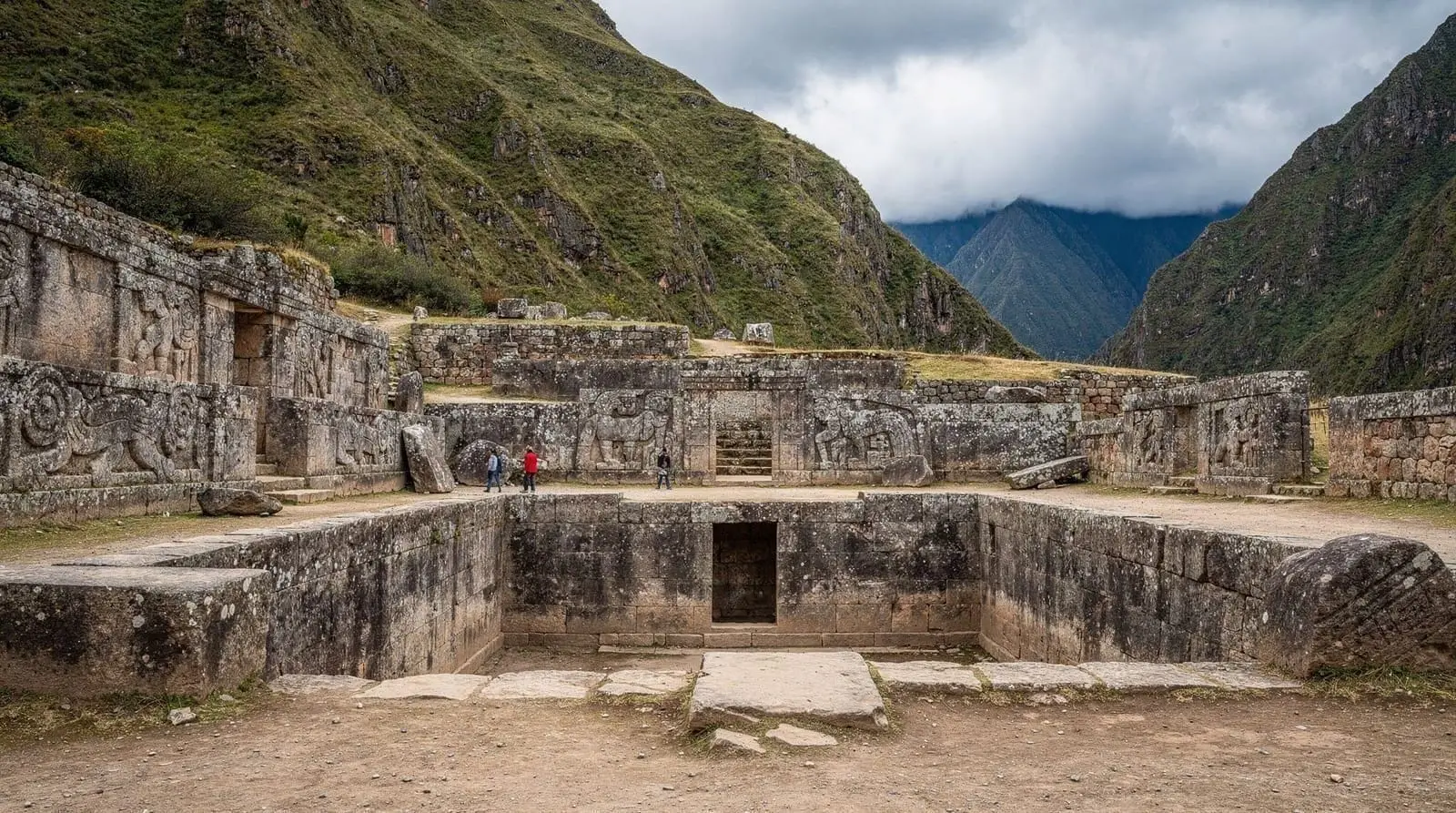
Chavín de Huántar guide: the pre-Inca temple that shaped the Andes
From Huaraz: Chavín de Huántar Full-Day Tour with Lunch
What is Chavín de Huántar and why does it matter?
Chavín de Huántar is a UNESCO-listed ceremonial centre about 110 km from Huaraz, built by the Chavín culture between roughly 1200 and 400 BCE — over a thousand years before the Incas. Its underground stone galleries, the carved Lanzón monolith, and tenon heads make it one of the most important archaeological sites in the Americas.
A temple older than almost anything you’ve heard of
Most visitors to Peru organise their trip around the Incas — Machu Picchu, the Sacred Valley, Cusco. What surprises people is how late the Incas arrive in the story. Chavín de Huántar was already an ancient ruin by the time the Inca empire existed. Built and expanded by the Chavín culture between roughly 1200 and 400 BCE, it predates the Incas by more than a thousand years and ranks among the earliest monumental religious centres anywhere in the Americas. For perspective, the oldest parts of Chavín are contemporary with the height of ancient Egypt’s New Kingdom.
| Where | ~110km from Huaraz, via the Kahuish tunnel (4,500m) |
| Cost | ~S/15 site entry; S/60-110 guided day tour |
| Time needed | Full day (round trip ~6hrs) |
| Getting there | Organised tour (recommended) or combi |
| Best time | Early in your Huaraz stay, as an acclimatisation day |
What makes it extraordinary is not size — it is not a vast city — but sophistication. The Chavín built a complex of stone platforms riddled with interior galleries: dark, narrow stone passages that run inside the temple structure, ventilated and drained by an engineered system of channels. At the heart of it sits the Lanzón, a 4.5 m carved granite monolith depicting a fanged deity, still standing in the exact spot where it was placed nearly three thousand years ago. The site is a UNESCO World Heritage property and yet sees a tiny fraction of the visitors that flock to the Inca sites — which is precisely its appeal.
This guide covers what you will actually see, how to get there from Huaraz, and how to plan the visit. For the destination overview, see the Chavín de Huántar destination page.
What the Chavín culture actually was
Chavín was not an empire in the political sense. Archaeologists describe it as a religious phenomenon — a cult and an artistic style that spread across much of what is now Peru between roughly 900 and 200 BCE, a period often called the Early Horizon. Its influence shows up in pottery, textiles, and goldwork from the coast to the highlands, suggesting Chavín de Huántar functioned as a kind of pilgrimage centre, drawing people and ideas from a wide region. The recurring imagery — fanged felines, raptors, serpents, and beings that blend human and animal features — became a shared visual language across Andean cultures for centuries.
The leading interpretation is that Chavín’s priests used the temple’s architecture to stage transformative religious experiences. The dark galleries, the disorienting acoustics, the sudden encounter with the Lanzón, and very likely the ritual use of psychoactive San Pedro cactus (depicted in the site’s carvings) combined to produce an overwhelming sensory event for initiates. Whether or not you accept every detail of that reconstruction, standing in the galleries makes the theatrical intent unmistakable.
What you’ll see on site
The galleries
The interior passages are the highlight and the thing no photograph prepares you for. They are genuinely dark, low, and narrow — claustrophobic for some — and lit today only by modest electric lighting. The most famous, the Gallery of the Lanzón, leads to the central monolith. Walking through, you understand how the architecture was designed to control what an initiate saw and heard, building to the encounter with the deity. The Chavín engineered ventilation and water channels through these passages, and on certain occasions water was apparently run through to produce a roaring sound — an acoustic effect you can still partly appreciate.
The Lanzón
The Lanzón is the singular object at Chavín. A 4.5 m blade-shaped granite shaft, carved in low relief with a standing anthropomorphic figure — fangs, clawed hands, snakes for hair, one arm raised and one lowered. It remains in situ, in the cruciform chamber at the meeting of two galleries, exactly where the Chavín placed it. Seeing it in its original dark setting, rather than in a museum, is the reason to come.
The plazas and the carved heads
Outside, the Circular Plaza and the larger sunken square were the public gathering spaces, faced with carved stone slabs depicting processions of figures. Around the temple exterior, the cabezas clavas (tenon heads) — carved stone heads that projected from the walls, several showing the apparent stages of a ritual transformation from human to feline — are among the site’s most striking sculptures. Most originals are now protected; one remains on the wall and the rest are in the museum.
The Museo Nacional de Chavín
A short distance from the ruins, the Museo Nacional de Chavín holds the moveable sculpture, including most of the original tenon heads and the celebrated Tello Obelisk and Raimondi Stela (note: the Raimondi Stela’s original is in Lima; check current displays). Visiting the museum transforms the trip — without it, the carved imagery at the site is hard to read. A good day tour includes the museum; a cheap one often skips it, which is a false economy. When booking, confirm the museum is part of the itinerary.
Chavín de Huántar and museum day trip from HuarazGetting there from Huaraz
Chavín de Huántar lies about 110 km south-east of Huaraz, on the far (eastern) side of the Cordillera Blanca, in the Conchucos valley. The drive takes roughly three hours each way and is, frankly, half the experience: the road climbs to the Kahuish tunnel at around 4,500 m, punching through the mountain wall, then descends into a different, greener landscape on the eastern side. The scenery is superb in clear weather.
There are two practical ways to visit:
Organised day tour from Huaraz is what the vast majority do, and it makes sense — the logistics, the long drive, the guide who can read the carvings for you, and usually lunch and the museum are bundled. A full-day guided tour typically costs S/60–110 (about $16–30 USD) per person, plus the site entry fee.
Chavín de Huántar full-day tour with lunch from HuarazIndependent by public transport is possible but a long day: combis and colectivos run from Huaraz to the town of Chavín de Huántar (the modern village beside the ruins), taking three to four hours. You then walk to the site and museum. This is cheaper — bus fares run roughly S/15–25 each way — but you lose the guided interpretation and risk a rushed visit if the return transport is unreliable. For most travellers the tour is better value once you account for the guiding.
Excursion to Chavín de HuántarCosts, hours, and the honest budget
- Site entry: the combined ticket for the ruins (and, where applicable, the museum) is modest — around S/15 (about $4 USD) for the archaeological site, with the national museum often free or a small additional fee; confirm current pricing, as it changes.
- Guided day tour from Huaraz: roughly S/60–110 including transport, guide, and usually lunch.
- Lunch independently: the village has simple restaurants; a menú del día runs S/12–20.
Opening hours for the site are generally 09:00 to 17:00, with the last entry well before closing; the museum keeps similar hours and is often closed one day a week (frequently Monday). Because tour timetables and the museum’s closing day shift, confirm when you book.
The altitude angle
The drive crosses the Kahuish tunnel at around 4,500 m, but you do not spend long at that height and the site itself sits lower, around 3,150 m — similar to Huaraz. That said, this is still a high-altitude excursion, and the early start with a long winding drive can be hard on anyone not yet acclimatised or prone to motion sickness. A sensible plan is to do Chavín as an acclimatisation-friendly day — it involves little strenuous walking — early in your Huaraz stay, before the harder high-altitude hikes. See the Huaraz acclimatisation guide for how to sequence your days, and the best day hikes near Huaraz for the more strenuous alternatives.
The rediscovery and conservation of the site
Chavín did not survive the centuries intact. After the Chavín culture declined around 200 BCE, the site was occupied and altered by later groups, and over the following two millennia it suffered earthquakes, looting, and burial under landslide debris from the steep valley above. The Peruvian archaeologist Julio C. Tello, often called the father of Peruvian archaeology, carried out the foundational excavations in the early twentieth century and recognised Chavín’s role as a wellspring of Andean civilisation — the Tello Obelisk bears his name. A catastrophic 1945 landslide (an aluvión) buried much of the site again, and subsequent decades saw further excavation and painstaking clearing of the galleries.
Conservation is an ongoing challenge. The galleries are vulnerable to water infiltration, and the soft stone of some carvings erodes with humidity and handling, which is why interior photography rules and visitor routing are managed. Understanding this history adds to a visit: you are not looking at a pristine monument but at a resilient one, repeatedly damaged and repeatedly recovered, whose survival reflects more than a century of Peruvian scholarship and care.
What to eat and drink on the day
The village of Chavín de Huántar has a handful of simple restaurants around its plaza serving trout (trucha, farmed locally in the Conchucos valley), soups, and the standard menú del día for S/12-20. If your tour includes lunch, it is usually here or at a countryside restaurant en route; if travelling independently, eat before or after the site visit rather than counting on finding an open kitchen at odd hours in a small mountain town. Bring your own snacks and plenty of water for the drive itself, since services thin out considerably once you cross the Kahuish tunnel.
Practical tips and honest warnings
- Bring a light layer. The galleries are cool and damp even on a warm day.
- Watch your footing. The gallery floors are uneven and low; tall visitors will stoop.
- Photography: flash is usually restricted inside the galleries to protect the carvings; the lighting is dim, so a steady hand or a fast lens helps.
- Motion sickness: the winding road over the Cordillera turns some stomachs. If you are prone, take medication before departure and sit toward the front.
- Don’t rush the museum. People who skip it leave confused about what they saw; people who linger leave understanding why Chavín matters.
- Manage expectations on scale. This is not a giant lost city. It is a compact, profoundly important ceremonial centre. Come for the significance and the galleries, not for grandeur on the scale of Machu Picchu.
- Hire a knowledgeable guide. The carved imagery is dense with meaning that is invisible without explanation; a good guide transforms a pile of old stones into a coherent story. This is the single biggest reason a guided tour usually beats going independently.
- Allow a full day. The round trip drive alone is six hours, and rushing the site and museum defeats the purpose. Treat it as a whole-day commitment, not a quick stop.
Combining Chavín with the rest of your Huaraz trip
Chavín works best as a contrast day amid the high-altitude hiking that defines a Cordillera Blanca trip. Because it involves little strenuous walking, it slots neatly into your first or second day in Huaraz, giving your body a gentler day while you adjust to elevation before the demanding hikes. From a planning standpoint, a balanced week might pair the cultural day at Chavín with the glacial-lake day hikes — Laguna 69, the Llanganuco Lakes, and Laguna Parón — covered in the best day hikes near Huaraz guide. Trekkers heading onto the Santa Cruz or Huayhuash routes sometimes use Chavín as a rest day between acclimatisation hikes.
The eastern side of the Cordillera, where Chavín sits, is greener and more agricultural than the trekking valleys to the west, and the drive through the Kahuish tunnel is a genuine highlight rather than mere transit. If you have a particular interest in pre-Columbian archaeology, Chavín pairs thematically with later coastal sites — the Moche and Chimú ruins near Trujillo on the north coast — for travellers building a deeper Peruvian-history itinerary rather than focusing solely on the Incas.
How Chavín reshapes the usual Peru story
For most visitors, Peru’s past begins and ends with the Incas. Chavín is the corrective. It demonstrates that the Andes hosted complex, monumental, artistically sophisticated societies more than two thousand years before the Inca empire rose — and that the Incas were the final chapter of a very long story, not its beginning. The fanged deities, the engineered galleries, the pan-regional religious influence: all of it predates Cusco by a millennium and more. Walking the dark passages to the Lanzón, you are standing inside one of the foundational monuments of Andean civilisation. That perspective alone makes the long day trip from Huaraz worthwhile for anyone who wants to understand Peru beyond the postcard image of Machu Picchu.
Where Chavín fits a Huaraz trekking trip
Most visitors to this region come for the Cordillera Blanca’s trekking, not its archaeology, so Chavín tends to get squeezed out unless you plan for it deliberately. It fits best at the very start of a stay, before the harder trekking days — see the Huaraz complete guide for how to structure a full week around acclimatisation, day hikes and multi-day treks. If your trip includes the Santa Cruz trek or the longer Huayhuash circuit, Chavín works well as a low-exertion rest day either just before you set out or just after you return, when your legs need a break but your curiosity doesn’t.
A sensible seven-day Huaraz frame looks like this: day one, arrive and rest at altitude; day two, Chavín as a gentle acclimatisation day with minimal walking; days three to six, the Santa Cruz trek or a rotation of day hikes to Laguna 69 and the Llanganuco Lakes; day seven, recovery and travel onward. Compressing Chavín into the same window as a demanding trek start or finish usually means arriving tired to a site that rewards attention, so give it its own day if you can.
Frequently asked questions about Chavín de Huántar
How old is Chavín de Huántar?
The site was built and expanded by the Chavín culture between roughly 1200 and 400 BCE, making it over a thousand years older than the Inca empire and one of the earliest monumental religious centres in the Americas.
Is Chavín de Huántar worth visiting?
For anyone interested in Andean history, yes — it is a UNESCO World Heritage site of exceptional importance, with underground stone galleries and the in-situ Lanzón monolith that you cannot see anywhere else. It is not a vast ruin like Machu Picchu, so come for the significance and the architecture rather than sheer scale.
How do I get to Chavín de Huántar from Huaraz?
It is about 110 km (roughly three hours each way) via the Kahuish tunnel over the Cordillera Blanca. Most visitors take an organised day tour that includes transport, a guide, lunch, and the museum. Independent travel by combi is possible but makes for a long, less interpreted day.
How much does a Chavín de Huántar day trip cost?
A guided full-day tour from Huaraz typically costs S/60–110 (about $16–30 USD), including transport and usually lunch, plus the modest site entry fee of around S/15. Independent transport is cheaper but you lose the guiding.
What is the Lanzón at Chavín de Huántar?
The Lanzón is a 4.5 m carved granite monolith depicting a fanged deity, standing in its original position deep inside the temple’s galleries. It is the central religious object of the site and the main reason to visit.
Do I need to acclimatise before visiting Chavín?
The site sits around 3,150 m — similar to Huaraz — and the visit is not physically strenuous, so it makes a good acclimatisation-friendly day early in your stay. The drive does cross a 4,500 m pass briefly, which can affect those very sensitive to altitude or motion sickness.
Is the museum included in Chavín tours?
Good tours include the Museo Nacional de Chavín, which holds the original tenon heads and key sculptures and is essential for understanding the site. Cheaper tours sometimes skip it, so confirm the museum is on the itinerary before booking.
Should I visit Chavín before or after trekking the Cordillera Blanca?
Before, ideally, or on a rest day between treks. It involves little strenuous walking, so it works well as an acclimatisation-friendly day early in your Huaraz stay, ahead of demanding routes like the Santa Cruz trek or the Huayhuash circuit.
Can I visit Chavín de Huántar in a half-day?
No, realistically. The round-trip drive alone takes about six hours given the distance and the mountain road, so treat it as a full-day commitment rather than trying to combine it with another excursion the same day.
Top experiences
Bookable activities with verified prices and instant confirmation on GetYourGuide.
