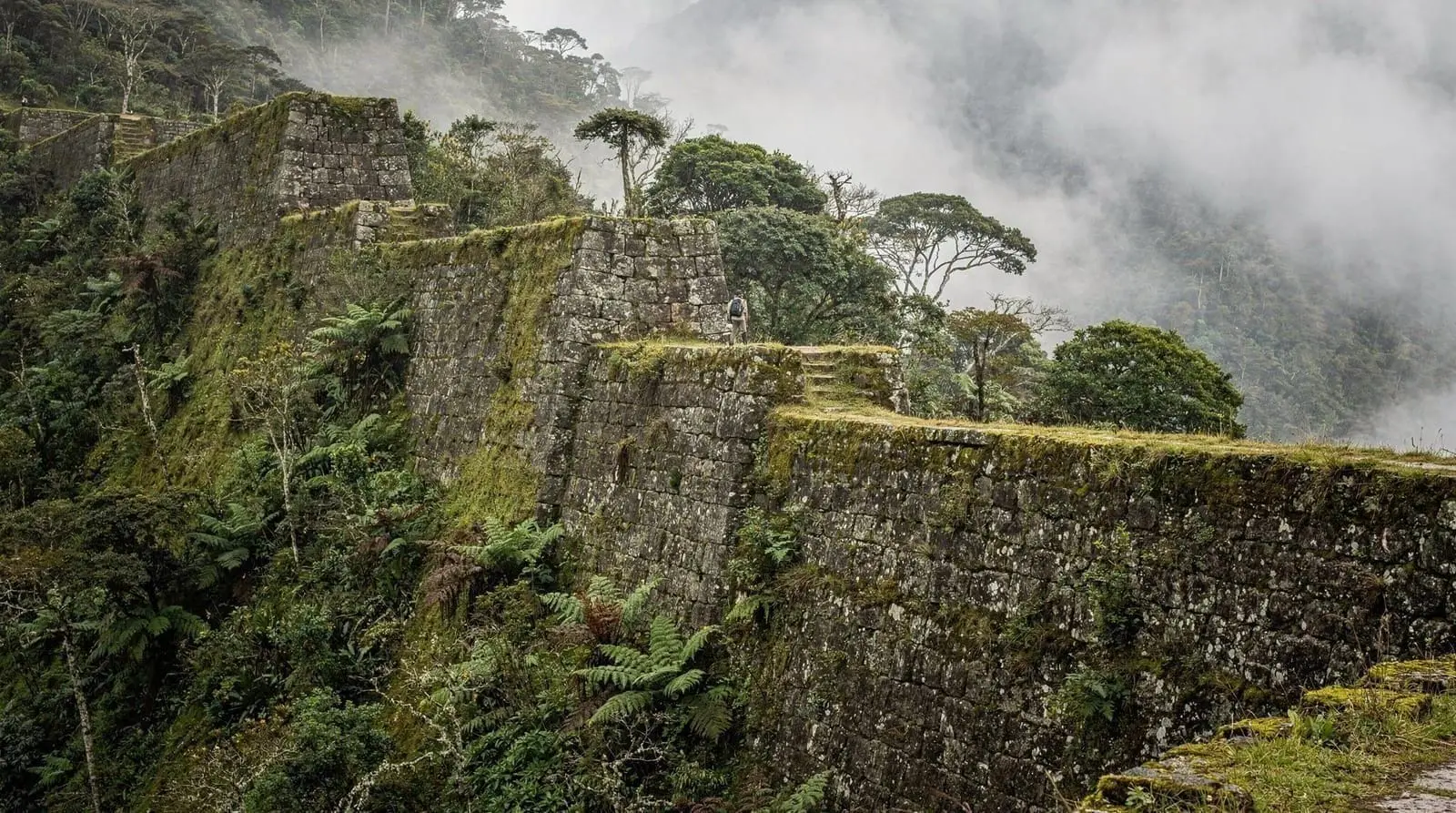
Kuélap: the citadel I had almost to myself
I stood on the outer wall of Kuélap, twenty metres of stone falling away below me, the cloud forest steaming in the valley, and counted the other tourists I could see. There were four. Four people, in a fortress that predates Machu Picchu and is arguably more imposing, on a Tuesday in January. I had come to the north of Peru chasing exactly this feeling, and Kuélap delivered it so completely that I kept waiting for the crowd to arrive. It never did.
| Where | Chachapoyas region, northern Peru, ~3,000m |
| Getting there | Fly Lima–Jaén (~2hrs) then van to Chachapoyas (~4hrs), or overnight bus from Lima |
| Cost | Around S/120 (about USD 32) incl. transport, cable car, entry, guide |
| Time needed | A full day from Chachapoyas; base there 3-4 nights for the wider region |
| Best time | Dry season (May-Sept) for clearer views, though the cloud forest earns its name year-round |
Why almost nobody comes here
Kuélap suffers from the thing that also makes it wonderful: it is hard to get to. The fortress sits at around 3,000 metres above the Utcubamba valley in the Amazonas region, and to reach it you first have to reach Chachapoyas, which is a long way from anywhere most tourists go. I flew Lima to Jaén, which takes a bit under two hours, then endured a four-hour shared-van ride through the mountains to Chachapoyas that I will remember for the rest of my life and not entirely fondly. There is also a brutal overnight bus from Lima that takes the better part of a day. Either way, you have to want it.
The payoff for that effort is a major Andean site without the machinery of mass tourism around it. There is no town of hotels at the base, no train, no queue system, no timed entry sold out three months ahead. There is a cable car and a ticket window and, on the day I went, almost nobody.
The cable car changes the maths
For years, visiting Kuélap meant a long, steep hike or a rough drive up to the site. Since the telecabina opened, you ride a cable car across the valley instead, and it is genuinely one of the better-value experiences I had in Peru. I booked the Kuélap tour with the cable car included through an agency on the Chachapoyas plaza for around S/120 (about USD 32), which covered transport from town, the cable car, the site ticket, and a guide. The Kuélap cable car guide has the full mechanics of the ride if you want the practical detail before you book.
The cable-car ride is about twenty minutes and the views are absurd: you float over the canyon while the fortress slowly resolves on the ridge ahead. Even if Kuélap were dull, the ride up would be worth the ticket. Kuélap is not dull.
What the fortress is actually like
This is where Kuélap quietly outdoes its expectations. It is not a collection of temples like Machu Picchu; it is a fortress, and it feels like one. The outer wall stands up to nineteen or twenty metres high in places, built from limestone blocks fitted together by the Chachapoya people, the “cloud warriors”, centuries before the Inca arrived. You enter through a narrow, funnel-shaped passage that pinches down to a single-file gap, an architecture of defence that makes the purpose of the place obvious the moment you walk through it.
Inside, there are the remains of over four hundred circular stone houses, many decorated with zigzag and rhomboid friezes, scattered across the hilltop and slowly being eaten back by the forest. Bromeliads and moss grow out of the ancient walls. Llamas wander the grass. My guide, a local who switched easily between Spanish and careful English, pointed out details I would have walked straight past: a building shaped like an inverted cone whose purpose is still debated, the spots where archaeologists found human remains, the way the friezes might have marked status or lineage.
Part of the site was closed when I visited. Sections of the outer wall collapsed a few years ago and restoration work has been ongoing, with access to some areas restricted depending on the day. It is worth asking your agency what is currently open before you commit. I still saw the vast majority of it, and the closed sections did nothing to dent the experience.
The Machu Picchu comparison, honestly
You cannot write about Kuélap without addressing the comparison, because every agency in Chachapoyas makes it for you. “The Machu Picchu of the north,” they say. It is and it isn’t.
In raw construction, Kuélap is arguably more impressive than people expect: the sheer wall, the scale, the defensive engineering. In setting, Machu Picchu’s dramatic ridge above the Urubamba is hard to top, though Kuélap’s cloud-forest perch is its own kind of spectacular. The honest difference is not the stones. It is the silence. At Machu Picchu I shuffled through circuits with thousands of others and a guide hurrying us along. At Kuélap I sat on a wall for twenty minutes with nobody asking me to move.
If you want the single most famous site in South America and you do not mind sharing it with the world, Machu Picchu wins and should — the Machu Picchu complete guide covers that side properly. If you want a comparably ancient, comparably monumental site that you can experience almost privately, Kuélap is the trade. I am glad I saw both. I will remember Kuélap more vividly precisely because I had room to. The Kuélap vs Machu Picchu comparison lays out the trade-offs in more detail than I can as a diary.
Make it part of a wider northern loop
The mistake would be to fly all the way to Chachapoyas only for Kuélap. The region rewards a few days. From the same base I did a separate day out to the Gocta waterfall, one of the tallest in the world, a proper sweaty jungle hike to a curtain of water so high you feel small looking up at it. There are also the cliff-set sarcophagi at Karajía, painted clay figures of the Chachapoya dead standing in a row on a ledge, watching the valley for centuries — the Karajía sarcophagi guide covers how to see them.
I gave the whole northern circuit four nights based in Chachapoyas and could have used a fifth. The town itself is pleasant and low-key, with a handsome colonial plaza, cheap menús del día at S/12–15, and the kind of slow pace that the south of Peru lost to tourism a long time ago. The Chachapoyas complete guide is the fuller planning resource for the whole region, including how to actually get there.
Is it worth the detour from the south?
This is the honest question anyone weighing Cusco-and-Machu-Picchu against a northern add-on has to answer, and it depends entirely on what you want from a trip. If your Peru time is under two weeks and you have not yet done the Sacred Valley or Machu Picchu, do those first — they are the essential Peru.
But if you have already done the south, or you have three weeks or more, Kuélap is one of the best “second act” additions in the country precisely because almost nobody else makes the effort. It rewards travellers who have already ticked the obvious boxes and want a monumental site without the machinery of mass tourism. The Chachapoyas vs Cusco guide runs the comparison properly if you’re deciding where to spend limited days.
The verdict
Kuélap is a long way to go and that is the entire point. The effort filters out the crowds and leaves you with a monumental, atmospheric, genuinely ancient fortress that you can experience the way these places are best experienced: quietly, with time, without a queue behind you. The cable car has made it far more accessible than it used to be without ruining the sense that you have escaped the well-worn track.
Go if you have already done the southern highlights and want something that still feels like a discovery, or go first and skip the comparisons entirely. Either way, bring rain gear, because the cloud forest earns its name, and bring patience for the journey. The four other people on the wall that Tuesday all looked as quietly pleased to be there as I was. That, more than the stones, is what Kuélap is selling.