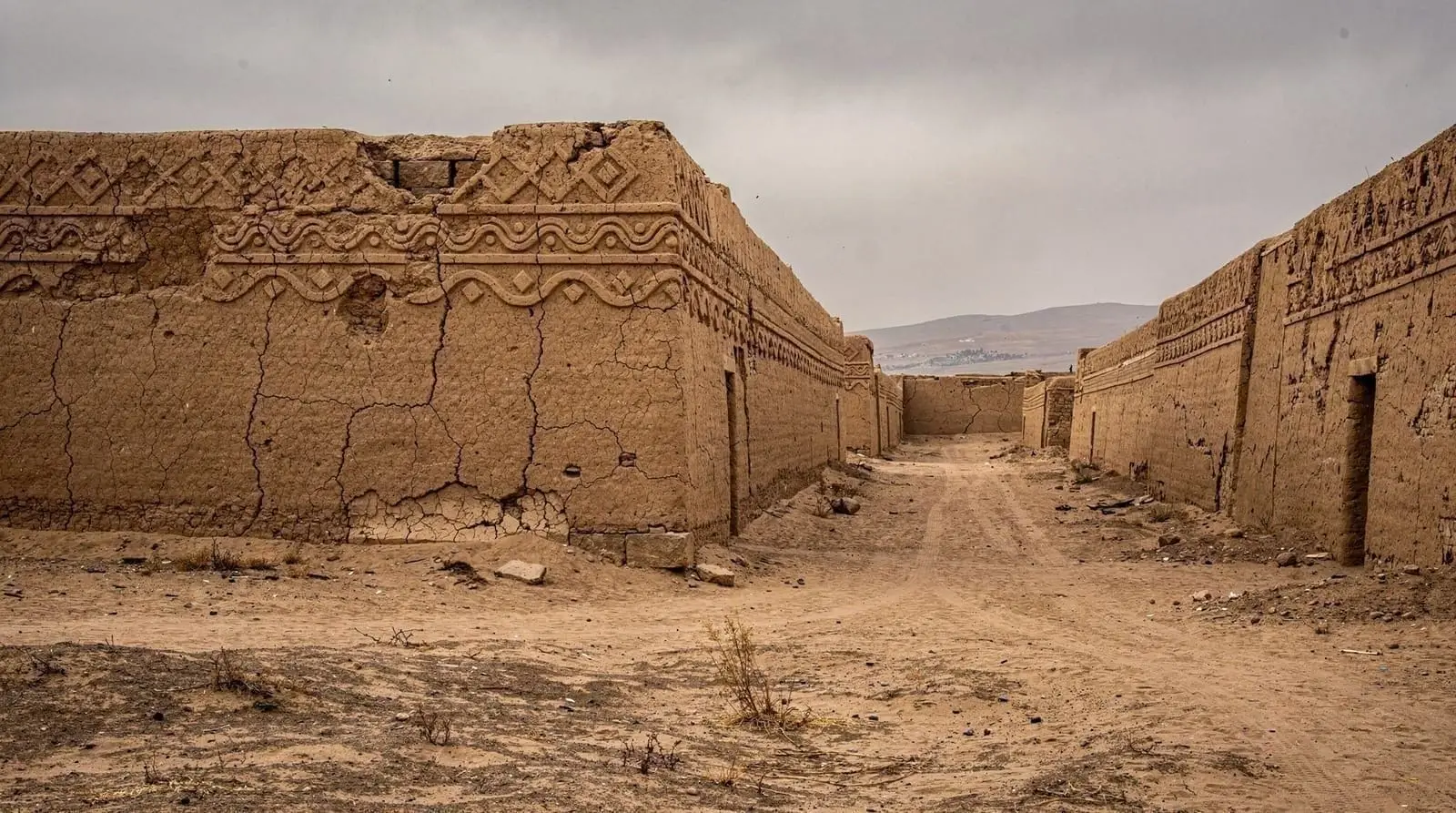
Chan Chan guide
Trujillo: Discovering Chan Chan
What is Chan Chan and is it worth visiting?
Chan Chan is the largest adobe city ever built and the former capital of the Chimú empire, just outside Trujillo. The restored Tschudi palace, with its carved fish and seabird friezes, is well worth two to three hours — and it is far quieter than any Inca site.
The largest mud-brick city ever built
There is nothing else quite like Chan Chan. Spread across roughly 20 sq km of coastal desert just west of Trujillo, it was the capital of the Chimú empire and, at its 15th-century peak, home to an estimated 30,000–40,000 people. Every wall, palace, reservoir, and storeroom was built from adobe — sun-dried mud brick — which makes it both the largest pre-Columbian city in South America and one of the most fragile World Heritage Sites on the planet.
| Where | 5km west of Trujillo, on the road to Huanchaco |
| Cost | Around S/15 (~$4), combined ticket |
| Time needed | 2-3 hours |
| Getting there | Colectivo (S/2-3) or taxi (S/15-20) |
| Best time | Mid-morning, before heat and tour buses |
The Chimú were a maritime civilisation. Their cosmology revolved around the Pacific, and their art shows it: walk the corridors of the restored palace and you pass band after band of carved fish, sea otters, pelican-like seabirds, and fishing-net diamonds. This was a kingdom that worshipped the ocean and feared the moon more than the sun. Understanding that single fact changes how the whole site reads.
What you are actually looking at
A common disappointment among unprepared visitors: Chan Chan is not 20 sq km of walkable ruins. The Chimú built nine vast royal compounds, called ciudadelas, each constructed for a successive king and sealed as a mausoleum when he died. Most of these remain unexcavated — eroded earthen mounds you see across the desert as you approach. Only one compound, the Tschudi palace (also signed as Nik An), has been consolidated and opened to visitors, and it is what your ticket covers.
That is still plenty. The Tschudi circuit takes you through a high-walled entrance corridor into a huge ceremonial plaza, past the audiencias (administrative niches shaped like inverted U’s), a deep walk-in reservoir (huachaque) that tapped the water table, and the royal burial platform. The friezes deepen and grow more intact the further in you walk — fishing scenes near the entrance, then geometric seabird and sea-otter bands closer to the heart of the palace.
How the city worked
It helps to understand the logic behind the ciudadelas. Each Chimú king built a new palace compound for himself, ran his administration from it, and was buried within it when he died — at which point it became a sealed mausoleum and his successor built a fresh one. This is why there are nine of them and why so much of the city is, in effect, a field of royal tombs rather than a living residential district. The common population lived in more modest neighbourhoods of small irregular rooms outside the great walled compounds, working as farmers, fishermen, and craftsmen for the state.
The Chimú ran a tightly planned economy. Within the compounds you can still see the audiencias — small U-shaped administrative niches thought to be where officials controlled the flow of goods in and out of vast storerooms. Chan Chan was a redistribution machine: tribute and produce flowed in, were recorded and stored, and were doled back out. The deep walk-in well, the huachaque, tapped the high coastal water table to supply the city, and a network of canals once irrigated fields around it. When the Inca finally conquered Chimor in the 1470s, the most effective weapon was reportedly cutting those water supplies.
Tickets and the combined entry
Entry to Chan Chan is around S/15 (roughly USD 4). Crucially, this is a combined ticket valid for several days that also covers the on-site museum plus two outlying Chimú huacas — Huaca Esmeralda (in the Mansiche district) and Huaca Arco Iris / El Dragón (in La Esperanza), both known for rainbow-and-dragon friezes. If you have a half-day, doing all three with the same ticket is good value. Keep the stub.
The small museum near the entrance is worth 20 minutes before you walk the palace — it sets up the chronology and shows reconstruction drawings of how the friezes looked when freshly plastered and painted.
Trujillo: Discovering Chan ChanOpening hours and when to go
Chan Chan and the museum open daily from about 9am to 4pm, with last entry around 3:30pm. Two practical reasons to arrive mid-morning rather than midday: the coastal sun is fierce and there is almost no shade inside the palace, and the occasional tour-bus cluster thins out before lunch. Bring water, a hat, and sunscreen — there is no café inside the gate, only drink vendors at the entrance.
Be aware that sections, or occasionally the whole site, can close at short notice for restoration, especially after any El Niño rain. Adobe is unbaked mud, and water is its enemy.
Getting there from Trujillo
Chan Chan lies about 5 km west of Trujillo on the road to Huanchaco.
- Colectivo: Minibuses bound for Huanchaco leave constantly from central Trujillo (around the Avenida España / Industrial area) and pass the Chan Chan access road for S/2–3. Ask the driver for “Chan Chan” — you walk a few hundred metres from the highway to the gate.
- Taxi: S/15–20 one way from the centre. For independent visits, negotiate a round trip with waiting time, or have the driver continue to Huanchaco for lunch.
- Tour: Most travellers see Chan Chan as part of a combined day covering the Huacas de Moche and Huanchaco — the most efficient way to do all three.
Do you need a guide?
Yes, more than at most sites. Without explanation, the adobe walls and plazas blur into one another and the symbolic logic of the friezes is invisible. Licensed guides wait at the entrance booth and charge roughly S/30–50 for an English tour, S/20–30 in Spanish, lasting 60–90 minutes. Hire only the official, badged guides at the booth — ignore freelancers who approach you in the car park, who are unlicensed and sometimes inaccurate. If you join an organised tour from Trujillo, the guide is already included.
The friezes and what they mean
The carved relief walls are Chan Chan’s signature, and they reward slow looking. Unlike the painted figurative friezes of the Moche Huacas de Moche, the Chimú worked in repeating geometric and naturalistic motifs moulded into the adobe: rows of fish swimming in alternating directions (thought to represent the two ocean currents the Chimú depended on), squadrons of pelican-like seabirds, sea otters, and lattices echoing fishing nets. The sea is everywhere. For a people who drew much of their protein and trade from the Pacific and who tracked the moon for the tides, this was not ornament but cosmology rendered in mud.
Look, too, at the scale of the walls — some of the perimeter walls of the compounds rose to nine or ten metres, built in tapering sections to resist the wind and the occasional tremor. Standing in the entrance corridor with these blank earthen cliffs on either side gives you the clearest sense of Chimú power: this was architecture designed to impress and to control who saw what.
The outlying huacas
Two smaller Chimú huacas, covered by the same combined ticket, are worth adding if you have a half-day. Huaca Arco Iris (also called Huaca El Dragón), in the La Esperanza district, is named for its repeating rainbow-and-serpent reliefs and is unusually well preserved. Huaca Esmeralda, in Mansiche, is more eroded but atmospheric and rarely visited. Neither is far, and seeing them rounds out the Chimú picture beyond the single Tschudi compound. A taxi can string all three together in a morning.
How Chan Chan fits the bigger picture
Chan Chan belongs to the Chimú (roughly 900–1470 CE), who absorbed the earlier Moche heritage of the same coast before the Inca conquered them in the 1470s. To make sense of the whole sweep — Moche pyramids, Chimú adobe, and the royal tombs that rewrote north-coast history — read the Moche and Chimú civilizations guide. For the Moche side specifically, pair your visit with the Huacas de Moche guide, and plan your base from the Trujillo complete guide.
Combining Chan Chan with the rest of the day
Chan Chan rarely stands alone in a visit, and it shouldn’t. The classic loop pairs it with Huanchaco, the reed-boat fishing village just 5 km further along the same road, where you can have ceviche on the seafront and watch the caballitos de totora — boats whose design the Chimú’s ancestors would have recognised.
With an early start, you can add the Moche Huacas de Moche on the southern side of the city for a complete pre-Inca day, though that side requires a separate taxi or an organised tour since no road connects the two directly. The most efficient version of this is a single combined tour out of Trujillo that handles the logistics; the most flexible is a hired taxi for the day. Doing Chan Chan and Huanchaco by colectivo alone is cheap and entirely feasible if you have the time.
A brief history of the site
Chan Chan was the capital of Chimor, the Chimú kingdom, which grew from around 900 CE to dominate roughly a thousand kilometres of the Peruvian coast — the largest state in the Andes before the Inca. The city was the seat of a hereditary dynasty and the nerve centre of a planned, redistributive economy famous for mass-produced black ceramics and industrial-scale gold and silverwork.
Its decline was abrupt and external: in the 1470s the expanding Inca, under Tupac Inca Yupanqui, conquered Chimor and carried its goldsmiths off to Cusco, which is why later Inca metalwork bears a Chimú imprint. When the Spanish arrived in the 1530s, Chan Chan’s remaining treasures were systematically looted, and the abandoned adobe city began the long erosion you see today. The full story, and how it connects to the earlier Moche, is in the Moche and Chimú civilizations guide.
Honest tips before you go
- Manage expectations. This is a study in scale and erosion, not a Disney-style restored ruin. The reward is atmosphere and solitude, not spectacle.
- Go now-ish. UNESCO lists Chan Chan as World Heritage in Danger. It will look meaningfully different in fifty years.
- Skip the freelance “guides” in the car park. Use the booth.
- Combine with Huanchaco lunch. The fishing village is 10 minutes further; the cevicherías there are the natural pairing.
- Don’t climb on the walls. Beyond being prohibited, every footfall on adobe accelerates the loss.
What visitors get wrong before they arrive
The single biggest expectation mismatch is scale versus access: people picture 20 sq km of walkable ruins and find one restored compound. Manage that ahead of time and the visit lands well. The second mismatch is timing — Chan Chan is a coastal desert site with essentially no shade, so a midday arrival in the dry season sun is genuinely uncomfortable, while the same walk at 9am is pleasant. Third, travellers sometimes assume the combined ticket to Huaca Esmeralda and Huaca Arco Iris is automatic; it isn’t automatic transport, just automatic admission — you still need a taxi or colectivo to reach those outlying huacas separately from the main Tschudi compound.
For first-hand texture beyond the practical logistics, our Trujillo Moche trail diary covers one traveller’s day moving between Chan Chan, the Huacas de Moche and Huanchaco, which is a useful gut-check on pacing if you are trying to fit all three into a single day.
A fourth, smaller mismatch worth flagging: visitors sometimes expect Chan Chan to be photogenic in the way Machu Picchu is, with clean sightlines and dramatic backdrops. It isn’t. The reward here is intellectual — understanding a redistribution economy, a maritime cosmology rendered in mud, a civilisation the Inca themselves respected enough to deport its goldsmiths to Cusco — rather than a single postcard shot. Adjust your expectations accordingly and the two-to-three-hour visit becomes genuinely absorbing rather than a letdown.
Frequently asked questions about Chan Chan
How much does it cost to enter Chan Chan?
What are the opening hours of Chan Chan?
How do I get to Chan Chan from Trujillo?
How much of Chan Chan can you actually visit?
Do I need a guide for Chan Chan?
Is Chan Chan or Machu Picchu more impressive?
Does the Chan Chan ticket include transport to the outlying huacas?
Is there shade at Chan Chan?
Top experiences
Bookable activities with verified prices and instant confirmation on GetYourGuide.
