El Brujo and the Lady of Cao guide
Trujillo: The Sorcerer and the Lady of Cao
Who was the Lady of Cao and why does she matter?
The Lady of Cao was a high-status female Moche ruler buried around 400 CE at the El Brujo complex, discovered in 2006. Her tomb — rich with gold, war clubs, and tattoos — overturned the assumption that Moche power was exclusively male. The Museo Cao that displays her is one of Peru's best small museums.
The discovery that rewrote Moche history
For decades, archaeologists assumed the Moche elite were men — warriors, priests, and lords whose tombs had defined the civilisation. Then, in 2006, a team excavating the Huaca Cao Viejo at the El Brujo complex opened an undisturbed tomb and found something that forced a rewrite. Inside lay a young, high-status woman, buried around 400 CE wrapped in layers of fine cotton, surrounded by gold and copper ornaments, ceremonial objects, and — most strikingly — war clubs and spear-throwers, symbols of military and political power. Her skin bore tattoos of snakes and spiders. She became known as the Señora de Cao, the Lady of Cao, and she is now understood to have been a ruler in her own right.
El Brujo sits on the coast about an hour north of Trujillo, near the village of Magdalena de Cao. It is the quietest of the region’s major Moche sites and, for that reason, one of the most rewarding — you can stand at the painted reliefs with almost no one around.
| Where | ~50 km north of Trujillo, near Magdalena de Cao |
| Cost | around S/15 (~$4), entry + museum included |
| Time needed | 1.5–2 hrs on site, plus 2–3 hrs round-trip travel |
| Getting there | Half-day tour or hired taxi (no public transport) |
| Best time | Morning, before the site closes mid-afternoon |
The name and the place
“El Brujo” means “the sorcerer,” and the name is not marketing — it comes from the long tradition of shamans and curanderos who used these ancient mounds for healing and divination rituals well into modern times, drawn by the site’s perceived spiritual power. That layered sense of the sacred, accumulated over thousands of years, is part of what gives the place its atmosphere. The complex sits on a bluff above the Pacific near the small town of Magdalena de Cao, surrounded by sugar-cane fields, with the sound of the surf never far off. It is remote enough that reaching it takes commitment, which is precisely why it stays quiet.
What is the El Brujo complex?
El Brujo (Spanish for “the sorcerer,” after the shamans who long used the mounds for rituals) is not a single building but a layered archaeological complex on a coastal terrace, occupied across thousands of years. Three structures dominate:
- Huaca Prieta — an ancient prehistoric mound, among the oldest known sites of human occupation on the Peruvian coast, with evidence of early agriculture and textiles dating back roughly 14,000 years.
- Huaca Cortada — a Moche pyramid, partially eroded, named for the deep cut slicing through it.
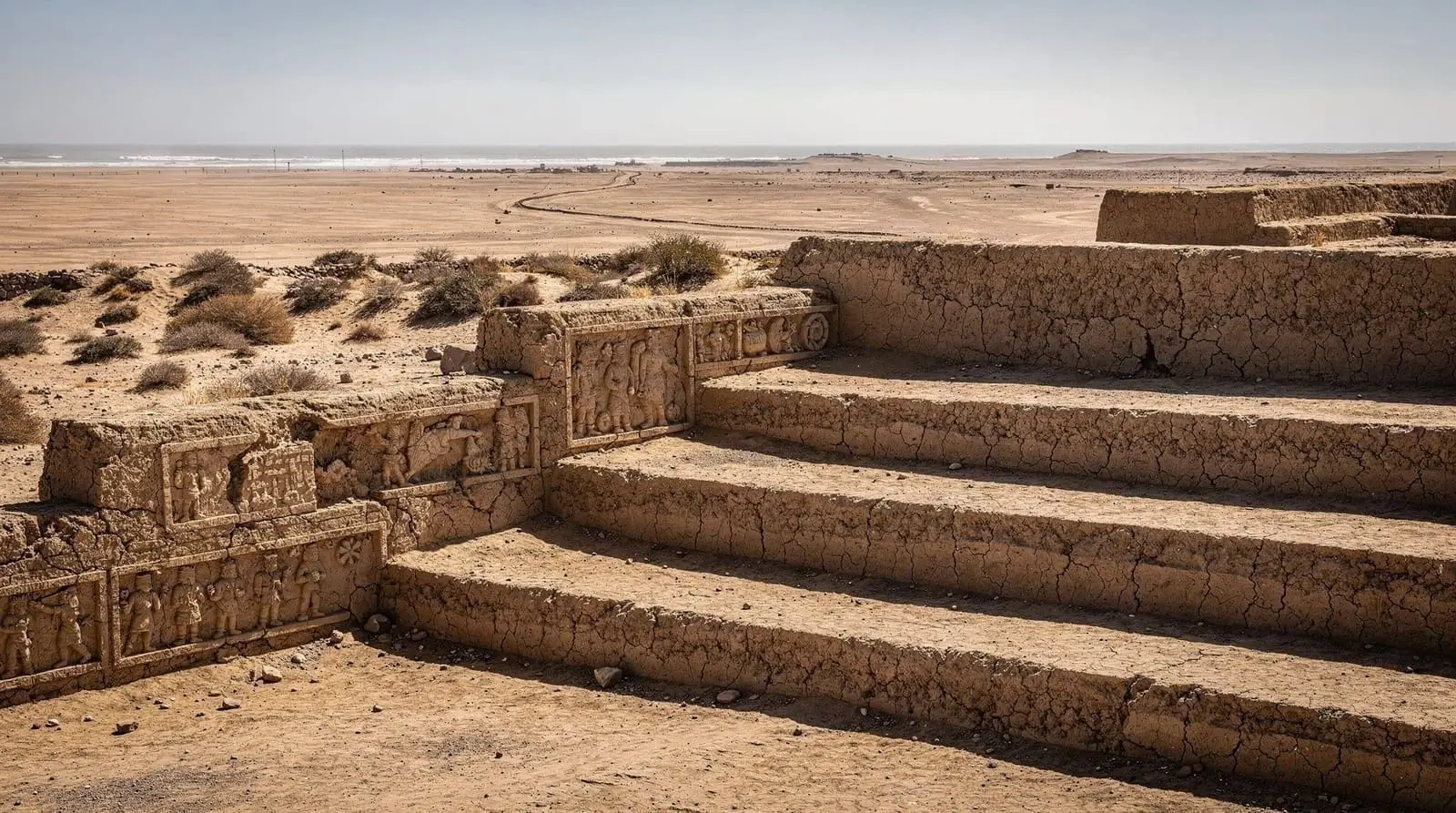
- Huaca Cao Viejo — the centrepiece, a Moche temple decorated with painted polychrome reliefs of warriors, captives, and ritual scenes, and the place where the Lady of Cao was found.
Your visit focuses on the Huaca Cao Viejo circuit and the museum beside it.
Trujillo: The Sorcerer and the Lady of CaoWhy the discovery mattered so much
To understand the significance, you have to know what came before. For most of the twentieth century, the great Moche tombs that defined the field — culminating in the spectacular Lord of Sipán found near Chiclayo in 1987 — belonged to men, and the standard interpretation cast Moche rulers, priests, and warriors as a male elite. Women appeared in the iconography largely as priestesses in supporting ritual roles.
The Lady of Cao broke that frame. She was not a consort or a priestess buried beside a king; she was buried alone, with her own full panoply of power — gilded copper crowns, gold nose ornaments, dozens of ceramic vessels, and, decisively, the war clubs and spear-throwers that in Moche art mark military and political authority. Isotope and forensic analysis suggested she was in her mid-twenties and may have died from complications of childbirth.
The serpent and spider tattoos covering her arms and hands likely carried ritual or symbolic meaning. Taken together, the burial made it impossible to keep treating Moche rulership as a male monopoly. She is now one of the most important single finds in Peruvian archaeology, and the reason El Brujo punches far above its visitor numbers.
The painted reliefs of Huaca Cao Viejo
Beyond the tomb, the Huaca Cao Viejo itself is decorated with some of the most vivid painted reliefs of any Moche site. The circuit takes you past tiered facades showing files of warriors, naked bound captives roped together by the neck, dancers holding hands, and stylised marine and supernatural figures — much of it still carrying its original red, ochre, white, and black pigment. One striking panel depicts the so-called “Decapitator” wielding a knife and a severed head, a direct echo of the Ai Apaec imagery you see at the Huacas de Moche. The reliefs make clear that El Brujo was a major ceremonial centre in its own right, not a minor outpost.
The Museo Cao
The on-site Museo Cao is, plainly, one of the best-presented small archaeological museums in Peru. It was purpose-built to house the Lady of Cao and her tomb, and it does so with restraint and intelligence: low lighting, clear bilingual panels, and a facial reconstruction that gives a human face to the remains. You see her preserved body, the gold nose ornaments and crowns, the war clubs, and the textiles she was wrapped in — laid out so the story of the excavation unfolds as you walk. Allow 45 minutes here alone; it is the emotional heart of the visit and is included in your ticket.
What a visit feels like
El Brujo is a different experience from the busier in-town sites, and the difference is mostly solitude. The complex sits on an open coastal terrace above the Pacific, with the wind, the surf, and very few other visitors. You walk the Huaca Cao Viejo circuit first, taking in the painted reliefs and the views over the sea and the surrounding sugar-cane fields, then move into the purpose-built museum. Because the site sees a fraction of the traffic of Chan Chan, you often have the reliefs and the tomb display largely to yourself — which, given the intimacy of the Lady of Cao’s story, suits the place. It is the kind of visit that rewards a slower pace and a good guide rather than a quick photo stop.
Tickets, hours, and guides
- Entry to the El Brujo complex including the Museo Cao: around S/15 (roughly USD 4).
- Hours: generally daily, roughly 9am to 4:30pm (last entry mid-afternoon).
- Guide: a licensed guide adds S/30–50 and is worth it for the relief panels and the tomb story; tour visitors have a guide included.
- Duration on site: about 1.5–2 hours for the huaca circuit plus the museum.
Bring sun protection and water — the terrace is exposed coastal desert with little shade.
Getting there from Trujillo
This is the one north-coast highlight that takes real effort to reach. El Brujo is about 45–60 km north of Trujillo near Magdalena de Cao, roughly 1 to 1.5 hours by road, and there is no clean public-transport route to the gate.
- Half-day tour: the simplest option, typically running 4–5 hours door to door from Trujillo.
- Hired taxi: negotiate a round trip with waiting time; expect a meaningful fare given the distance — agree it in full before leaving.
- From Salaverry port: cruise passengers docking at Salaverry can reach El Brujo on dedicated excursions.
Should you make the trip?
Be honest about your time. On a single full day in Trujillo, prioritise Chan Chan and the Huacas de Moche — they are closer, equally significant, and easier to combine. El Brujo earns its place on a second or third day, when you have the appetite and the hours for a half-day excursion. For travellers genuinely interested in the Moche, it is arguably the most affecting of the three sites, precisely because the Lady of Cao puts a human story at the centre of the archaeology.
To understand how El Brujo, the Huacas de Moche, and Chan Chan fit into the broader sweep of north-coast civilisations, read the Moche and Chimú civilizations guide. If you are continuing the circuit, the northern Peru route guide covers pacing toward Chiclayo and the Lord of Sipán.
El Brujo Complex & the Lady of Cao Archaeological TourAccessibility and practical notes for visitors
The site sits on an open, unpaved coastal terrace, and the walking surface between the museum and the huaca is uneven sand and packed earth rather than a smooth path, which is worth knowing if mobility is a concern. There is no shade along most of the outdoor circuit, so the sun exposure is real even on a mild-feeling coastal day — reapply sunscreen rather than relying on a morning application alone. Restrooms and a small visitor area are available near the museum entrance, but there are no food or drink concessions on site, so bring water and any snacks with you from Trujillo or Magdalena de Cao.
Combining El Brujo with the coast
Because the drive from Trujillo passes through coastal countryside and fishing villages, El Brujo pairs well with a relaxed coastal lunch. Some excursions, including those running from the cruise port at Salaverry, fold in a stop at Huanchaco on the way back for ceviche and the caballitos de totora. If you are building your own day with a hired taxi, ask the driver to route through Huanchaco on the return — it turns a there-and-back errand into a proper day on the north coast. Just keep an eye on the El Brujo closing time, since the site shuts mid-afternoon and the drive back is over an hour.
The wider Moche tomb story
The Lady of Cao does not stand alone. She belongs to a remarkable run of intact Moche royal burials uncovered on the north coast over the last few decades, the most famous being the Lord of Sipán, found near Chiclayo in 1987 and often described as the richest unlooted tomb ever excavated in the Americas. Where Sipán revealed the dazzling gold-and-turquoise regalia of a male lord, the Lady of Cao revealed that the same kind of authority could belong to a woman.
Visiting both — El Brujo and the Lord of Sipán museum in the north — gives you the fullest possible picture of Moche elite power and is the backbone of a serious north-coast archaeology trip. The Moche and Chimú civilizations guide ties the threads together, and the northern Peru route guide covers how to chain the sites.
Photography and site etiquette
Photography is generally permitted around the Huaca Cao Viejo reliefs and the exterior grounds, but flash and photography of the Lady of Cao’s remains inside the museum are typically restricted — follow the posted signage and staff guidance rather than assuming. The painted reliefs are original pigment exposed to the coastal air, so touching the walls is not permitted; admire from the marked walkway. As with any Peruvian archaeological site, drones require separate permission and are not something to fly casually.
Conservation and why the site stays quiet
Part of what keeps El Brujo so peaceful is deliberate: the site receives careful, limited management rather than mass-tourism infrastructure, and the fragile painted reliefs of Huaca Cao Viejo are actively conserved against the coastal salt air and sun that would otherwise degrade the pigments. The Wiese Foundation, which has backed the excavation and the Museo Cao since the Lady of Cao’s discovery, funds ongoing research and restoration rather than expanding visitor numbers, which is exactly why the experience still feels intimate two decades after the find made headlines.
Honest tips
- Treat it as a half-day, not a quick stop. The travel time is the real cost; build the day around it.
- The museum is the highlight — pace your visit so you arrive at the Museo Cao with energy left.
- Combine with a tour unless you are confident negotiating a taxi round trip with waiting time.
- Go in the morning for cooler temperatures and softer light on the reliefs.
- Manage one-day expectations — if you only have a day, the in-town sites come first.
- Bring water and sun cover — the terrace is exposed coastal desert with little shade.
- Confirm the closing time before you set out, and leave enough margin for the hour-plus drive back to Trujillo.
Frequently asked questions about El Brujo and the Lady of Cao
How far is El Brujo from Trujillo?
How much does it cost to visit El Brujo and the Museo Cao?
Can you see the actual Lady of Cao mummy?
Is El Brujo worth the trip from Trujillo?
What is the El Brujo complex?
How long do you need at El Brujo?
Can you take photos at El Brujo and the Museo Cao?
Top experiences
Bookable activities with verified prices and instant confirmation on GetYourGuide.
