Huacas de Moche guide
Trujillo: Huacas de Moche, Chan Chan & Huanchaco Beach
What are the Huacas de Moche and are they worth visiting?
The Huacas de Moche — the Pyramids of the Sun and Moon near Trujillo — are the ceremonial heart of the Moche civilisation. The Huaca de la Luna's painted polychrome friezes are the highlight, and the on-site museum is one of the best in northern Peru. Well worth 2–2.5 hours.
The painted heart of the Moche world
Eight kilometres south of Trujillo, where the coastal desert meets the dark slope of Cerro Blanco, two enormous mud-brick pyramids face each other across a buried city. These are the Huacas de Moche — the Huaca del Sol and the Huaca de la Luna — and they were the ceremonial and political centre of the Moche civilisation, which flourished on the north coast roughly between 100 and 800 CE. That is centuries before the Inca existed, and the gap matters: nothing here is Inca, and the art has its own distinct vocabulary.
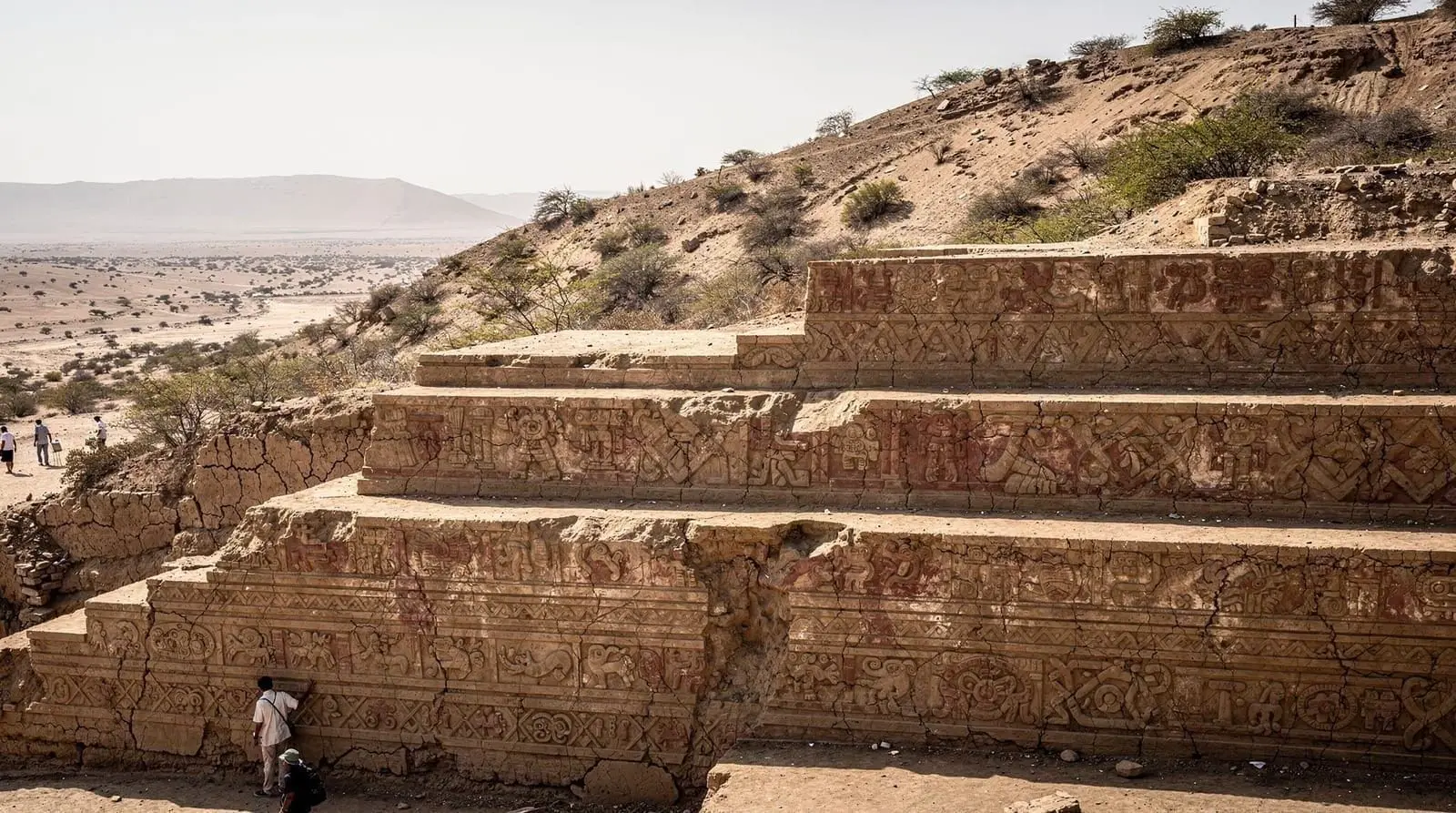
What makes this site exceptional is not just scale but colour. While much of the Moche world is known from pottery in museums, here you walk past the painted friezes in situ — repeated images of Ai Apaec, the fanged supreme deity, in red, white, yellow, and black pigment preserved by a thousand years of bone-dry desert. Few archaeological sites in the Americas let you stand this close to original pre-Columbian paint.
| Where | 8 km south of Trujillo, at the foot of Cerro Blanco |
| Cost | around S/15 (huaca) + S/10 (museum) |
| Time needed | 2–2.5 hours including the museum |
| Getting there | Taxi round trip S/25–35, or a combined tour |
| Hours | Daily ~9am–4pm, last guided group ~3:30pm |
The two pyramids
Huaca del Sol
The Huaca del Sol (Temple of the Sun) is the larger structure — at roughly 340 m long it ranks among the biggest adobe constructions ever raised in the Americas, built from an estimated 130 million mud bricks. The catch: it is closed to visitors. Centuries of erosion (worsened by 16th-century Spanish looters who diverted a river to wash out its base in search of gold) have left it fragile, and conservation work continues. You see it across the plain but do not climb it.
Huaca de la Luna
The Huaca de la Luna (Temple of the Moon) is the visitable pyramid and the real reason to come. Under careful excavation since the 1990s, it has revealed that the Moche built new temples directly over old ones every few generations, sealing the earlier painted facades inside. Archaeologists have peeled back these layers, so the guided circuit takes you past superimposed friezes from different centuries — including a dramatic multi-tier facade where Ai Apaec stares out in rows, flanked by warriors, captives, and geometric serpents.
Trujillo: Huacas de Moche, Chan Chan & Huanchaco BeachReading the friezes
What you are looking at on the Huaca de la Luna’s facades is not decoration for its own sake — it is a religious and political program. The dominant figure is Ai Apaec, sometimes called the Decapitator, rendered as a frontal face with bulging eyes, feline fangs, and serpent appendages. Around and below him run registers of other imagery: stylised waves, anthropomorphised spiders, marine creatures, ritual combatants, and rows of bound, naked captives being led to sacrifice. The repetition is deliberate. Each new generation of priests rebuilt the temple over the old one, recreating the same iconography, reinforcing a continuity of belief across centuries.
A guide will usually point out the famous superimposed facade, where excavation has exposed several construction phases stacked vertically, so you can see how the temple grew. It is one of the clearest demonstrations anywhere of how Andean peoples conceived of sacred architecture as something to be renewed rather than replaced. The pigments — iron-oxide reds, mineral yellows, charcoal blacks, lime whites — are largely original, which is why photography without flash is the rule and why the more fragile chambers are roofed against sun and the rare rain.
The on-site museum
Across the access road, the Museo Huacas de Moche is one of the best small archaeological museums in northern Peru and a genuine asset to the visit. Its reconstruction drawings and lighting help you picture the friezes as they once were — freshly plastered, vivid, and ceremonially active — and its ceramics show the Moche’s astonishing portrait vessels and scenes of daily life, ritual, and warfare. Entry is a separate ticket of about S/10. See it before the huaca if you can; the context makes the walk land harder.
Practicalities on site
There is no public transport to the gate, so plan your arrival deliberately (see Getting there below). At the entrance you will find the ticket office, restrooms, a small craft and snack area, and the guides’ booth; there is no full restaurant, so bring water and a snack if you skip lunch. The walk through the huaca is on uneven adobe surfaces and includes some stairs, so wear closed shoes with grip. The chambers are roofed, but the approach and the upper platform are fully exposed — a hat and sunscreen are not optional on the coast.
Photography is permitted without flash; the original pigments are light-sensitive, and flash is prohibited in the painted chambers. Drones are not allowed over the protected site. If you are short on time, the museum can in theory be skipped, but it genuinely doubles the value of the visit — budget the extra 45 minutes if you possibly can.
Tickets, hours, and the guided circuit
- Entry to the huaca: around S/15 (roughly USD 4), including a mandatory guided circuit — you cannot wander alone.
- Museum: separate, about S/10.
- Hours: daily roughly 9am–4pm, last guided group around 3:30pm.
- Duration: allow 2–2.5 hours for the huaca plus museum.
Guides are organised by language at the booth; English-speaking guides are usually available. The walk is on uneven adobe and exposed to the sun, so bring water, a hat, and closed shoes. There is shade only inside the excavated chambers.
Getting there from Trujillo
The site is about 8 km south of Trujillo at the foot of Cerro Blanco, and this is the one north-coast highlight with no convenient public transport to the gate.
- Taxi: the practical independent option. Negotiate a round trip with waiting time for around S/25–35 — do not let the driver leave, as flagging a return cab here is unreliable.
- Tour: most visitors include the Huacas de Moche in a combined day with Chan Chan and Huanchaco, which solves the transport problem entirely.
Who built it, and when
The Huacas de Moche were the capital of the Southern Moche state, occupied for most of the civilisation’s span from roughly 100 to 800 CE. The urban zone between the two pyramids — a sprawl of compounds, workshops, plazas, and streets now largely buried under sand — once housed perhaps 10,000 to 15,000 people, including the metalworkers and potters whose output defined Moche material culture. Excavation here has been ongoing since the early 1990s under Peruvian archaeologists, and it remains an active dig, which means the visitor experience evolves year to year as new sections open. You are not visiting a finished, frozen monument; you are visiting a working archaeological project.
The decline of the site mirrors the wider Moche collapse. Severe El Niño episodes brought flooding and then drought that strained the irrigation agriculture the whole society depended on, and by around 800 CE the ceremonial centre had been largely abandoned. The story did not end there — successor cultures and ultimately the Chimú inherited the same coast — but the Huacas del Sol y Luna mark the high-water mark of the Moche themselves. For the full arc, see the Moche and Chimú civilizations guide.
Independent visit versus organised tour
Both work, and the right choice comes down to how much else you want to see in a day. Going independently means hiring a taxi for the round trip with waiting time (around S/25–35) — buy your ticket at the gate, join the next guided group, and visit the museum at your own pace. This is flexible and lets you linger, but you will need a second taxi arrangement to reach Chan Chan afterward, since no road links the two huaca areas directly.
An organised tour from Trujillo is the efficient choice if you want the Huacas de Moche, Chan Chan, and Huanchaco in a single day: the guide, transport, and sequencing are handled, and you avoid the awkward cross-city transfer. For a focused, unhurried visit to the huacas alone, go independently; for a full pre-Inca day without logistics, take the tour.
What makes this site different from Chan Chan
Visitors often assume Chan Chan and the Huacas de Moche are variations on the same theme because both are large adobe complexes near Trujillo, but the differences run deeper than the calendar gap between them. Chan Chan is built from carved and moulded relief walls — geometric patterns, fish, birds, repeated in vast open plazas — reflecting Chimú urban planning on an imperial scale.
The Huacas de Moche, by contrast, are about painted narrative: the Ai Apaec friezes tell a specific religious story in colour rather than presenting an abstract architectural pattern, and the site is smaller and more intimate, built as a temple complex rather than a city. If you can see only one, choose Chan Chan for scale and urban planning, or the Huacas de Moche for colour, narrative and the sense of standing in front of a working excavation. Seeing both in one day, as most visitors do, gives you the fullest comparison of how the two civilisations expressed power and religion in mud brick a few centuries apart.
How it fits the wider circuit
The Huacas de Moche are the Moche counterpart to the Chimú Chan Chan on the other side of the city — two civilisations, two materials, two art styles, one efficient day. For the full historical thread connecting them (and the royal tombs of the Lady of Cao further north), read the Moche and Chimú civilizations guide. Plan logistics and lodging from the Trujillo complete guide.
What else is nearby
The Huacas de Moche pair naturally with the rest of Trujillo’s pre-Inca circuit, even though they sit on the opposite side of the city from Chan Chan. The standard combined day runs the Huacas in the morning, Chan Chan and the outlying Chimú huacas around midday, and finishes with a ceviche lunch in Huanchaco, the reed-boat fishing village. If the Moche have caught your imagination, set aside a half-day for El Brujo and the Lady of Cao an hour north, where a female Moche ruler was found in 2006. Use the Trujillo complete guide to fit it all into a coherent two-day plan rather than a rushed single day.
A note on the name
You will see the site labelled several ways — Huacas de Moche, Huacas del Sol y Luna, the Pyramids of the Sun and Moon — and they all refer to the same place. “Huaca” is a Quechua word for a sacred place or object, applied across Peru to pre-Hispanic temples and mounds; you will encounter it from Lima’s Huaca Pucllana to the huacas of Chan Chan. The “de Moche” simply locates these particular huacas in the Moche valley, which in turn gave its name to the whole civilisation. Knowing the vocabulary helps you decode signage and tour names that flip between the Spanish and the archaeological labels.
Honest tips
- Do the museum first if time allows — it transforms the friezes from “old painted wall” into a readable narrative.
- Combine, don’t isolate. Visiting the Huacas alone wastes the transport effort; pair them with Chan Chan and Huanchaco.
- Morning light brings out the pigment far better than flat midday sun.
- The Huaca del Sol is off-limits — set expectations and don’t promise yourself a climb.
- Tip your guide if the explanation was good; many work largely on tips at the smaller circuits.
Accessibility on site
The guided circuit through the Huaca de la Luna covers uneven adobe surfaces, gravel paths, and a number of stairs between excavation levels, which makes it genuinely difficult for wheelchair users and challenging for anyone with limited mobility. There is no adapted route around this — the site’s archaeological value is precisely in the layered, stepped construction that a smooth path cannot replicate.
Travellers who cannot manage stairs should still consider the on-site museum, which is flatter and fully viewable, and weigh whether the huaca circuit itself is realistic before committing to the taxi fare out. For families, the walk is manageable for children old enough to handle uneven ground with supervision, though the mandatory pace of the guided group means you cannot linger or rush on your own schedule.
Best time of day and year to visit
Arrive as close to opening (around 9am) as your schedule allows. Morning light rakes across the friezes at a low angle that brings out the carved and painted detail far better than the flat, harsh light of midday, and the site is markedly less crowded before the tour-bus groups arrive around 11am. Seasonally, the north coast desert is dry and warm essentially year-round, so there is no real off-season weather-wise — the main variable is cruise-ship and tour-group scheduling rather than climate. If your itinerary allows flexibility, a weekday morning visit gives you the best combination of light, quiet, and unhurried guide attention.
Frequently asked questions about Huacas de Moche
How much does it cost to visit the Huacas de Moche?
Can you climb the Huaca del Sol?
What are the opening hours of the Huacas de Moche?
How do I get to the Huacas de Moche from Trujillo?
What is the difference between the Huacas de Moche and Chan Chan?
Is a guide included at the Huaca de la Luna?
Top experiences
Bookable activities with verified prices and instant confirmation on GetYourGuide.
