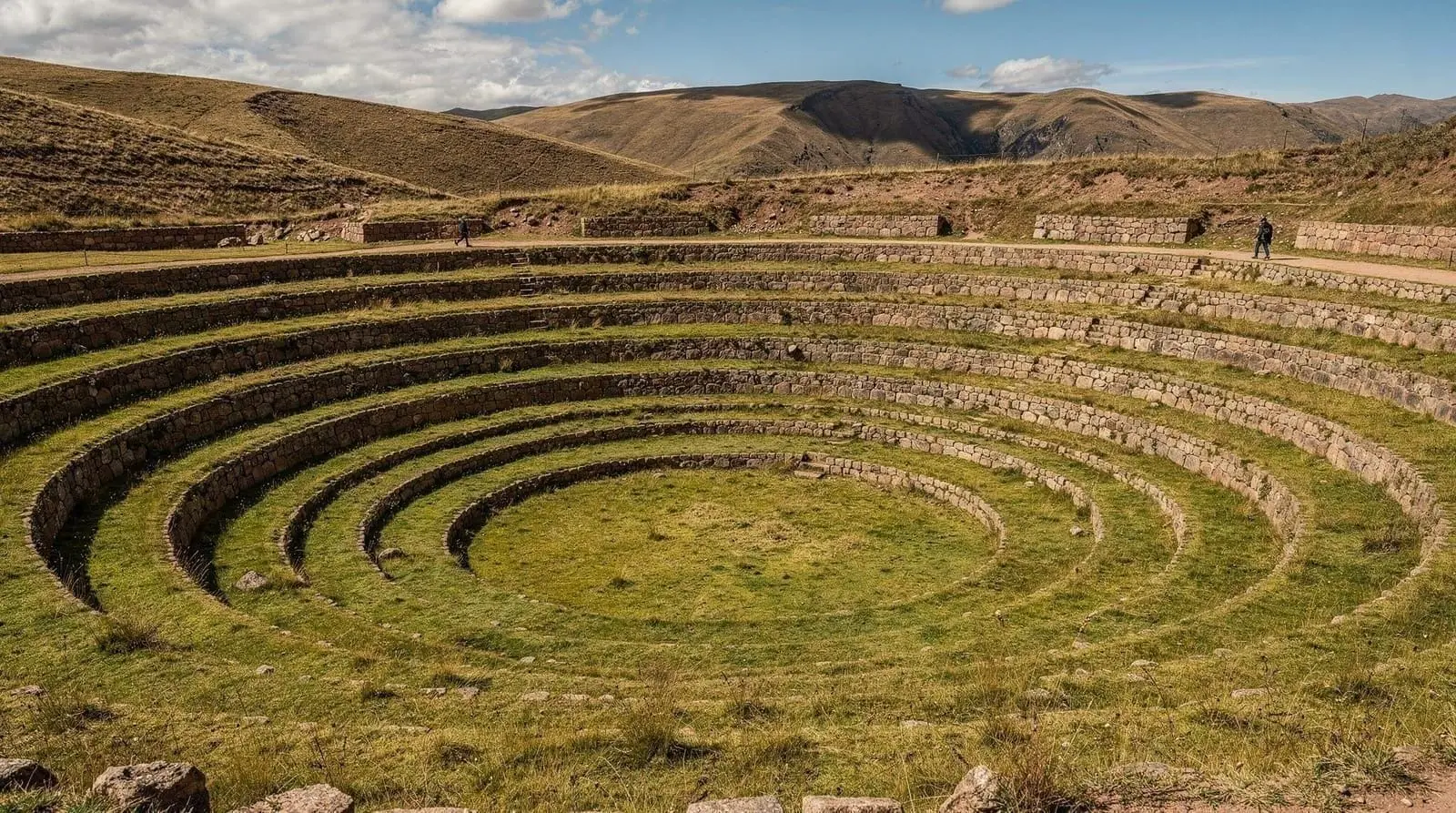
Moray: the Inca agricultural terraces
Cusco: Pisac, Maras, Moray, Ollantaytambo Small Group Tour
What is Moray and what was it for?
Moray is a set of huge concentric circular terraces sunk into the ground on the plateau above Urubamba. The leading theory is that it was an Inca agricultural laboratory: temperatures differ by several degrees between the top and bottom rings, letting the Inca test crops in many microclimates. Entry is via the Boleto Turístico.
An Inca site that is all earthworks and no walls
Most Inca sites in the Sacred Valley announce themselves with stonework — temples, terraced fortresses, neat trapezoidal doorways. Moray is the odd one out. There are no buildings to photograph, no carved temples, almost no walls. Instead, three great bowls of concentric circular terraces are carved down into the earth, the largest dropping some 30 metres from rim to floor like a green amphitheatre. It looks more like land art than archaeology, and it leaves first-time visitors slightly puzzled about what they are looking at.
That puzzle is the point. Moray is widely interpreted as an Inca agricultural laboratory, an open-air experiment in growing food at altitude, and it tells you more about how the Inca fed an empire than any single temple does. It rewards understanding over wandering, so this guide focuses on what the site actually was, alongside the practical detail you need: the ticket, the hours, how to visit, and how Moray fits with the nearby Maras salt pans. For the combined logistics, see the Maras and Moray day-trip guide.
| Where | Plateau above Urubamba, Sacred Valley |
| Ticket | Boleto Turístico only — Circuit III S/70 or full S/130 |
| Time needed | About 1 hour, more with the salt pans |
| Getting there | Taxi/tour from Urubamba or Cusco; usually paired with Maras |
| Best time | Early morning, before the tour convoys arrive |
| Altitude | Around 3,500 m — acclimatise before visiting |
The microclimate theory, explained
The leading explanation for Moray is agricultural experimentation. The Inca were master farmers feeding a vast, vertically stacked empire that ran from coastal desert to high puna, and they needed crops adapted to wildly different conditions. Moray, the theory goes, let them compress many of those conditions into one place.
The mechanism is the sunken, concentric design. By digging the terraces down into a natural depression and orienting them carefully, the Inca created a structure that traps sunlight and warmth at the bottom while the upper rings stay cooler and more exposed. Measurements have recorded a temperature difference of several degrees — frequently cited at up to about 15°C — between the highest and lowest terraces. Add differences in sun exposure, humidity, soil and wind across the rings, and a single bowl can mimic the growing conditions of many different altitudes.
The plausible implications are striking. The Inca may have used Moray to test which crop varieties thrived where, to adapt highland plants such as potatoes and maize step by step toward different climates, and even to acclimatise seeds and seedlings between zones. Soil analysis has suggested earth was brought in from different regions to recreate distinct conditions in different terraces. Nothing is proven beyond doubt — Moray left no written records, and some scholars propose ceremonial or astronomical roles too — but the agricultural-laboratory reading fits the evidence best and is the one most guides present. Either way, it is a monument to Inca engineering and botany rather than to gods or armies.
For how Moray sits within the wider sweep of Inca building in the region, the Cusco archaeological sites guide and the Ollantaytambo ruins guide are useful companions.
Tickets, hours and the essentials
Moray is entered only with the Boleto Turístico del Cusco. There is no single-site ticket at the gate. Your options:
- Boleto Parcial Circuito III (partial): S/70 (about $19), valid 2 days, covering Pisac, Ollantaytambo, Chinchero and Moray.
- Boleto General (full): S/130 (about $35), valid 10 days, covering 16 sites.
For a valley-focused trip the partial Circuit III ticket is the better value; the Cusco tourist ticket guide explains the trade-offs. Bring cash, as card acceptance is unreliable. Note that the neighbouring Maras salt pans are not on the boleto — they charge a separate S/18 cash entry.
Opening hours run from roughly 7am to mid or late afternoon (about 4-5pm depending on the season). Allow about an hour for the main bowl and the viewpoints.
Moray sits at around 3,500 m on the plateau above Urubamba, higher than the valley floor. The walk around and partway down the terraces is more tiring than the gentle slopes suggest, so pace yourself and bring water, sun protection and layers.
How to visit, and what you can and cannot do
The site has a main car park and a path that brings you to the rim of the largest bowl, where the scale becomes obvious. From there you walk around the upper levels and viewpoints. Access to the central, lowest terraces has been restricted to protect the structure from erosion and foot damage, so plan to admire the main bowl from the rim and upper rings rather than descending to its floor; some side terraces and the smaller bowls can usually be approached. Follow the on-site signage.
A guide makes a real difference here. Unlike a temple you can read by eye, Moray’s meaning is invisible without explanation — the temperature gradient, the imported soils, the experimental theory. On a tour the guide is included; independently, you can sometimes hire one at the entrance, or read up beforehand so the earthworks make sense.
The site is exposed with little shade. Morning visits are cooler and quieter; by late morning the tour convoys arrive. Combining Moray with the salt pans 15 minutes away is the standard plan — do Moray first while it is calm.
Combining Moray with Maras and the wider valley
Moray pairs naturally with the Salineras de Maras into a half-day on the plateau, and both fold easily into a full Sacred Valley loop with Pisac and Ollantaytambo.
The most efficient way to see all of it without a car is an organised loop. The Pisac, Maras, Moray and Ollantaytambo small-group tour covers Moray alongside the salt pans and the headline ruins in one day with transport handled, which is the only painless option if you do not have your own vehicle. The Sacred Valley tour with lunch is a comparable alternative. Independently, a taxi from Urubamba runs roughly S/80-120 round trip for the Maras-Moray pair; the day-trip guide covers the routes and timing in detail.
If you are using the valley to acclimatise before Machu Picchu or a trek, a calm morning at Moray and the salt pans is an ideal gentle activity at a comfortable-but-not-extreme altitude.
What the Inca knew about farming at altitude
Moray makes more sense once you understand the problem it was built to solve. The Inca empire, Tawantinsuyu, stretched from the Pacific desert to the high puna and down into the Amazon fringe, encompassing an extraordinary range of altitudes and climates within short horizontal distances. Feeding millions of people across that vertical patchwork meant the state had to be a master of agronomy. Andean farmers had already domesticated thousands of varieties of potato, dozens of types of maize, plus quinoa, oca, ulluco and other crops, each suited to a specific band of altitude and temperature. The genius of the Inca was organising this knowledge at the scale of an empire.
Terracing was central to that effort everywhere in the Andes — you see it across the Sacred Valley, at Pisac and Ollantaytambo — because terraces create flat, irrigable, erosion-resistant planting beds on steep ground and trap warmth. Moray takes that ordinary logic and turns it into something experimental.
Instead of climbing a hillside, its terraces descend into the earth in tight concentric rings, deliberately stacking many growing conditions into a small, observable space. The careful drainage, which keeps the deep bowls from flooding even in heavy rain, is itself a feat of hydraulic engineering, suggesting the builders understood the water table and soil behaviour intimately.
If the agricultural-laboratory reading is right, Moray let the Inca do something close to controlled trials: plant a variety in the warm lower rings and the cool upper ones, compare yields, and gradually acclimatise highland seeds toward lowland conditions or vice versa. Researchers have even found that the soil composition differs between terraces, implying earth was carried in from other regions to recreate distant growing conditions on site.
Whether or not every detail of the theory holds, Moray belongs to the same world as the storehouses (qollqas) that dot the valley and the freeze-drying of potatoes into chuño in the high cold — a civilisation that engineered its food supply as deliberately as its temples. The Cusco archaeological sites guide sets this in the wider context of what the Inca built around the old capital.
Seen that way, the empty earthworks stop looking underwhelming. You are standing in what may be one of the oldest agricultural research stations in the world, built by people with no writing, no wheel and no draught animals, who nonetheless fed an empire spanning some of the harshest terrain on the planet.
Photography and the light
Moray photographs best in the low, angled light of early morning, when the concentric rings throw long shadows that make the depth of the terraces obvious in a way flat midday light does not. Arrive close to opening time and you also get the bowl largely to yourself before the first tour groups appear, which matters for both the photos and the atmosphere — a quiet Moray feels closer to an ancient laboratory than a crowded one does. A wide-angle lens or your phone’s panorama mode captures the full circle better than a standard shot from the rim, and walking a quarter of the way around the perimeter gives you a genuinely different composition than the spot everyone photographs first.
A practical visitor’s checklist
To get the most from a Moray visit, a few concrete pointers beyond the basics:
- Carry the right tickets. The boleto for Moray and S/18 in cash for the adjacent salt pans. There is no ATM on the plateau.
- Time it early. Aim to be at the rim by 8am, before the convoys. The morning light across the rings is also better for photographs.
- Bring a windproof layer. The open plateau at 3,500 m can be cold and breezy even under sun, and the temperature drops fast when clouds cross.
- Sun protection is essential. There is almost no shade, and the UV at this altitude is intense regardless of how warm it feels.
- Allow for the altitude on the walk. The loop around the rim and any descent toward the side terraces is more tiring than the gentle gradients suggest. Pace yourself and hydrate.
- Consider a guide or read ahead. Moray’s meaning is invisible without the explanation; an unguided wander among earthworks underwhelms most visitors.
- Pair it with Maras. Almost nobody visits Moray alone; the salt pans 15 minutes away complete the half-day.
For where Moray sits within a longer trip, see the itineraries hub and the broader Sacred Valley overview.
Getting there without a tour
Independent travellers based in Urubamba or Ollantaytambo can reach Moray by taxi in around 30-40 minutes; agree the fare and any waiting time before you set off, since there is little passing traffic to flag down a return ride from the site itself.
Colectivos (shared vans) run from Urubamba toward Maras town, from where a shorter taxi or mototaxi covers the final stretch to Moray, but this adds transfer time and is only worth it if you are comfortable improvising in Spanish. From Cusco directly, a private taxi for the Moray-Maras pair typically runs a few hours round trip including waiting time; most independent travellers instead base themselves in the valley for a night to avoid the long return drive to altitude.
Honest notes and common misunderstandings
“It’s just some terraces.” Visually, yes — and people who arrive expecting a temple can feel underwhelmed. The reward is conceptual: this is Inca agricultural science made visible. Go in knowing the story and it becomes one of the most interesting sites in the valley.
The temperature claim is a model, not a guarantee. The microclimate effect is real and measured, but the exact figures vary with weather, season and source. Treat “up to 15°C” as the headline, not a constant.
You probably can’t reach the bottom. Manage expectations about descending into the main bowl; access is limited to protect the site.
Don’t confuse the two tickets. Moray is on the boleto; the salt pans are not. Carry both the boleto and S/18 in cash, and read the Cusco tourist ticket guide before you go.
Altitude. At about 3,500 m, this is not a first-day-off-the-plane activity. Sleep lower in the valley first and let your body adjust.
How Moray compares to the valley’s other stops
If you are deciding how much time to give Moray relative to the valley’s other headline sites, here is the honest comparison:
| Site | Time needed | Best for | On the boleto? |
|---|---|---|---|
| Moray | ~1 hour | Understanding Inca agronomy | Yes |
| Salineras de Maras | ~1 hour | Photogenic salt pans | No (separate S/18) |
| Pisac | 2-3 hours | Ruins plus a lively market | Yes |
| Ollantaytambo | 2-3 hours | The valley’s most dramatic fortress | Yes |
Moray and Maras are the lightest stops in time terms but the ones most people would regret skipping, precisely because they are so different from the temples and fortresses elsewhere in the valley.
Frequently asked questions about Moray: the Inca agricultural terraces
What was Moray used for?
How much does Moray cost and what ticket do I need?
Is there really a temperature difference between Moray's terraces?
Can you walk down into the Moray terraces?
How is Moray different from other Inca ruins?
How long do you need at Moray?
Top experiences
Bookable activities with verified prices and instant confirmation on GetYourGuide.


