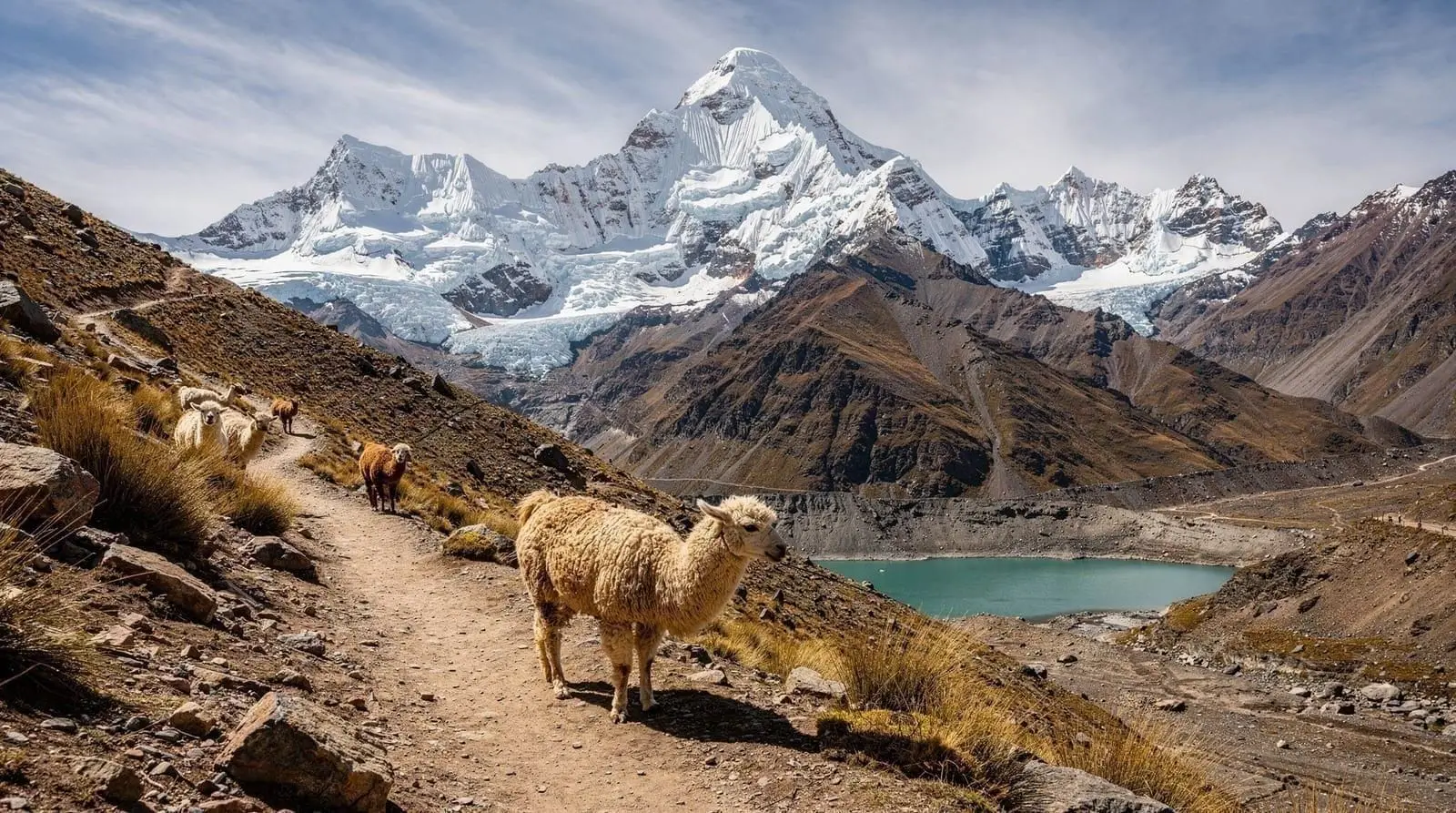
Ausangate trek guide
From Cusco: Ausangate Lakes and Glaciers ATV Tour
What is the Ausangate trek?
A high-altitude circuit around Nevado Ausangate (6,384 m) in the Cordillera Vilcanota, usually 4–6 days, crossing passes between 4,800 m and 5,200 m. It is one of Peru's most remote and physically demanding treks, far quieter than the Inca Trail, and increasingly combined with Rainbow Mountain.
The hardest trek near Cusco, and the most rewarding
If the Inca Trail is the famous trek and Salkantay is the popular alternative, the Ausangate circuit is the connoisseur’s choice — the high, remote, punishing loop that serious trekkers talk about in lowered voices. It rings Nevado Ausangate, the 6,384 m glaciated peak revered as the most powerful apu (mountain spirit) of the southern Andes, and it never drops below 4,000 m for its entire length. You cross passes above 5,000 m on back-to-back days, sleep in sub-freezing camps, and for stretches of the route you will not see another foreign trekker — only herders, alpacas, and the occasional vicuña.
This guide is honest about what that means. Ausangate is not a stepping-stone trek you do straight off the plane. It demands real acclimatisation, decent fitness, and respect for the altitude. In return it gives you turquoise glacial lakes, hot springs, red-rock valleys, and — increasingly — a back-route to Rainbow Mountain that beats the day-trip experience by a wide margin. If you want a shorter taste of the same scenery without the full commitment, our Ausangate lakes day trip guide covers the single-day option.
| Where | Cordillera Vilcanota, ~100 km southeast of Cusco, staged from Tinki |
| Cost | Around S/900–1,800/person for 4–5 days, all-inclusive of guide, cook and pack animals |
| Time needed | 4–6 days, never dropping below 4,000 m |
| Altitude | Passes at 4,800–5,200 m; camps at 4,300–4,800 m |
| Best time | Dry season, May–September only |
Where the trek goes
The Ausangate circuit lies about 100 km southeast of Cusco in the Cordillera Vilcanota. Almost every route stages from the village of Tinki (around 3,800 m), a three-to-four-hour drive from Cusco via Urcos. From there the trail climbs into a world of glaciers and high pampa, looping clockwise (or counter-clockwise) around the massif.
A typical 5-day itinerary covers these high points:
- Day 1: Cusco to Tinki by road, then trek to the first camp around Upis (4,400 m), often beside natural hot springs.
- Day 2: cross the first major pass, often Arapa or Apuchata, near 4,800–4,900 m, descending to camp at a high lagoon.
- Day 3: the big one — over the Palomani pass at roughly 5,100–5,200 m, the trek’s highest point, with the full glaciated south face of Ausangate above you.
- Day 4: cross another pass and, on longer variants, route toward the Vilcanota lakes or the approach to Rainbow Mountain.
- Day 5: descend out toward Pacchanta (with more hot springs) and drive back to Cusco.
Distances run 6–12 km a day, but distance is the wrong metric here. Altitude is the real difficulty. Six kilometres over a 5,100 m pass is a far bigger day than fifteen flat kilometres at sea level.
The Rainbow Mountain connection
The single biggest change to Ausangate trekking in recent years is the Rainbow Mountain detour. Vinicunca sits within the same Vilcanota range, and several 4–6 day itineraries now route over or alongside it. The advantage is enormous: trekkers reach Rainbow Mountain on foot from the quiet back side, often in the early morning before the convoy of day-trip vans arrives from Cusco. You get the famous striped ridge with a fraction of the crowds.
If the multi-day commitment is too much but Rainbow Mountain is non-negotiable, the standard day trip remains the practical option — see our best day trips from Cusco for how it stacks up. But if you have the days and the legs, reaching it as part of the Ausangate circuit is a categorically better experience.
How hard is it really?
Let me be blunt: Ausangate is harder than the Inca Trail and harder than Salkantay, and the reason is sustained altitude. On most multi-day Cusco treks you cross one high pass and spend the rest below it. On Ausangate you are above 4,000 m for the entire trek and cross 5,000 m-plus passes repeatedly. Your body never gets a low-altitude night to recover.
That has three consequences. First, you must arrive already well acclimatised — at least three or four days in Cusco or the Sacred Valley beforehand, ideally with a high day hike like the Ausangate lakes or Humantay Lake under your belt. Second, fitness helps but does not substitute for acclimatisation; very fit people who skip the build-up still get altitude sickness. Third, the cold is severe — camp nights routinely drop to −10 °C or lower, and your gear has to handle it.
If you have never trekked at altitude before, do not make Ausangate your first attempt. Build up with Salkantay or a Sacred Valley multi-day first. Our altitude sickness guide explains the symptoms that mean you must descend rather than push on.
Costs and what is included
Guided group treks run roughly S/900–1,800 (about $240–490) for the standard 4–5 day circuit. The price reflects real logistics: this is a self-sufficient expedition into terrain with no lodges, no shops, and no road access for days.
A fair, fully inclusive price covers:
- A licensed bilingual guide and a cook.
- Pack animals (horses or llamas) and an arriero (wrangler) to carry group gear, tents, and food.
- Tents, dining tent, sleeping mats, and all meals on the trail.
- Round-trip transport between Cusco and the Tinki trailhead.
What is usually extra: a sleeping bag rated to −15 °C (rent for S/40–70 if you do not own one), community entrance fees of S/10–30 at several checkpoints, the separate Rainbow Mountain entry if your route includes it, and tips for the guide, cook, and arriero (budget S/100–200 total across the team for a multi-day trek).
Be wary of the cheapest operators. On a trek where you are days from help, the savings come from thin tents, overworked staff, no emergency oxygen, and unqualified guides. This is the wrong corner of the budget to economise.
Independent vs guided
Unlike the Inca Trail, Ausangate has no permit system, so independent trekking is legal and possible. People do it. But the practical hurdles are real: route-finding across unmarked high terrain, carrying or arranging pack animals from Tinki, cooking for yourself at altitude, and managing emergencies with no support. For all but very experienced high-altitude trekkers, a guided trip is the sensible and often safer choice — and it puts money into the local communities whose land you cross.
When to go
The dry season — May to September — is the only sensible window. Days are clear and intensely sunny; nights are bitterly cold but stable. June to August is the reliable core, with the trade-off of the coldest nights and the most other trekkers (still very few by Inca Trail standards).
Avoid the wet season (December to March) entirely. Snow buries the passes, the trails turn to mud or vanish, river crossings swell, and the lakes lose their colour under grey cloud. It is both miserable and genuinely dangerous, and most reputable operators do not run trips then. The shoulder months of April and October can work but carry weather risk. For the wider seasonal picture, see the best time to visit Cusco.
A lower-commitment way to taste Ausangate
Not ready for four nights above 4,000 m? You do not have to skip the mountain. The Ausangate lakes and glaciers ATV tour from Cusco delivers the glacial lagoons and the south-face glacier views in a single (long) day with minimal walking — a fair compromise for travellers short on time or unsure of their altitude tolerance. The day-hike option is the middle ground for those who want to walk but not camp.
If your heart is set on a multi-day Andean trek but Ausangate sounds like too much, the 5-day Salkantay ultimate trek to Machu Picchu is the logical alternative: lower, warmer, busier, and ending at Machu Picchu rather than circling a single peak. Our Salkantay trek guide compares the two in detail.
What to pack
- A −15 °C-rated sleeping bag, a warm sleeping mat, and a thermal liner.
- A full layering system: thermal base layers, fleece, an insulated jacket, and a windproof, waterproof shell.
- Warm hat, gloves, and a buff for the freezing dawns and pass crossings.
- Broken-in waterproof boots, gaiters, and trekking poles.
- Fierce sun protection: glacier-grade sunglasses, brimmed hat, and high-factor sunscreen and lip balm.
- A headlamp, power bank, and water purification or tablets.
- Cash in soles for fees and tips, and any personal altitude medication.
Route variations to know
Ausangate is not a single fixed route, and the version your operator sells matters. A few common variations:
The classic 5-day circuit loops the full massif, crossing the high passes and taking in the Vilcanota lakes and the hot springs at Upis and Pacchanta. This is the benchmark experience.
The 7-day Ausangate–Rainbow Mountain trek adds the Vinicunca detour and often a more remote extension, reaching Rainbow Mountain on foot from the quiet side. This is the route for trekkers who want the striped ridge without the day-trip crowds.
Shorter 3–4 day versions cut one or two passes and camps, sampling the scenery for those with less time or appetite for consecutive 5,000 m days. They are still demanding.
Lodge-to-lodge variants exist on parts of the range, using fixed mountain lodges instead of tents — far more comfortable and far more expensive, and a good option for those who want the route without the camping.
Always confirm exactly which passes, lakes, and side trips your itinerary includes, and whether Rainbow Mountain is genuinely part of it or just a marketing mention.
Training and preparation
You cannot fake your way through Ausangate, but you can prepare for it. In the months before, build cardiovascular endurance with long hikes, stair climbing, or running, and get used to carrying a daypack for hours — even with porters handling the main gear, you carry water, layers, and snacks all day. Break in your boots thoroughly; a 5,100 m pass is the wrong place to discover a hot spot.
The preparation that matters most, though, happens in Peru: acclimatisation. Arrive in Cusco at least three or four days before the trek, sleep high, and ideally do a high day hike first — the Ausangate lakes, Humantay, or Rainbow Mountain — to test how your body handles serious altitude before you are committed to days of it with no easy exit. If those day hikes go badly, take it as the warning it is and reconsider the full circuit.
How Ausangate compares to the other Cusco treks
To place it among the region’s multi-day options: the Inca Trail is the historic, permit-controlled classic ending at the Sun Gate above Machu Picchu — busy, regulated, and culturally rich, with one major pass. Salkantay is the popular alternative — lower, warmer, no permit needed, also ending at Machu Picchu, with one big high pass and a long descent into cloud forest. Ausangate is the outlier: it does not end at Machu Picchu, it circles a single sacred peak, it stays high throughout, and it is the quietest and hardest of the three. Choose Ausangate when the landscape and the solitude are the goal in themselves, not the ruins at the end.
Is the Ausangate trek for you?
If you are an acclimatised, fit trekker who wants the wildest, highest, quietest multi-day route the Cusco region offers — and who would rather earn Rainbow Mountain on foot than queue for it — Ausangate is unmatched. If you are new to altitude trekking, short on acclimatisation days, or want to end at Machu Picchu, choose Salkantay or the Inca Trail and come back for Ausangate when you are ready. Whatever you decide, do not underestimate it: the altitude that makes this trek extraordinary is the same altitude that makes it unforgiving.
Responsible trekking on Ausangate
Ausangate is not just a mountain; it is the most sacred apu of the southern Andes, woven into Quechua belief and ritual, and the high pilgrimage of Qoyllur Rit’i takes place on its flanks each year. Trek it with that in mind. The route crosses community land, so pay the entrance fees willingly and tip the local arrieros, cooks, and guides who make the trip possible — they are the economic backbone of these high villages.
Choose operators who pay their staff fairly, use pack animals humanely, and carry out all waste. Pack out everything, use established camps and toilet practices, and never leave litter in an environment where the cold preserves it almost indefinitely. Going lightly is how the circuit stays the wild, quiet route that makes it worth the effort in the first place.
Choosing an operator for a remote multi-day trek
Because Ausangate has no permit system and no huts, the operator you choose is effectively your entire safety net for four to six days. Ask directly: how many staff per trekker, what emergency evacuation plan exists if someone develops HAPE or HACE at a 5,000 m pass, whether the cook and arriero are paid fairly and given proper gear, and how recent their group’s reviews are. A good operator answers plainly and in detail; a vague or defensive answer on safety questions is reason to look elsewhere, especially given how far this route sits from any clinic. Group size also matters more here than on the Inca Trail — smaller groups move faster over the passes and get more attention from the guide if someone struggles.
Frequently asked questions about the Ausangate trek
Frequently asked questions about Ausangate trek
How hard is the Ausangate trek?
How many days does the Ausangate trek take?
How much does the Ausangate trek cost?
Do I need a permit for the Ausangate trek?
When is the best time to trek Ausangate?
Can I see Rainbow Mountain on the Ausangate trek?
Top experiences
Bookable activities with verified prices and instant confirmation on GetYourGuide.

