ATV and quad tours from Cusco: honest guide
From Cusco: Rainbow Mountain and Red Valley ATV Tour
Are ATV tours from Cusco worth it?
Yes, for the right traveller. ATV (quad) tours cover scenic high-Andes terrain you would otherwise see only on foot or from a van, and they are a good fit for people who want active sightseeing without a long hike. The catches are real altitude (routes climb to 4,000–5,000 m), variable operator safety standards, and dust. Choose a reputable operator and respect the altitude.
A different way to see the high Andes
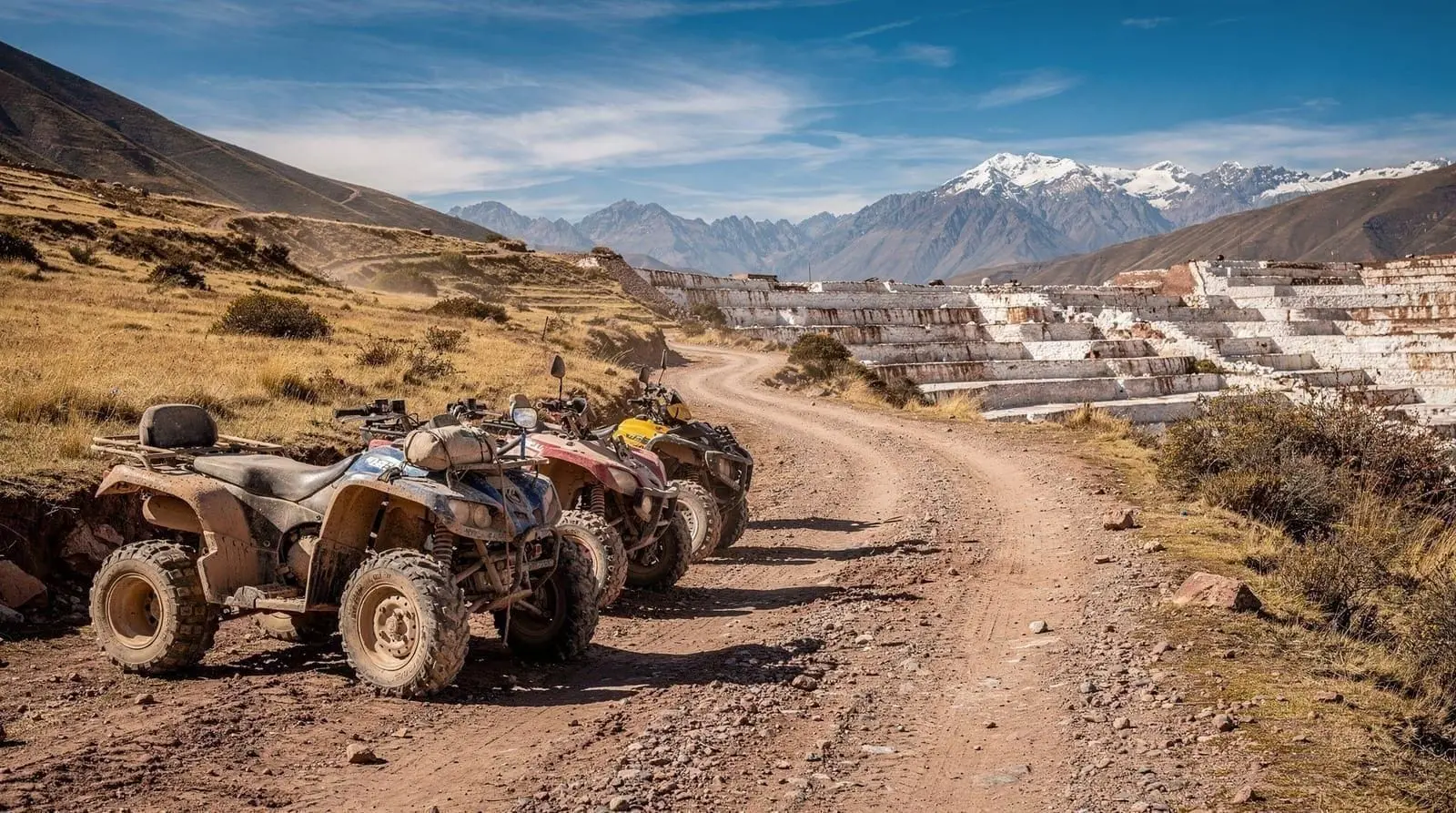
Most visitors experience the landscape around Cusco from a tour van window or on foot. ATV tours — quad bikes, in local parlance — offer a third way: covering ground actively, on dirt tracks through farmland, past Inca terraces, and up toward high-altitude lakes and ridgelines, with the wind and the dust and a measure of control over your own pace. For travellers who find long hikes too much at altitude but want more than a bus seat, it is a genuinely good middle path.
It is also a category where the honest-planner caveats matter. These are real machines on real terrain at real altitude — routes climb anywhere from 3,300 m in the Sacred Valley to nearly 5,000 m near Rainbow Mountain. Operator quality varies from professional outfits with maintained quads and proper helmets to cut-price operators that skimp on both. The altitude impairs judgment and stamina. And the Andes throw cold, dust, and weather at you fast. This guide covers the main routes, real prices, who they suit, and how to do them without becoming a cautionary tale.
| Where | Maras-Moray (Sacred Valley), Rainbow Mountain/Red Valley, Ausangate |
| Cost | Around $40–80 half-day; $90–160 full-day high routes |
| Time needed | Half-day (Maras-Moray) to a 12-hour day (Rainbow Mountain/Ausangate) |
| Altitude | 3,300 m up to nearly 5,000 m — acclimatise before high routes |
| Best fit | Active travellers who want scenery without a full trek or hike |
The main ATV routes from Cusco
Maras, Moray and the salt pans (the classic starter)
The most popular ATV tour is the Maras-Moray circuit in the Sacred Valley. You ride through high farmland and rolling Andean countryside between the Moray concentric agricultural terraces and the Maras salt pans — thousands of small white salt ponds cascading down a hillside, fed by a saline spring the Incas already exploited.
It is the best beginner route: the altitude is moderate by Cusco standards (roughly 3,300–3,500 m), the terrain is mostly gentle dirt track, and the scenery is constant. Half-day tours run about $40–80 per person depending on whether you ride solo or share a quad, group size, and what is included (transport from Cusco, site entrances, sometimes lunch). It pairs naturally with a Sacred Valley day.
Rainbow Mountain and the Red Valley (the dramatic one)
For high-altitude spectacle, the Rainbow Mountain (Vinicunca) ATV routes are the headline. You quad across a remote, treeless plateau toward the striped mineral ridges, often combined with the deep-red Red Valley nearby. The Rainbow Mountain and Red Valley ATV tour from Cusco swaps part of the standard slog for a quad ride, which appeals to people who want the scenery without the full uphill walk — though you will still hike the final stretch to the viewpoint at around 5,000 m.
This is not a casual outing. The altitude here is extreme — far above Cusco — and demands prior acclimatisation. Do not book it for your first days in the region. Full-day prices run roughly $90–160 given the long pre-dawn transfer, entrances, and altitude logistics.
Ausangate lakes and glaciers (the wild card)
Beyond Rainbow Mountain, the Ausangate massif offers some of the most striking high-Andes scenery anywhere — turquoise glacial lakes beneath a sacred snow peak. The Ausangate lakes and glaciers ATV tour rides through this dramatic, far less crowded landscape. Like Rainbow Mountain, it is high (around 4,500–5,000 m), remote, and best for travellers who are already acclimatised and comfortable on a quad. The reward is scenery without the crowds that swamp Vinicunca.
Altitude: the rule that overrides everything
The single most important planning point. ATV routes near Cusco range from 3,300 m to nearly 5,000 m, and altitude does not care that you are sitting on a machine rather than walking.
- Acclimatise first. Do not do a high route (Rainbow Mountain, Ausangate) in your first days. Spend time at Cusco altitude or, better, the lower Sacred Valley first. The Maras-Moray route is the safer early choice because it is lower.
- Altitude impairs judgment and reaction time. Thin air plus a motorised vehicle is a combination to respect. Ride conservatively.
- The final approach is often on foot. Even ATV “Rainbow Mountain” tours involve a hike at the top, at 5,000 m, where every step is hard.
- Know the danger signs. Headache and breathlessness are normal; confusion, loss of coordination, or a wet cough mean descend and get help.
Read the altitude sickness in Cusco guide before booking any high route, and the altitude medicine scams guide so you do not waste money on canned oxygen at the trailhead.
Choosing a safe operator
This is where the honest planning earns its keep. ATV operator quality in Cusco runs a wide spectrum, and the cheapest option is rarely the one to take.
What to check before booking:
- Helmets provided, no exceptions. A reputable operator gives every rider a helmet. If they shrug at this, walk away.
- Machine condition. Ask the age and maintenance of the quads. Worn brakes and bald tyres on a high dirt track are a real hazard.
- A proper briefing. Beginners should get hands-on instruction on a flat area before setting off, not a wave toward the bikes.
- Guide-to-rider ratio. A guide who can actually keep the group together matters on remote high trails.
- Group size and insurance. Smaller groups get more attention; ask what insurance covers in case of an accident.
- Honest reviews. Recent, specific reviews mentioning safety and machine condition are worth more than star averages.
Booking through an established platform with verifiable reviews and clear inclusions reduces the odds of ending up with a fly-by-night operator. Whatever you book, insist on the helmet, ride within your limits, and never ride after drinking — basic rules that the cut-price end of the market sometimes lets slide.
What to wear and bring
The high Andes are cold, sunny, and extraordinarily dusty, often all within an hour.
- Layers. A warm base, a windproof outer, and something you can shed as the sun rises. High routes start frigid before dawn.
- A buff, scarf, or bandana and sunglasses or goggles. The dust on dirt tracks is relentless; protect your eyes and airways.
- Gloves and closed shoes. Bare hands and open shoes are miserable on a quad.
- Strong sun protection. UV at 4,000–5,000 m is brutal even on cool days.
- Water and a snack, plus any personal medication.
- A dust-proof case for your phone or camera.
Operators usually supply a helmet and sometimes goggles and an overall; confirm exactly what is included so you are not caught out.
Who ATV tours suit (and who should skip them)
Good fit: active travellers who want to cover scenic ground without a full trek, people who enjoy driving, and anyone wanting a different angle on the Sacred Valley or the high country. The Maras-Moray route in particular is accessible to confident beginners.
Think twice if: you are newly arrived and not acclimatised (do a lower route or wait), you are uneasy on motorised vehicles, or you have heart or respiratory conditions that altitude exertion would aggravate — check with a doctor. Pregnant travellers and very young children are generally not suited to the high or rougher routes.
For gentler high-Andes experiences, the Humantay Lake day and the standard Rainbow Mountain hike are alternatives; for the full safety picture across activities see /guides/peru-travel-safety-2026/. Browse /itineraries/ to slot an adventure day into a wider trip and the planning tools at /tools/.
How an ATV day actually unfolds
To set expectations, here is the rough shape of a typical tour so the logistics are not a surprise.
Maras-Moray half-day. Pickup from your Cusco hotel mid-morning, a 45–60 minute drive to the staging area in the high Sacred Valley, then a safety briefing and a flat practice loop before setting off. You ride between the Maras-Moray sites — typically stopping at the Moray terraces and the salt pans, with time off the bike to walk and photograph — then ride back to the vehicles and return to Cusco by late afternoon. Total quad time is usually two to three hours.
Rainbow Mountain full-day. This is a long day. Expect a pre-dawn pickup (often around 4:00 am) for the multi-hour drive to the high trailhead, breakfast en route, the quad ride across the plateau, the final hike to the Rainbow Mountain viewpoint, lunch, and a long drive back, returning to Cusco in the evening. Twelve hours door to door is normal. The altitude makes it genuinely demanding regardless of the quad.
Knowing the shape helps you judge fit: the half-day suits almost anyone acclimatised; the full-day high routes are for people who tolerate long days and thin air.
Cost breakdown: what you are paying for
When you compare quotes, the headline price hides a lot. A fair ATV tour price typically covers:
- The quad rental and fuel.
- A guide and safety briefing.
- Hotel pickup and drop-off transport to the trailhead.
- A helmet (and sometimes goggles, gloves, or an overall).
- On longer routes, site entrance fees and lunch.
The big swing factor is single versus shared quad — riding your own costs more than sharing or going pillion. Suspiciously cheap tours usually cut on machine quality, group size, or safety gear, not on profit margin. When one quote is far below the rest, ask exactly what is missing. Paying a bit more for a maintained quad, a real helmet, and a competent guide is the right trade on terrain like this.
ATV versus hiking versus horseback: comparing the options
For the same landscapes, Cusco visitors typically choose between an ATV, a hike, or a horseback tour, and each suits a different traveller.
- ATV: covers the most ground fastest, needs no fitness beyond comfort on the machine, but demands you handle a vehicle on rough terrain and tolerate dust and noise. Best for active travellers short on time or wary of long walks.
- Hiking: the Rainbow Mountain hike or Humantay Lake walk-in gives a quieter, self-paced experience and no machine to manage, but requires real fitness and more time at altitude on foot.
- Horseback: widely offered as an add-on or alternative on the same routes, easier on the legs than hiking but still exposed to weather, and horse welfare standards vary — ask about the animals’ rest and load before booking.
If your priority is speed and novelty, ATV wins. If it is a quieter, more contemplative pace, hiking wins. There is no wrong choice, only a mismatch between the option and your fitness or interests.
Frequently asked questions about ATV and quad tours from Cusco: honest
Do I need a licence or experience to ride an ATV in Cusco?
How much do ATV tours from Cusco cost?
Which ATV route from Cusco is best?
Is it safe to ride an ATV at altitude near Cusco?
Can beginners do ATV tours in Cusco?
What should I wear and bring for an ATV tour from Cusco?
Top experiences
Bookable activities with verified prices and instant confirmation on GetYourGuide.

