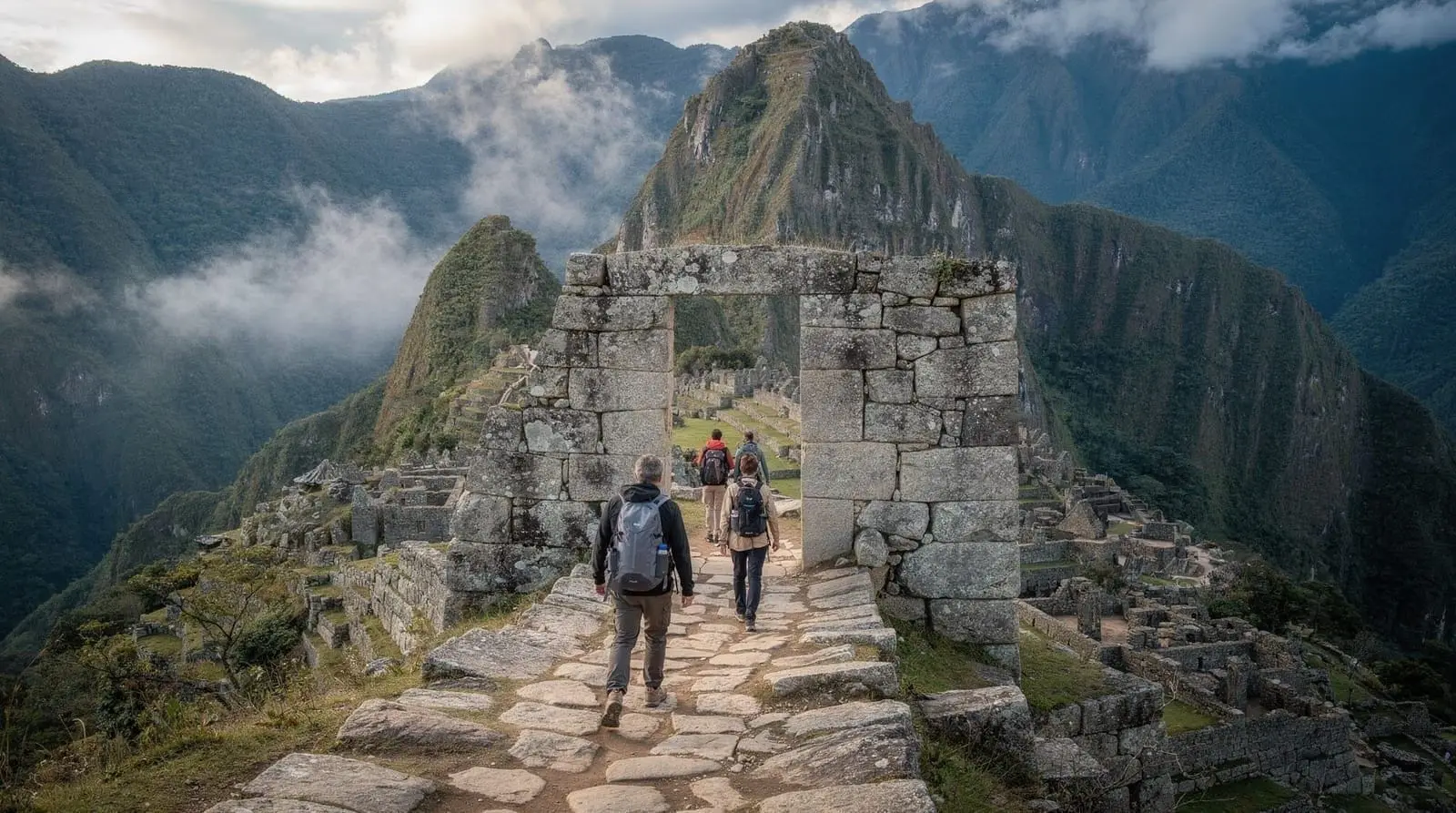
Short Inca Trail (2-day) guide: the one-day hike to Machu Picchu
From Cusco: Machu Picchu Short Inca Trail 2-Day Tour
What is the Short Inca Trail and who is it for?
The Short Inca Trail is a 2-day tour with one real hiking day: about 10-12 km from KM104, up through the Sun Gate to Machu Picchu, then a hotel night in Aguas Calientes and the citadel the next morning. It needs the same permit as the 4-day trek and suits hikers short on time or fitness.
The Inca Trail for people who don’t have four days
The classic 4-day Inca Trail is the most famous trek in South America, but it asks a lot: four days of camping, a 4,215 m pass, permits booked months ahead, and a price tag to match. Plenty of travellers cannot give it the time, the fitness, or the camping nights — and that is exactly the gap the Short Inca Trail fills. It is the only other way to walk the original Inca stone path and enter Machu Picchu through the Sun Gate on foot, compressed into a single demanding-but-manageable hiking day with a hotel bed at the end instead of a tent.
It is genuinely the best-kept compromise in the Cusco trekking menu, and it is also widely misunderstood — people assume “2-day” means two days of hiking, or that it skips the permit. Neither is true. This guide lays out exactly what the route is, the permit situation (which catches a lot of people out), the fitness you need, what it costs, and how to decide between the short trail, the full 4-day trek, and simply taking the train. If you want the long version, read it against the Inca Trail complete guide and the best treks to Machu Picchu round-up.
| Where | KM104 trailhead to Machu Picchu via the Sun Gate |
| Cost | less than the 4-day trek, more than the train alone |
| Time needed | 1 hiking day (10-12 km, 6-7 hours) plus a Machu Picchu morning |
| Getting there | train or transfer from Cusco/Ollantaytambo to KM104 |
| Best time | May-September dry season; trail closed every February |
What the Short Inca Trail actually is
The Short Inca Trail is a 2-day, 1-night tour with one real day of hiking. The route starts at the trailhead known as KM104, on the railway line between Ollantaytambo and Aguas Calientes. The hike covers roughly 10–12 km over six to seven hours, climbing the original Inca paving, passing the ruins of Chachabamba and the spectacular terraced site of Wiñay Wayna (“forever young”), before the final climb to Intipunku, the Sun Gate — the same dramatic first view of Machu Picchu that 4-day trekkers earn.
You then descend to the citadel and bus down to Aguas Calientes for a hotel night. The next morning you return to Machu Picchu, properly rested, for a guided tour of the ruins themselves on a timed circuit.
So you walk the iconic last stretch of the Inca Trail — the part with the Sun Gate arrival — without the three days of high-altitude camping that precede it on the classic route. You sleep in a real bed, you tour Machu Picchu fresh rather than exhausted, and you still arrive on foot through the gate the way the Inca intended.
You still need a permit
This is the single most important thing to understand, and the one most travellers miss: the Short Inca Trail uses the same restricted permit system as the 4-day trek. Both routes share the same daily quota of trail spaces, the same government regulation, and the same rule that you cannot hike either independently — a licensed operator and guide are mandatory.
That means short-trail permits sell out, just like the long ones, though usually with somewhat less lead time. In high season (roughly May to September) you should book two to four months ahead; for the quieter months you may get away with less, but never assume walk-up availability. And like the 4-day trek, the Short Inca Trail closes every February for maintenance, when only the train and the alternative treks reach Machu Picchu. The full permit mechanics, release timing and broker tips are in the Inca Trail permits guide.
The guided short trail with the permit, transport, guide and Machu Picchu tour bundled is the Short Inca Trail 2-day tour from Cusco.
A note on the “2-day Inca Trail with train”
You will also see a separate “2-day Inca Trail” product that uses a panoramic train for part of the journey rather than starting from KM104. These vary — some are essentially a train-and-Machu-Picchu tour with a short walk, others a lighter hiking variant — so read the inclusions carefully if walking the Sun Gate stretch is your goal. The 2-day Inca Trail with panoramic train is the train-assisted version; confirm exactly how much hiking it actually involves before booking if the on-foot Sun Gate arrival is what you want.
Day by day
Day 1 — KM104 to Machu Picchu via the Sun Gate
An early start: a transfer or train from Cusco / Ollantaytambo to KM104, where you cross the Urubamba River and begin. The trail climbs steadily — the first couple of hours of ascent are the hardest part of the whole tour — past Chachabamba, then traverses to the terraces of Wiñay Wayna, one of the most beautiful ruins on the entire trail and far less crowded than Machu Picchu itself. From there a gentler stretch leads to the Sun Gate (Intipunku), where Machu Picchu first appears below you, framed by the peak of Huayna Picchu. You descend to the citadel for photos in the late-afternoon light, then take the shuttle bus down to Aguas Calientes and check into your hotel. Total hiking: around six to seven hours, 10–12 km.
Day 2 — Machu Picchu
A relaxed start compared with the campers’ pre-dawn scramble. You return up to Machu Picchu by the first or second buses for a full guided tour of the citadel on your assigned circuit — the temples, the terraces, the residential sectors — without yesterday’s pack on your back. Afterwards you return to Aguas Calientes and take the train back toward Ollantaytambo and a transfer to Cusco. For how the citadel’s timed circuits work, see the Machu Picchu circuits explained guide.
How fit do you need to be?
The Short Inca Trail is moderately demanding for one day, not a stroll. The high point — the Sun Gate — sits at about 2,720 m, well below the 4,215 m of the classic trek’s Dead Woman’s Pass, so altitude is far less of a factor here than on the 4-day route or on Salkantay. The challenge is the sustained uphill on stone steps for six-plus hours with a daypack. If you can manage a long, hilly day hike, you can do this. It is a realistic option for moderately fit travellers, older hikers, and families with teenagers who would find four days of camping too much.
Bring broken-in boots, layers (it can be hot and humid on the lower trail and cool at the Sun Gate), rain gear, sun protection, plenty of water, snacks, and a daypack — the operator handles the rest. You will not need camping gear.
Costs and what to check
The Short Inca Trail costs less than the 4-day trek (fewer days, no camping logistics, no porters carrying camp kit) but more than simply taking the train to Machu Picchu, because you are paying for the regulated permit, the licensed guide and the trail experience. Before booking, confirm the tour includes: the trail permit, the Machu Picchu entrance and a guided citadel tour on day two, transport (the train to KM104 and back), the Aguas Calientes hotel night, the bus up and down between Aguas Calientes and the citadel, and meals as stated. Cheaper tours sometimes leave the Machu Picchu bus, some meals, or even the second-day entrance for you to cover separately.
The ruins you actually walk past
One of the under-sold strengths of the Short Inca Trail is that the single hiking day takes in two genuine Inca sites that train passengers never see, plus the most famous gateway in the Andes.
Chachabamba. Soon after you cross the river at KM104, you reach Chachabamba, a compact ceremonial and water-shrine complex with finely cut fountains. It sat on the trail to control access to the sanctuary and is a quiet, atmospheric first stop before the climb begins in earnest.
Wiñay Wayna. The highlight of the hike. “Forever young” in Quechua, Wiñay Wayna is a spectacular tier of curved agricultural terraces and ritual buildings clinging to a steep slope above the Urubamba, with a run of ceremonial fountains. Many trekkers rate it the most beautiful ruin on the whole Inca Trail, and because it sits late in the day’s walk you often have it to yourself or nearly so — a stark contrast to Machu Picchu’s crowds.
Intipunku, the Sun Gate. The payoff. The original Inca gateway frames your first view of Machu Picchu spread out below, with Huayna Picchu rising behind it. Arriving here on foot, having earned it over a day’s climb, is a different emotional experience from stepping off a bus — and it is the single thing that makes the short trail worth choosing over the train.
When to go
The Short Inca Trail follows the same calendar as the classic route. The dry season (May to September) gives the clearest Sun Gate views and the firmest footing on the stone steps, at the cost of the highest demand for the shared permit. The shoulder months of April and October are quieter and mostly dry — a good compromise. The wet season (November to March, except the February closure) means humid, slippery stone, cloud that can veil the Sun Gate view, and the heaviest rain in January and February. Remember the trail is completely closed every February for maintenance; in that month only the train and the alternative treks such as Salkantay reach Machu Picchu.
Short trail vs 4-day trek vs the train
Take the Short Inca Trail if you want to walk the original Inca path and arrive through the Sun Gate, but cannot spare four days, do not want to camp, or are not sure about four days of high-altitude hiking. You get the iconic arrival and a real bed.
Take the classic 4-day trek if you want the full experience — the high passes, the string of ruins like Runkurakay and Sayacmarca, the camaraderie of camp, and the dawn Sun Gate arrival at the end of a four-day journey. It is harder, longer and pricier, and needs the earliest booking. The 4-day Inca Trail guided trek is the full version.
Just take the train if you have no interest in hiking, are very short on time, or could not get a permit. You reach Machu Picchu by train to Aguas Calientes and bus up — no Sun Gate arrival on foot, but the easiest and often cheapest way in. The Inca Trail complete guide weighs all the options together.
| Option | Hiking | Camping | Permit needed | Sun Gate on foot |
|---|---|---|---|---|
| Short Inca Trail | 1 day, 10-12 km | No — hotel night | Yes | Yes |
| 4-day Inca Trail | 4 days, ~42 km | Yes, 3 nights | Yes | Yes |
| Train only | None | No | No | No |
If the permit is sold out
Because the Short Inca Trail shares its permit pool with the classic trek, it can sell out for your preferred dates even in shoulder season. If that happens, do not panic — the best treks to Machu Picchu guide lists non-permitted alternatives such as Salkantay, which reaches Machu Picchu without any quota system and can usually be booked with far less notice. It is a longer, higher trek, but it is the most reliable fallback if the short trail is gone for your window.
Who the Short Inca Trail suits best
Think of the Short Inca Trail as the answer for a specific traveller profile rather than a universal recommendation. It suits people who want the emotional payoff of walking through the Sun Gate but who are constrained by time, fitness, or simply a dislike of camping — families with teenagers, older travellers who still hike regularly, and anyone who booked late and found the 4-day trek’s permits gone. It suits it less if you specifically want the archaeology-dense, multi-day journey of the classic route, or if a single demanding day of stone-step climbing at altitude (even the lower altitude here) sounds worse to you than simply taking the train.
Health and comfort notes for the hiking day
The single hiking day is short by trekking standards but genuinely strenuous in its own right — six to seven hours of sustained uphill on uneven stone steps is a real workout even without serious altitude to contend with. Pace yourself early rather than pushing hard on the first climb past Chachabamba; a steady, moderate rhythm gets you to Wiñay Wayna in better shape than a fast start followed by a slow, exhausted finish. Carry more water than you think you need — the exposed lower sections get hot and humid, and refill points are limited. A trekking pole or two, even just one, noticeably eases the knees on the steeper stone stretches, particularly if you are not used to sustained stair-climbing.
Frequently asked questions about the Short Inca Trail
How long is the Short Inca Trail hike?
The hiking portion is about 10–12 km over six to seven hours on a single day, starting from KM104 and ending at Machu Picchu via the Sun Gate. The “2 days” of the tour refers to the hiking day plus a hotel night in Aguas Calientes and a guided Machu Picchu visit the next morning.
Do I need a permit for the Short Inca Trail?
Yes. The Short Inca Trail uses the same restricted permit system as the 4-day trek, and you must go with a licensed operator and guide — independent hiking is not allowed. Permits sell out in high season, so book two to four months ahead, and note the trail closes every February for maintenance.
Is the Short Inca Trail hard?
It is moderately demanding for one day — six-plus hours of uphill on stone steps with a daypack — but the altitude is much lower than the 4-day trek (the Sun Gate is about 2,720 m), so it is far more accessible. Reasonably fit travellers, including older hikers and families with teenagers, can do it.
What is the difference between the Short Inca Trail and the 4-day Inca Trail?
The Short Inca Trail is one hiking day from KM104 to Machu Picchu via the Sun Gate, with a hotel night and no camping. The 4-day trek covers far more distance, crosses high passes up to 4,215 m, passes many more ruins, and involves three nights of camping. Both arrive through the Sun Gate and both need a permit.
Can I do the Short Inca Trail without a guide?
No. Like the classic Inca Trail, it can only be hiked with a licensed operator and an accompanying guide — independent trekking is prohibited on the regulated trail. You book it as a guided tour that includes the permit.
How far in advance should I book the Short Inca Trail?
For high season (May to September), book two to four months ahead, as the shared permit quota sells out. Shoulder and low-season dates can sometimes be booked with less notice, but never rely on last-minute availability, and remember the trail is closed throughout February.
Top experiences
Bookable activities with verified prices and instant confirmation on GetYourGuide.
