Qoyllur Rit'i: the snow-star pilgrimage
What is Qoyllur Rit'i?
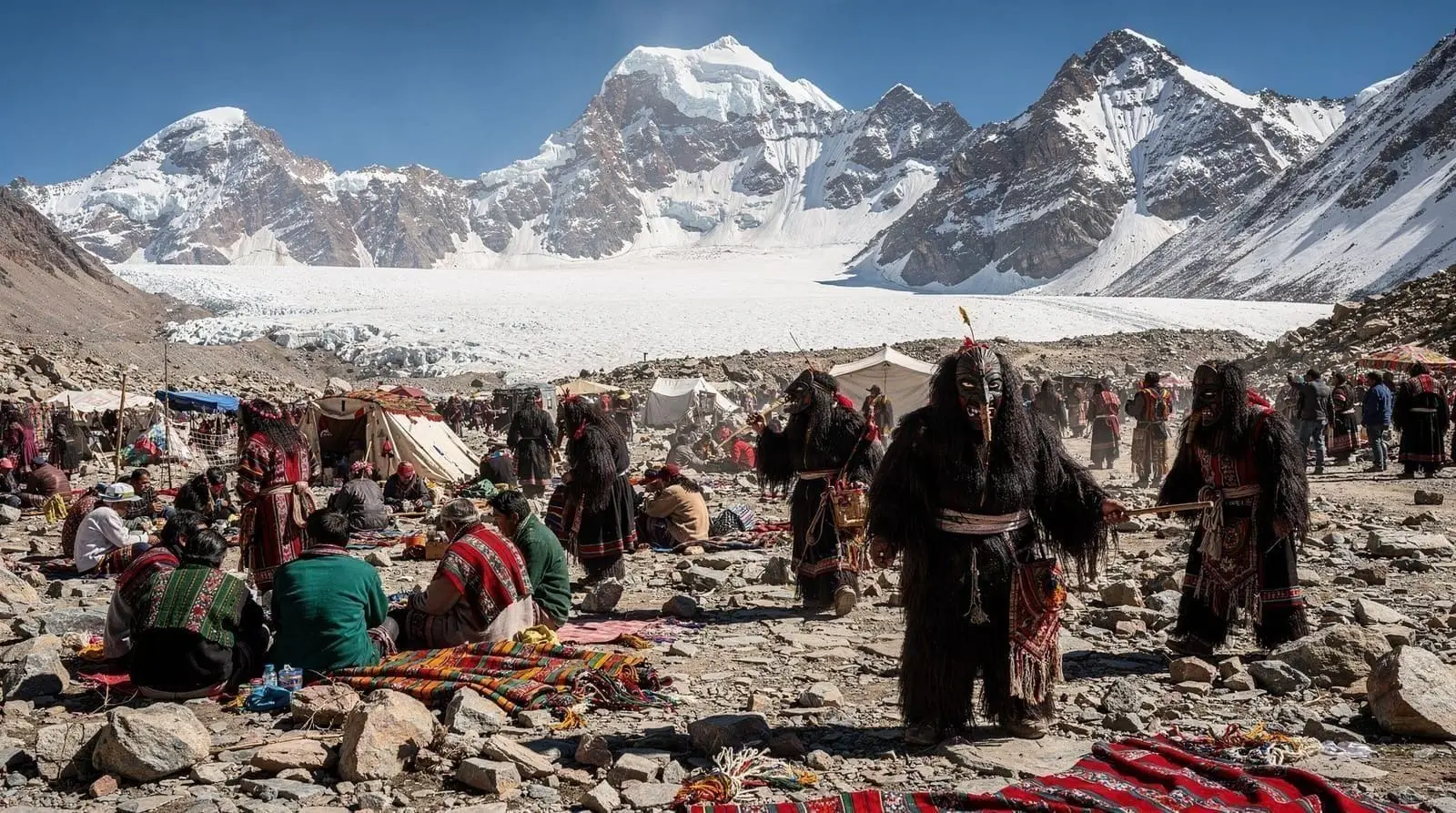
Qoyllur Rit'i is a vast Andean pilgrimage held high on the slopes below the Sinakara glacier near Mount Ausangate, southeast of Cusco. Tens of thousands of pilgrims climb to nearly 4,800 m to honour a Christ image and far older mountain-worship traditions, with days of dancing, processions, and the famous ukuku bear-men who ascend the glacier. It falls in late May or June, before Corpus Christi.
The biggest festival most travellers never hear about
Every year, in the cold weeks before Corpus Christi, tens of thousands of people climb to nearly 4,800 m on the flanks of Ausangate, the highest and most sacred mountain in the Cusco region, and gather in a freezing high valley for days of dancing, prayer, and ritual. This is Qoyllur Rit’i — “snow star” in Quechua — and it is one of the largest Indigenous pilgrimages in the Americas.
It is also almost invisible on the standard tourist trail, which fixates on the photogenic Inti Raymi in the city. Qoyllur Rit’i is the harder, higher, more genuinely Andean event, and this guide explains what it is, when it happens, and how to engage with it honestly and respectfully.
| Where | Sinakara valley, on the flanks of Ausangate, near Ocongate |
| When | Late May or June, ~58 days after Easter, before Corpus Christi |
| Altitude | ~4,700-4,800 m sanctuary, higher on the glacier |
| Access | Trailhead at Mahuayani, then an ~8km climb |
| How to attend | With a knowledgeable local guide or specialist operator, not independently |
A note of framing up front: this is not a spectacle staged for visitors. It is a living religious pilgrimage in an extreme high-altitude environment, attended overwhelmingly by Quechua-speaking communities for whom it is profoundly meaningful. Travellers can attend, and a small number do, but the right posture is that of a respectful guest at someone else’s sacred event, not a ticket-holder at a show.
What Qoyllur Rit’i is
The two layers of belief
Qoyllur Rit’i is one of the clearest living examples of religious syncretism in the Andes — Catholic and pre-Columbian belief grown together so thoroughly they cannot be cleanly separated.
On the Catholic surface, the pilgrimage centres on the Señor de Qoyllur Rit’i, an image of Christ associated with an 18th-century apparition story: a vision said to have appeared to a young Indigenous herder, Mariano Mayta, on the mountainside, leaving an image of Christ painted on a rock. A sanctuary grew at the site, and the church recognised the devotion.
Beneath that runs a far older Andean substrate: the worship of the apus, the mountain spirits, with Ausangate the supreme apu of the region; the veneration of the glacier and its sacred ice; and traditions tied to the reappearance of the Pleiades star cluster in the dawn sky, which marks the agricultural new year — the “snow star” the festival is named for. The pilgrimage falls at this astronomically and agriculturally charged moment, and many of its rituals address the mountain and the ice as much as the Christ image.
Who comes
Pilgrims arrive in nations — organised delegations from different regions, each with its own dance troupes, costumes, brass and pipe bands, and ritual roles. The valley fills with music and dancing that runs day and night. Among the most important figures are the ukukus (also called pabluchas), costumed half-man, half-bear tricksters in shaggy masks who serve as guardians, comedians, and enforcers of order — and who perform the festival’s most dramatic act.
The glacier ascent
The defining ritual is the nighttime ascent of the ukukus onto the Sinakara glacier above the sanctuary. Historically they climbed to the ice, held vigils through the freezing night, and cut blocks of sacred glacial ice to carry back down — water from this ice was considered blessed and healing. Glacier retreat has changed this profoundly. As the ice has shrunk dramatically with climate change, the cutting of ice has been formally curtailed or ended to protect the glacier, and the ascent has become more about vigil and symbol than ice-harvesting. It is one of the most visible ways in which a warming climate is reshaping an ancient Andean tradition in real time.
When it happens
Qoyllur Rit’i is a moveable feast, tied to the church calendar rather than a fixed date. It falls roughly 58 days after Easter, in the week leading up to Corpus Christi — which means late May or June depending on the year. Because the date shifts annually, always check the current year against the Cusco festivals calendar before building plans around it. It sits within Cusco’s dense June festival season, just before Corpus Christi in the city and the buildup to Inti Raymi on 24 June.
Getting there, and the realities
The logistics are demanding and should not be underestimated.
- The route. Pilgrims travel from Cusco to the Ocongate district and the trailhead at the village of Mahuayani, several hours by road southeast of the city. From there it is a steep walking trail of around 8 km up to the Sinakara sanctuary at roughly 4,700–4,800 m.
- The altitude. This is far higher than Cusco’s 3,400 m and far higher than most travellers have been. Altitude sickness is a real danger for the unacclimatised. You should already have spent days adjusting in Cusco and ideally the Sacred Valley before attempting this, and even then it is high enough to be risky. The Ausangate trek guide gives a sense of the altitude environment in this part of the Andes.
- The cold. Nights fall well below freezing. Conditions are basic — pilgrims camp or shelter roughly — and there is little infrastructure. Serious cold-weather gear is essential.
- The crowds. Tens of thousands of people converge on a remote valley. It is intense, loud, and physically taxing, with limited facilities for the numbers present.
For these reasons, independent travel to Qoyllur Rit’i is not advisable for most visitors. Going with a knowledgeable local guide or a small operator who understands the pilgrimage and can manage altitude, cold, and cultural protocol is by far the wiser route. Note that, as a religious pilgrimage rather than a ticketed event, it is not the kind of thing sold as a standard packaged tour — access is best arranged through specialists in the region.
Attending respectfully
If you do go, the ethics matter more here than at almost any other event in Peru.
- You are a guest, not an audience. Behave as you would at any sacred ceremony — quietly, attentively, taking your cues from the pilgrims around you.
- Photography needs care. Ask before photographing people, especially during prayer and ritual. Many moments are not for the camera, and the ukukus in particular have authority over conduct at the site.
- Do not interfere with rituals or treat costumed participants as props.
- Tread lightly on the environment — the glacier and the high valley are fragile and already under climate stress.
- Defer to the ukukus, who are the traditional keepers of order; if they direct you, follow.
The reward for getting this right is witnessing something that the polished city festivals cannot offer: Andean spirituality alive at its source, at the foot of a glacier, in the language and on the terms of the communities who have kept it for centuries. For more on those communities and the worldview behind the pilgrimage, see the Quechua culture guide.
The nations, the dances, and the sound
Part of what makes Qoyllur Rit’i overwhelming is its sheer organised complexity. Pilgrims do not arrive as a formless crowd; they come in nations — traditionally grouped into broad regional blocs, each with its own delegations, ritual roles, and above all its dance troupes. Dance is not entertainment here but devotion and identity: each comparsa performs specific dances in specific costumes, day and night, in the cold, as an offering.
You will see the ch’unchu dancers evoking the jungle peoples, the qhapaq qolla representing highland traders, and many regional forms besides, each tied to a particular community and history. Brass bands, pan-pipe ensembles, and drums play almost without pause, so the valley is a wall of overlapping music around the clock. For an outsider it is disorienting and exhausting; for participants every element is legible and meaningful, a point worth holding onto so you read the event as the structured ceremony it is rather than chaos.
A practical preparation checklist
If you decide to attend, preparation is not optional. Build in at least three to five days at Cusco altitude or in the Sacred Valley beforehand — this is significantly higher than Rainbow Mountain, and the exposure is sustained over days rather than a single morning. Pack as though for a genuine winter expedition: a warm sleeping system if you plan to stay overnight, a four-season-capable jacket, thermal layers, gloves, a warm hat, and sturdy waterproof boots. Bring more water and high-energy food than you think you need, since facilities are minimal.
Cash in small soles is essential, as there is no infrastructure for cards. Arrange your yellow-fever-style due diligence in reverse here — this is an altitude risk, not a tropical one — by discussing the trip with a doctor if you have any heart, lung or blood-pressure concerns, exactly as you would before the Ausangate trek. Above all, arrange a knowledgeable guide well ahead of the date rather than trying to improvise logistics in Cusco at the last minute.
How it compares to other Cusco-region festivals
Cusco’s June festival season is dense, and Qoyllur Rit’i sits at one extreme of it. Inti Raymi on 24 June is the most famous to outsiders: a staged, scripted recreation performed for a paying and photographing audience in and around the city, comfortable to attend and easy to book. Corpus Christi, a week or so earlier, is a genuine religious procession but takes place in the city centre with full amenities.
Qoyllur Rit’i is the opposite of both: unstaged, remote, physically demanding, and attended almost entirely by pilgrims rather than tourists. None of the three is a substitute for another — together they show the full range of how Cusco expresses Andean and Catholic identity, from the polished civic spectacle to the raw, high-altitude devotion of the glacier pilgrimage.
Why it matters, and its UNESCO status
Qoyllur Rit’i is not a fringe local custom — it is recognised as one of the great living expressions of Andean culture. It forms part of the “pilgrimage to the sanctuary of the Lord of Qoyllur Rit’i,” inscribed by UNESCO on its list of Intangible Cultural Heritage of Humanity, acknowledged precisely for the way it fuses Catholic and pre-Hispanic Andean belief and binds together dozens of communities across the southern highlands. That status is a useful corrective to the tourist hierarchy that elevates a staged spectacle like Inti Raymi above this far older, far more participatory devotion.
It also underlines the stakes of the climate story: the glacier that is central to the pilgrimage’s meaning is retreating fast, and how the tradition adapts — as it already has by curtailing the ice-cutting — is being watched as a case study in how Indigenous ritual responds to environmental change. To understand the worldview that animates all of it, the Quechua culture guide is the natural next read, and the high-mountain landscape itself is covered in the Ausangate trek guide.