Quechua culture: a traveller's guide
Who are the Quechua people?
The Quechua are the largest Indigenous people of the Andes, descendants of the populations the Inca empire unified, spread across Peru, Bolivia, Ecuador, and beyond. They speak Quechua (Runasimi), the most widely spoken Indigenous language in the Americas, and maintain a distinct culture of communal organisation, reciprocity, weaving, farming, and Andean spirituality that travellers encounter throughout the Cusco region and the highlands.
The living culture beneath the ruins
Travellers come to the Cusco region for stone — Machu Picchu, the Inca walls, the terraced ruins. But the Inca did not vanish. Their descendants, the Quechua, are the largest Indigenous people of the Andes and a living, contemporary culture you encounter constantly: the woman weaving in a Sacred Valley doorway, the porter on a trek, the family farming a hillside of terraces their ancestors built, the language you hear in a highland market that is not Spanish. Understanding even the outline of Quechua culture transforms a trip from sightseeing among old stones into something closer to meeting the people whose forebears raised them — and helps you behave better while you do it.
This guide is a respectful, traveller-focused primer: who the Quechua are, the language, how communities organise themselves, the textiles and food and beliefs you will meet, and — importantly — how to engage without being extractive or condescending. It pairs naturally with the Inca empire for travelers guide on the historical side and the Andean textiles guide on the craft side.
| Who | Largest Indigenous people of the Andes, descendants of the Inca-unified peoples |
| Language | Quechua (Runasimi), official alongside Spanish in Peru |
| Where to meet the culture | Sacred Valley weaving cooperatives, highland markets, festivals |
| Key idea | Reciprocity — ayllu, ayni, minka — organises community life |
| How to engage | Ask before photos, buy direct from weavers, choose community-run tourism |
Who the Quechua are
The Quechua are not a single nation but a broad ethnolinguistic group — the peoples unified under the Inca empire and held together since by shared language and culture. They number in the millions and live across Peru, Bolivia, Ecuador, and parts of Colombia, Argentina, and Chile. In Peru they are the country’s largest Indigenous population, concentrated in the southern and central Andean highlands, with the Cusco region and the Sacred Valley a heartland.
A crucial reframing for visitors: highland Quechua communities are modern people living modern lives, not a preserved museum exhibit. Many farm and herd as their families have for generations, but they also carry mobile phones, send children to school and university, migrate to cities for work, and participate in national life. Traditional dress, where worn daily, is genuine and regionally specific — but plenty of Quechua people dress like anyone else and the assumption that “authentic” means “costumed” is one to drop.
The language: Runasimi
Quechua — called Runasimi, “the people’s language,” in the language itself — is the most widely spoken Indigenous language family in the Americas, with millions of speakers. It was the administrative lingua franca of the Inca empire, and that imperial spread is why related dialects stretch across so many countries today. In Peru it holds official status alongside Spanish, and in the rural highlands around Cusco it remains the first or only language of many people, especially older generations and remote communities.
Learning even a handful of words goes a long way and is genuinely appreciated:
- Allillanchu — hello / how are you (the common all-purpose greeting)
- Sulpayki / Añay — thank you
- Ari — yes; Mana — no
- Allinmi — I’m well / it’s good
You will also already know some Quechua without realising it: words like condor, llama, puma, quinoa, coca, and jerky (from ch’arki, dried meat) entered English through Spanish from Quechua.
How communities work: reciprocity at the core
If there is one concept that unlocks Quechua highland culture, it is reciprocity — the idea that giving and receiving must balance, between people and between people and the living world.
- The ayllu. The base unit of traditional Andean society is the ayllu, an extended kin-based community bound by shared land, ancestry, and mutual obligation. It long predates the Inca, who built their empire on top of the ayllu system, and it survives in rural communities today as the framework for landholding and collective decision-making.
- Ayni. Ayni is reciprocal labour between individuals and families — you help build my house or harvest my field, and I am bound to do the same for you. It is mutual aid as a deep social contract, not a casual favour.
- Minka. Minka (or mink’a) is collective labour for the common good — the whole community turning out to repair an irrigation channel, a path, or a school. The Inca state scaled this principle up into the labour tax that built roads and terraces across the empire.
These are not historical curiosities; they still organise farming, festivals, and public works in highland communities. They also explain the communal, non-individualistic texture of rural Andean life that visitors often sense but cannot name.
Textiles: the most legible art
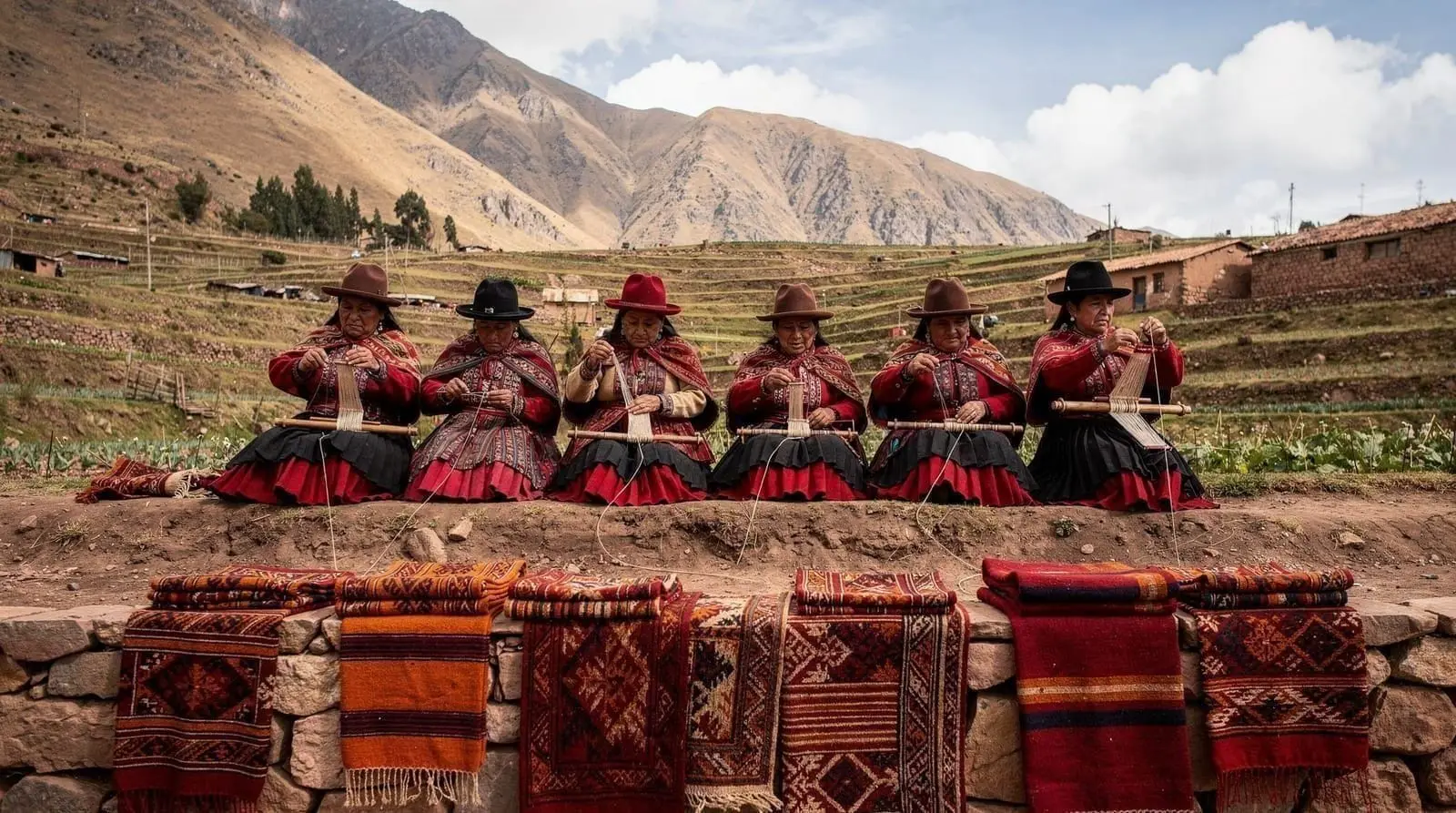
For travellers, weaving is the most visible and accessible expression of Quechua culture — and one of the most misunderstood, because the markets are flooded with cheap acrylic imitations of genuine handwork.
Real Andean textiles are a language. Patterns, motifs, and colour combinations carry meaning — community identity, status, the local landscape, cosmological symbols — and a genuine piece is hand-spun, dyed with natural materials (cochineal red, indigo blue, plant yellows), and woven on a backstrap loom over many days or weeks. The skill is passed down through generations of women, and a good weaving is both an artwork and a record of who its maker is.
The honest way to engage:
- Buy directly from weavers or from genuine cooperatives rather than market middlemen, so the money reaches the maker.
- Learn to tell real from fake — genuine alpaca and hand-spun wool versus squeaky acrylic — and pay fairly for the real thing without grinding the price of weeks of work down to nothing.
- Visit a working cooperative where you can see the spinning, dyeing, and weaving. The Chinchero weaving guide covers the best-known centre, and the broader Andean textiles guide explains how to identify quality and meaning.
Food, farming, and the land
Quechua food culture is rooted in Andean agriculture developed over millennia at extreme altitude — the same ingenuity that produced the terraces and the Moray agricultural laboratory. The Andes is the birthplace of the potato, and Quechua farmers maintain hundreds of native varieties, alongside other Andean staples: quinoa, maize, oca, olluco, and the freeze-dried potato called chuño, made by leaving potatoes out to the high-altitude frost and sun. Guinea pig (cuy) is the traditional ceremonial meat.
This agricultural knowledge is not folklore — it is a living technical achievement. Farming at 3,500-4,000 m and higher, in thin soil and unpredictable frost, demanded generations of careful selection and risk management: planting the same crop across many small, scattered plots at different altitudes and microclimates so that a frost or hailstorm destroying one field leaves others untouched.
Freeze-drying techniques like chuño turned a perishable crop into one that could be stored for years, effectively insurance against a bad harvest. Modern agronomists studying climate resilience increasingly look to these Andean techniques for lessons, which is a useful corrective to any traveller tempted to see highland farming as simply “traditional” rather than sophisticated.
Underlying it all is a sacred relationship with the land itself, which leads directly into belief.
A few words that unlock a lot
Beyond the basic greetings, a handful of terms come up constantly once you know to listen for them, and recognising them changes how you read a menu, a market stall or a guide’s explanation. Pachamanca — a feast cooked in an underground pit of hot stones — is a direct descendant of pre-Hispanic cooking technique, still used for celebrations.
Chakra simply means a cultivated field or farm plot, the basic unit of highland agriculture. Apu, already mentioned for the mountain spirits, appears constantly in place names and conversation. And mit’a, the Inca-era rotational labour tax, is the historical root of the minka system still practised today — a reminder that many “traditional” institutions are not static relics but living adaptations of very old ideas.
Belief: Pachamama, the apus, and a layered faith
Quechua Andean spirituality did not disappear under Catholicism — it fused with it. Most highland Quechua are practising Catholics and devoted to Pachamama, the earth mother, and the apus, the mountain spirits, all at once, with no sense of contradiction.
- Pachamama is the living, sacred earth — generous but owed reciprocity. Before drinking, people may spill a few drops for her (the challa); communities make offerings called despachos or pagos a la tierra, bundles of coca leaves, seeds, fat, and symbolic objects, burned or buried to feed the earth and the mountains.
- The apus are the spirits of the great peaks, ranked by the mountain’s height and power — Ausangate above Cusco is among the supreme apus of the region. They watch over communities and must be honoured.
This syncretism is on full display at festivals. The Qoyllur Rit’i pilgrimage near Ausangate is perhaps its purest living expression — a Catholic devotion wrapped around glacier and mountain worship at nearly 4,800 m — while Corpus Christi and Inti Raymi in Cusco show the same layering in the city. Coca leaves, sacred for divination, offerings, and as a mild stimulant against altitude and hunger, run through all of it.
Engaging respectfully
The difference between a trip that honours this culture and one that exploits it comes down to a few choices:
- Ask before photographing people. Posed photos — with someone in traditional dress, or holding a llama or lamb in Cusco — are a paid transaction; tip fairly. Candid shots of strangers without consent are intrusive.
- Choose community-based tourism. Favour homestays, weaving cooperatives, and village visits that are run by and pay the communities themselves, over staged “native village” stops on mass tours that extract value and return little. Community-based and fair-trade operators around the Sacred Valley and Lake Titicaca are the way to do this well.
- Pay fairly. Do not beat down the price of genuine handwork to a few soles. Polite negotiation is normal; treating weeks of skilled labour as worthless is not.
- Drop the museum mindset. Treat the people you meet as contemporaries, not as living history. Curiosity is welcome; condescension is not.
- Learn a little language and history. A few words of Quechua and a grasp of the Inca background (see the Inca empire for travelers guide) change how you are received.
Get this right and the highlands open up in a way the ruins alone never will. For ways to build community and cultural experiences into a wider trip, browse /itineraries/.