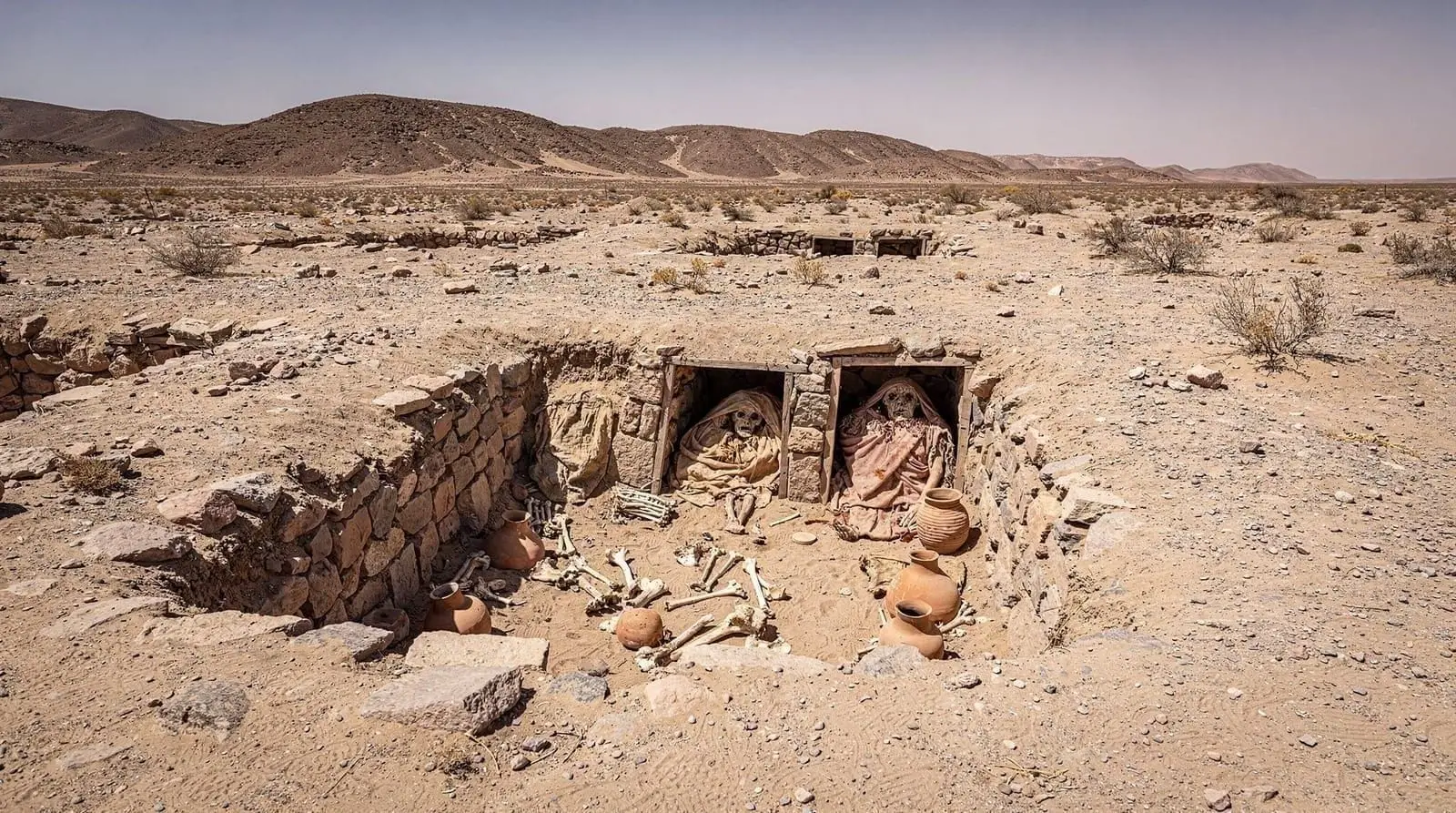
Chauchilla cemetery: visiting Nazca's open-air mummies
Nazca: Chauchilla Cemetery Archaeological Tour
Is Chauchilla cemetery worth visiting?
Yes, if pre-Columbian history interests you. Chauchilla is an ancient desert cemetery where mummies sit in open tombs, hair and textiles preserved by the dry climate. It is a short, cheap half-day from Nazca — entry is about S/8 plus transport, or S/30–50 on a tour.
Most people come to Nazca for the Lines and leave without realising the area’s other major draw sits 30 km down a desert track: Chauchilla, an ancient cemetery where mummies sit upright in open tombs, their hair and woven shrouds preserved by a thousand-plus years of bone-dry air. It is unusual, slightly unsettling, and one of the few places anywhere you can stand at the edge of an open pre-Columbian grave and look a mummy in the face. This guide covers how to visit it, what it costs, and the ethical questions worth thinking about before you go.
| Where | 30km south of Nazca, unpaved final stretch |
| Cost | ~S/8 entry; S/30-50 guided tour |
| Time needed | 45min-1hr on site, ~3hrs total with travel |
| Getting there | Guided tour or hired taxi |
| Best time | Morning or late afternoon, avoid midday heat |
What Chauchilla is
The Cementerio de Chauchilla is a burial ground used mainly by the Nasca culture, roughly between 200 and 900 AD, and possibly into later periods. The dead were buried in a seated, fetal position, wrapped in layers of cotton textiles, sometimes coated with a resin that helped preservation, and placed in mud-brick tombs in the desert. The extreme aridity of the Nazca region did the rest: instead of decomposing, the bodies desiccated, leaving skin, hair (sometimes metres long), and textiles remarkably intact more than a millennium later.
What you actually walk among today is a set of about a dozen reconstructed tombs. The mummies and grave goods are authentic, but the open-pit presentation is a partial reconstruction — which connects directly to the site’s troubled history.
The looting and why it matters
For most of the 20th century Chauchilla was a free-for-all for huaqueros (grave robbers), who tore open the tombs for the textiles, pottery and gold that collectors paid for. They scattered bones across the desert, and for decades the site was a field of broken skeletons and shredded mummy cloth. You can still see fragments of bone and textile in the sand around the protected area — a blunt reminder of what happened.
In 1997 the Peruvian state finally gave Chauchilla legal protection. The current open-tomb display was created to present the remaining and recovered mummies in something like their original context, and the entry fees now fund preservation and a guardian presence that deters renewed looting. This history is the heart of the ethical debate: visiting puts money toward protecting the site, but the spectacle itself exists because the graves were violated in the first place.
Is it ethical to go?
There is no clean answer, and it is worth deciding for yourself. The case for visiting: controlled, paid tourism funds the site’s protection, gives looting an economic alternative, and treats the dead with more dignity than the huaqueros ever did. The case against: it is, undeniably, paying to view human remains in their disturbed graves.
If you do go, the decent approach is straightforward — do not touch anything, do not climb into or lean over the tombs, do not photograph in a mocking way, and listen to the guardian’s rules. Treat it as you would any cemetery, because that is what it is. Plenty of thoughtful travellers visit and come away moved rather than ghoulish; others would rather not, and that is a reasonable position too.
Getting there
Chauchilla is about 30 km south of Nazca town, around 45 minutes each way, with the final stretch on an unpaved desert road. A visit including travel runs about three hours.
Your options:
- Guided tour — the standard choice. A half-day tour from Nazca with transport and a guide costs S/30–50 (USD 8–14) per person; the guide’s context about the Nasca culture and burial practices adds a lot.
- Hired taxi — S/60–90 for the vehicle round trip with waiting time; good for groups or anyone wanting flexibility.
Site entry itself is only about S/8 (USD 2), paid at the gate. Bring cash; card payment is not reliable out here.
What to expect on site
The visit is short and self-contained. A path loops past roughly a dozen roofed, open tombs, each holding one or more seated mummies surrounded by skulls, pottery fragments and bundles of textile. The desert setting is stark and quiet, and the preservation is genuinely striking up close — you can see individual strands of long hair, the weave of the burial cloths, and in some cases facial features.
There is a small interpretation area explaining the Nasca burial customs and the looting history. Allow 45 minutes to an hour on site. There is little shade and the desert sun is fierce, so bring a hat, sunscreen and water.
A second tour option covers the same site and is widely available if the first is sold out:
Chauchilla Cemetery TourCombining it with the Nazca Lines
Chauchilla pairs naturally with the Nazca Lines. The classic Nazca day is the Lines flight in the morning — a 30–35 minute small-plane flight over the geoglyphs, best taken early when the air is calmest — followed by Chauchilla in the afternoon, plus perhaps the Cantalloc aqueducts or the Maria Reiche planetarium. The two sights complement each other: the Lines show how the Nasca shaped the desert surface, Chauchilla shows how they buried their dead in it.
For how Nazca fits the wider south coast route from the capital, see the Lima to Paracas and Nazca itinerary, and the Nazca destination page for where to stay and the flight logistics.
Fitting Chauchilla into a longer south coast route
Nazca rarely stands alone on a Peru itinerary — it usually anchors one stop on a longer desert-and-coast run that also takes in Paracas to the north (for the Ballestas Islands and the national reserve) and Huacachina, the oasis town famous for sandboarding and dune buggies. A common sequence runs Lima → Paracas → Huacachina/Ica → Nazca, with Chauchilla and the Lines as the Nazca leg’s twin highlights. Building in Chauchilla costs little extra time against that backdrop, since it slots into an afternoon that would otherwise be idle waiting for a bus.
Practical tips
- Go in the morning or late afternoon to avoid the worst midday heat; there is almost no shade.
- Bring water, a hat and sunscreen — it is open desert.
- Carry small soles for the entry fee and tips.
- Manage expectations on time — this is a 45-minute to one-hour site, not a half-day attraction in itself. Combine it with the Lines or aqueducts.
- Be respectful — no touching, no climbing, no disrespectful photos. The site guardians enforce this.
The honest verdict
Chauchilla is worth it if you have any interest in pre-Columbian Peru and you are comfortable with the ethics of viewing human remains. It is cheap, quick, genuinely unusual, and the funds support protecting a site that was nearly destroyed by looting. It is not a must-do on the level of the Nazca Lines, and travellers who find mummies distasteful can skip it without regret. If you do go, go thoughtfully — and remember the scattered bones in the sand are not a curiosity but the wreckage of a crime the site is still recovering from.
Frequently asked questions about Chauchilla cemetery: visiting Nazca's open-air mummies
How much does it cost to visit Chauchilla?
How far is Chauchilla from Nazca?
Are the mummies real?
Is it ethical to visit?
Can I combine Chauchilla with the Nazca Lines?
Does Chauchilla fit into a Paracas-to-Nazca south coast route?
What should I bring to Chauchilla?
Top experiences
Bookable activities with verified prices and instant confirmation on GetYourGuide.

