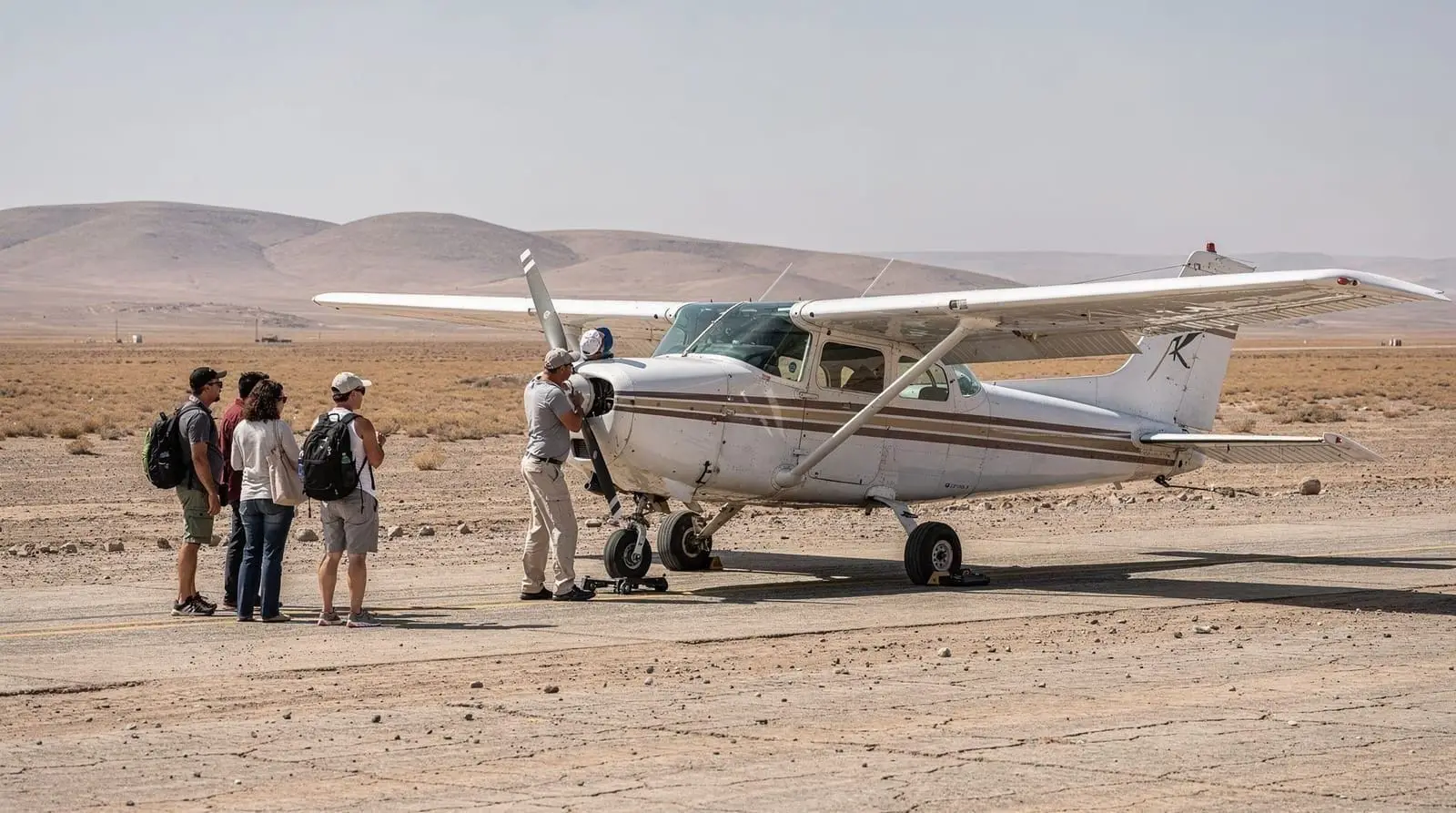
Nazca Lines flight safety
From Nazca: 30-Minute Flight over Nazca Lines
Are Nazca Lines flights safe?
They are much safer now than in the 2000s, when a string of crashes killed and injured tourists. Reforms tightened oversight, but this is still small-aircraft flying over desert with mixed operators. Choose a reputable airline with two pilots and maintained planes, fly early, and the risk is low but not zero.
The Nazca Lines overflight is one of the very few tourist activities in Peru with a serious accident history, and travellers deserve a straight account of it rather than the cheerful silence of most brochures. The short version: there was a genuinely bad stretch in the 2000s, regulatory reforms followed, and flying is far safer now than its reputation — but it remains small-aircraft aviation over remote desert, run by a mix of operators, and your choice of airline matters more here than for almost anything else you will book in Peru.
This guide lays out what happened, what changed, which operators are established, how to vet them, and the practical steps that genuinely reduce your risk. It pairs with the Nazca Lines complete guide (logistics and costs) and is the Nazca flight worth it (the value question).
| Era of concern | 2000s (several fatal crashes) |
| Since reforms | Two-pilot crews, tighter maintenance and licensing |
| What you control | Operator choice, flight time, weather patience |
| Best time to fly | Earliest slot, before afternoon thermals build |
| Insurance | Confirm light-aircraft sightseeing is covered before you fly |
| Red flag | Single pilot, tired airframe, or pressure to fly in bad weather |
The honest accident history
There is no point sugar-coating it. In the mid-to-late 2000s, Nazca overflights had a run of fatal and near-fatal crashes that made international news:
- In 2008, a light aircraft crashed shortly after take-off, killing five French tourists.
- In 2009, a plane carrying tourists ran out of fuel and crash-landed; passengers survived but were injured.
- In 2010, a crash killed all seven people aboard, including six Chilean tourists, and led to the suspension of the operator involved.
Investigations and reporting at the time pointed to a recurring set of causes: ageing single-engine aircraft, intense commercial pressure to fly as many circuits as possible, pilot fatigue, inadequate maintenance, and weak regulatory oversight. The figures-tour flight profile itself — repeated steep banking turns at low altitude — leaves little margin if an engine fails at the wrong moment.
This is the reputation that lingers, and it is why you will meet travellers who refuse to fly at all.
What changed
Peru’s civil aviation authority and the affected operators responded to the 2000s crashes with reforms that meaningfully improved the safety picture:
- Two-pilot crews became standard on commercial overflights, so a single incapacitation no longer leaves the aircraft without a qualified pilot.
- Maintenance and inspection requirements tightened, pushing operators to retire the worst of the ageing fleet and document upkeep.
- Scheduling and rest rules were enforced more strictly to curb the fly-them-till-they-drop pressure that contributed to fatigue.
- Licensing oversight increased, with the worst operator (Alas Peruanas, involved in the 2010 crash) suspended.
Since these reforms, serious incidents have been markedly rarer, and millions of tourists have flown the lines without harm. The activity is no longer the recurring tragedy it was fifteen-plus years ago. But “much safer than it was” is not the same as “risk-free,” and honest planning means holding both facts at once.
Putting the risk in perspective
Headlines distort risk, so it helps to frame the numbers honestly. The Nazca overflight has carried hundreds of thousands of passengers a year for decades. Concentrate the handful of fatal accidents into the 2000s — when ageing single-engine fleets and lax oversight were the norm — and the per-flight risk in that era was elevated for sightseeing aviation but still far lower than the everyday drive down the Panamericana you take to reach the airfield, where Peru’s road-accident rate is genuinely high. Since the reforms, fatal incidents have been rare exceptions rather than a pattern.
That is not a reason to be cavalier. It is a reason to put the fear in proportion: the realistic risk on a flight today, with an established two-pilot operator flying early in good weather, is low — comparable to other small-aircraft tourism worldwide, and dwarfed by the road risk of the bus journey to get there. The thing you actually control is which operator you board, so spend your worry budget there rather than on the activity in the abstract.
The established operators
A handful of long-running airlines dominate the legitimate market. The names you will see most often, and that have the longest operating histories, include:
- Aerodiana — one of the larger, longest-established operators, flying from Nazca, Ica and Pisco.
- AeroNasca — a long-standing Nazca-based operator.
- Movil Air — another established name on the route.
Alas Peruanas, by contrast, was the operator suspended after the 2010 crash, and is the cautionary example of why operator history matters.
A crucial caveat: reputations and fleets change over time, ownership shifts, and a name that was solid a few years ago may not be today (or vice versa). Treat the list above as a starting point, not a guarantee. Always verify current licensing status, recent reviews, and on-the-day aircraft and crew before you fly. The point is not to memorise brands but to refuse the unknown fly-by-night deals that resurface around the bus terminals.
How to vet an operator before you book
The single biggest lever you control is choosing a reputable, established airline rather than the cheapest sticker at the bus station. Concretely:
- Confirm two pilots. A dual-pilot crew is the baseline you should insist on. If an operator flies single-pilot, walk away.
- Ask about the aircraft. Newer, well-maintained, twin-pilot-rated Cessnas are what you want. Be wary of visibly tired airframes.
- Check the airport tax and ticketing are official. Legitimate operators sell through proper channels and the S/30-ish Nazca airport tax is collected at the airfield, not pocketed by a tout.
- Read recent reviews, specifically for cancellations-for-weather (a good sign — it means they do not fly in marginal conditions), aircraft condition and pilot professionalism.
- Avoid the lowest-price race. A flight that undercuts everyone else is undercutting something — usually maintenance, crew or weather discipline.
Booking through an established channel with these checks done in advance removes most of the risk you can influence.
What the flight physically feels like
Part of “safety” is knowing what is normal so you do not panic at sensations that are entirely routine. The aircraft are small high-wing Cessnas seating roughly 6 to 12 passengers plus two pilots, and to give both sides of the cabin a clear view of each figure the pilot banks the plane hard left, then hard right, in a repeated sequence of steep turns at low altitude. This feels dramatic — the wing drops, the horizon tilts, and your stomach lurches — but the banking is deliberate, controlled and the whole point of the manoeuvre, not a sign of trouble.
You will also feel the desert thermals: as the ground heats, columns of rising air give the plane sudden small drops and bumps, more pronounced as the morning wears on. Again, normal, and the reason every guide insists on the earliest slot when the air is coolest and smoothest. The combination of small cabin, repeated banking and thermals is exactly why a large share of passengers feel air-sick — a comfort issue, not a safety one. Knowing the rhythm in advance, taking the first flight, and keeping your eyes on the horizon between figures all help you ride it out calmly rather than tensing up.
Nervous flyers and children
If you are a nervous flyer, know what you are signing up for before you board: repeated, deliberate hard banking at low altitude for 30-plus minutes, in a small cabin, often with mild-to-moderate turbulence. This is a different sensation from a commercial jet and it surprises people who fly regularly but have never done small-aircraft sightseeing. If motion sickness or a fear of small planes is a serious concern, consider whether the ground-level mirador and planetarium (covered in the complete guide) might be the better personal choice — there is no shame in skipping the flight if it would ruin your day rather than make it.
For children, most operators set a minimum age (commonly around 2 years old, sometimes higher) and the same banking and thermal bumps that make adults queasy affect kids more unpredictably. Ask the operator directly about their age policy and honestly assess whether your child handles motion well before booking, rather than finding out mid-flight.
Travel insurance and the fine print
Do not assume your policy covers you in the air. Standard travel insurance usually covers scheduled light-aircraft sightseeing, but the wording varies and some policies exclude “private,” “charter” or non-commercial aviation, which an overzealous adjuster might try to apply to a small Nazca operator. Before you fly:
- Read the adventure-activities clause and confirm light-aircraft sightseeing is named or clearly included.
- Check whether there is an excursion-operator licensing condition — some policies only pay out if the operator was properly licensed, which is one more reason to choose an established airline.
- Keep your ticket and receipt, including the official airport-tax receipt, as proof of a legitimate commercial booking.
- If in doubt, email your insurer and get written confirmation that Nazca overflights are covered; a one-line reply costs nothing and settles the question.
Flying more safely on the day
Beyond operator choice, a few habits reduce both risk and misery:
- Take the earliest flight. Morning air is cooler, calmer and clearer; afternoon thermals make for turbulence and a higher chance the flight is cancelled or rough.
- Do not let a schedule pressure you. Never book the flight on a day you must immediately catch an onward bus or connection. That pressure is exactly how travellers end up accepting a marginal-weather departure. Leave a buffer day or half-day.
- Respect a weather cancellation. If the operator scrubs for wind, that is the system working. Reschedule rather than hunting for someone willing to fly in conditions a careful operator refused.
- Manage air-sickness (medication, light meal, early slot, eyes on the horizon) — not a safety issue per se, but a panicking, vomiting cabin is no one’s idea of a controlled flight.
Red flags that should make you walk away
You will not always be able to vet an operator in advance — sometimes you are standing at the aerodrome deciding on the spot. A few on-the-ground warning signs justify declining even after you have paid a deposit:
- A single pilot. A dual-pilot crew is the post-reform baseline; one pilot is a hard no.
- A visibly tired airframe — heavy corrosion, leaking fluids, threadbare interior, or anything that looks neglected rather than merely old.
- No official airport-tax receipt, or a “guide” pocketing cash that should be collected at the airfield — a sign of an off-the-books operation.
- Pressure to fly in obviously bad weather because the day’s slots are backed up. A careful operator scrubs for wind; one that pushes through it is cutting the corner that matters most.
- An overbooked, rushed turnaround where the crew is clearly being run flat out with no rest between circuits.
None of these guarantees a problem, but any one of them is reason enough to ask for a refund and find another operator. The few dollars you might lose are trivial against the thing you are protecting.
It is worth saying plainly: walking away after paying a deposit feels awkward, and tourists often talk themselves out of it to avoid an uncomfortable conversation or a small financial loss. Do not. A polite but firm request for a refund, citing any of the red flags above, is a completely normal and reasonable thing to do at a Peruvian aerodrome, and reputable operators will not push back hard on it.
A pre-flight safety checklist
Run through this before you commit, ideally the day before:
- Operator is an established, currently licensed name with recent reviews.
- The flight is the earliest slot of the day.
- Confirmed two pilots on board.
- You have a buffer day — no onward bus or connection immediately after.
- Travel insurance confirmed to cover light-aircraft sightseeing.
- Air-sickness medication taken, light meal eaten, camera ready and secured.
- You are prepared to accept a weather cancellation rather than chase a riskier operator.
So, should you fly?
That is ultimately a personal risk decision, and it is fine either way. The modern record is good, the reforms were real, and the overwhelming majority of travellers fly the lines and remember the figures, not the turbulence. If you choose an established operator, fly early, and refuse to be rushed, you have done essentially everything within your control. If the history is a genuine dealbreaker for you, the Nazca Lines complete guide covers the (limited) ground-viewing alternatives — the roadside tower and planetarium — and is the Nazca flight worth it helps weigh the whole detour.
For the broader picture of staying safe across the country — roads, altitude, theft, scams — see the Peru travel safety guide for 2026.
If you would rather book a flight already vetted against these checks than shop around at the aerodrome, the standard Nazca circuit is a reasonable starting point to compare against whatever you are offered on the day.
Nazca Lines 30-minute overflight from Nazca