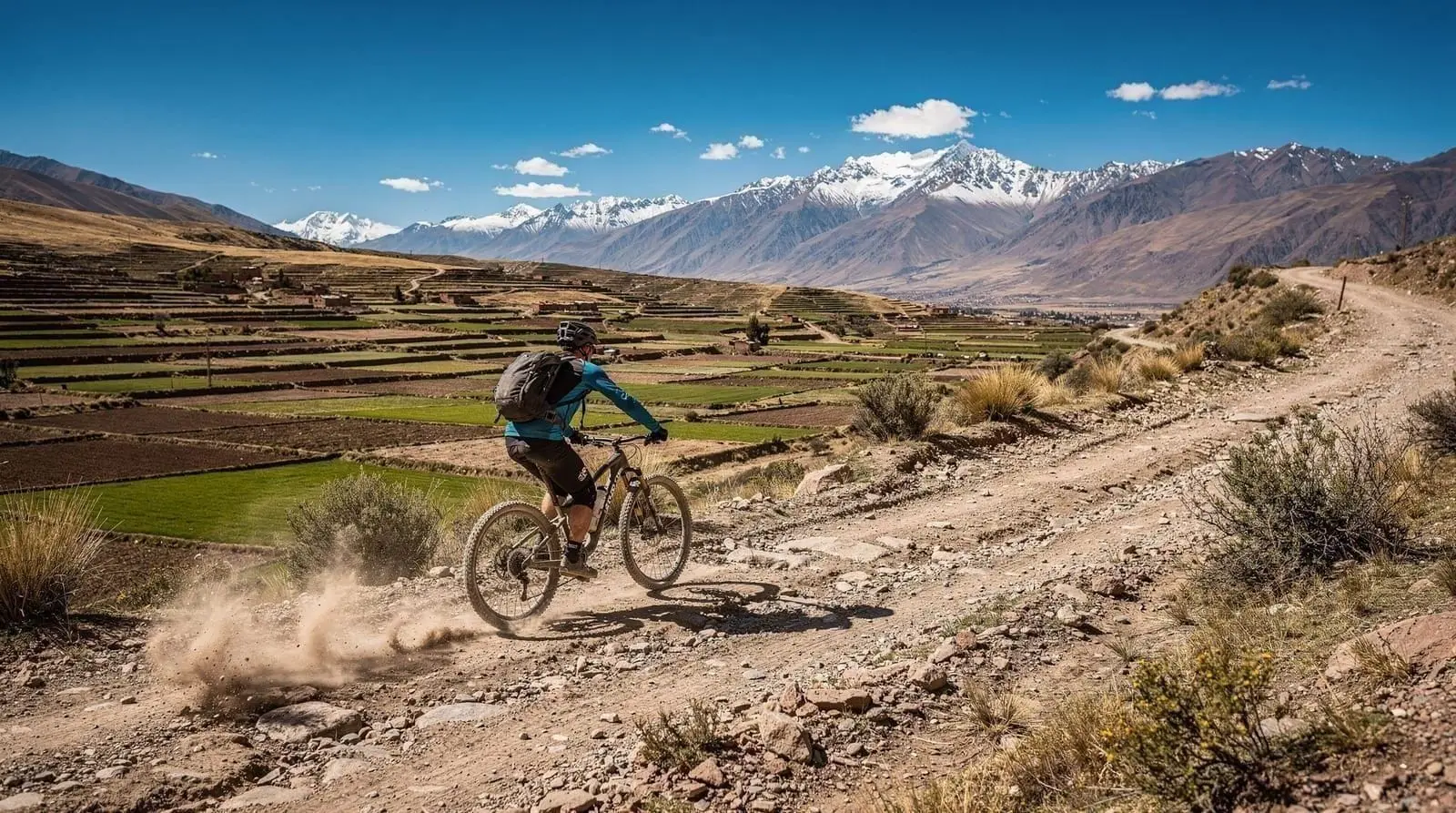
Mountain biking around Cusco
From Cusco: Rainbow Mountain and Red Valley ATV Tour
Is Cusco good for mountain biking?
Yes, for downhill and descent-focused riding. The terrain ranges from the gentle Maras-Moray plateau to steep Andean drops like Abra Málaga toward the jungle. Altitude is the catch: rides often start above 3,500 m, so acclimatise first and check bike quality, brakes and operator safety carefully.
Why Cusco is a downhill rider’s region
Mountain biking around Cusco is overwhelmingly about going down. The region’s defining feature for cyclists is vertical relief: passes above 4,000 metres dropping toward valley floors and, in places, all the way to the cloud forest. That gives some of the longest, most scenic descents in South America. What it does not give, for most visitors, is comfortable uphill riding — pedalling hard at altitude in thin air is brutal, and few short-trip travellers come here to grind up Andean climbs.
So the realistic picture is this: gentle plateau loops for beginners, long shuttle-assisted descents for experienced riders, and a handful of multi-day adventures that fold biking into trekking. The terrain is genuinely world-class, but two things separate a great day from a bad one — your own acclimatisation, and the quality of the operator and bike. Both are within your control if you plan, and both are routinely ignored by travellers who book the cheapest option and find out the hard way that the brakes don’t work at 4,000 metres.
This guide covers the real routes, the altitude reality, how to vet an operator and a bike, costs, safety, and the honest caveats. For the wider menu of excursions, see the day trips from Cusco guide.
| Where | Maras-Moray plateau, Chinchero, Abra Málaga pass |
| Cost | Around $50-120/day guided, depending on route and bike |
| Time needed | Half day (plateau) to full day (Abra Málaga) |
| Level | Beginner-friendly plateau loops to advanced descents |
| Best time | Dry season (May-September); mornings year-round |
| Book ahead | Recommended, especially for Abra Málaga support vehicles |
The altitude reality nobody mentions in the brochure
Read this before booking anything. Cusco sits at about 3,400 m (11,150 ft), and most bike routes start higher — Abra Málaga is over 4,300 m, the Maras-Moray plateau around 3,500 m. Even “all downhill” rides involve some pedalling, braking effort, and the simple work of staying upright, all of which are far harder in thin air than at sea level.
The non-negotiable rule: do not bike on your first or second day in the Andes. Spend at least two to three days acclimatising first, ideally sleeping lower in the Sacred Valley (2,800-3,000 m) before going higher. Our Cusco acclimatisation plan sequences the first days, and the altitude sickness guide covers the warning signs — headache, nausea, breathlessness, poor sleep — that mean you should not be on a bike on a mountain.
Practical altitude habits for a biking day: hydrate heavily the day before and during, eat light, avoid alcohol the night before, and tell your guide immediately if you feel unwell. A reputable operator carries oxygen and a support vehicle and will pull you off the route without argument.
The routes worth knowing
Maras, Moray and the Salineras plateau (beginner-friendly). The high plateau above Urubamba offers rolling dirt tracks linking the Moray terraces and the Maras salt pans, with big open views and manageable gradients. It is the best introduction for less-experienced riders once acclimatised, and it doubles as a fresh way to see two sites most people visit by van. Combine it with a look at the Maras and Moray sites themselves.
Chinchero plateau loops (intermediate). Around Chinchero at roughly 3,760 m, dirt roads and trails cross open highland scenery with weaving villages and lake views. Scenic, moderately demanding, and high — acclimatisation matters here.
Abra Málaga descent (advanced). The classic Cusco downhill. From the Abra Málaga pass at over 4,300 m on the road toward the jungle, a long paved-and-dirt descent drops thousands of metres toward the cloud forest, with the climate and vegetation changing dramatically as you go. It is exhilarating and long, demands confident bike handling and reliable brakes, and is usually done with a support vehicle. This is not a beginner ride.
Inca Jungle multi-day (mixed). The popular Inca Jungle route to Machu Picchu opens with a downhill biking leg from a high pass before continuing on foot, raft and zipline. It is a way to combine biking with reaching Machu Picchu; see the treks to Machu Picchu guide for how it compares to the classic trails.
A note on independent riding: this is not a self-guided region for most visitors. Routes use remote roads at altitude with limited services, traffic on some descents, and no easy rescue. Guided, vehicle-supported riding is the sensible default here. Even confident riders who cycle regularly at home should not assume the fitness translates directly — thin air at 3,500-4,300 m changes effort and recovery in a way flat-country riding does not prepare you for, so treat your first Cusco route as an assessment day rather than your hardest ride of the trip.
How to vet an operator and a bike
This matters more than the route. The gap between a good and a bad operator in Cusco is the gap between a memorable descent and a hospital visit, and price alone does not tell you which you are getting.
Inspect the bike before you pay or set off:
- Brakes first. Squeeze both levers hard. On a steep, high descent your brakes are your life. Hydraulic disc brakes that bite firmly are what you want; spongy, worn or cable brakes on a downhill route are a red flag.
- Suspension and frame. For real descents you want a maintained dual-suspension downhill or enduro bike, not a tired rigid hardtail.
- Tyres and drivetrain. Decent tread, no bald patches, gears that shift cleanly.
- Fit. The bike should be sized to you with the saddle and controls adjustable.
Confirm the safety package: a properly fitting helmet (essential and non-negotiable), gloves, and ideally elbow and knee pads for technical routes; a guide who rides with the group and controls the pace; a support vehicle following for steep descents; and a basic first-aid and oxygen capability. Ask group size — smaller groups get more attention and safer spacing.
Choose on reputation, not the lowest quote. Read recent reviews specifically mentioning bike condition and brakes. The cheapest operators economise exactly where it hurts: old bikes, big groups, no support vehicle. The price difference is usually the safety margin. The Cusco tourist traps guide covers how the cut-price adventure market operates here.
Costs, gear and what to bring
A guided downhill day typically runs from around $50 to $120, depending on the route, bike quality, group size, and whether transport, support vehicle, snacks and lunch are included. The Abra Málaga and multi-day options sit at the higher end. Treat suspiciously cheap quotes as a warning about the bike and the support.
What the operator should provide: the bike, helmet, gloves, protective pads on technical routes, and transport to the start.
What to bring yourself:
- Sun protection — high-factor sunscreen, sunglasses and lip balm; the UV at altitude is intense.
- Layers — it can be cold at the start pass and warm at the bottom of a long descent, especially toward the jungle. A windproof layer is worth having for the speed of a descent.
- Gloves of your own if you have them, for comfort and grip.
- Water and a few snacks; some calories help at altitude.
- Cash in soles for entries, tips and roadside stops.
- Closed shoes with grip — never sandals.
Group size and private options
Most operators run small group departures of around 4-10 riders, which keeps the pace manageable and lets the guide keep an eye on everyone on a descent. Larger groups of 15-plus are a red flag on technical routes like Abra Málaga, since a guide cannot realistically watch that many riders on a fast downhill with a support vehicle running the same road.
If you are travelling as a couple or small group and want more flexibility on pace and stops, ask specifically for a private departure — it costs more but lets stronger and weaker riders in your party each ride at a comfortable speed rather than one group pace forced on everyone. Solo travellers usually join a shared group, which is also a good way to meet other riders heading the same direction through Peru.
What the scenery actually looks like
The appeal of these routes is as much visual as physical. The Maras-Moray plateau opens onto wide highland fields, distant snow peaks, and the geometric terraces and salt pans below — a landscape that looks almost lunar in places. Abra Málaga is the more dramatic transformation: you start in cold, wind-scoured puna grassland at the pass, and within a couple of hours the descent drops you through cloud forest, with vegetation, temperature and even the birdsong changing noticeably as you lose altitude. Riders who do this descent often say the ecological transition is as memorable as the ride itself — few single days let you experience two such different Andean environments back to back.
A note on motorised alternatives
If you want the high-Andes adrenaline without pedalling at altitude, the region also runs guided ATV (quad bike) tours, which are a different experience but appeal to similar travellers. They are motorised, so the altitude exertion is far lower, and they reach scenic high terrain quickly. The honest trade-off is that they are noisier, less of a workout, and a different kind of fun.
If that suits you better, the Rainbow Mountain and Red Valley ATV tour pairs quad riding with one of the region’s signature landscapes, and the Ausangate lakes and glaciers ATV tour reaches remote high-altitude lakes by quad. Our ATV and quad tours guide compares them honestly. These are not mountain biking, but they answer the same “I want a thrill in the high Andes” brief for non-cyclists.
Planning a biking day into a Cusco trip
The most common scheduling mistake is slotting a bike day too early. Because rides start high, you want biking placed after your acclimatisation, not during it. A workable sequence for a typical trip: arrive and transfer straight down to the lower Sacred Valley to sleep at 2,800-3,000 m, spend a day or two on gentle valley sightseeing such as the Maras and Moray plateau, then schedule biking once you are clearly adjusted. The Cusco acclimatisation plan sequences these first days in detail, and getting it right is the difference between enjoying a descent and gritting through altitude misery on a bike.
Think about where biking sits relative to your other big days, too. It is poor planning to bike the day before or after a strenuous trek or a Rainbow Mountain excursion, since all of them tax you at altitude. Spread the demanding days out and keep at least one easier day between them. If your trip centres on Machu Picchu, remember the Inca Jungle route already builds a downhill biking leg into the journey there, so you may not need a separate biking day at all — compare the options in the treks to Machu Picchu guide before booking both.
For families, biking is a tougher sell than the gentler day trips from Cusco, but the easy Maras-Moray plateau loop can work for confident teenage riders who are acclimatised. Younger children are better suited to the non-cycling valley activities.
Matching the route to your ability honestly
The single best thing you can do for a good biking day, after acclimatising and vetting the bike, is to be honest with the operator about your level. Cusco’s downhill market includes everything from gentle plateau cruises to steep technical descents, and operators can match you to the right route only if you tell them the truth.
If you are a confident, experienced rider, the long Abra Málaga descent toward the cloud forest is the standout — a sustained, dramatic drop through changing ecosystems that few places in the world can match. Insist on a quality dual-suspension bike with strong hydraulic brakes and a support vehicle, and treat the descent with respect: the gradient, the altitude at the top, and any shared traffic all demand attention.
If you are an intermediate rider, the Chinchero plateau and longer Sacred Valley dirt routes give scenery and a real ride without the commitment of a major technical descent. They are high, so acclimatisation still matters, but the gradients are forgiving.
If you are a beginner or returning after a long break, stick to the Maras-Moray plateau loop. Rolling tracks, big open views, manageable hills, and the bonus of seeing two famous sites by bike rather than from a van. It is the right place to find out whether biking at altitude suits you before committing to anything steeper.
Whatever your level, never let an operator push you onto a route beyond it because it is what the group is doing or because it costs more. A misjudged descent at 4,000 m with marginal brakes is exactly the scenario the Cusco tourist traps guide warns about. The good operators will steer you correctly; the bad ones will sell you the trip you should not take.
Honest caveats
Acclimatisation is the whole game. The single biggest cause of a miserable or dangerous biking day here is going too high too soon. Build the days in first.
Cheap usually means worse brakes. The downhill market has a long tail of budget operators running tired bikes. On a 4,000-metre descent that is not where to save money.
“Downhill” still means effort. Marketing implies you coast the whole way. In reality you brake constantly, handle the bike actively, and pedal across flatter sections, all at altitude.
Weather changes fast. Afternoon rain in the wet season (November-March) makes descents slick and visibility poor. Dry season (May-September) is far safer for biking; mornings are most reliable year-round.
Shared roads. Some descents use public roads with vehicle traffic. A support vehicle and a disciplined guide controlling the pace are what keep this safe.
Routes compared at a glance
| Route | Level | Altitude start | Best for |
|---|---|---|---|
| Maras-Moray plateau | Beginner | ~3,500 m | Scenery plus seeing the sites by bike |
| Chinchero plateau | Intermediate | ~3,760 m | Open highland views, weaving villages |
| Abra Málaga descent | Advanced | 4,300+ m | The big, dramatic downhill |
| Inca Jungle (day 1) | Mixed | High pass | Combining a bike leg with the Machu Picchu trek |