Machu Picchu train tickets guide: classes, prices, routes
Cusco: Machu Picchu + Tourist Train + Entrance Ticket
How do train tickets to Machu Picchu work?
Two operators, PeruRail and IncaRail, run the line to Aguas Calientes. Most travellers board at Ollantaytambo, the cheapest and most frequent leg (about 1h40). Standard tourist class runs roughly $130–170 round trip and panoramic glass-roof class around $160–220. Book directly on perurail.com or incarail.com, timed so you arrive about 90 minutes before your entry slot.
The train is the only way in — so it sets the day
There is no road to Aguas Calientes, the town at the foot of Machu Picchu. The final stretch is rail or foot only, which makes the train the spine of any visit: it determines when you arrive, when you leave, and how much of the day you actually spend on the mountain. Get the train wrong — wrong class, wrong times, wrong boarding point — and you have either wasted money or wrecked the schedule around your non-refundable entry slot.
This is the practical guide to what you are buying: the two operators, every class, real round-trip prices, where to board, and how to time the train to your gate slot. If you want the consumer-protection angle on fake sites and hidden markups, the Machu Picchu train ticket scams guide covers that separately. Here, the goal is simply to help you book the right train without overpaying or mistiming it.
| Operators | PeruRail and IncaRail — same line, different names |
| Best boarding point | Ollantaytambo (about 1h40 to Aguas Calientes) |
| Standard class | around $130–170 round trip |
| Panoramic class | around $160–220 round trip |
| Book by | as soon as your entry ticket is confirmed |
The two operators
One line runs down the Urubamba canyon to Aguas Calientes, and two companies operate trains on it:
PeruRail (perurail.com) — the larger operator, with the most departures and the widest range of classes, including the luxury Hiram Bingham. Its standard tourist class is Expedition and its panoramic class is Vistadome.
IncaRail (incarail.com) — the other operator, with slightly different class names: The Voyager for standard, 360 for the panoramic glass-roof carriage, and First Class at the premium end. IncaRail also offers some bimodal options pairing a bus segment with the train.
Both run the same gauge line to the same station in the middle of Aguas Calientes, at broadly similar prices and quality. There is no clear winner — choose on the times and class that fit your entry slot, and compare both operators for your specific date rather than picking on the brand name.
The classes, plainly
Strip away the marketing and there are three tiers.
Standard tourist class — PeruRail Expedition / IncaRail The Voyager. Comfortable seats, large side windows, a basic snack service. This is the best value and perfectly pleasant for the 1h40 ride. Most visitors should book this tier.
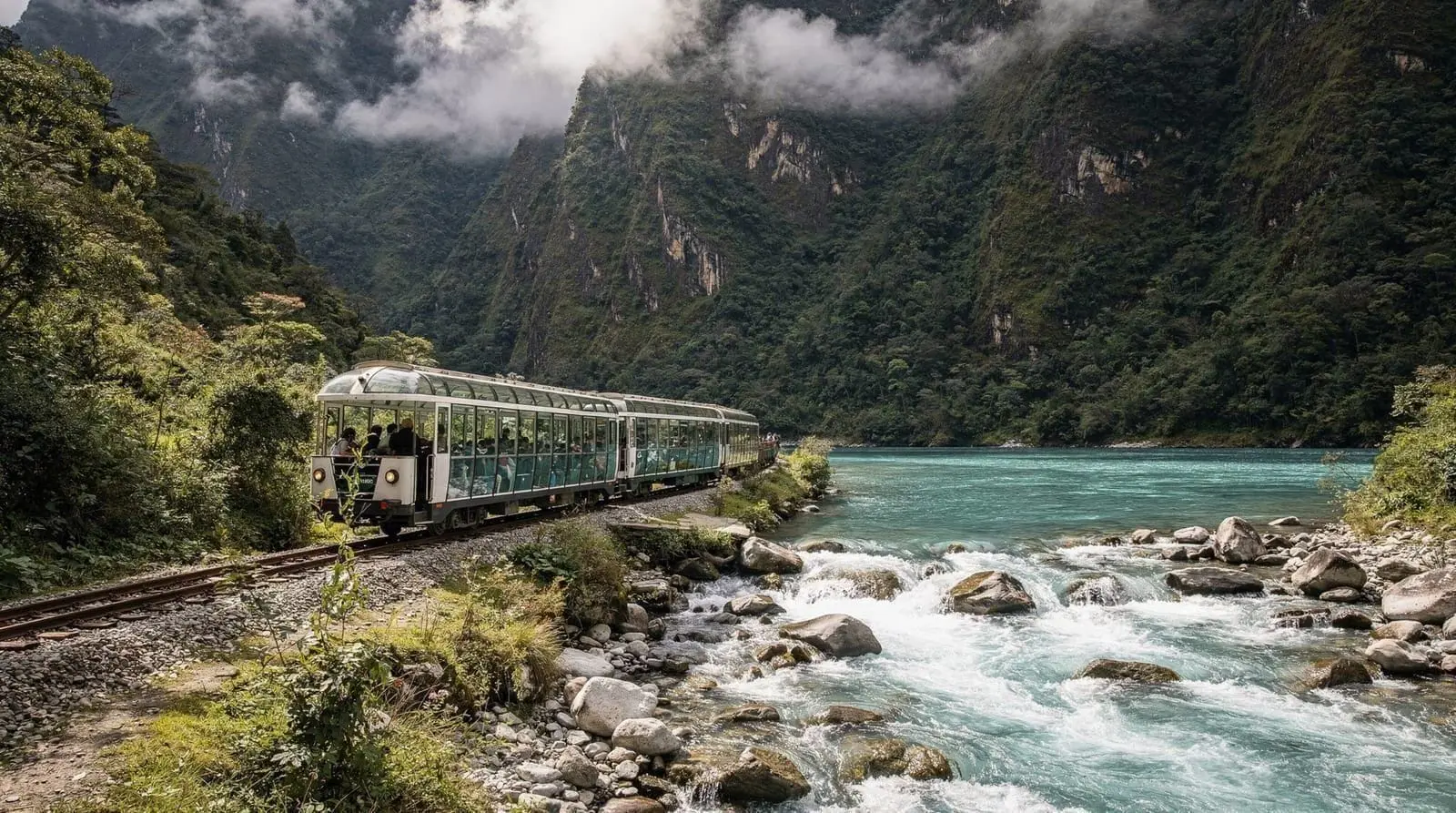
Panoramic glass-roof class — PeruRail Vistadome / IncaRail 360. Bigger windows that curve up into the roof so you see the canyon walls overhead, more space, snacks, and on the return leg a small onboard dance and fashion show. Worth the premium if scenery is part of the experience for you. The 360 has an open-air observation area on some services.
Premium / luxury — PeruRail Hiram Bingham, IncaRail First Class. Fine dining, a bar car, live music. These are about the journey as an event, not a better view of the ruins — the citadel looks identical whichever class you arrived in. Only book these if the train ride itself is the point.
Real prices (round trip, from Ollantaytambo, 2026)
| Class | Operator examples | Approx. round trip |
|---|---|---|
| Standard tourist | PeruRail Expedition / IncaRail The Voyager | $130–170 |
| Panoramic glass-roof | PeruRail Vistadome / IncaRail 360 | $160–220 |
| Premium / luxury | Hiram Bingham / IncaRail First Class | $500+ |
Prices vary by departure time, season and how far ahead you book, and rise for the convenient slots. These are train fares only — they do not include the Consettur bus up to the gate (about $24 round trip) or your entry ticket. Fares from the Cusco area, when those trains run, are higher; see why below.
Where to board: Ollantaytambo, not Cusco
The smart, standard choice is to board at Ollantaytambo in the Sacred Valley. The Ollantaytambo–Aguas Calientes leg is about 1 hour 40 minutes, the cheapest stretch, and has the most frequent departures across both operators.
Direct trains from the Cusco area depart from Poroy (or occasionally San Pedro), but they are far fewer, longer and pricier — and Poroy service is often suspended for track work, so it cannot be relied on. The dependable plan for anyone based in Cusco is a road transfer to Ollantaytambo (about 2 hours) and the train from there. This also doubles as a chance to stop in the Sacred Valley and acclimatise at a lower altitude than Cusco before the visit.
Timing the train to your entry slot
This is the part travellers most often get wrong. Your Machu Picchu entry ticket is the fixed, non-refundable anchor; the train serves it, not the reverse. Book your entry slot first, then choose trains that:
- Arrive about 90 minutes before your gate slot. That leaves room for the Consettur bus queue (30–45 minutes in peak) and the 25-minute ride up.
- Return mid-afternoon if you are day-tripping — roughly 2:30–3:30 pm, which gives a full morning on the mountain. The early-afternoon return trains are the first to sell out because they suit a same-day-back-to-Cusco plan, so book them early.
If you are staying overnight, you have more freedom on the return and can take the first morning buses for a quieter citadel. For the full day-trip timeline, see the Machu Picchu day trip from Cusco guide.
Booking: direct or bundled
You can book directly on perurail.com or incarail.com — straightforward for most travellers and the cheapest route, since it cuts out reseller markups. Compare both operators for your date and lock the train as soon as your entry ticket is confirmed.
If coordinating the train, bus and entry feels like too much, a bundle collapses them into one booking. A Machu Picchu day trip with the tourist train and entrance ticket handles the train, the Consettur bus and the timed entry together, which removes the timing risk between the legs.
For travellers based in the Sacred Valley who want an overnight rather than a rushed day, a 2-day Machu Picchu tour from Ollantaytambo bundles the train, the overnight in Aguas Calientes, the bus and the entry. Whichever route you choose, confirm the operator, class and exact times so the train matches your gate slot — and read the train scams guide before paying any reseller.
Traveling with kids or limited mobility
Families and travellers with mobility concerns generally find the standard tourist class perfectly manageable — seats are comfortable, the ride is smooth, and there is no walking involved beyond boarding. The panoramic class adds no real benefit for young children, who often care more about snacks than canyon views, so it is a reasonable place to save money on a family trip.
If mobility is a bigger concern than budget, note that Aguas Calientes station involves a short walk on uneven pavement, and the Consettur bus queue can mean standing for 20-30 minutes in peak season — arrive early or via an assisted route if that is a constraint. For the wider question of pacing a family visit, Machu Picchu with kids covers the day in more detail.
The journey itself: what to expect on board
The ride down the Urubamba canyon is part of the experience, not just transit. From Ollantaytambo, the train drops steadily through a narrowing gorge, the river running alongside, the canyon walls closing in and the vegetation thickening from dry Andean scrub into cloud-forest green as you lose altitude toward the 2,040 m of Aguas Calientes. On the panoramic classes the glass roof lets you watch the walls rise overhead; on the standard classes the large side windows still frame the river and the peaks well.
Snacks and drinks are served on most tourist services, and the return leg of the panoramic trains includes a short dance and fashion presentation in the aisle — touristy, but good-natured. The ride is smooth and slow, about walking-and-then-some pace, and the scenery is the reason even the standard class feels like part of the visit rather than a chore. Bring a layer: the carriages can be cool in the morning and warm by midday as you descend.
A realistic train budget
It helps to see the train as one slice of the total cost of reaching the citadel, so you can decide where the money is best spent. For a typical visit from Ollantaytambo, the train is your largest single transport cost — $130-170 round trip in standard class, more for panoramic. Around it sit the Consettur bus (about $24 round trip), the road transfer from Cusco to Ollantaytambo (S/15-25 each way in a colectivo, more privately), and the entry ticket itself (S/152, about $41).
The luxury trains can more than triple your transport spend on their own. For most travellers, the sensible allocation is standard or panoramic train, a pre-booked bus in peak season, and the savings redirected to an overnight in Aguas Calientes for the quiet early gate — which improves the visit far more than a fancier carriage does.
Common train mistakes to avoid
A few recurring errors cost travellers time or money:
- Booking the train before the entry ticket. The entry slot is the fixed anchor; book it first, then match the train to it.
- Choosing a too-early return on a day trip. The early-afternoon return trains sell out first and force a rushed morning. Aim for mid-afternoon.
- Planning around a direct Cusco (Poroy) train. It is unreliable and often suspended. Default to road-plus-Ollantaytambo.
- Accepting a vague “tourist train” booking. Confirm the exact class — Expedition/The Voyager or Vistadome/360 — so you are not quietly downgraded, a tactic covered in the train ticket scams guide.
- Travelling with large luggage. Trains cap bag size and weight, and big backpacks are barred inside the citadel. Leave large bags in Cusco or Ollantaytambo.
What you do not need to overpay for
The premium dining trains are wonderful if a luxury rail experience is on your list, but they do not improve the visit to Machu Picchu itself. The standard tourist class is comfortable, the scenery down the canyon is striking from any carriage, and the money saved is better spent on an extra night in Aguas Calientes for the quiet early gate, or a licensed guide who actually explains the ruins. Spend on the parts of the day that change what you see, not on the carriage you sit in to get there.
If you’d rather skip the train altogether
The train is the default, but it is not the only way to reach Aguas Calientes. Budget travellers sometimes take a combi to Hidroelectrica and walk the final stretch along the tracks — a legitimate way to cut cost, covered in the Machu Picchu budget Hidroelectrica guide.
Others choose a multi-day trek instead of arriving by rail entirely; the train vs. trek to Machu Picchu guide weighs both against each other, and best treks to Machu Picchu covers the route options if hiking in appeals more than the scenic ride. Whichever way you arrive, the ticket rules from the tickets explained guide still apply once you reach the gate.
How the train fits a longer Cusco itinerary
Most visitors are not booking the train in isolation — it is one leg of a wider Cusco trip that also includes acclimatization days, the Sacred Valley, and often Rainbow Mountain or a jungle extension. If you are still deciding how many days to allocate around the train and entry day, the Cusco Machu Picchu 4-day itinerary and the longer Cusco Machu Picchu 5-day itinerary both build in the acclimatization buffer that a rushed train-only day skips.
Choosing between the operators for your date
Because PeruRail and IncaRail run the same line at similar prices, the real decision comes down to which one has the right departure for your specific entry slot. In practice, open both perurail.com and incarail.com, enter your date and the Ollantaytambo–Aguas Calientes leg, and compare the timetables side by side. PeruRail’s larger fleet usually means more departure options, which helps if your gate slot is awkward; IncaRail’s bimodal and some class differences can occasionally suit a particular schedule better.
Look for an outbound train that lands you in Aguas Calientes about 90 minutes before your slot, and a return that fits your plan — mid-afternoon for a day trip, flexible if you are staying overnight. Do not agonise over the brand; the carriages, scenery and service are comparable. The winning operator is simply whichever has the seat at the time you need, in the class you want, for your date. Booking both legs with the same operator can simplify the day, but it is not essential — a PeruRail down and IncaRail back is perfectly workable if that is what the timetables offer.
Frequently asked questions about Machu Picchu train tickets guide: classes, prices, routes
PeruRail or IncaRail — which is better for Machu Picchu?
Where should I catch the train to Machu Picchu?
How much is a round-trip train to Machu Picchu in 2026?
Which train class should I book?
How early should I book Machu Picchu train tickets?
Can I take a train all the way from Cusco to Machu Picchu?
Top experiences
Bookable activities with verified prices and instant confirmation on GetYourGuide.
