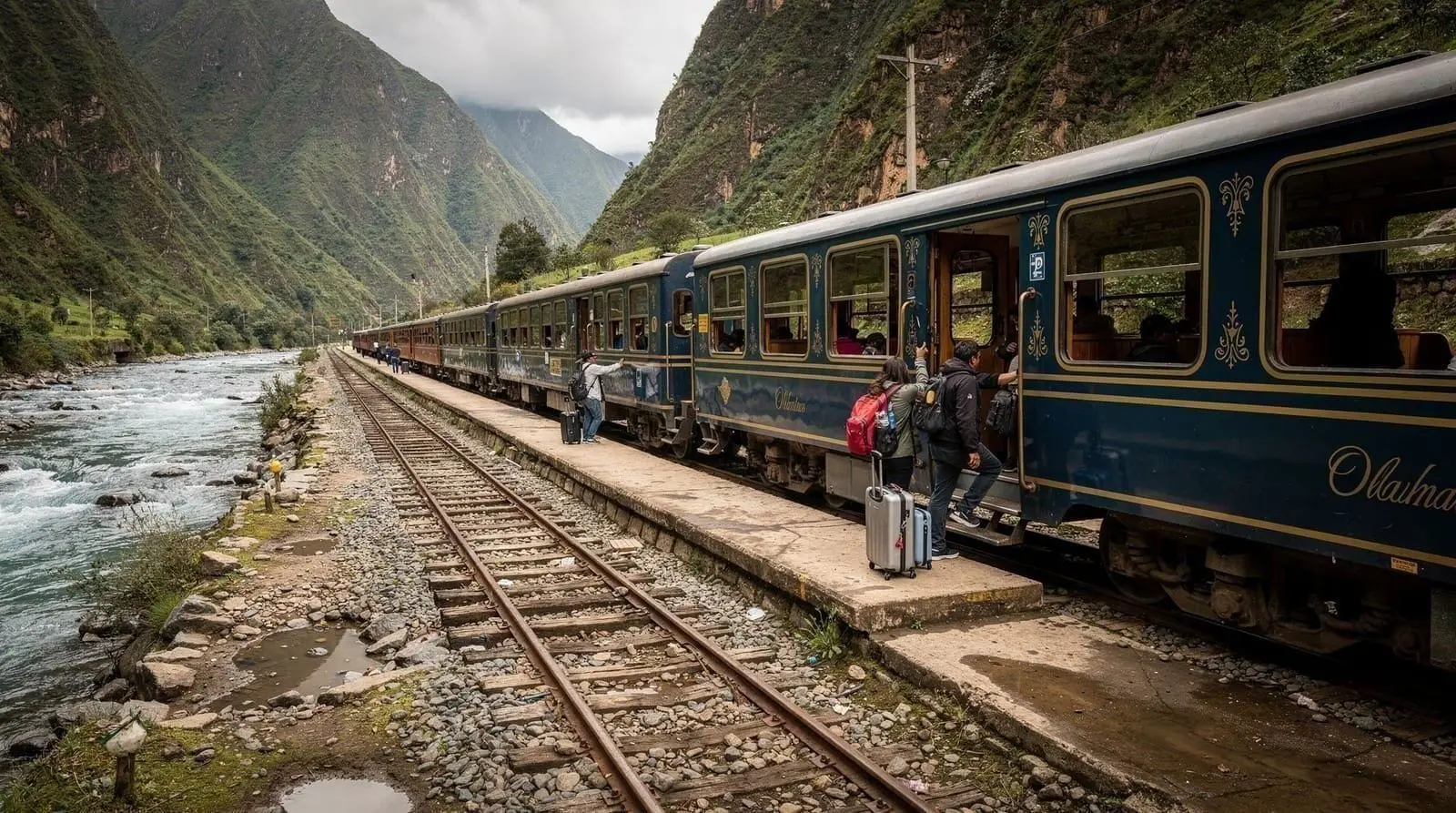
Machu Picchu train ticket scams and how to avoid them
What are the main Machu Picchu train ticket scams?
The big ones are lookalike websites posing as PeruRail or IncaRail, street and agency resales of train tickets at hidden markups, vague 'tourist train' offers that downgrade you to the cheapest class, and inflated 'last seat' pressure sales. Book directly on the official perurail.com or incarail.com sites, or through a reputable agency that names the operator, class and exact times.
Why train tickets are a softer target than entry tickets
Most travellers know to be careful with Machu Picchu entry tickets — the fake Machu Picchu tickets problem gets plenty of warnings. Train tickets get far less attention, and that is exactly why they are the easier place to get fleeced. There is no government portal with your name printed on it for trains; there are two private operators, a thin supply of seats, and a long chain of agencies and resellers between them and you. That structure leaves more room for hidden markups, quiet downgrades, and outright fakes than the entry system does.
This is the honest-planner breakdown of how the train scams actually work and how to book around them. It is the consumer-protection companion to the practical Machu Picchu train tickets guide, which covers classes, prices and timing. Read this one to know what to watch for; read that one to know what you are actually buying. No affiliate links appear on this page — it exists purely to keep you from losing money.
| Official sellers | perurail.com and incarail.com only |
| Standard classes | PeruRail Expedition / IncaRail The Voyager |
| Panoramic classes | PeruRail Vistadome / IncaRail 360 |
| Biggest risk | Lookalike domains, hidden markups, “tourist train” downgrades |
| Golden rule | Book entry ticket first, then match the train to it |
Scam one: lookalike PeruRail and IncaRail websites
There are exactly two train operators on the line down the Urubamba canyon to Aguas Calientes: PeruRail (perurail.com) and IncaRail (incarail.com). Scam sites copy their branding — logos, colours, carriage photos — onto near-identical domains: extra words bolted on, a different country ending, a hyphen where there should not be one. You fill in a real-looking booking form, pay, and receive a confiding-looking confirmation that does not exist in either operator’s system.
How to avoid it: type the domain yourself rather than clicking an ad or a link in a forum. The only two safe direct sources are perurail.com and incarail.com. Be especially wary of any train site that demands a bank transfer or cryptocurrency, shows no verifiable company registration, or quotes a fare below the official price. A genuine ticket can always be verified directly with the operator using the booking reference — if it cannot, it is not real.
Scam two: hidden-markup agency resales
Reputable agencies legitimately resell PeruRail and IncaRail tickets, often bundled with entry and the Consettur bus, and that convenience is worth paying a fair fee for. The scam version hides the markup. You are quoted a single all-in price with no breakdown, the train portion is marked up well above the operator’s fare, and you have no way to see what you actually paid for the seat.
How to avoid it: ask any agency to state, in writing, the operator (PeruRail or IncaRail), the exact class, and the departure times in both directions. Then cross-check that fare against the operator’s own site. A trustworthy agency has no problem itemising this; one that resists, dodges, or only gives you a lump sum is hiding something. A modest service fee is fair; a doubled fare buried in a bundle is not.
Scam three: the ‘tourist train’ downgrade
“Tourist train” sounds like a class. It is not — it is a vague umbrella that lets a seller deliver the cheapest tier while you imagine the panoramic one. PeruRail Expedition and IncaRail The Voyager are the standard economy classes with side windows. PeruRail Vistadome and IncaRail 360 are the pricier glass-roof panoramic carriages. A seller who only says “tourist train,” takes a Vistadome-level price, and books you Expedition has pocketed the difference.
How to avoid it: never accept “tourist train” as the answer. Make the seller name the exact class before you pay, and confirm it appears on your ticket. If you wanted the panoramic carriage, the words “Vistadome” or “360” must be on the booking — not a generic label.
Scam four: ‘last available seat’ pressure sales
The line has only two operators and limited daily capacity, so genuine seats really do sell out — which makes scarcity an easy lever to pull. Street touts and some agencies manufacture urgency: a “last available seat” for cash today, a “special” that expires in an hour, a warning that everything else is booked. The pressure is the product. It pushes you to skip verification and pay on the spot.
How to avoid it: treat urgency as a red flag, not a reason to hurry. The real scarcity is solved by booking early through official channels, not by trusting someone who approached you on the street. If a deal is only good “right now, in cash,” walk away. The same dynamic shows up across Cusco’s tourist economy — the Cusco tourist traps guide covers the broader pattern.
Scam five: mismatched times that wreck your entry slot
A subtler one. Your train ticket is genuine, but the times do not align with your Machu Picchu entry slot — booked carelessly by a reseller chasing whatever seats were left, or quoted to you without anyone checking your gate time. You arrive too late for your slot, or with hours to kill, and the entry ticket is the one that is non-refundable.
How to avoid it: book the entry ticket first, then match the train to it — arriving in Aguas Calientes about 90 minutes before your gate slot. If an agency books your train, give them your entry slot and confirm the arrival lines up. The train tickets guide and the tickets explained guide both lay out the booking order; the train serves the entry slot, not the other way around.
Scam six: the fake bimodal or bus-train switch
A newer wrinkle. IncaRail genuinely offers bimodal services that combine a road segment with the train, which legitimately changes where you board. Scammers exploit the unfamiliarity: you are sold a “bimodal” or “bus-plus-train” ticket that quietly replaces a proper train seat with a long bus ride, or that lands you at a boarding point far from where you expected, with no clear explanation of the swap. You only discover the substitution on the day, when changing it is impossible.
How to avoid it: if a seller offers a bimodal or combined option, ask precisely which segments are bus and which are train, and where exactly you board and disembark. A genuine bimodal service is fine if it suits you — but you must understand what you are buying. If the answer is vague, or the “train” turns out to be mostly bus, decline and book a standard train leg from Ollantaytambo instead.
Scam seven: the fake “combined” trek-and-train swap
Travellers piecing together a budget route sometimes get sold a “combined” trek-plus-train package that quietly substitutes a long, unshaded walk along the tracks for the train leg they thought they paid for. This overlaps with the cheaper Hidroelectrica route, which is a legitimate budget option in its own right — the scam is not the walking route itself, it is being sold a train ticket that never existed and discovering the substitution only at the station.
If you are deliberately choosing the budget hike-and-train combo, book it knowingly through a source that states exactly which leg is on foot; if you paid for a full train journey, insist on it. For a full comparison of the trek options against the train, see train vs. trek to Machu Picchu.
What to do if you get to the station and something is wrong
If your ticket does not scan, the class does not match what you paid for, or the departure time is wrong, raise it at the PeruRail or IncaRail counter immediately rather than boarding and hoping it sorts itself out — station staff can often rebook you onto a genuine seat if you catch the problem before departure. Keep your booking confirmation and payment receipt accessible on your phone and on paper; a verifiable reference number is your strongest leverage in the moment.
This is also why building slack into your schedule matters: travellers who arrive at Ollantaytambo with an hour to spare have room to resolve a ticket problem, while those who arrive five minutes before departure do not. For the wider question of how much buffer to leave around Machu Picchu day, see how many days in Cusco you should plan for, and compare the different circuit choices in the Machu Picchu circuits compared guide before you fix your entry slot.
Red flags checklist
Run any train offer past this list before you pay. The more boxes it ticks, the more cautious you should be:
- The domain is not exactly perurail.com or incarail.com, yet uses their branding.
- The price is below the official fare — genuine tickets are not discounted below operator rates.
- You are asked to pay by bank transfer, cash on the street, or cryptocurrency rather than a traceable card.
- The seller will not name the operator, exact class, and departure times in writing.
- The offer comes with artificial urgency — “last seat,” “expires in an hour,” “cash only now.”
- The class is described only as “tourist train” with no specific name.
- A bimodal option is offered without a clear breakdown of which segments are bus and which are train.
- The booking reference cannot be verified directly with PeruRail or IncaRail.
None of these alone proves a scam — reputable agencies charge a fair service fee and do sell out of seats. But several together are a clear signal to step back and book through official channels instead.
Why this matters more in peak season
The pressure to cut corners rises exactly when the risk is highest. From June to August, genuine train seats and Machu Picchu entry slots are scarcest, which is precisely when “last available seat” tactics land hardest and when desperate travellers skip verification. The defence is the same defence that solves the genuine scarcity: book early.
A traveller who locks the entry ticket and the train weeks ahead through official channels is immune to peak-season pressure sales, because they need nothing from a street tout. The scams feed on last-minute desperation — remove the desperation by planning ahead, and most of them simply cannot reach you. For the wider pattern of how Cusco’s tourist economy manufactures urgency, the Cusco tourist traps guide is worth reading alongside this one.
How to book trains safely, in one paragraph
Book your Machu Picchu entry ticket first. Then buy the train directly on perurail.com or incarail.com, or through a reputable agency that names the operator, class and times in writing — most travellers board at Ollantaytambo for the cheapest, most frequent leg. Confirm the exact class (Expedition/The Voyager for standard, Vistadome/360 for panoramic), match the arrival to your entry slot, ignore street pressure, verify any reseller ticket against the operator’s system, and never pay below the official fare or by untraceable transfer. Do that and the train, the link most travellers underestimate, becomes the easy part.
What a legitimate train booking looks like
It is easy to list the scams; it is more useful to know what a clean booking actually looks like, so you can recognise the real thing. A legitimate train ticket: comes from perurail.com or incarail.com, or from an agency that openly states it is reselling one of those operators’ tickets; names the exact class (Expedition, The Voyager, Vistadome, 360, or a premium service) on the confirmation, not a vague “tourist train”; shows specific departure times in both directions that align with your Machu Picchu entry slot; charges at or above the official operator fare, never below; is paid for by a traceable method, ideally a card; and carries a booking reference you can verify directly with the operator.
If your ticket has all of those properties, you are fine — the scams in this guide all fail at least one of them. When in doubt, the single most reliable test is verification: call or email PeruRail or IncaRail with the reference and confirm the ticket exists in their system before you travel.