Machu Picchu day trip from Cusco: is one day enough?
Cusco: Machu Picchu + Tourist Train + Entrance Ticket
Can you visit Machu Picchu as a day trip from Cusco?
Yes, but it is a 15–17 hour door-to-door day with no road to Aguas Calientes. You leave Cusco around 4–5 am for the road transfer to Ollantaytambo, take the train down, ride the bus up, walk one circuit, then reverse the whole chain. It works if your timing is tight and your bookings are locked, but it leaves no buffer for delays.
The honest version of a one-day Machu Picchu trip
The single-day Machu Picchu trip is the most over-sold and under-explained plan in Peru. Tour boards in Cusco advertise it as a tidy outing, but what they are selling is a 15-to-17-hour relay with four separate links — road, train, bus, gate — each of which has its own timetable and each of which can hand you a problem if the previous one runs late. There is no road to Aguas Calientes, so the train leg is not optional, and the train leg is exactly where a day trip gets fragile.
This guide is not here to talk you out of it. Plenty of people do the day trip and come home glad they did. But you should walk in knowing the real timeline, the real cost, and the one mistake — booking too early a return train — that turns a long day into a frantic one. If your dates are fixed and your bookings are locked the moment you decide, a day trip is a perfectly reasonable way to see the citadel. If you have any slack at all, an overnight buys you a calmer, better visit for a few extra dollars.
For a single bundled booking that handles the train, the bus, and the timed entrance in one place, a Machu Picchu day trip with the tourist train and entrance ticket removes most of the coordination risk described below — it is the version of the day trip with the fewest failure points.
| Where | Cusco to Machu Picchu and back, same day |
| Cost | Around $230–360/person independently |
| Time needed | 15–17 hours door to door |
| Getting there | Road to Ollantaytambo, then train |
| Best for | Fixed dates, tight schedules, no spare night |
The real 16-hour timeline
Here is how a working day trip actually runs, built backwards from a mid-afternoon return train. Times are typical, not promises.
- 4:30 am — leave Cusco. A road transfer to Ollantaytambo takes about 2 hours. Colectivos and private cars both leave from the Cusco side; allow margin for the slow climb out of the city.
- 6:30–7:00 am — Ollantaytambo station. Arrive with time to find your platform and stow luggage. Trains run on their own schedule and do not wait.
- 7:00–8:45 am — train to Aguas Calientes. The Ollantaytambo–Aguas Calientes leg is roughly 1 hour 40 minutes down the Urubamba canyon.
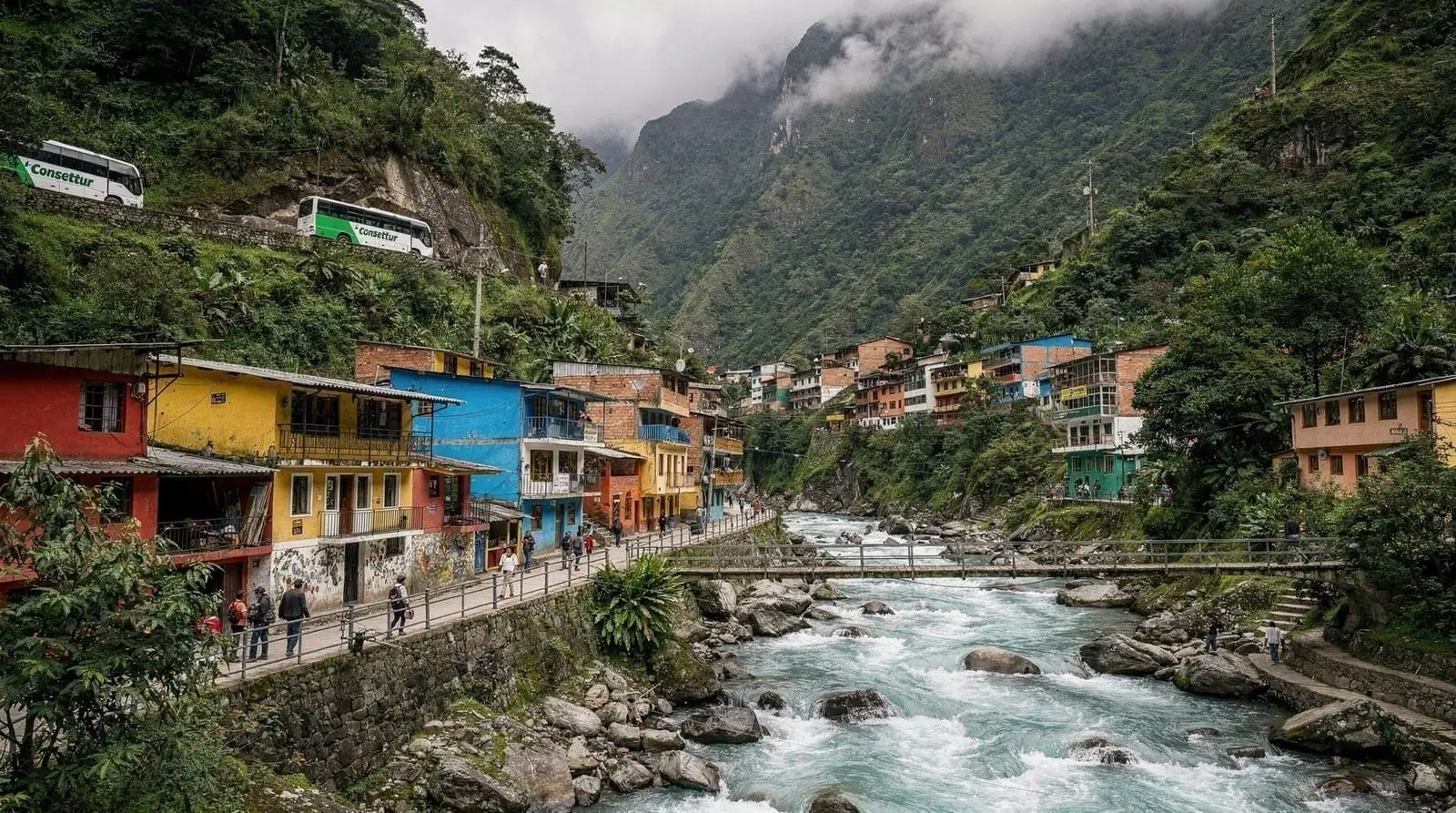
- 8:45–9:30 am — bus up. The Consettur shuttle queue along the river can run 30–45 minutes in peak season. The ride itself is 25 minutes of switchbacks.
- 9:30 am–12:30 pm — the citadel. You walk one circuit. You enter on your timed slot and you do not re-enter once you leave.
- 12:30–1:30 pm — bus down and lunch in Aguas Calientes. A quick meal before the return train.
- 2:30–3:30 pm — return train to Ollantaytambo. Then a 2-hour road transfer back to Cusco, arriving around 7–9 pm depending on traffic.
That is the compressed version. Notice how little air there is in it. A late road transfer in the morning, a long bus queue, or a delayed train at either end eats the buffer fast — and the train will not hold for you.
The last-train trap
The single most common day-trip mistake is booking a return train that is too early. People see an early-afternoon departure, assume “more time in Cusco that evening is better,” and book the 1:30 pm train. Then they spend the morning watching the clock instead of the ruins, sprinting the circuit and skipping the bus queue.
Book your return train no earlier than mid-afternoon — roughly 2:30 to 3:30 pm from Aguas Calientes. That gives you a full morning on the mountain plus a margin for the bus down. And book it before you lock your entry slot, because the early-afternoon trains are the first to sell out: they are the ones every day-tripper wants, so they vanish weeks ahead in dry season. For how trains, classes, and prices work in detail, see the Machu Picchu train tickets guide.
What it actually costs
Building a day trip independently, here is the 2026 math per foreign adult:
- Entry ticket: S/152, about $41 (S/200 with a mountain add-on, about $54).
- Round-trip train, Ollantaytambo: $130–220 depending on class (standard tourist vs. panoramic glass-roof).
- Consettur bus: about $24 round trip.
- Cusco–Ollantaytambo road, both ways: S/15–25 each way in a shared colectivo, considerably more in a private car.
That lands most independent day trips around $230–360 per person before food. A packaged tour that folds in transport, train, bus, entry, and often a guide frequently comes out in the same band — and it removes the risk of one mis-timed booking unravelling the chain. Compare the ticket types before you commit, since the circuit you pick changes both the price and how much walking the day involves.
When the overnight wins
The day trip’s weakness is that everything happens during the busiest window. You arrive when the morning trains from Ollantaytambo are dumping their crowds, and you leave when those crowds leave. You never see the quiet citadel.
Staying one night in Aguas Calientes flips that. You catch the first buses at 5:30 am, reach the gate before the day-trippers, and walk a far emptier circuit in clearer morning light — mornings are reliably less cloudy than afternoons. An overnight also gives you a buffer: if a train slips or a transfer runs late, you have not blown your only shot. The town itself is unlovely and overpriced, but you are paying for the early gate, not the charm.
Two-day packages make this painless. A 2-day Machu Picchu tour from Ollantaytambo handles the train, the overnight, the bus, and the entry as one booking if you are already based in the Sacred Valley. From Cusco, a Sacred Valley and Machu Picchu 2-day train tour folds the citadel into a valley loop, which uses the second day far better than a round-trip dash.
Day trip vs. overnight at a glance
Choose the day trip if: your dates are fixed, you have already booked the entry slot and a mid-afternoon return train, you are well acclimatised, and you accept a long day with no margin. It is also the right call if you simply cannot spare a second night.
Choose the overnight if: you want the first morning buses and a quiet citadel, you value a buffer against delays, or you are visiting in peak season when crowds and bus queues are at their worst. For most travellers with one flexible day to give, the overnight is the better experience for a modest premium.
The four links and where each one breaks
It helps to think of the day trip as a chain of four independent links, each with its own failure mode, because that is how you spot the weak point in your own plan.
Link one — the road to Ollantaytambo. A colectivo or private car from Cusco, about 2 hours. The failure mode is a late start or heavy morning traffic climbing out of Cusco. Mitigate it by leaving earlier than you think you need to and, ideally, by basing in Ollantaytambo the night before, which removes this link entirely.
Link two — the train. Roughly 1h40 from Ollantaytambo. The failure mode is mistiming: a return train booked too early, or an arrival that does not align with your gate slot. The train runs on its own clock and will not wait. Mitigate it by booking the train immediately after your entry slot and matching the two.
Link three — the Consettur bus. A 25-minute ride up, but the queue at the river can run 30-45 minutes in peak. The failure mode is underestimating the queue and missing your timed slot. Mitigate it by joining the queue well before your gate time, since the gate enforces the slot, not your bus departure.
Link four — the gate and the citadel. Your timed entry and one circuit. The failure mode is arriving late for your slot, or choosing a circuit that demands more walking than your compressed day allows. Mitigate it by picking Circuit 2 or a shorter circuit for a day trip and skipping the mountain climbs, which eat 2-4 hours you do not have.
Read down that list and the pattern is clear: every link can be steadied by booking in the right order and building margin into the morning. The day trip fails when one delayed link cascades into the next.
Which circuit suits a day trip
On a day trip, time is the scarce resource, so the circuit you book matters more than usual. Circuit 2 is the standard choice — it covers the most named structures in a single walk and still gives a good overview shot, which is exactly what a one-day visitor wants. Circuit 1 is shorter and reaches the classic postcard viewpoint, a reasonable pick if your priority is the photo and you want to keep the visit tight. Avoid the mountain add-ons — Huayna Picchu and Machu Picchu Mountain add hours of climbing that a day trip simply cannot absorb without a dawn start and an overnight. Save the peaks for a two-day plan.
Acclimatise before you go
One overlooked point: a day trip from Cusco starts you at 3,400 m. Machu Picchu itself is lower, at 2,430 m, but the 4:30 am start and the long day are harder if you arrived in Cusco only a day or two earlier. Spend two to three nights in Cusco or, better, in the lower Sacred Valley before attempting the trip, so altitude does not blunt the one day you have. If you are based in Ollantaytambo the night before, you are both better acclimatised and already at the train platform — a quiet advantage the day trip from Cusco gives up.
What the weather does to a day-trip timeline
Season changes the risk profile of a day trip more than most people expect. In the dry season (May–September), the road to Ollantaytambo and the rail line both run reliably, so the main risk is booking pressure — the mid-afternoon return trains sell out weeks ahead. In the wet season (November–March), the physical risk rises: heavy rain can slow the road transfer with minor landslip clearing near Ollantaytambo, and low cloud sometimes delays the very first buses up from Aguas Calientes. A day trip has almost no slack to absorb either kind of delay, which is one more reason an overnight is the safer choice specifically in wet-season months, even for travellers who would otherwise prefer the tighter schedule.
Packing for a day trip specifically
Because you are carrying everything for a 15-plus-hour day rather than checking into a room partway through, pack differently than you would for an overnight. A small daypack should hold: your passport and printed or downloaded tickets (train, entry, bus), a light rain layer even in dry season, sun protection, at least 1.5 litres of water, a few snacks since food inside the citadel is not sold, and cash in soles for the bus and any last-minute purchases. Leave anything you do not need at your Cusco hotel — most hold luggage for guests doing the day trip at no charge — since large bags are barred both on the train and inside the citadel.
Frequently asked questions about Machu Picchu day trip from Cusco: is one day enough?
What is the earliest train back I should book on a day trip?
Is a Machu Picchu day trip worth it or should I stay overnight?
How much does a Machu Picchu day trip from Cusco cost in 2026?
Do day-trip tours from Cusco include the entrance ticket?
What time do I need to leave Cusco?
Can I take the train all the way from Cusco?
Is a day trip riskier in the wet season?
What should I pack for a Machu Picchu day trip specifically?
Top experiences
Bookable activities with verified prices and instant confirmation on GetYourGuide.
