Pachacamac guide: visiting Lima's great oracle city
From Lima: Pachacamac Archaeological Site Guided Tour
Is Pachacamac worth visiting from Lima?
Yes, if you have a third day in Lima and an interest in archaeology. Pachacamac is one of the Pacific coast's largest ancient cities, 31 km south of Miraflores (45-60 minutes). Entry including the site museum is S/15 (about $4); budget two to three hours on site.
Why Pachacamac matters
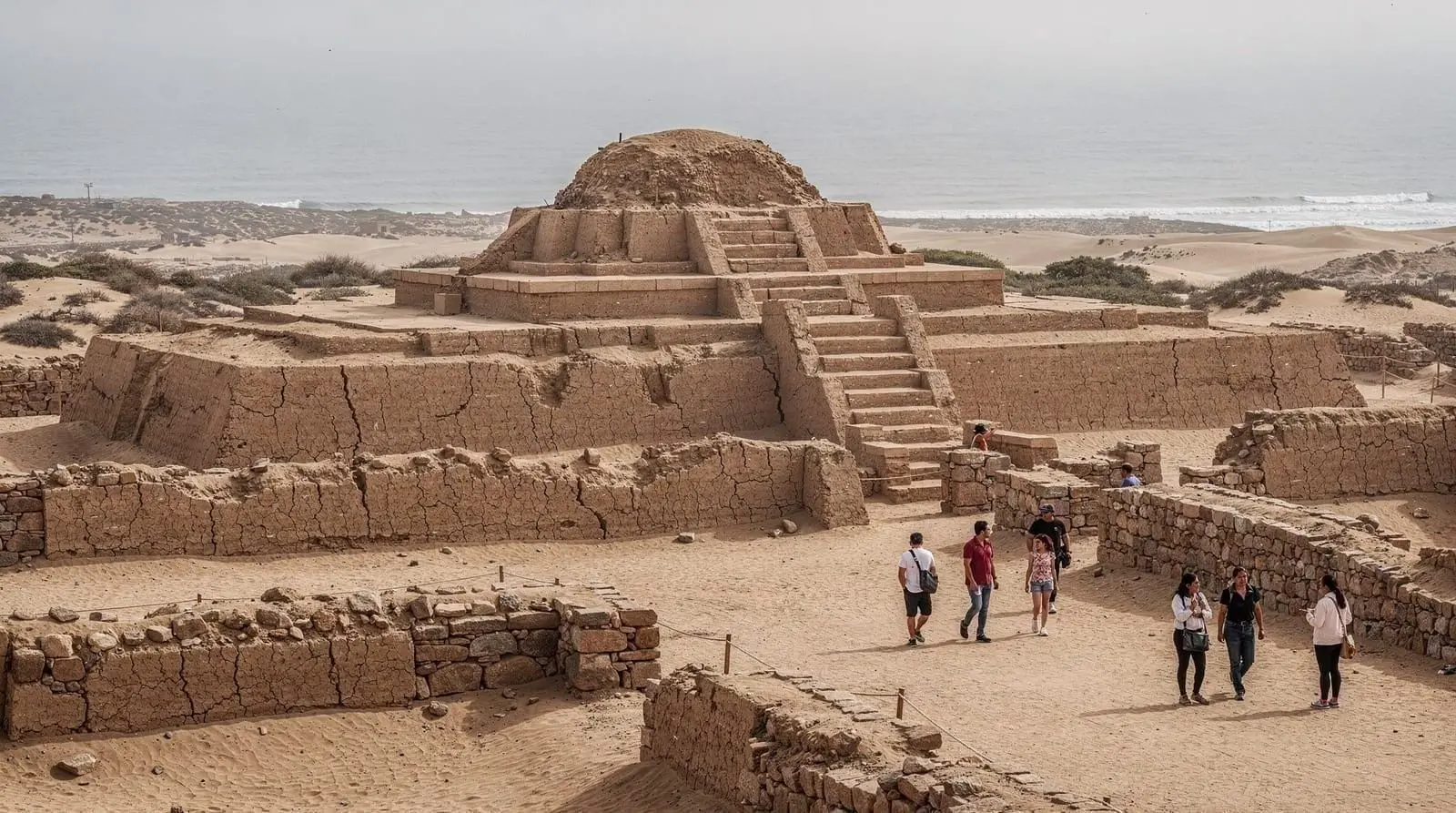
Pachacamac is the most important archaeological site within easy reach of Lima, and one of the largest ancient cities on the entire Pacific coast of South America. Spread across roughly 460 hectares of desert above the Lurín valley, 31 km south of Miraflores, it was a sacred pilgrimage centre for well over a thousand years — occupied successively by the Lima Culture, the Wari, the Ychsma, and finally the Inca, who built a Temple of the Sun and an “acllahuasi” (house of chosen women) here before the Spanish arrived in 1533.
The name comes from the creator deity Pacha Kamaq, “he who animates the world,” whose oracle drew pilgrims from across the Andes much as Delphi did in the ancient Mediterranean. That continuity of worship across so many cultures is what makes the site historically remarkable, even if, like most coastal Peruvian sites, much of it reads to the untrained eye as low adobe mounds rather than dramatic stone architecture. Come for the history and the scale, manage your expectations on the photogenic-ruins front, and you will not be disappointed. For the full destination overview, see /destinations/pachacamac/.
| Where | Lurín district, 31 km south of Miraflores |
| Cost | S/15 (about $4) combined site and museum ticket |
| Time needed | 2-3 hours |
| Getting there | App taxi (45-60 min) or a guided tour from Lima |
| Best time | Weekday mornings, arriving near the 9 am opening |
A thousand years of history in one place
What sets Pachacamac apart from a single-culture site is its extraordinary continuity. Worship here did not begin and end with one civilisation; it ran almost unbroken for well over a millennium, with each new power building on, rather than erasing, what came before.
The earliest monumental construction belongs to the Lima Culture (roughly 200-700 CE), whose stepped adobe platforms form the oldest core. The Wari empire, expanding from the highlands around 600-1100 CE, made Pachacámac a major provincial centre and helped spread the cult of the oracle across the Andes. After the Wari, the local Ychsma lord domain (around 1100-1470 CE) built most of the adobe pyramids with ramps that dominate the central site, governing the Lurín and Rímac valleys from here.
Finally, the Inca absorbed the coast in the late 15th century and, rather than suppress the oracle, co-opted it — adding the Temple of the Sun and the Acllahuasi and folding Pacha Kamaq into their own state religion. When Hernando Pizarro arrived in 1533, sent ahead by his brother Francisco to seize the temple’s legendary gold, he found the wooden idol and a sanctuary that had drawn pilgrims and offerings from across the empire. That layered story — coastal and highland, pre-Inca and Inca, indigenous and then disrupted by conquest — is what you are really visiting. Read up a little beforehand and the low adobe mounds resolve into something far more legible.
Tickets and what is included
A combined ticket covering the archaeological site and the Pachacamac Site Museum costs S/15 (about $4) for adults, with reduced rates for students with ID and for children. This is one of the best-value archaeological tickets in Peru. The site is generally open Tuesday to Sunday, roughly 9 am to 4 pm (last entry around 3 pm), and closed on Mondays — always confirm before travelling, as hours shift with the season and public holidays.
A licensed guide at the entrance costs around S/40-70 for a small group and is genuinely worth it: without context the adobe structures are hard to interpret. An on-site shuttle (when running) and parking are small extra costs.
Getting there from Lima
Pachacamac lies 31 km south of central Lima, in the Lurín district, a journey of 45-60 minutes in normal traffic and considerably longer during morning and evening rush hours.
- App taxi (recommended for independent visitors): Roughly S/50-65 one way from Miraflores using Cabify, InDriver, or Uber. The honest catch is the return: ride-hail availability at the site is patchy, so either ask your driver to wait (negotiate an hourly rate, around S/30-40/hour) or arrange a round trip in advance.
- Public bus: Buses run south along the Panamericana Sur from points in central and southern Lima. They are cheap (a few soles) but slow, crowded, and drop you on the highway with a walk to the entrance. Only worth it if you are confident with local transport and not pressed for time.
- Organised tour: Removes all the return-transport uncertainty. The guided Pachacamac tour from Lima includes round-trip transport and a guide, while the Pachacamac archaeological site visit is a straightforward option that handles the logistics. For most first-time visitors, a tour is the path of least resistance.
What to see on site
Start at the site museum
Begin at the Pachacamac Site Museum, opened in 2016 and widely praised for its restrained, modern design that sits quietly in the landscape. It displays key finds from the complex, most famously the carved wooden Pachacamac idol — a two-faced staff-like figure that was the focus of the oracle cult. Twenty to thirty minutes here gives you the context that makes the rest of the site legible.
The Temple of the Sun
The Inca-built Temple of the Sun (Templo del Sol) is the most imposing structure, a stepped platform of adobe and stone on a rise overlooking the Pacific. From the top you get the best view of the whole complex and the ocean beyond — on a clear day (November to April) this is the photographic highlight of the visit. Note that access to the temple itself is sometimes restricted to protect the structure; check at the entrance.
The Painted Temple and the Ychsma pyramids
The Painted Temple (Templo Pintado) preserves traces of the murals that once covered its façade. Around it spread numerous adobe pyramids with ramps, built by the Ychsma culture, which functioned as administrative and ceremonial centres for the pilgrims arriving to consult the oracle.
The Acllahuasi (Mamacona)
The restored Acllahuasi, sometimes called Mamacona, is the most architecturally complete structure, with recognisable Inca stone-and-adobe walls and trapezoidal niches. It was where the “acllas,” women chosen for religious and weaving service, lived. This is the one part of the site that looks unmistakably Inca and gives a tangible sense of scale.
When to go and what the seasons mean
Pachacámac follows Lima’s coastal climate, so the same garúa fog that grey-washes the city from May to October settles over the desert here too. In those months the air is cool and damp, the light is flat, and the ocean views from the Temple of the Sun are muted — but the walking is far more comfortable, and the site is quieter. From November to April the skies clear, the Pacific shows blue from the temple platform, and the photographs come out well, but the midday sun on the exposed desert is genuinely punishing.
Whatever the season, aim to arrive when the site opens (around 9 am). You beat the worst of the heat, the light is gentler, and you sidestep both the late-morning tour groups and the worst of the return traffic into Lima. Weekdays are quieter than weekends, when Limeño families and school groups visit. Avoid Mondays entirely, as the site is normally closed.
What to bring
This is open desert with almost no shade and no shops on site beyond a small kiosk, so come prepared:
- Sun protection: a hat, sunglasses, and high-factor sunscreen, even on foggy days when the UV is deceptively strong.
- Water: at least a litre per person; there is little to buy once you are inside.
- Footwear: closed, comfortable shoes — the ground is sandy, uneven, and dusty.
- Cash in soles: for the entry ticket, an on-site guide, and any kiosk purchases; do not assume cards are accepted.
- A light layer: mornings in the garúa season can be cool and breezy on the exposed platforms.
Where to eat near Pachacámac
The Lurín valley below the site is known for its rustic country restaurants (campestres), several of them set among fields and trees, serving generous Lima-style cooking — chicharrón, seco de cabrito, pachamanca on weekends, and plenty of ceviche. They make a natural lunch stop on the way back to the city, and most taxi drivers and tour guides know them. Eating here is both cheaper and more characterful than rushing back to Miraflores hungry, and it turns a half-day of ruins into a fuller day out. If you are continuing south toward Paracas, the valley is also a sensible last proper meal before the long desert drive.
Pachacámac versus Lima’s other ruins
Lima has two main archaeological options for visitors, and they serve different purposes. Huaca Pucllana sits right in the middle of Miraflores, is reached in a ten-minute walk or a short taxi, takes about an hour, and offers atmospheric evening torchlit visits — it is the convenient, low-commitment choice for travellers who want a taste of pre-Columbian Lima without dedicating half a day. Pachacámac is the opposite: far larger, far more historically significant, and far more demanding in time and logistics.
If your schedule is tight and you simply want to see one pre-Inca monument, Huaca Pucllana wins on convenience. If you have a genuine interest in archaeology and a spare half-day, Pachacámac rewards the effort with scale and a thousand-year story that the small urban huaca cannot match. Committed visitors do both — Huaca Pucllana as an evening activity in Miraflores, Pachacámac as a dedicated morning excursion. The nearby Huaca Huallamarca in San Isidro is a third, minor option, a restored pyramid worth a brief look only if you happen to be in that district.
A useful mental frame: Pachacámac is to Lima what a major out-of-town archaeological park is to a capital — not something you stumble across between meals, but a deliberate trip that defines a chunk of your day. Plan it as such and it delivers; treat it as a quick detour and the distance will frustrate you.
Practical visiting tips
- Time on site: Two to three hours is right. Less feels rushed; more is only for serious enthusiasts.
- Heat and sun: The site is open desert with almost no shade. Bring a hat, sunscreen, water, and closed shoes. The garúa fog months (May-October) are actually more comfortable for walking, even if the photos come out grey.
- Driving the circuit: A road loops between the main monuments. Keeping your taxi or tour vehicle lets you skip the long, exposed walks between structures.
- Pair it with lunch in Lurín or the south: The Lurín valley has rustic country restaurants (campestres) known for chicharrón and Lima-style cooking. Many tours and drivers can stop on the way back.
- Combine with the south coast: If you are heading to Paracas or Huacachina anyway, Pachacamac sits on the route south and can be a worthwhile first stop, though most south-coast tours skip it.
What to expect on the ground
It helps to set expectations honestly before you arrive, because Pachacámac is not Machu Picchu and visitors who expect dramatic stonework can come away flat. Most of the complex is built from adobe — sun-dried mud brick — which after centuries of coastal weathering reads as a series of large tawny mounds and terraced platforms rather than crisp ruins. The scale is genuinely impressive once you grasp it, but it asks you to use your imagination and lean on the site museum and a guide to bring it alive.
The reward is atmosphere and historical depth rather than postcard drama. Standing on the Temple of the Sun with the Pacific spread out below, knowing that pilgrims walked here from across the Andes for a thousand years to consult an oracle, is a quietly powerful experience for those who engage with it. The light, the wind off the ocean, and the emptiness of the desert all contribute. Come with that frame of mind — historical pilgrimage site, not architectural showpiece — and Pachacámac delivers. Come expecting Cusco-style masonry and it will not.
A practical consequence: this is a site that rewards reading a little beforehand or hiring a guide on arrival. Unguided and uninformed, the adobe platforms can blur together; with context, each structure tells part of the story of a sacred city that outlasted four civilisations.
How Pachacamac fits into your Lima time
Pachacamac is a third-day activity for most visitors. A focused two-day Lima plan (see /guides/lima-in-2-days/) covers the colonial centre, Miraflores, the Larco Museum, and Barranco without it. Add Pachacamac when you have the extra day and a genuine interest in archaeology, or when you want to balance a food-and-neighbourhoods trip with one substantial historical excursion.
If you would rather spend a third day differently — beaches, the south coast, or the Nazca region — compare the alternatives in /guides/lima-day-trips/. For where Pachacamac sits in a longer national route, see /guides/peru-2-week-itinerary-guide/ and the /itineraries/ hub.
Travellers who only have time for one set of ruins in the city itself often choose the far more convenient Huaca Pucllana, which sits right in the middle of Miraflores. Pachacamac is the more rewarding site for the committed, but it asks for the better part of a day in return.
Booking a guide versus going independent
The choice between an independent taxi visit and an organised tour comes down to how much you value context versus flexibility. Going independently — taxi there, wander at your own pace, taxi back — costs less and lets you linger at whichever structure interests you, but you either hire a guide at the gate (worth it, as noted above) or walk the site cold, which for most first-timers means the Temple of the Sun and the pyramids blur together without explanation.
An organised tour removes the return-transport uncertainty entirely and typically bundles Pachacamac with another Lima sight, most commonly the Larco Museum, since the collection there gives useful pre-Inca and Inca context that makes the ruins more legible once you arrive. The trade-off is a fixed schedule and a shared group pace.
Guided Pachacamac tour from LimaFor a broader day that folds in the wider Lima archaeological picture, the Lima city tour combining Larco Museum and Huaca Pucllana is worth comparing against a Pachacamac-only booking if you are trying to decide how to spend a single free day.
A little more on the oracle itself
It is worth understanding what pilgrims actually came for, because the “oracle” label undersells how significant Pachacamac was to the pre-Columbian Andean world. Pilgrims travelled from as far as modern-day Ecuador and Bolivia to consult Pacha Kamaq on matters of health, harvests, and the future, leaving offerings of textiles, ceramics, and precious metals along the way. The wooden idol now displayed in the site museum was reportedly kept in near-total darkness, attended only by priests who fasted before approaching it, and consulted the deity through a system of questions with mediated answers — a practice with clear parallels to Delphi’s oracle in ancient Greece, separated by an ocean and centuries with no contact between the two.
When the Inca absorbed the coast, they were shrewd enough not to suppress a cult already commanding empire-wide devotion; instead they built the Temple of the Sun alongside it and let the two belief systems coexist under one roof. That pragmatic layering of faiths — rather than the more usual pattern of conquerors erasing what came before — is arguably the single most interesting thing about the site, and it is easy to miss entirely without a guide or the museum’s context pointing it out.
Excavations at Pachacamac have continued for well over a century, since the German archaeologist Max Uhle’s pioneering work here in the 1890s, and new finds still surface periodically — mummy bundles, textile fragments, and ceramic offerings that keep refining the picture of who worshipped here and how. Unlike Machu Picchu, whose story is fixed and well-told, Pachacamac is still, in a small way, an active dig, which is part of why serious archaeology enthusiasts rate it so highly even though it draws a fraction of Machu Picchu’s visitors.
Frequently asked questions about Pachacamac guide: visiting Lima's great oracle city
How much does it cost to enter Pachacamac?
How do I get to Pachacamac from Lima?
How long do you need at Pachacamac?
Is there a museum at Pachacamac?
Can you walk around Pachacamac or do you need a vehicle?
Is Pachacamac better than Lima's other ruins?
Top experiences
Bookable activities with verified prices and instant confirmation on GetYourGuide.

