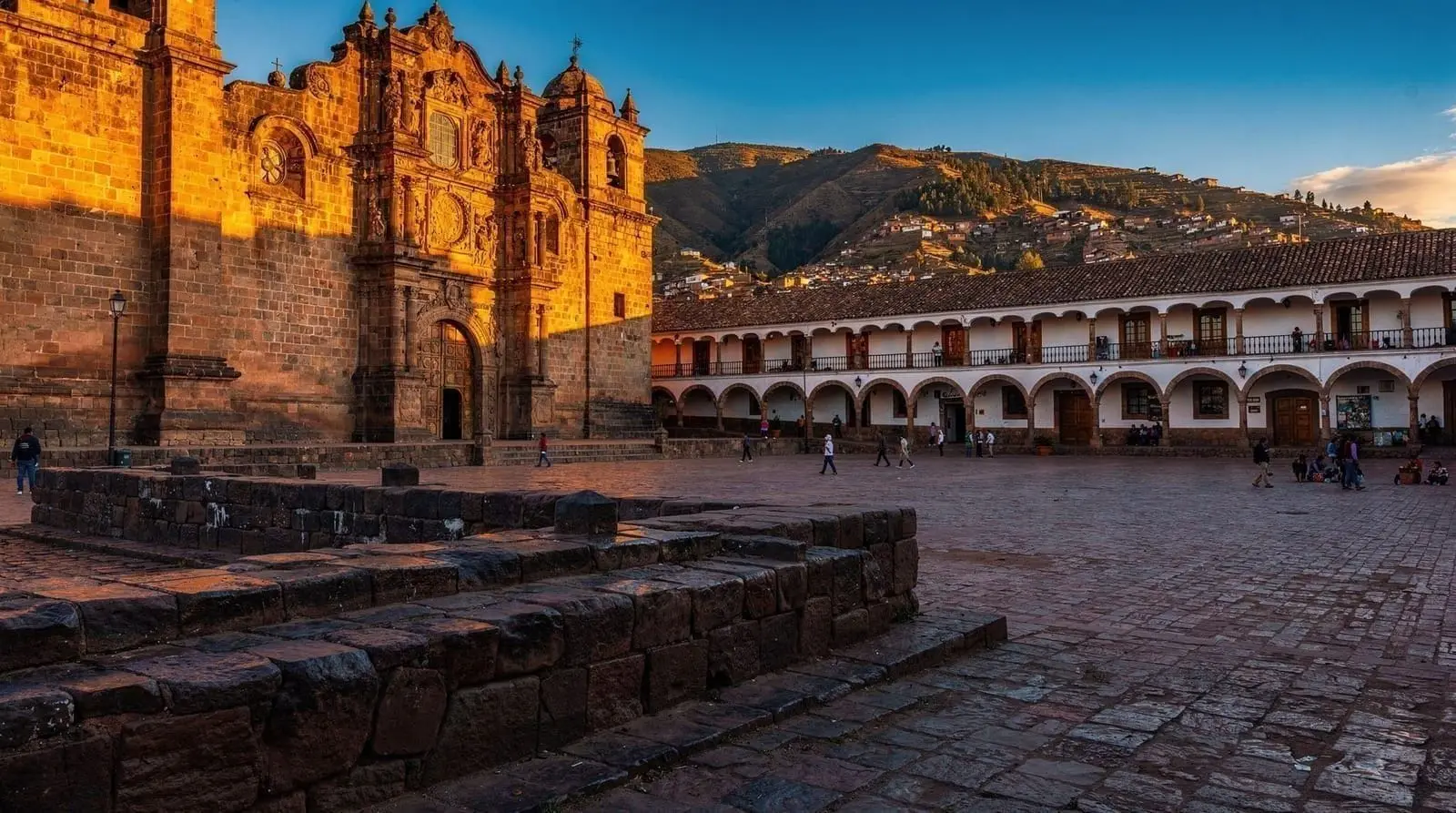
Historic centre of Cusco
The UNESCO heart of Cusco explained: Plaza de Armas, the cathedral, Inca walls on Hatun Rumiyoc, real prices, and the plaza-balcony pricing trap.
Cusco: City Center and San Blas Walking Tour
Quick facts
- Status
- UNESCO World Heritage Site (since 1983)
- Altitude
- 3,400 m / 11,150 ft
- Cathedral entry
- Around S/40 (religious circuit) — not on the boleto turístico
- Best for
- Inca-on-colonial architecture, the Plaza de Armas, walkable history
A city built twice, on the same stones
The historic centre of Cusco is the clearest place on earth to see two empires stacked on top of each other. Walk almost any street within a few blocks of the Plaza de Armas and you find the same pattern: a base of dark, tight-fitting Inca masonry — laid without mortar, the joints so fine a knife blade will not pass between them — supporting a colonial wall of adobe and plaster, topped by a tiled roof and a wooden balcony. The Inca courses survive earthquakes that crack the Spanish work above them. That layering is the whole story of the place, and it is free to read on foot.
| Where | Central Cusco, around the Plaza de Armas |
| Time needed | Half day to a full day |
| Cost | Free to walk; cathedral religious circuit ~S/40 |
| Getting there | Walkable from anywhere in central Cusco |
| Best time | Early morning (quiet plaza) or evening (floodlit churches) |
This is the part of Cusco most visitors see first, and it makes an ideal acclimatisation outing because the core around the plaza is comparatively flat. UNESCO listed the centre in 1983 for exactly this dual heritage. You can cover the essentials in half a day, but lingering — a coffee on a balcony, an hour in the cathedral, an evening when the floodlights come on — is the better way to do it.
The Plaza de Armas
The Plaza de Armas is the centre’s anchor and was, in Inca times, the ceremonial Huacaypata — a far larger square that hosted the empire’s great festivals. The Spanish shrank it, paved it, and ringed it with arcaded buildings and two churches whose façades dominate the skyline: the Cathedral on the northeast side and the Iglesia de la Compañía de Jesús to the southeast, the latter a Jesuit church whose lavish front famously outshone the cathedral and irritated the local clergy.
The square is at its best twice a day. Arrive soon after dawn and you get the plaza nearly to yourself, before the tour groups and the photographers with costumed llamas (who expect a tip — S/2–5 — if you photograph them). Return after dark, when both churches are floodlit and the surrounding hills glitter with house lights.
The balcony-restaurant trap: the upper-floor restaurants ringing the plaza charge a steep premium for the view — often double the price of an identical dish a block away. They are not scams, but they are not value either. If you want the vista, order a single drink and pay for the seat consciously; eat your actual meal off the square.
Photographing the plaza: the classic shot is from one of the balcony cafés looking down over the fountain toward the cathedral, but the same view is achievable for the price of a coffee rather than a full meal — order just a drink if photography, not dining, is your goal. At street level, the arcades on the southwest side frame the cathedral nicely in late-afternoon light, when the sun is low enough to avoid the harsh midday glare that washes out most daytime plaza photos.
A guided walk is the most efficient way to decode the doorways, coats of arms, and stonework you would otherwise pass blindly. The Cusco city centre and San Blas walking tour links the plaza, the Inca walls, and the climb up to the San Blas artisan quarter in one route with a guide who can point out what each layer of wall actually is.
Cusco Cathedral
The Catedral Basílica de la Virgen de la Asunción took nearly a century to build (begun 1559) and stands on the foundations of the Inca Kiswarkancha palace, using stones hauled down from Sacsayhuamán. Inside, the highlights are specific and worth seeking out rather than drifting past:
- The Last Supper by Marcos Zapata — a Cusco School canvas in which the centrepiece dish on Christ’s table is a roast cuy (guinea pig), the Andean ceremonial food. It is the single most-pointed-to painting in the building and a perfect emblem of how Indigenous artists folded their world into imposed Christian forms.
- El Señor de los Temblores (the Lord of the Earthquakes) — a darkened Christ figure credited with halting the catastrophic 1650 earthquake, and still the city’s most venerated image, paraded each Easter Monday.
- The carved cedar choir stalls and the silver-clad main altar.
Entry is via the religious circuit ticket, around S/40, which usually also covers nearby churches; it is not included on the boleto turístico. Photography inside is restricted. Allow 45–60 minutes. The cathedral is right on the plaza, so it pairs naturally with the morning or late-afternoon square visit.
Beyond the headline pieces, the cathedral’s side chapels hold a substantial collection of Cusco School paintings — the distinctive colonial style in which Andean and Indigenous artists, trained by Spanish friars, produced religious scenes with local faces, plants, and symbolism woven into ostensibly European compositions. Spending ten extra minutes with the smaller canvases, rather than making a beeline for the famous Last Supper, rewards attentive visitors with a much fuller sense of how deeply this hybrid art tradition runs through the building.
Hatun Rumiyoc and the twelve-angled stone
A short, gentle uphill from the plaza along Calle Hatun Rumiyoc runs the most famous stretch of Inca wall in the city — the side of what was the palace of the Inca Roca, now the Archbishop’s Palace. Set into it is the celebrated twelve-angled stone (la piedra de los doce ángulos), a single block cut with twelve faces to interlock perfectly with its neighbours, no mortar involved.
It is genuinely impressive engineering, and it is also a managed tourist moment: expect a small crowd, a costumed “Inca” who will pose beside it for tips, and vendors. Look beyond the famous block at the whole wall — the entire run is a masterclass in polygonal masonry, and quieter sections a few metres along let you appreciate the technique without the scrum. The street continues up toward San Blas, making this a natural step on the climb into the artisan quarter.
Look closely and you can find blocks with even more angles than the famous twelve — a fourteen-angled stone exists nearby, tucked into a less-photographed section of wall, though it gets a fraction of the attention. Guides who know the neighbourhood well can point it out; independent visitors often walk straight past it looking only for the marked twelve-angled block.
The Compañía de Jesús and the lesser churches
The Iglesia de la Compañía de Jesús, on the southeast corner of the plaza, is the building that nearly out-grandeured the cathedral. The Jesuits built it on the foundations of the Amarucancha, the palace of the Inca Huayna Cápac, and made its façade so elaborate that the bishop complained to Rome; by the time the Pope ruled the cathedral should remain pre-eminent, the church was already finished. Inside, the gilded retablo and the painted ceiling are worth the small separate entry (around S/15). Climb to the upper choir for one of the best framed views straight out over the Plaza de Armas.
A short walk west, the Iglesia de San Francisco on its own quiet square has catacombs and a notable colonial art collection, and sees a fraction of the plaza’s foot traffic — a good escape when the main square feels overrun. The Templo de la Merced, two blocks from the plaza, holds a famous jewel-encrusted gold monstrance in its small museum. None of these are essential, but together they show how thoroughly the religious orders carved up the old Inca core between them.
Visiting all three lesser churches in sequence — San Francisco, La Merced, and a final look back at the Compañía de Jesús — makes a natural, low-crowd afternoon loop for travellers who have already ticked off the cathedral and want more depth without more crowds. Each charges a small separate entry, and none require advance booking.
The Museo Inka and reading the layers properly
For context that the street walls alone cannot give, the Museo Inka (the “Admiral’s House,” Cuesta del Almirante, just off the plaza) is the best single museum in the centre. Housed in a grand colonial mansion built — predictably — on Inca foundations, it lays out the pre-Columbian cultures of the region in order, from the textiles and ceramics of earlier Andean peoples through to the Inca and the conquest.
Entry is modest (around S/20, not on the boleto turístico). An hour here before you walk the streets makes the difference between seeing “old walls” and recognising what each course of stone is and who laid it. A guided walk such as the Qorikancha and Sacsayhuamán city tour can fill the same role for travellers who would rather have the layers narrated on the spot than read in a gallery.
The streets worth wandering
Beyond the marquee sights, the centre rewards aimless walking:
- Calle Loreto — flanked on both sides by long, unbroken Inca walls (one belonging to the Acllawasi, the house of the chosen women), this is the best place to feel the scale of pre-conquest Cusco.
- Calle del Medio and Calle Espaderos — colonial lanes leading off the plaza toward the San Pedro market, lined with balconied mansions.
- Plazoleta Regocijo and Plaza San Francisco — quieter squares a few blocks west, with less commercial pressure than the main plaza.
- Avenida El Sol — the modern artery running downhill toward Qorikancha, home to the banks, the COSITUC boleto office, and the post office.
None of these streets require a plan beyond wandering with your head up. The pleasure of the centre is as much in the incidental details — a carved door lintel, a shop built into a niche of Inca stone, a balcony railing worn smooth by centuries of hands — as in the marquee sights, and a slow, aimless hour often turns up more than a checklist tour.
Practicalities for the centre
Altitude: even though the core is flat, you are still at 3,400 m. On your first day, take the stairs into the cathedral slowly and do not be alarmed by breathlessness. The centre is the right place for a gentle first outing precisely because it asks little of your legs.
Tickets at a glance: the cathedral and the Compañía de Jesús are on the religious circuit (around S/40 and S/15 respectively), not the boleto turístico. Qorikancha, a short walk downhill, is also separate (around S/15). The boleto turístico is what you need for the ruins above town and the Sacred Valley — see the full breakdown on the Cusco page.
Money and touts: the plaza is the city’s densest zone for flyer-handers offering massages, restaurants, and “free” workshops. A polite “no, gracias” and steady walking handles it. Keep your phone pocketed in the crowds.
Restrooms: public toilets are scarce around the plaza itself; the cathedral, the Museo Inka, and cafés with paying customers are the reliable options. Budget a small coin for pay-toilets at the market end of the centre.
Timing the visit: combine an early-morning plaza walk and the cathedral, break for lunch off the square, then climb gradually toward Hatun Rumiyoc and San Blas in the afternoon. Return to the plaza after dark for the floodlights.
Where to stay in and around the centre
Staying in or just off the historic centre puts you within walking distance of everything, but the trade-offs are real and worth weighing.
On the Plaza de Armas itself — a handful of grand hotels occupy converted colonial buildings right on the square, with unbeatable views and unbeatable prices to match. The catch is noise: the plaza hosts frequent parades, protests, and festivals, and the bars on Plateros and Procuradores run late. Light sleepers should ask for an interior room.
The quiet streets just off the plaza — the blocks toward San Blas and around Plaza Regocijo offer the same walkability with markedly less noise, often in restored mansions with courtyards. This is the sweet spot for most visitors.
Avoiding the trap rooms — some budget places advertise a “Plaza de Armas location” but are actually up several flights of unlit colonial stairs with no lift, which is brutal at 3,400 m with luggage. Check explicitly whether there is an elevator and how many stairs are involved before booking, especially on your acclimatisation days.
A note on the steep approach streets: the centre is flat at its core but the lanes radiating outward — toward San Blas, San Cristóbal, and the upper barrios — climb quickly. Pick accommodation by how much daily climbing you are willing to do while your body adjusts. If in doubt, ask your hotel directly how many metres of elevation gain the walk from the plaza involves — a genuinely useful question that front-desk staff are used to answering for altitude-conscious guests.
Festivals that take over the centre
The historic centre is the stage for Cusco’s biggest celebrations, and timing a visit around (or deliberately away from) them changes everything.
- Inti Raymi (24 June) — the Festival of the Sun begins with ceremonies at Qorikancha and a procession through the Plaza de Armas before moving up to Sacsayhuamán. The centre is packed and prices peak for the surrounding fortnight.
- Corpus Christi (late May / June) — fifteen saints and virgins are carried from their parish churches into the cathedral in a vivid, deeply local procession that fills the plaza. Less touristed than Inti Raymi and arguably more authentic.
- Señor de los Temblores (Easter Monday) — the darkened Christ from the cathedral is paraded around the plaza, showered in red ñucchu petals, in the city’s most emotional religious event.
If you want a calm, photogenic centre, avoid the days immediately around these dates; if you want the city at its most alive, plan for them and book far ahead. The Cusco festivals calendar guide has the full year of dates if you want to plan a trip specifically around, or specifically away from, the crowds.
How the centre fits your Cusco days
The historic centre is the natural first-day, low-altitude outing of any Cusco stay. From here the city opens outward: downhill to Qorikancha, uphill to San Blas and on to Sacsayhuamán, and across to San Pedro market for lunch. For the bigger picture — acclimatisation strategy, the boleto, and onward trips to the Sacred Valley and Machu Picchu — start from the main Cusco guide, browse /itineraries/, or use the planning tools at /tools/.
Frequently asked questions about Cusco’s historic centre
Is the historic centre walkable on the first day at altitude?
Yes — it is the best low-effort outing for an acclimatisation day. The core around the Plaza de Armas is comparatively flat, so you can see the square, the cathedral, and the Inca walls without much climbing. Save the uphill push to San Blas and Sacsayhuamán for your second or third day.
Is the cathedral included in the boleto turístico?
No. Cusco Cathedral is on a separate religious-circuit ticket costing around S/40, which usually also admits you to a couple of nearby churches. The boleto turístico covers the ruins above town and Sacred Valley sites, not the centre’s churches. Qorikancha is also ticketed separately.
What is the twelve-angled stone and where is it?
It is a single Inca block cut with twelve interlocking faces, set into the wall on Calle Hatun Rumiyoc, a short uphill walk from the Plaza de Armas. It is free to see from the street. Expect a small crowd and costumed performers who pose for tips; the whole wall, not just that one stone, is worth your attention.
Should I eat at the balcony restaurants on the Plaza de Armas?
Only if you are paying consciously for the view. The upper-floor plaza restaurants charge roughly double for the same dishes you will find a block away. They are fine for a single drink to enjoy the square, but eat your main meal off the plaza for far better value.
How long do I need in the historic centre?
Half a day covers the essentials — the plaza, the cathedral, and the Inca walls along Hatun Rumiyoc and Loreto. A full day lets you add the cathedral interior properly, wander the quieter side streets, and return after dark for the floodlit square. Many visitors split it across two visits during their Cusco stay.
When is the Plaza de Armas least crowded?
Soon after dawn, before the day’s tour groups and the costumed-llama photographers arrive. Early evening is busier but rewarding once the cathedral and Compañía de Jesús are floodlit. Midday and early afternoon are the most crowded and the most flyer-heavy stretch.
Top experiences
Bookable activities with verified prices and instant confirmation on GetYourGuide.
