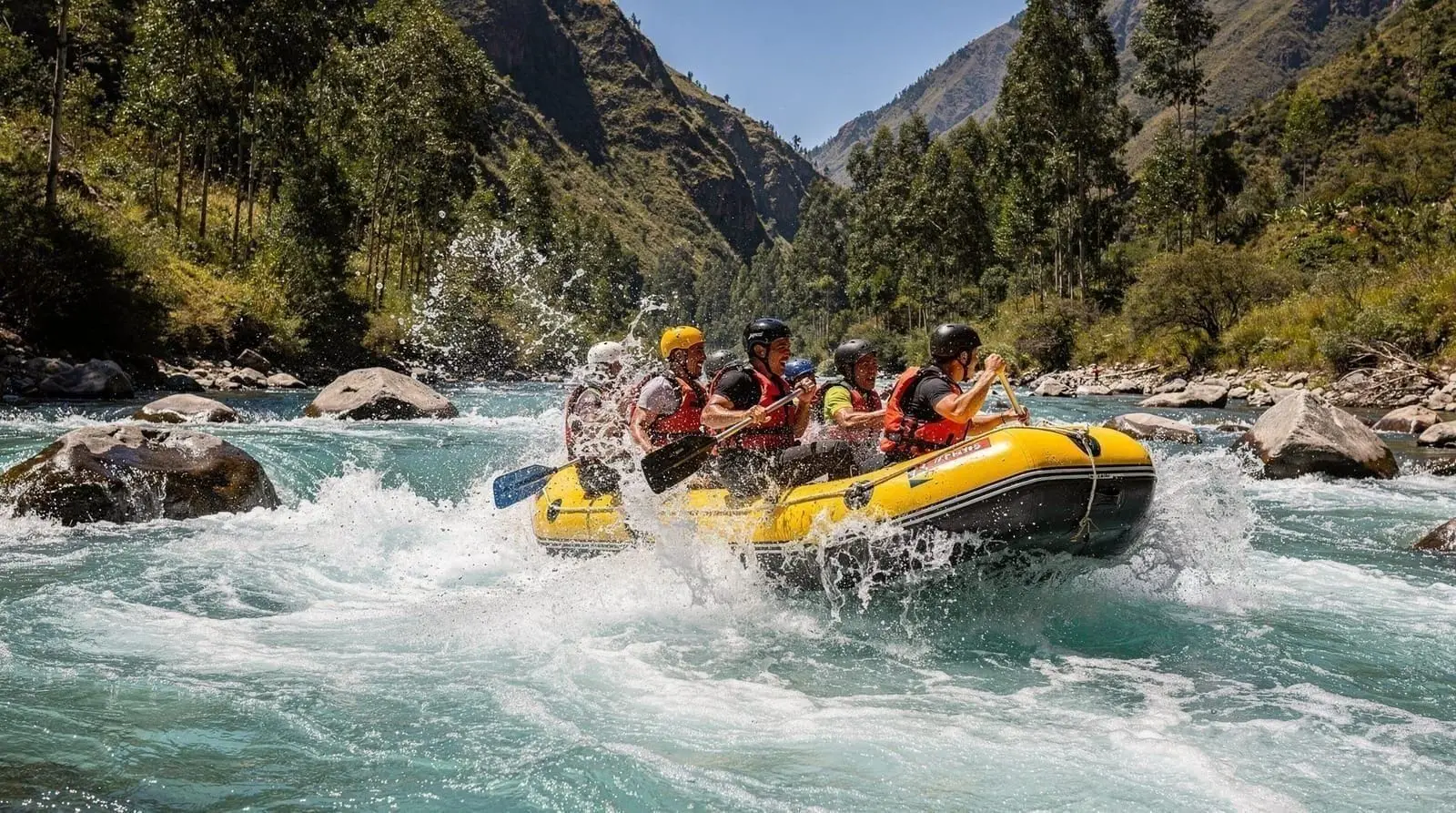
Rafting in Cusco guide
Where can you go rafting near Cusco?
The main rivers are the Urubamba, an easy half-day trip near the Sacred Valley with Class II-III rapids, and the Apurimac, a serious multi-day Class III-IV+ expedition. Pick the river to match your experience, go in the dry season for the safest conditions, and choose a properly equipped operator.
What rafting near Cusco is really like
White-water rafting is one of the more underrated adventures in the Cusco region, and also one where the gap between a good operator and a bad one matters most. The landscape is dramatic — fast Andean rivers cutting through canyons and valleys below snow-capped peaks — but rivers are unforgiving, and Cusco’s rafting scene ranges from professional, safety-led outfitters to cut-price operations with worn gear and undertrained guides.
This guide lays out the two main rivers, what the rapid grades actually mean, when to go, what it costs, and the safety red flags that should make you walk away. It is an honest planner’s take rather than a sales pitch, and because river outfitters change hands often, it focuses on what to look for rather than promoting any single tour.
| Where | Urubamba (Sacred Valley) or Apurimac (remote canyon) |
| Cost | Urubamba S/100-200 half-day; Apurimac $400-700+ multi-day |
| Time needed | Half-day (Urubamba) to 3-4 days (Apurimac) |
| Best time | Dry season, roughly May-September |
| Experience needed | None for Urubamba; real experience for Apurimac |
| River | Rapid class |
| Urubamba | II-III |
| Apurimac | III-IV+ |
The two rivers that matter
Almost all rafting from Cusco happens on one of two rivers, and they could hardly be more different.
The Urubamba
The Urubamba River runs through the Sacred Valley and is the accessible option. The popular sections near Urubamba and Ollantaytambo offer mostly Class II-III rapids — fun, splashy and manageable for beginners and families with a competent operator. A typical trip is a half-day, often combined with a Sacred Valley visit, and it is a good adventure add-on once you are acclimatised, since the river sits lower than Cusco itself.
The honest caveat is water quality. Parts of the Urubamba receive runoff and untreated wastewater from towns upstream, and pollution varies by section and season. A reputable operator will run the cleaner stretches; a cheap one may not care. Ask specifically which section you will paddle and how clean it is before you book.
The Apurimac
The Apurimac is a different animal entirely. One of the source rivers of the Amazon, it carves through a deep, remote canyon southwest of Cusco and offers serious Class III-IV+ white water on multi-day expeditions, typically three to four days with riverside camping. This is genuine wilderness rafting: spectacular, committing, and not something to attempt without real experience and a top-tier commercial outfitter. The remoteness is part of the appeal and part of the risk — rescue is hours or days away, so the quality of your guides and equipment is everything.
Understanding rapid classes
River difficulty is graded on a I-to-VI scale, and knowing what the numbers mean prevents you from booking something beyond your comfort:
- Class I-II: easy, small waves, suitable for complete beginners and children.
- Class III: moderate, bigger waves and some maneuvering required; manageable for fit first-timers with a good guide.
- Class IV: advanced, powerful rapids demanding precise paddling and prior experience.
- Class V: expert only, with serious consequences for mistakes.
- Class VI: essentially unrunnable / extreme.
The Urubamba’s tourist sections sit in the II-III band. The Apurimac reaches III-IV+ and occasionally higher depending on water levels, which is why it is firmly an experienced-rafter river.
The best season for rafting
Season changes everything on a river. The dry season, roughly May to September, generally offers the safest and most predictable conditions: lower, clearer water and manageable flows. This is the window most operators recommend for the Apurimac in particular, and the most comfortable time for a relaxed Urubamba trip.
The rainy season, roughly December to March, raises water levels and pushes rapids up a grade or more. That makes the rivers faster and more exciting but also more dangerous, with stronger currents and more debris. Higher water is for experienced rafters with the best operators only; beginners should stick to the dry season. Note too that some operators suspend the Apurimac entirely during peak high water.
What it costs
- Half-day Urubamba trip: roughly S/100-200 (about $27-54), usually including gear, a guide and transport from the valley or Cusco.
- Multi-day Apurimac expedition: considerably more, often $400-700 or more for a three-to-four-day trip, reflecting the remote logistics, camping, food and extended guiding.
As with most adventure activities around Cusco, a suspiciously cheap quote is a warning sign rather than a bargain. On a river, the money you save on a discount operator can be exactly the money that should have gone toward a safety kayaker, current-rated guides and well-maintained gear.
Tips for guides and drivers are customary but not included in the quoted price; budget roughly 10-15 soles per person for a half-day Urubamba trip, more for a multi-day Apurimac crew who have cooked, camped and paddled alongside you for several days.
Safety: the red flags that matter
Rafting is as safe as the operator running it, so vet yours carefully. Walk away if you see any of these:
- Worn, ill-fitting or insufficient life jackets and helmets — every paddler needs both, in good condition.
- No safety briefing, or guides who cannot communicate clearly with you.
- No safety kayaker or throw-bag setup on Class III+ runs.
- Guides who are vague about their experience, training or first-aid capability.
- Pressure to run a river grade above your stated experience.
- The cheapest deal on a Cusco street corner with no fixed office or paperwork.
A good operator will happily answer questions about guide certification, group size, the specific section you will run, and what happens if someone falls out. If the answers are evasive, that tells you what you need to know. This consumer-protection mindset matters more on a river than almost anywhere else in your trip.
Health and altitude considerations
Rafting sits at a lower elevation than Cusco itself, which makes it a genuinely good adventure choice once you have a few acclimatisation days behind you, since the exertion is easier on the body than a high-altitude hike. That said, do not treat rafting day one as your acclimatisation strategy — arrive already adjusted to Cusco’s altitude, since the drive to and from the put-in still passes through high terrain, and cold-water immersion is its own physical stress.
Anyone with a heart condition, limited swimming ability, or a fear of cold water should discuss the Urubamba’s easier sections with the operator honestly beforehand rather than discovering a problem mid-river. The Apurimac’s remoteness means any medical issue is hours from help, which is one more reason it is not the place to test your comfort with white water for the first time.
What to expect on the day
A typical Urubamba half-day starts with transport to the put-in, where guides hand out and fit the gear: a wetsuit or splash jacket, a helmet, a life jacket and a paddle. The safety briefing is the most important part of the day — it covers how to paddle on command, what to do if you fall out, how to hold the paddle so it does not hit anyone, and the “high-side” move if the raft hits an obstacle. A good guide will not rush this.
On the water you paddle as a team to the guide’s calls, with calmer flat stretches between the rapids where you can take in the scenery. Expect to get wet and cold even in the dry season, since the rivers are glacier- and rain-fed; the wetsuit matters. Multi-day Apurimac trips add riverside camping, with the outfitter handling tents, cooking and gear transport, and the rhythm becomes paddle-by-day, camp-by-night through an increasingly remote canyon.
What to bring and wear
Operators supply the technical gear, but a few personal items make the day better. Wear quick-drying clothes and a swimsuit underneath the wetsuit, and bring a complete dry change of clothes and a towel for afterward — you will be soaked. Secure, strap-on water shoes or old trainers are far better than flip-flops, which float away. Add sunscreen and a hat for the flat stretches, since the high-altitude sun is strong even on the water. Leave valuables behind; only waterproof, secured cameras belong on the river. For multi-day Apurimac trips, follow the outfitter’s packing list closely, since you will be self-contained in the canyon for days, and bring warm layers for cold riverside nights at altitude.
How rafting fits a Cusco trip
Rafting works best as an adventure add-on once you are acclimatised, not on your first day in the region. The Urubamba sections pair naturally with a Sacred Valley visit, since both sit lower than Cusco. The Apurimac, being a multi-day commitment, needs its own slot in your itinerary and is best for travellers who specifically want a serious wilderness adventure.
If you are assembling a roster of Cusco adventures, rafting sits alongside options like the ATV and quad tours from Cusco and the other outings covered in best day trips from Cusco. For the wider planning picture, the Cusco destination page and the /itineraries/ hub help you sequence everything, and the /tools/ page is useful for checking seasonal conditions before you commit to a river date.
Other rivers and adventure water nearby
While the Urubamba and Apurimac dominate Cusco rafting, a few other options exist for travellers who want variety. The Vilcanota (the Urubamba’s upstream name) has additional runnable sections beyond the standard tourist stretches, some used by operators when water levels suit. Further afield, multi-day expeditions on rivers in the wider southern Andes and toward the Amazon basin attract serious rafters, though these are committing trips that belong on a dedicated adventure itinerary rather than a casual add-on.
For most visitors, though, the choice remains simple: the Urubamba for an accessible half-day, the Apurimac for a genuine expedition. If you are chasing white water specifically, time your trip for the dry season and budget for a quality operator rather than trying to fit rafting into a packed sightseeing schedule on whatever river happens to be running.
Realistic expectations
It helps to be clear about what Cusco rafting is and is not. On the Urubamba it is a fun, splashy half-day that gets you onto a beautiful Andean river without serious risk, provided your operator is sound — a great change of pace from ruins and museums, but not a heart-stopping adrenaline epic. On the Apurimac it is the opposite: a remote, demanding, multi-day wilderness expedition that rewards experienced rafters and punishes the underprepared.
Problems arise mainly when travellers book the wrong river for their experience, or chase the cheapest price on water where safety margins are thin. Match the trip to your ability, vet the operator properly, go in the right season, and rafting becomes one of the more memorable and underrated things you can do around Cusco.