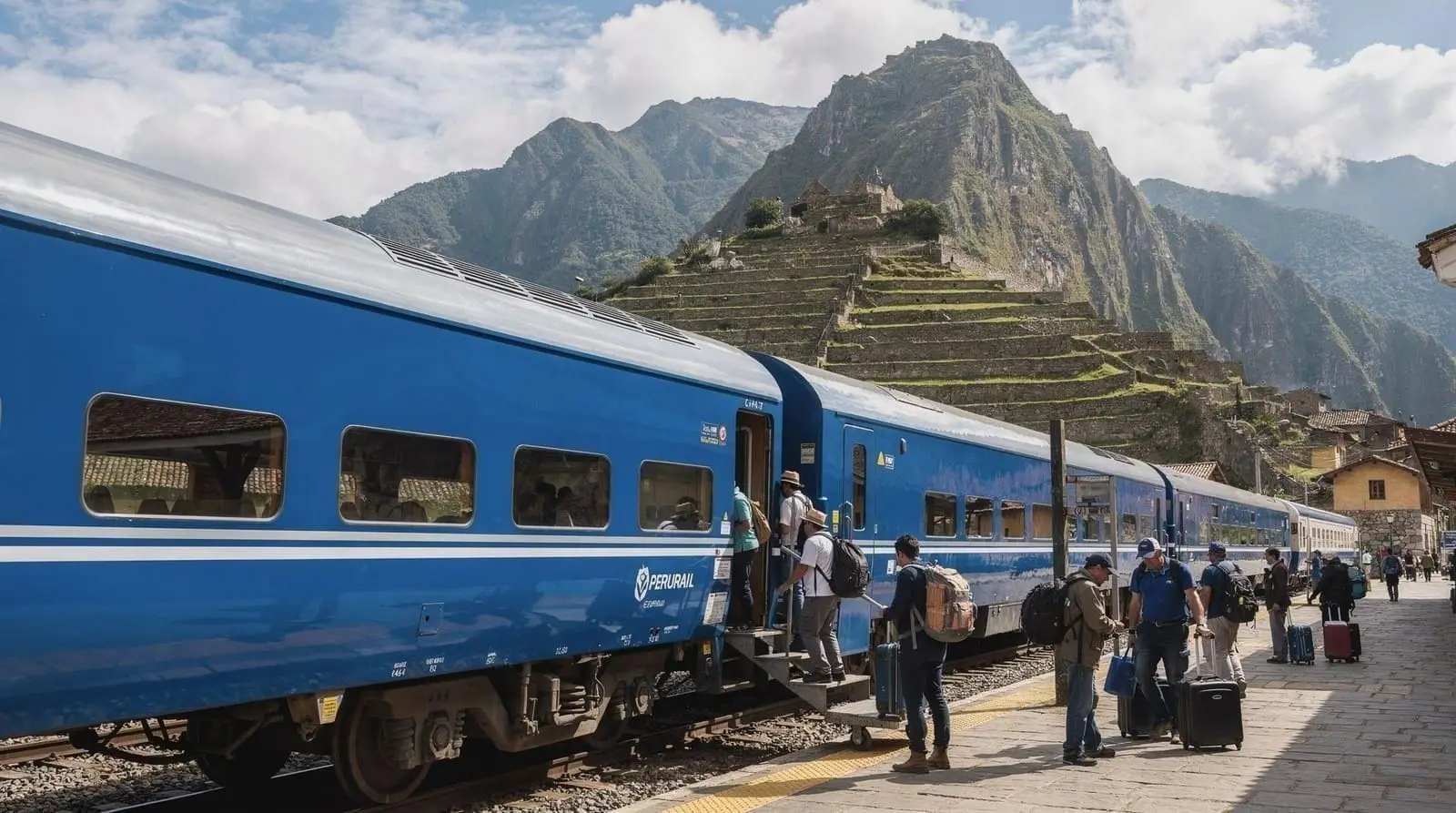
Trains to Machu Picchu compared: PeruRail vs Inca Rail
Cusco: Machu Picchu + Tourist Train + Entrance Ticket
Which train should I take to Machu Picchu?
Two companies serve the route: PeruRail and Inca Rail. For most travellers the mid tier — PeruRail Vistadome or Inca Rail 360 — is the sweet spot, adding panoramic windows for a modest premium over the basic Expedition and Voyager classes. The luxury Hiram Bingham and First Class are special-occasion splurges. The bigger decision is your departure station: Ollantaytambo has the most departures, while the train from Cusco's Poroy area runs less often.
One gorge, two operators, many fare tiers
The train to Machu Picchu is one of the more confusing purchases in Peru travel, not because it is complicated but because two companies offer half a dozen overlapping classes under names that mean nothing until someone explains them. There is no road to Aguas Calientes; the only way in, short of trekking, is this single rail line down the Urubamba gorge. Get the booking right and it is a smooth, scenic 1.5-hour glide. Get it wrong and you overpay for a class you did not need or, worse, find your preferred departure sold out and get pushed into a pricier seat.
This guide cuts through it. We compare the two operators — PeruRail and Inca Rail — class by class, lay out the departure stations and what they mean for your day, give real price bands in US dollars, and say plainly which class is worth the money. The broader question of whether to take the train at all is covered in train vs trek to Machu Picchu; this page assumes you are riding the rails.
| Operators | PeruRail, Inca Rail |
| Main railhead | Ollantaytambo (~1.5hrs to Aguas Calientes) |
| Cusco-end departures | PeruRail only, fewer, ~3-3.5hrs |
| Basic class | ~$60-80 one way (Expedition/Voyager) |
| Panoramic class | ~$85-120 one way (Vistadome/360) |
PeruRail vs Inca Rail: the two companies
Two private operators share the route, and they run parallel rather than competing on quality.
PeruRail is the older and larger operator. It runs the most departures across the day, offers the widest range of classes, and is the only company that operates from the Cusco end of the line — though most of its services, like Inca Rail’s, leave from Ollantaytambo. It also runs the marquee luxury train, the Hiram Bingham.
Inca Rail is the newer challenger. It departs exclusively from Ollantaytambo, tends to undercut PeruRail slightly on the basic and mid classes, and runs its own luxury service. Frequency is good but not quite PeruRail’s breadth.
In practice, the difference between the two for a standard passenger is small. Both run clean, modern carriages down the same canyon to the same town. The real decision is less “which company” and more “which class and which station,” so check both operators’ timetables for your date and pick the departure that fits your day and budget.
The classes, decoded
Each operator sells, broadly, three tiers. The names differ but the tiers line up.
Basic / tourist class — PeruRail Expedition, Inca Rail Voyager. These are the workhorses: comfortable padded seats, large windows, a snack and drink service, and no fuss. Fares start around $60-80 one way. For many travellers this is all you need; the windows are big enough to enjoy the scenery, and the journey is short.
Panoramic class — PeruRail Vistadome, Inca Rail 360. The upgrade most people consider worthwhile. These carriages add curved glass roofs that open the view up the canyon walls and into the cloud forest, plus larger windows and sometimes onboard entertainment on the return leg. Expect roughly $85-120 one way, a premium of about $25-40 over basic. On a once-in-a-lifetime journey through dramatic terrain, that premium buys a noticeably better view.
Luxury class — PeruRail Hiram Bingham, Inca Rail First Class / Private. A different proposition entirely: all-inclusive fine dining, bar carriages, observation decks, and on the Hiram Bingham a brunch or dinner with live music and, often, bundled bus and entrance. Prices run into several hundred dollars each way. This is a special-occasion splurge, not a transport choice; you are buying an experience, not a faster trip.
The honest recommendation: take the panoramic class if the budget stretches, the basic class if it does not, and the luxury class only if the train journey itself is something you want to celebrate. The ruins are identical regardless of which carriage delivered you.
Departure stations: the decision that shapes your day
Where you board matters more than most first-timers realise, because there is no train station inside Cusco city.
Ollantaytambo is the main railhead, used by both companies, and the one most travellers use. It sits in the Sacred Valley about 1.5-2 hours by road from Cusco. The journey from here to Aguas Calientes is the short, scenic 1.5-hour ride. The catch is the road transfer beforehand — you need a colectivo, taxi or transfer from Cusco or your Sacred Valley hotel to reach the station, factored into your timing. Logistics for that leg are in getting around the Sacred Valley.
The Cusco end (the Poroy or Bimodal/Wanchaq station, depending on the season’s operating arrangement) is served by limited PeruRail departures. Boarding here removes the road transfer to Ollantaytambo, but the train then takes 3-3.5 hours because it must climb out of the Cusco basin first, and there are far fewer departures. It suits travellers based in Cusco who prefer a single rail journey over a road-then-rail combination, but the choice of times is narrow.
For travellers already staying in the Sacred Valley — a smart acclimatisation move — Ollantaytambo is the obvious and easiest railhead. For those committed to basing in Cusco city, weigh the convenience of boarding near Cusco against the much wider Ollantaytambo timetable.
At Aguas Calientes: the last leg
Whichever train and class you take, you arrive at Aguas Calientes, the small town at the foot of the mountain. The train does not go up to the ruins; from the station you walk a few minutes to the bus stop and take the 25-minute shuttle up the switchback road to the Machu Picchu entrance. The round-trip bus is about $24 and is bought separately from any train operator. Buy bus tickets the afternoon before to skip the dawn queue, and note that the early-morning buses fill fast. The town itself is functional rather than lovely, with hot springs and a row of restaurants; the candid rundown is in the Aguas Calientes guide.
What the journey actually looks like
It helps to know what you are paying for beyond the seat. The line follows the Río Urubamba as it carves down from the Sacred Valley into the high jungle, and the change in landscape across an hour and a half is the real attraction. You leave the dry, terraced valley around Ollantaytambo, the gorge narrows, the walls steepen, and the vegetation thickens into cloud forest as the altitude drops from about 2,790 m at Ollantaytambo to roughly 2,040 m at Aguas Calientes — itself a small mercy for anyone feeling the altitude. Snow peaks appear and vanish behind the canyon rims, and the river runs hard and brown alongside the track for most of the way.
The carriages reflect their tier in small but real ways. Basic class gives you a forward- or backward-facing seat with a generous side window and a tray; a hostess passes through with a snack and a hot or cold drink. The panoramic classes add the curved glass roof that turns the upper canyon walls into part of the view, which on this particular stretch of scenery is the difference between glimpsing the cliffs and actually seeing them.
On the return leg, some panoramic services lay on a light entertainment programme — a costumed dance and a fashion show of alpaca textiles — which divides opinion but passes the time. The luxury trains are a self-contained occasion of dining cars and observation platforms where the journey, not the ruins, is the product.
A practical tip on seating: the views switch sides as the train follows the river’s bends, so there is no single “best” side to request. What matters more is sitting near a window rather than on an aisle in a four-seat cluster, and arriving at the platform early enough to stow luggage without a scramble. Large bags are restricted on board — each operator caps carry-on size and weight — so leave the big suitcase at your Cusco or Sacred Valley hotel and travel up with a daypack.
Booking the train
You can book directly through PeruRail’s or Inca Rail’s own websites once your dates and your timed Machu Picchu entrance ticket are confirmed — the two must align, since your train arrival has to leave time for your ticket’s entry window. If you would rather not juggle separate train, bus and ticket bookings, a bundled package handles all three. The Machu Picchu day trip with tourist train and entrance ticket packages the rail, transfer and entry together, and the two-day Sacred Valley and Machu Picchu train tour adds the overnight in Aguas Calientes that lets you reach the ruins early.
Book as far ahead as you can in the May-September dry season, when the convenient mid-morning and afternoon departures sell out weeks in advance and the remaining seats get pushed into the costlier classes. The step-by-step logistics of the whole journey are in how to get to Machu Picchu.
Common booking mistakes to avoid
A few errors recur often enough to be worth naming. The first is mismatching the train and the ticket times. Your Machu Picchu entrance ticket carries a fixed entry window, and your train must arrive at Aguas Calientes with enough margin to clear the bus queue and reach the gate inside that window — book the two without checking they line up and you can end up with a perfect train and an unusable ticket, or vice versa.
The second is leaving it too late and getting upsold. When the convenient departures sell out, the only seats left are in the pricier classes, so procrastinators routinely pay luxury money for what should have been a basic-class trip. Booking early is the cheapest upgrade there is.
The third is forgetting the return is also the busy direction. Everyone wants the same late-afternoon trains back to Ollantaytambo after a full day at the ruins, and those sell out as readily as the morning departures. Book both legs at once. Finally, do not assume the train includes the bus up to the citadel — the shuttle is a separate ticket from a separate company, and the dawn queue for it is real, so buy bus tickets the afternoon before. Pre-booking the bus is one of the small moves that most improves a Machu Picchu morning.
The budget alternative: Hidroelectrica
Travellers on a tight budget sometimes skip the train entirely via the Hidroelectrica route — a long van ride from Cusco or the Sacred Valley to a hydroelectric station, followed by a roughly two-hour walk along the train tracks into Aguas Calientes. It cuts the cost dramatically compared with any train class, but it eats most of a day, is physically tiring, and lacks the scenery of the rail journey through the gorge. It suits committed backpackers more than travellers short on time or comfortable paying for the train. The Machu Picchu budget guide covers the route, timing and safety notes in full.
Choosing between Ollantaytambo and a Sacred Valley base
Because Ollantaytambo carries the vast majority of departures, where you sleep the night before matters. Travellers based in the Sacred Valley — a smart acclimatisation move in itself — are typically a short taxi from the Ollantaytambo station and can pick from the full timetable. Travellers based in Cusco city face a choice: the road transfer out to Ollantaytambo for the wider timetable, or the limited, slower Cusco-end departures. Most opt for the transfer, since the extra hour or so of road time is offset by far more train-time flexibility. The getting around the Sacred Valley guide has the practical transfer options and rough costs.
A note on children and older travellers
Both PeruRail and Inca Rail carry passengers of all ages comfortably, and the train is, by a wide margin, the easiest way for families or anyone with limited mobility to reach Machu Picchu. Bring snacks and entertainment for young children on the longer Cusco-end departures, and note that the 25-minute shuttle bus up to the entrance involves switchback roads that can unsettle sensitive stomachs — sitting near the front helps. Wheelchair users should contact the operator ahead of time, since boarding assistance and accessible carriages are limited and vary by train and station.