How to get to Machu Picchu
Cusco: Machu Picchu + Tourist Train + Entrance Ticket
What's the easiest way to get to Machu Picchu?
Train from Ollantaytambo to Aguas Calientes (about 1.5–2 hrs, S/250–600+ round trip depending on class and time), then a 25-minute shuttle bus or a steep hour-long walk up to the citadel. There is no road and no train all the way from Cusco — Ollantaytambo is the practical railhead.
The thing nobody tells you first: there is no direct route from Cusco
The single most common planning shock is realising that you cannot simply drive or take a train all the way from Cusco to Machu Picchu. The citadel sits on a ridge above a steep, road-less gorge, and the only settlement at its foot — Aguas Calientes, officially Machu Picchu Pueblo — has no road link to the outside world at all. You reach it by train or on foot, full stop.
That geography is what drives every option below. The train doesn’t even start in Cusco for most services: the practical railhead is Ollantaytambo, 1.5–2 hours away by road in the Sacred Valley. From Aguas Calientes there is then a final leg up to the gate — a 25-minute shuttle bus on switchbacks, or a steep walking trail of roughly an hour and a half.
So getting to Machu Picchu is really a chain of legs. There are three broad ways to assemble them: the standard train route (what most people do), the budget Hidroeléctrica route (cheaper, much longer), and trekking in. Here is each, with honest times, prices in soles, and the catches.
| From | Cusco, via Ollantaytambo (no direct route) |
| Fastest | Train, about 4–5 hours each way door to door |
| Cheapest | Hidroeléctrica route, $40–60 round trip + a full extra day |
| Cost (train) | S/250–600+ round trip, plus $24 bus, plus ~S/152 entry |
| Book ahead | 2–3 months for June–August; weeks for shoulder season |
Option 1: the train route (what most travellers do)
This is the comfortable, reliable default, and for good reason.
The legs
- Cusco to Ollantaytambo by road — 1.5–2 hours. A pre-booked private transfer, a colectivo shared van from Calle Pavitos (about S/15–20), or your tour’s included transport. Many people instead spend a night in the Sacred Valley first, which shortens the morning.
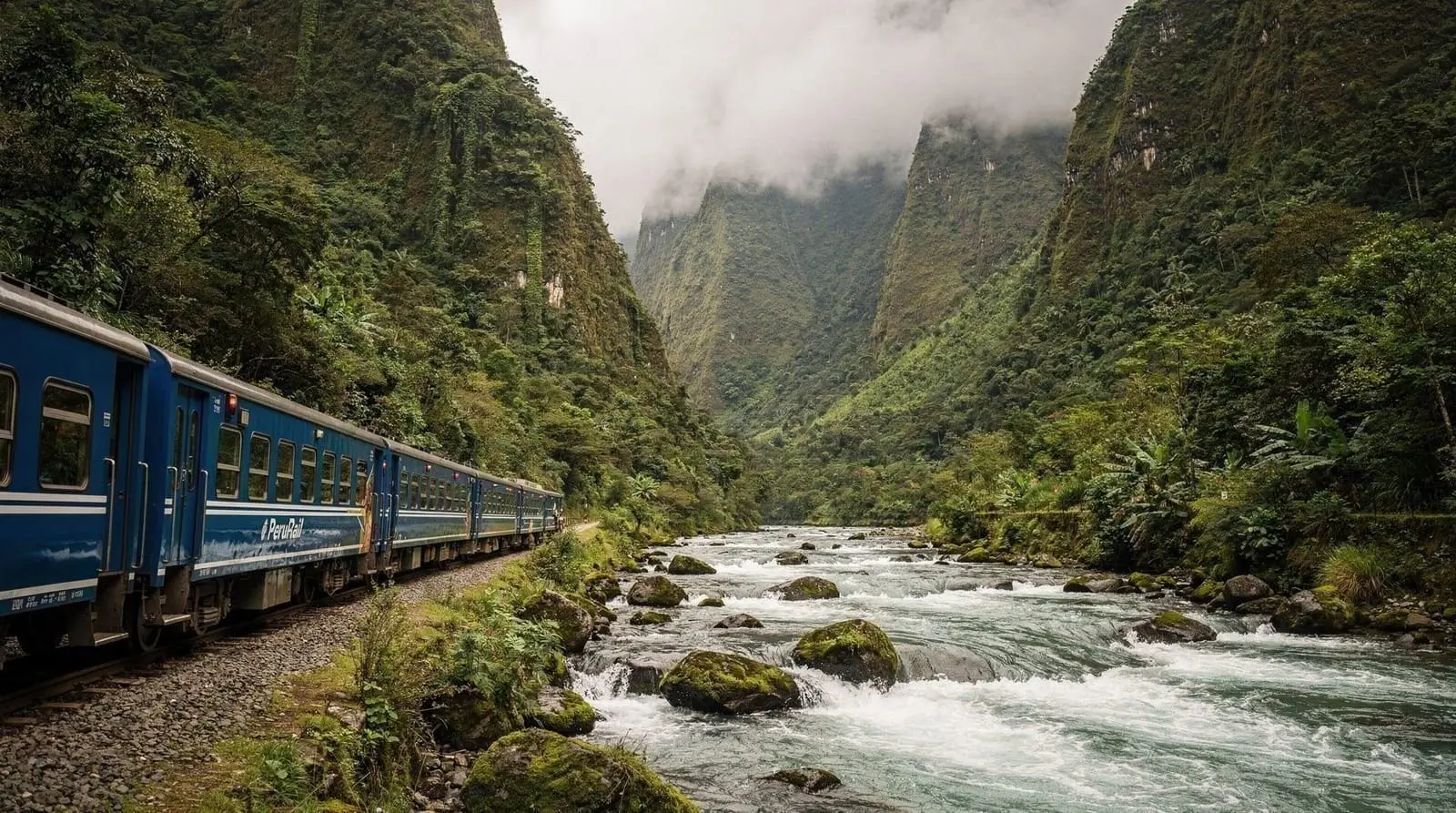
- Ollantaytambo to Aguas Calientes by train — 1.5–2 hours, along the Urubamba river gorge. Operated by PeruRail and IncaRail.
- Aguas Calientes to the citadel gate — a 25-minute Consettur shuttle bus up the switchbacks (about $12 each way, $24 round trip), or a steep 1–1.5 hour climb on the footpath if you prefer to save the fare and have the legs and lungs for it.
Train classes and prices
Train fares swing widely with class and departure time. Rough 2026 round-trip ranges:
- Expedition (PeruRail) / Voyager (IncaRail) — the standard tourist service, panoramic windows, S/250–400 round trip ($68–108).
- Vistadome / 360° — bigger windows, snacks, sometimes onboard entertainment, S/400–600 ($108–162).
- Belmond Hiram Bingham — luxury dining train, well over $900 round trip — a splurge, not transport.
Early-morning and late-afternoon departures cost more and sell out first. Bring your passport — names on train tickets must match ID, and they check.
A common simplification is to buy the train, entry ticket, and guide as one package so you are not juggling three separate booking systems. The Cusco Machu Picchu tour with the tourist train and entrance ticket bundles the railhead transfer, the train, the bus, and entry into a single booking — useful if the logistics feel daunting.
How long it really takes
Each direction is 4–5 hours when you add up the road transfer, the train, and the bus. That total is exactly why a same-day round trip from Cusco is a punishing 14-plus-hour day. Most travellers overnight in Aguas Calientes — see the Aguas Calientes guide — which also lets you reach the gate earlier and less frazzled the next morning.
Option 2: the Hidroeléctrica budget route
The backpacker’s classic: cheaper, far longer, and a genuine adventure or a genuine slog depending on your mood.
How it works
A van runs from Cusco over the Abra Málaga pass (4,316 m) and down through Santa María and Santa Teresa to the Hidroeléctrica power station — about 6–7 hours by road, often more in the wet season. From Hidroeléctrica you then walk the railway tracks to Aguas Calientes — roughly 10–12 km, 2.5–3 hours, mostly flat and scenic along the river.
The numbers
- Cost: roughly $40–60 round trip for the van transport, versus S/250+ for the train. Real money saved.
- Time: a full extra day. You typically leave Cusco early, reach Aguas Calientes by mid-to-late afternoon, sleep there, visit Machu Picchu the next morning, then do the long return. Two full travel days bracket the visit.
- Catch: the road is windy and the section beyond Santa María is landslide-prone in the wet season (November–March), when this route is least reliable and occasionally closed.
It is the right call if your budget is tight and you have the days; the wrong call if your time is short or you dislike long, bumpy van rides on mountain roads. The 2-day Machu Picchu budget tour from Cusco by car packages this route with the overnight and entry for those who want the low cost without arranging each leg.
What the walk from Hidroeléctrica is actually like
The railway-track walk deserves a fuller description because people arrive expecting either a wilderness trek or a paved path, and it is neither. You follow the flat, graded railway corridor alongside the Urubamba river, passing small food stalls, the occasional passing train (keep to the side), and increasingly dense cloud-forest vegetation as you near Aguas Calientes.
It is not technically difficult — flat, well-trodden, no navigation skill required — but it is 2.5 to 3 hours on your feet with a pack, on gravel and sleepers, so decent footwear matters more than fitness. Most people find it genuinely enjoyable rather than a chore, since the scenery is good and the pace is entirely your own. Carry water and a snack; there is limited shade for stretches and the stalls thin out toward the end.
Option 3: trek in
Walking to Machu Picchu is, for many, the whole point of the trip. The routes differ in where they deliver you.
- Classic Inca Trail — 4 days, 3 nights, arriving on the final morning through Inti Punku, the Sun Gate, with the citadel revealed below. This is the only route that walks you directly into Machu Picchu rather than via Aguas Calientes. It requires a permit booked months in advance (they cap daily numbers and sell out for peak months) and must go through a licensed operator — no independent hiking.
- Salkantay trek — 4–5 days over the dramatic Salkantay pass (4,630 m). No permit needed, more wilderness, and it ends at Aguas Calientes, from where you take the bus up like everyone else.
- Shorter options — the 2-day “Short Inca Trail” walks the final stretch to the Sun Gate after a train ride in, a good compromise for those short on time but wanting the trail’s finish.
For a full route-by-route comparison — difficulty, scenery, permits, and cost — see the best treks to Machu Picchu guide. The flagship 4-day Inca Trail guided trek to Machu Picchu covers the permit, porters, camps, and guide for the classic route, while the Salkantay route and Machu Picchu 4-day tour handles the permit-free alternative.
Booking order and the things that sell out
The pieces sell out independently, so book in this order for peak months (June–August and Peruvian holidays):
- Machu Picchu entry ticket — sold by circuit and time slot; the standard adult circuit is around S/152. Buy this first; it constrains everything else. Beware unofficial resellers — see how to get to Machu Picchu for the official channels and ticket pitfalls.
- The train (or trek permit) — match the train time to your entry slot.
- The shuttle bus up — Consettur tickets, buyable online or in Aguas Calientes; in peak season the early-morning queue is long, so buy ahead.
Booking window by season
How far ahead you actually need to book varies more than most guides admit. In June to August and around Peruvian public holidays (Fiestas Patrias in late July, for instance), the entry ticket for popular circuits, the Huayna Picchu and Machu Picchu Mountain add-ons, and the best train departure times can sell out two to three months ahead. In the April, May and October shoulder season, a few weeks’ notice is normally comfortable, and standard circuit tickets rarely sell out entirely.
In the wet low season (especially December to February, outside the Inca Trail’s February closure), you can sometimes book days ahead for the standard circuit, though the popular early-morning train slots and the mountain add-ons still go first. If your travel dates are fixed and non-negotiable, book the entry ticket the moment your dates are confirmed — it is the one piece of this chain that genuinely cannot be improvised on arrival.
In the shoulder season (April, May, October) a few weeks’ notice is usually enough; in the wet low season you can sometimes book days ahead, but the entry ticket for popular circuits and the add-on mountains still go.
The legs in detail: getting to Ollantaytambo
Because the train mostly starts at Ollantaytambo, reaching the railhead is its own small puzzle, and you have three ways to do it:
- A pre-booked private transfer from your Cusco hotel — the easiest, around S/120–200 for the car depending on operator, door to door in 1.5–2 hours. Worth it if you have an early train and don’t want to risk a colectivo running late.
- A colectivo (shared van) from Calle Pavitos in Cusco — about S/15–20 per person, leaving when full. Cheap and frequent, but timing is loose; give yourself margin before a train.
- Staying the night in the Sacred Valley — the smartest option if your schedule allows. Sleeping in Urubamba or Ollantaytambo the night before means a 10–20 minute hop to the station rather than a pre-dawn dash from Cusco, and it doubles as gentler acclimatisation. It also lets you see the Sacred Valley properly on the way through rather than rushing past it.
Whichever you pick, match it to your train time with a comfortable buffer — missing a Machu Picchu train is expensive and the next one may be full.
The shuttle bus vs walking up
From Aguas Calientes, the final climb to the citadel gate splits people:
- The Consettur shuttle bus zigzags up the switchbacks in about 25 minutes, roughly $12 each way ($24 round trip). In high season the early-morning queue forms before dawn, so buy tickets the day before and join the line early if you want a sunrise slot.
- The walking trail climbs the same height on a steep stone footpath, roughly 1–1.5 hours up. It saves the fare and is satisfying, but it is a genuine slog of stairs that will leave you sweating before you even start the citadel — and you are at altitude (though Aguas Calientes itself, at ~2,040 m, is lower than Cusco). Many people walk up and bus down, or vice versa.
Walking back down is the easier direction and a reasonable way to save half the bus fare if your knees are willing.
Which option is right for you?
| Priority | Best option | Why |
|---|---|---|
| Short on time, want comfort | Train, overnighting in Aguas Calientes | Reliable, no extra travel day |
| Tight budget, have a spare day | Hidroeléctrica route | Saves S/200+ for a full day |
| Want the journey to be the experience | Inca Trail or Salkantay trek | Sun Gate arrival or permit-free wilderness |
| Travelling with kids or limited mobility | Train plus shuttle bus | Avoids all the long walking |
Whatever you choose, build acclimatisation into the front of your trip — Aguas Calientes is actually lower than Cusco (about 2,040 m), so the altitude pain is in Cusco and on the treks, not at the citadel itself.
Travelling with limited mobility
Machu Picchu itself has stone paths, uneven steps and no wheelchair-accessible circuit through most of the ruins, so travellers with limited mobility need to plan the whole chain carefully, not just the citadel. The train and shuttle bus combination is the right choice here — it removes the Hidroeléctrica walk and the treks entirely.
Reserve seats near the train carriage doors, request shuttle-bus assistance at the Aguas Calientes stop, and check with your operator about the accessible viewing areas near the entrance, since the interior circuits involve stairs that cannot be avoided. Building in an unhurried overnight in Aguas Calientes, rather than a same-day round trip, matters even more here — rushing the connections is harder on anyone with mobility limitations.
Contact PeruRail or IncaRail directly ahead of travel if you need wheelchair assistance boarding the train; both operators can arrange it with advance notice, but it is not automatic at the platform. The Consettur shuttle buses have a step up at the door but staff will assist; the alternative walking trail is not a realistic option for most mobility-limited travellers, so budget the bus fare into your plan without hesitation.