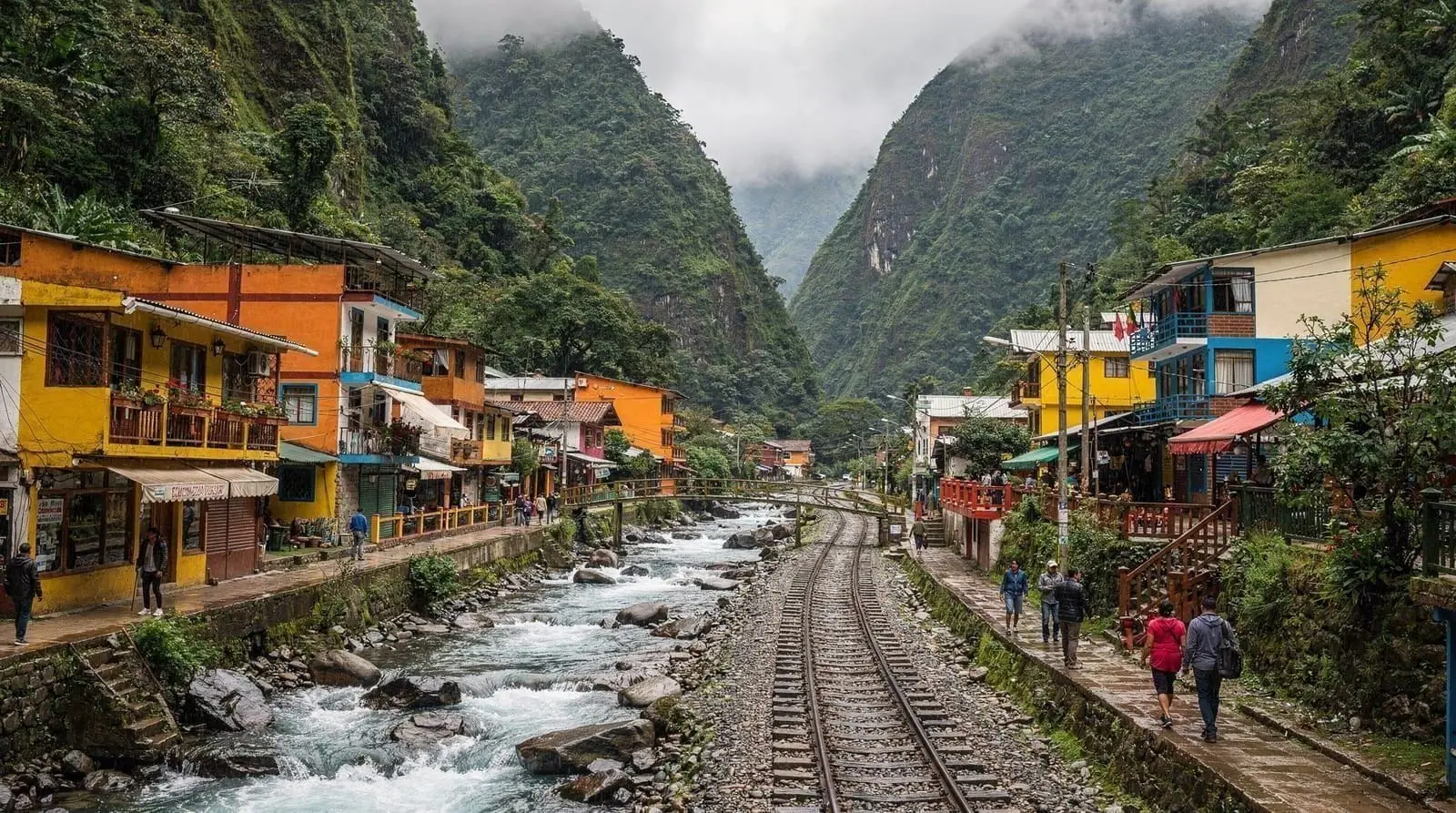
Aguas Calientes guide: the town below Machu Picchu
Cusco: Machu Picchu + Tourist Train + Entrance Ticket
Is it worth staying overnight in Aguas Calientes?
Yes, for almost everyone. A night in town (also called Machu Picchu Pueblo) lets you take the first 5:30 am buses up the mountain, beating the day-trippers who arrive on mid-morning trains. The town itself is overpriced and charmless, but the early-entry advantage is real.
The town nobody comes for, and everybody passes through
Aguas Calientes — officially renamed Machu Picchu Pueblo years ago, though almost nobody calls it that — exists for one reason: it is the last stop before the most famous ruin in South America. The town wedges itself into a steep, humid gorge at 2,040 m (6,690 ft), where the Vilcanota River roars past concrete hotels stacked on top of each other. There are no roads in. You arrive by train or, if you are hardy, on foot along the rail line. There is no airport, no bus terminal, no escape except the way you came.
None of this makes it charming. Aguas Calientes is a function town: a dense knot of restaurants, souvenir stalls, and hotels that exists to feed, house, and ferry the thousands of people who visit Machu Picchu every day. Prices are inflated because they can be — you are a captive customer the moment you step off the train. Understanding this is the key to not overspending or over-expecting.
What the town does offer is proximity. Sleeping here puts you at the bus stop before dawn, which is the single biggest practical advantage you can buy yourself for a Machu Picchu visit. This guide covers how to get in, what to pay, where to sleep and eat, and exactly how long to stay — which, for most people, is less than a day.
| Where | 2,040 m gorge below Machu Picchu, reachable only by train or on foot |
| Cost to sleep here | Around S/60–120 budget, $90–160 mid-range, $400+ top end |
| Time needed | One night is enough for almost everyone |
| Getting there | Train from Ollantaytambo (~1.5 hrs) or Poroy, or the Hidroeléctrica walk-in route |
| Best time to arrive | Afternoon, so you can queue for the 5:30 am bus the next morning |
Getting to Aguas Calientes
There is no driving to Aguas Calientes. The only ways in are by train or on foot, and the train is what nearly everyone uses.
By train. Two companies run the line: PeruRail and IncaRail. Trains depart mainly from Ollantaytambo in the Sacred Valley (a 1.5-hour ride) and, in the high season, from Poroy near Cusco (a longer, pricier route often suspended for track work). Standard tourist-class round-trip fares run roughly $120–180 USD depending on the service and how far ahead you book. The panoramic Vistadome and luxury Hiram Bingham cost considerably more. Book weeks ahead in dry season (May–September); same-week seats vanish.
The realistic chain for most travellers is: bus or colectivo from Cusco to Ollantaytambo (about 1.5–2 hours), then the train down to Aguas Calientes (1.5 hours). Many packaged tours bundle all of this — the Cusco to Machu Picchu round-trip train and entrance package handles the train, the bus up the mountain, and the citadel ticket in one booking, which removes most of the moving parts for first-timers.
On foot. The budget route skips the expensive Ollantaytambo–Aguas Calientes train. You take a long road transfer to the Hidroeléctrica station (6–7 hours from Cusco via Santa María and Santa Teresa), then walk the flat 2–3 hour trail along the railway tracks into town. It is cheap (often under $80 round trip including transport) and scenic, but it is a full, tiring day each way. Budget operators sell this as the “Machu Picchu by car” tour.
Trekking. Arriving on the Inca Trail or via Salkantay ends at or near the citadel; many Salkantay routes finish in Aguas Calientes the night before the visit.
The bus up to Machu Picchu
From Aguas Calientes, the citadel is still 400 m above you up a series of switchbacks. The bus is run by a single concessionaire, Consettur, and there is no competition to lower the price.
- Cost: roughly $24 USD round trip for foreign adults in 2026, or about $12 each way. Pay in USD or soles.
- Buying tickets: at the Consettur office on Avenida Hermanos Ayar, or online in advance. In high season the early-morning queue is long; buy your bus tickets the afternoon before.
- Schedule: the first buses leave at 5:30 am. To catch them, be in the queue by 5:00 am — it builds fast.
- The walk option: a steep stone stairway climbs the same 400 m in about 1.5–2 hours. It is free, but it is genuinely strenuous and you arrive sweat-soaked. Most people bus up and, if energetic, walk down.
The early bus is the whole reason to sleep in town. Day-trippers from Cusco cannot physically reach the gate before mid-morning. If you are inside the citadel at 6 am, you get the ruins in soft light and relative quiet before the crowds and the heat arrive.
Where to stay
Accommodation runs the full range, all of it pricier than equivalent rooms in Cusco or the Sacred Valley.
- Budget: hostels and basic guesthouses near the train tracks and the market run S/60–120 ($16–32) for a private double. Expect thin walls and the constant sound of the river.
- Mid-range: comfortable hotels like Tierra Viva Machu Picchu or El MaPi by Inkaterra run $90–160 a night.
- Top end: the Inkaterra Machu Picchu Pueblo Hotel and the Sumaq sit at $400–700-plus, with the Belmond Sanctuary Lodge (the only hotel actually at the citadel gate) far above that.
Whatever you pick, prioritise location near the bus stop and a hotel that serves breakfast early or packs you a box — you will leave before any normal breakfast service. Confirm this when booking.
Eating in Aguas Calientes
The main street, Avenida Pachacútec, is a gauntlet of restaurants whose staff stand outside thrusting laminated menus at you. The food is largely interchangeable pizza, pasta, and “Andean” dishes at 30–50 percent above Cusco prices. A few places stand out:
- Indio Feliz — a long-running French-Peruvian spot with a genuinely good three-course menu, usually S/60–90 a head.
- Mapacho Craft Beer & Peruvian Cuisine — riverside, with local beer and solid trout and alpaca dishes.
- The Tree House — pricier, reservation-worthy, more ambitious cooking.
For cheap eating, the mercado near the train station has set lunch menús for S/12–20 — the same value-for-money logic as anywhere in Peru, where the food market always beats the tourist strip. Buy your hiking snacks and water here too; the small shops on the main drag charge a premium.
The hot springs and other ways to fill an afternoon
The town owes its name to the aguas calientes — thermal baths up the hill at the end of Avenida Pachacútec. Set expectations low. They are a cluster of small concrete pools of lukewarm, sometimes cloudy water, around S/20 entry. After a long day on your feet they are a pleasant soak, nothing more. Bring your own towel and flip-flops, or rent them at the gate for a few soles.
The other low-key option is the small Museo de Sitio Manuel Chávez Ballón, a 20-minute walk toward the citadel base near the Puente Ruinas bridge. It gives useful archaeological context for Machu Picchu and is rarely crowded — a good use of a couple of hours if you arrive with time to spare. Beyond that, there genuinely is not much to do, which is exactly why you should not over-allocate days here.
How long to stay, honestly
For the overwhelming majority of visitors, one night is correct. The pattern that works:
- Travel from Cusco or the Sacred Valley in the afternoon, arriving in Aguas Calientes by early evening.
- Buy bus tickets and confirm your early breakfast or box.
- Sleep, wake at 4:30 am, queue for the 5:30 am bus.
- Spend the morning in the citadel on your timed-entry circuit.
- Return to town, collect your bag, eat lunch, and take an afternoon or evening train out.
A two-night stay only makes sense if you are climbing Huayna Picchu or Machu Picchu Mountain on a separate day from the main citadel circuit, or if you want a buffer against the occasional rail strike or weather delay. The two-day Machu Picchu tour from Ollantaytambo builds in that overnight if you want the slower pace.
If you are squeezing the visit into a single day from Cusco, it is doable but punishing — expect a 14-plus-hour round trip and a citadel arrival after the early crowds. See /destinations/machu-picchu/ for the full citadel logistics, circuits, and ticket types.
A sample one-night itinerary
To make the timing concrete, here is the pattern that works for most travellers arriving from the Sacred Valley:
Afternoon (day one). Take an afternoon train from Ollantaytambo, arriving in Aguas Calientes by early evening. Check in, drop your main bag, and head straight to the Consettur office to buy your bus tickets for the morning so you are not queuing twice at dawn. Confirm an early breakfast or a box from your hotel. Eat an early dinner — one of the better spots like Indio Feliz rather than the first tout who grabs you — and go to bed early.
Pre-dawn (day two). Wake by 4:30 am, eat or grab your box, and be in the bus queue by 5:00 am. Ride up on one of the first buses and aim to be at the gate around 6:00 am for the citadel in early light.
Morning. Spend two to three hours on your timed-entry circuit at Machu Picchu. If you have a Huayna Picchu or Machu Picchu Mountain add-on, factor in the extra climb and time slot.
Midday onward. Bus back down (or walk, if your knees are willing), collect your luggage from the hotel, have a relaxed lunch, and catch an afternoon or evening train out. By nightfall you are back in the Sacred Valley or Cusco, having seen the ruins at their best and spent only one night in the gorge.
This compression is the whole point of the overnight: maximum citadel quality, minimum time in an overpriced town.
Practical notes
- Altitude: at 2,040 m, Aguas Calientes is much lower than Cusco (3,400 m). It is actually a relief if you are still adjusting — see the altitude sickness guide. The catch is that arriving here straight from sea-level Lima skips your acclimatisation entirely, which matters if you later go up to Cusco or Rainbow Mountain.
- Weather: the gorge is humid and rains often, even in the dry season. Pack a light rain layer and a dry bag for electronics.
- Cash: ATMs exist but run dry and charge high fees. Bring soles from Cusco. Many small places do not take cards.
- Tickets: carry printed copies of your Machu Picchu entry ticket, bus ticket, and train ticket plus your passport — the passport number on your citadel ticket is checked at the gate.
- Luggage: trains limit you to a small bag (around 5 kg). Leave your main luggage at your Cusco or Sacred Valley hotel.
Money, connectivity and small logistics
Cash rules here more than almost anywhere else on a Peru trip. ATMs on Avenida Imperio de los Incas and near the plaza exist, but they run out of bills on busy weekends and charge steep withdrawal fees, so bring soles from Cusco rather than relying on them. Many family-run restaurants, the market stalls and small shops are cash-only; only the mid-range and top hotels and the better restaurants reliably take cards, and some add a surcharge.
Mobile signal is patchy in the gorge — Claro and Movistar both work in town but drop out fast on the trail toward the citadel, so download offline maps and any tickets before you leave Cusco or Ollantaytambo. Wi-fi in hotels is usually fine for messaging but slow for uploads, another reason to travel with printed or screenshotted copies of your Machu Picchu entry ticket, bus ticket and train ticket rather than counting on connectivity at 5 am.
One more timing detail worth knowing: train schedules shift with the season and occasional rail-line maintenance, so reconfirm your return time the evening you arrive rather than assuming the ticket you bought weeks ago is still accurate — desks at the station will adjust you onto a different service if needed, but only if you check ahead of the crowd.
Frequently asked questions about Aguas Calientes guide: the town below Machu Picchu
How many nights should I spend in Aguas Calientes?
Do I have to stay in Aguas Calientes to see Machu Picchu?
How much does the bus from Aguas Calientes to Machu Picchu cost?
Are the hot springs in Aguas Calientes worth it?
Where do I buy my Machu Picchu entry ticket?
Is the food in Aguas Calientes any good?
Top experiences
Bookable activities with verified prices and instant confirmation on GetYourGuide.

