Paracas vs Ballestas: which is worth your time and money?
Paracas: Ballestas Islands and National Reserve
Should I do the Ballestas Islands or the Paracas Reserve?
Do both if you have a full day — they complement each other. If you must choose: Ballestas for wildlife (sea lions, penguins, birds) by boat, Paracas Reserve for dramatic desert-meets-ocean landscapes by land. Ballestas is the safer single pick for most first-timers.
Almost everyone who reaches Paracas asks the same question: the islands or the reserve? They sound similar, they are sold together at every dock and agency, and the names blur after the third sales pitch. They are, in fact, two completely different experiences — one a boat trip to a wildlife-packed archipelago, the other a land tour across a stark coastal desert. This guide lays out what each actually delivers, what each costs, and how to decide.
| Ballestas Islands | Paracas Reserve | |
|---|---|---|
| What | Boat trip to offshore islands | Land tour across desert peninsula |
| Cost | S/45-60 + S/16 dock fee | S/11 entry + S/40-120 transport |
| Time needed | About 2 hours | Half-day (3-4 hours) |
| Best for | Guaranteed close wildlife | Dramatic desert-meets-ocean scenery |
The short version
If you have a full day, do both — they fit together neatly and complement each other. The Ballestas boat runs in the early morning, the reserve fills the rest of the day, and combined tickets make this the standard, sensible choice.
If you can only do one:
- Choose the Ballestas Islands if you want guaranteed, close-up wildlife and do not mind a boat. This is the right pick for most first-time visitors, families, and anyone short on time.
- Choose the Paracas National Reserve if you prefer dramatic empty landscapes — red beaches, desert cliffs, the ocean meeting the dunes — over animal-spotting, or if you get badly seasick.
Now the detail.
The Ballestas Islands: wildlife by boat
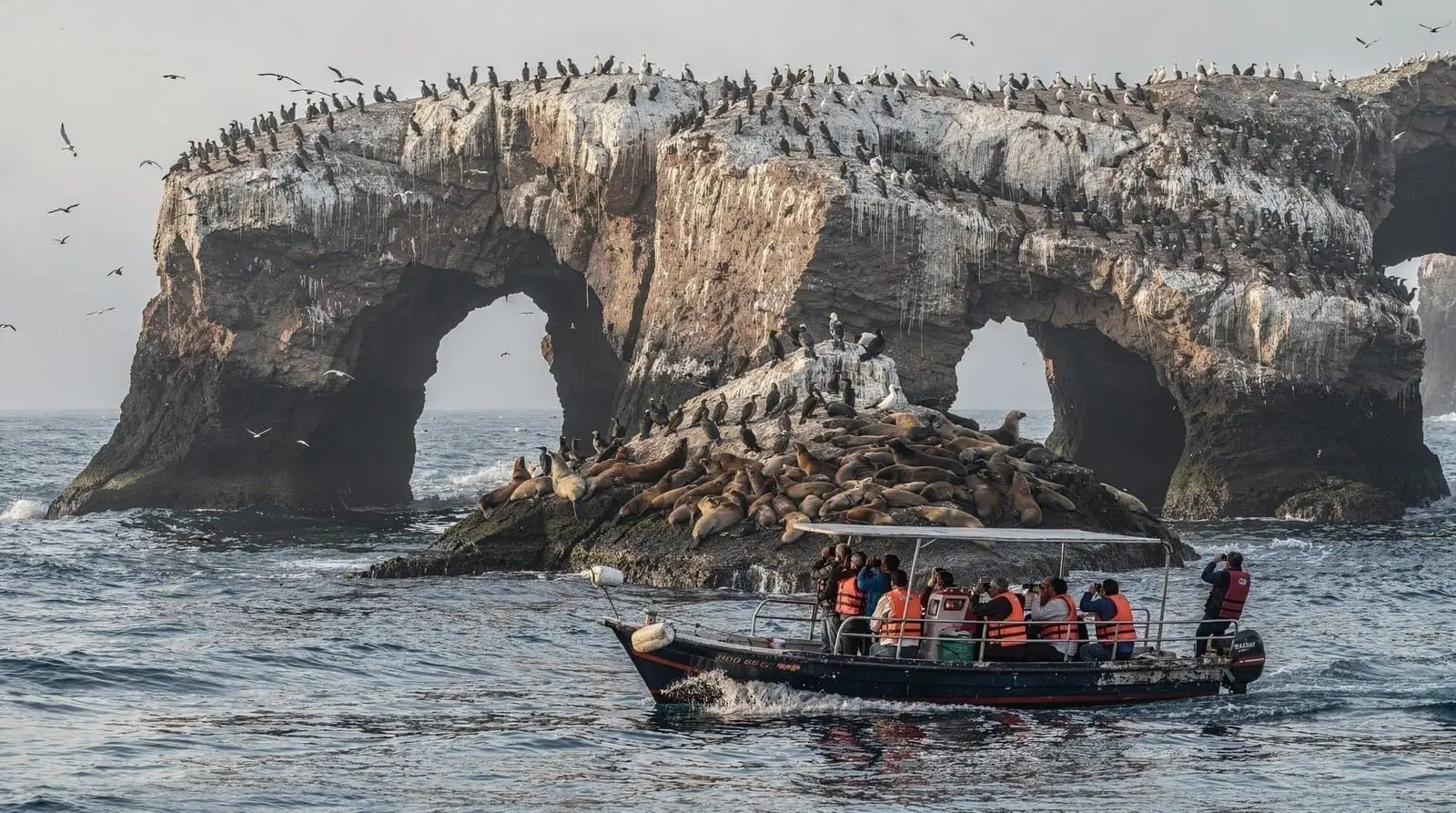
The Ballestas are a cluster of rocky islands about 30 minutes by speedboat off the Paracas coast, sometimes called “the poor man’s Galápagos.” It is a marketing line, and it oversells the comparison — you cannot land, and the diversity is far lower — but the density of wildlife is genuinely impressive.
On a typical two-hour trip you will see large, noisy colonies of South American sea lions hauled out on the rocks, Humboldt penguins, pelicans, Peruvian boobies, cormorants, and the striking red-billed Inca tern. Between June and around November you may spot dolphins, and the guano-covered cliffs swarm with seabirds year-round. On the way out, the boat slows at the Candelabro (the Candelabra), a giant geoglyph etched into a coastal hillside whose origin nobody has definitively explained.
From Paracas: Ballestas Islands Boat Ride TourWhat it costs: the boat trip itself is around S/45–60 (roughly USD 13–17), plus a S/16 dock and reserve tax paid at the pier. Boats leave from the El Chaco waterfront in two main waves, usually 08:00 and 10:00; the earlier slot is calmer and the light is better.
The catch: you stay on the boat the entire time — landing is banned to protect the breeding colonies and the guano deposits. The open boats are exposed; expect wind, spray and chop, especially in the second departure. Bring a windbreaker, sunscreen, a hat with a strap, and motion-sickness tablets if you are prone to it. And yes, the guano smell is real.
The Paracas National Reserve: desert by land
The Paracas National Reserve is a vast protected area of coastal desert and sea — Peru’s first marine protected area — covering the peninsula south of town. This is a land tour (by minibus, bicycle or car), not a boat trip, and the appeal is scenery rather than concentrated wildlife.
The highlights are landscapes: the deep-red sand of Playa Roja, the natural rock arch at La Catedral (partly collapsed in the 2007 earthquake but still dramatic), sweeping clifftop viewpoints where the desert drops straight into the Pacific, and the wide, calm beach at Lagunillas with a few simple seafood restaurants. Wildlife here is real but scattered — Chilean flamingos in the bay (best August to March), Andean condors, desert foxes, and seabirds — and you need patience and luck rather than a guarantee.
Paracas National Reserve Guided TourWhat it costs: reserve entry is about S/11 (USD 3) per person; a guided half-day land tour runs S/40–70 including transport and the visitor centre. You can also explore independently by hiring a taxi (S/80–120 for the loop) or renting a bicycle in town, though the distances and heat make cycling a serious undertaking.
The catch: there is very little shade, the wind picks up dramatically after midday, and the “wildlife” sell can disappoint anyone expecting Ballestas-style density. Go for the landscape, treat the animals as a bonus, and you will not be let down. The full reserve guide goes into routes and timing in detail: see the Paracas National Reserve guide.
Head to head
Wildlife: Ballestas wins decisively. Sea lions, penguins and seabirds at close range, every trip. The reserve’s wildlife is sparse and unpredictable.
Scenery: the reserve wins. Red beaches, desert cliffs and the empty Pacific coast are far more striking than the islands’ guano-stained rocks.
Time: Ballestas is a tidy two hours plus travel. The reserve is a flexible half-day; you can spend anywhere from two hours to a full afternoon.
Cost: Ballestas around S/60–75 all in; the reserve around S/50–80 with a guided tour. Similar, with combined tickets cutting the total.
Comfort: the reserve is gentler — no boat, no seasickness, more control over your pace. Ballestas involves an exposed, sometimes choppy ride.
Weather sensitivity: both run year-round, but Ballestas is more affected by wind and swell. If the sea is rough, the reserve is the safer bet for a comfortable morning.
Doing both in a day (the recommended plan)
The reason most agencies sell them together is that they slot into a single day without strain:
- 08:00 — Ballestas boat trip from El Chaco pier (back by about 10:00).
- 10:30 — Paracas National Reserve land tour: visitor centre, La Catedral, Playa Roja, Lagunillas for lunch.
- Afternoon — back in Paracas by mid-afternoon, with time to relax on the waterfront or move on to Ica and Huacachina.
Combined tours bundle both for roughly S/90–140 including the boat, reserve entry and transport, which is cheaper and simpler than booking separately:
Paracas: Ballestas Islands & Paracas Reserve Full-DayWho should skip which, specifically
Beyond the general guidance above, a few traveller profiles make the decision easier. Families with young children generally do better skipping the open-boat Ballestas trip in favour of the reserve, where a private taxi loop lets kids move around and take breaks rather than sitting still on a bouncing boat for two hours. Travellers with mobility limitations face the same calculation: stepping down into a floating speedboat is genuinely difficult for wheelchair users, while the reserve can be experienced largely from a vehicle. Conversely, serious wildlife photographers should prioritise Ballestas even if time is very tight, since the close-range colonies of sea lions and seabirds are simply not replicable on the reserve side.
Budget travellers weighing marginal costs will find little difference — both halves land in a similar S/50-80 range once transport is included — so cost alone should rarely be the deciding factor. The bigger variable is usually time: a tight one-night stopover before continuing to Ica or Nazca is the main scenario where picking just one half genuinely matters.
First-timers to Peru who have never seen sea lions, penguins or a large seabird colony up close should lean toward Ballestas almost by default — it is a genuinely memorable, low-effort wildlife encounter that is hard to replicate elsewhere on a standard Peru itinerary. Repeat visitors, or anyone who has already done a marine-wildlife trip elsewhere in South America (the Galápagos, Chilean Patagonia’s coast), often get more out of the reserve’s stark, unfamiliar desert landscape precisely because the wildlife novelty has worn off.
How this fits a wider trip
If you are coming from the capital, this whole experience usually anchors the first leg of the south coast run — see the Lima to Paracas and Nazca itinerary for how it connects to Nazca and the Nazca Lines. For a tight two-day version that pairs Paracas with the Ica dunes, the south coast two-day guide lays out the timing. The Paracas destination page covers where to stay and eat.
Frequently asked questions about Paracas vs Ballestas: which is worth your time and money?
Can I do both Ballestas and Paracas Reserve in one day?
How much does each cost?
Can you land on the Ballestas Islands?
Which has better wildlife?
Is the boat trip rough?
Top experiences
Bookable activities with verified prices and instant confirmation on GetYourGuide.

