Ballestas Islands guide
From Paracas: Ballestas Islands Boat Ride Tour
What are the Ballestas Islands?
A cluster of offshore rock arches and caves near Paracas, packed with sea lions, Humboldt penguins, Peruvian boobies and other seabirds. You view them from a two-hour boat tour; landing is prohibited. Tours cost around S/55 to S/70 plus a small dock tax.
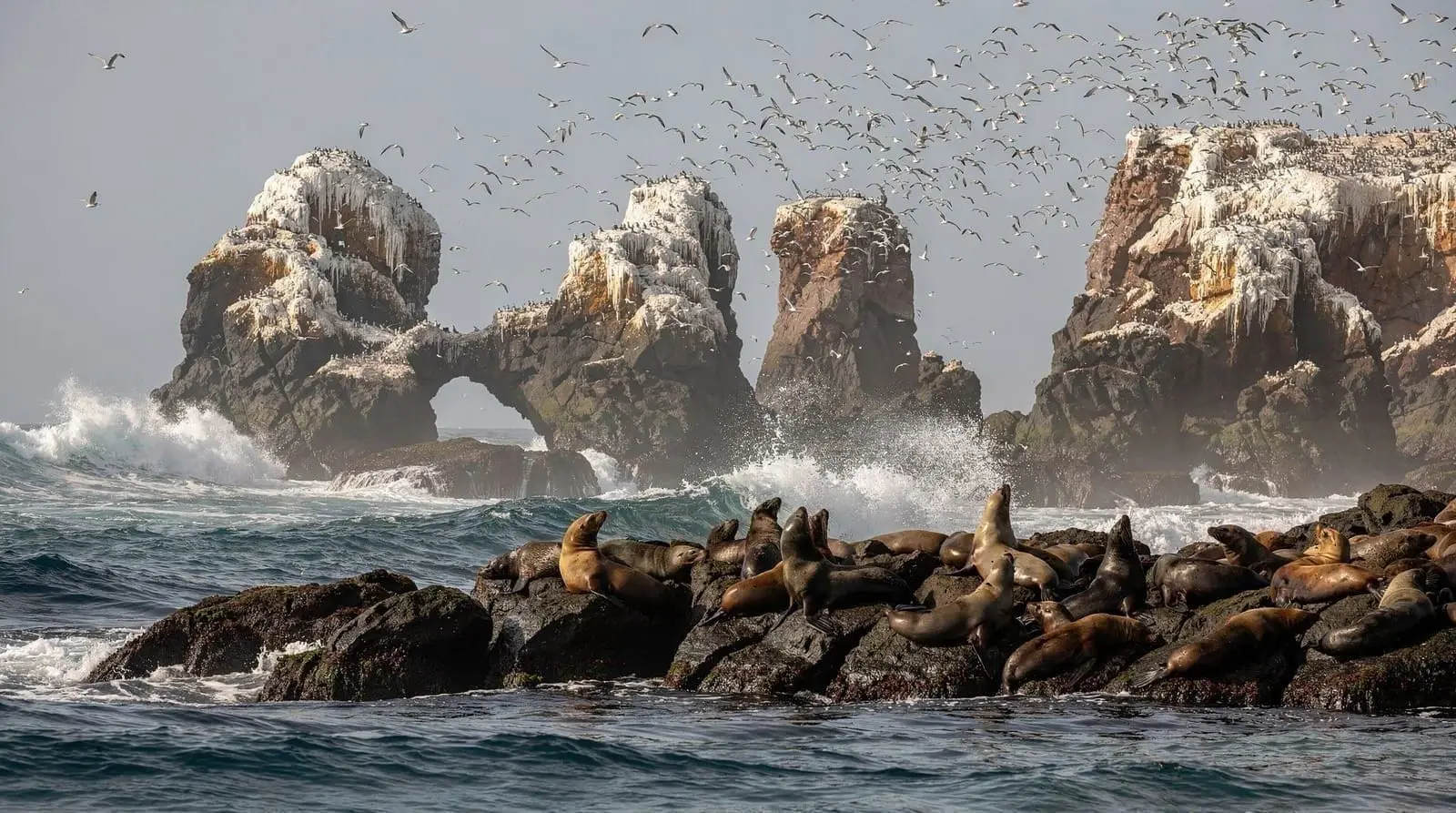
The Ballestas Islands are a knot of guano-white rock arches and sea caves about 12 km off the Paracas coast, and they hold one of the densest concentrations of marine wildlife you can see in Peru without a permit or a long expedition. Tour operators sell them as the “poor man’s Galápagos,” a phrase that both flatters and undersells the place. You will not find marine iguanas or giant tortoises, and you never set foot on land — but the sheer volume of animals barking, diving and nesting around a small open boat is, on a good morning, genuinely overwhelming.
This guide explains exactly what you see, how the boat trip works, what it costs, and how to avoid the small mistakes (wrong departure time, no seasickness pills, overpaying at the dock) that take the edge off an otherwise excellent two hours.
| Where | El Chaco harbour, Paracas — boats circle the islands, no landing |
| Cost | S/55–70/person plus a ~S/16 dock tax |
| Time needed | About 2 hours total (20–25 min crossing each way) |
| Getting there | Boats depart roughly 07:00–11:00; earliest is calmest |
| Best time | April–November for calmer seas; penguins and sea lions year-round |
What you actually see
The boat does not land — it circles the formations and pauses while passengers photograph. A guide on board narrates. In a typical 90 minutes around the rocks you can expect:
- South American sea lions hauled out by the hundreds on every flat ledge, with pups (born December to February) making the colonies especially loud and active in summer.
- Humboldt penguins, present year-round, nesting in crevices and standing in small groups on the rock — the headline sighting for most visitors, and the reason to bring a zoom lens.
- Peruvian boobies and pelicans in vast numbers, plus guanay cormorants whose droppings created the guano deposits that whiten the whole island.
- Inca terns, dark grey with a vivid red beak and a white “moustache” — one of the most photogenic seabirds on the coast.
- Chilean flamingos in the shallow bays between roughly June and November, and occasional dolphins on the crossing.
The white coating on the rock is guano — seabird droppings deposited over centuries. Peru’s guano islands were harvested commercially from the 19th century (the so-called guano boom helped finance Lima’s growth), and the Ballestas are still periodically worked by licensed crews. On a warm day the smell is part of the experience.
El Candelabro on the way out
Most boats pass close to the Paracas Peninsula’s northern cliffs on the outbound leg, where El Candelabro — a 150-metre geoglyph cut into the hillside — is clearly visible from sea level. It was made, like the Nazca Lines, by removing darker surface stones to expose lighter soil beneath. Its age and meaning are disputed (estimates run from 200 BCE to the colonial era), and theories range from a pre-Inca astronomical marker to a beacon for sailors. Whatever it is, it is large enough to study clearly from a moving boat a few hundred metres offshore.
How the boat tour works
Boats depart the El Chaco harbour in Paracas roughly between 07:00 and 11:00. The whole trip is about two hours, including the 20-to-25-minute crossing each way in an open speedboat seating 15 to 30 people. The first departures of the day generally have the calmest seas and the best light for photography.
Standard price is S/55 to S/70 per person (about $15 to $19 USD), and there is a separate dock/embarkation tax of around S/16 paid at the pier — carry small soles for it, as it usually is not bundled into pre-booked tickets. Boats are plentiful and rarely sell out except on Peruvian holiday weekends, so booking the night before or that morning is normally fine.
From Paracas: Ballestas Islands Boat Ride TourFor a tour that emphasises the scenic approach and the Candelabro alongside the wildlife circuit:
From Paracas: Scenic Boat Tour to Ballestas IslandsWhat to bring
The single most useful item is a windproof jacket — the open crossing is cold and breezy even when the town is warm. Add sunscreen and sunglasses (no shade on the boat), a hat that will not blow off, and motion-sickness medication taken 30 to 60 minutes beforehand if you are at all prone. The Humboldt swell is present year-round, so even strong stomachs can be surprised on a choppy morning.
For wildlife, a camera with a telephoto lens (200 mm or longer) makes a real difference, and binoculars — 8×42 are ideal — turn distant penguins on a ledge into a vivid scene. Keep gear in a dry bag; spray comes over the bow regularly.
Photographing the wildlife from a moving boat
Good Ballestas photos take a little planning, because you are shooting moving animals from a bouncing boat that does not stop for long.
- Sit on the side, not the bow. The bow takes the most spray and the most jolting. A side seat gives you a stable elbow rest on the gunwale and a cleaner angle on the rocks.
- Shoot fast shutter speeds. Aim for 1/1000s or faster to freeze both the swell and the birds; bump ISO rather than risk blur in the early-morning light.
- Pre-focus on the rock, then wait for the animal. Penguins and sea lions appear briefly between waves and wakes, so having focus and exposure already set means you catch the moment.
- Take the earliest boat for the light. The first departures get low, warm side-light on the white guano cliffs; by mid-morning the sun is flatter and harsher.
- Protect the gear. A UV filter, a strap around your neck, and a microfibre cloth for spray are worth more than an extra lens out here. Phones do fine for the rock arches; only a telephoto reaches the penguins.
Conservation, guano and why you cannot land
The no-landing rule is not bureaucratic fussiness — it is the reason the wildlife is so dense. The Ballestas sit within Peru’s Reserva Nacional de Sistema de Islas, Islotes y Puntas Guaneras, a protected network created to safeguard both the breeding colonies and the guano resource. Disturbing the colonies would scatter the sea lions and frighten nesting birds off their eggs, so visitor boats keep their distance and never set foot ashore.
The guano economy is genuinely old. In the 19th century, Peruvian seabird droppings — prized as a nitrogen-rich fertiliser before synthetic alternatives existed — were exported by the shipload, and the trade financed a chunk of the young republic’s budget. Licensed crews still harvest the deposits periodically, by hand, on a multi-year cycle that lets the birds rebuild the layer. That measured, sustainable extraction is why the islands remain both a working resource and a wildlife stronghold rather than a stripped rock.
Ballestas vs the Galápagos
The comparison is fair on density, not diversity. The Ballestas match the Galápagos for sheer numbers of sea lions and seabirds packed into a small area, and they cost a fraction as much — a full two-day Paracas-Huacachina-Nazca circuit is cheaper than a single day in the Galápagos. What they lack is endemic land species and the immersive, walk-among-the-animals access the Galápagos is famous for; here you stay on the boat the whole time. For a South America trip where the Galápagos is out of budget, the Ballestas deliver real wildlife drama for very little money.
Combining with the national reserve
The boat is a morning of about two hours, which leaves the afternoon free — and the Paracas National Reserve behind the town is the obvious pairing. The desert peninsula, the collapsed La Catedral arch, the flamingo lagoon and the Julio Tello Museum give a different, land-based half-day. Combined boat-plus-reserve tours exist and are the most efficient way to see both:
Paracas: Ballestas Islands and National ReserveIf you are weighing the islands against the peninsula because you only have time for one, the Paracas vs Ballestas comparison lays out the trade-offs. For the wider town logistics — buses from Lima, where to eat, onward transport to Ica — see the Paracas complete guide.
Booking, costs and avoiding the squeeze
The standard boat is a commodity — dozens of operators run near-identical circuits at near-identical prices, so the smart move is to compare on departure time and boat condition rather than chase the lowest sticker.
- Boat ticket: S/55 to S/70 (about $15 to $19 USD), bought at a harbour kiosk the night before or that morning.
- Dock/embarkation tax: about S/16, paid separately at the pier in small soles.
- Optional reserve add-on: S/25 entry plus transport if you continue to the peninsula afterward.
Two honest-planner cautions. First, ignore the touts who meet the buses with “combo” packages — they bundle a marked-up boat with a reserve taxi and pocket the difference. Second, decline the “private” or “VIP” boat upsell unless you specifically want a smaller craft; the wildlife is identical from the shared boat, and the only meaningful upgrade is grabbing the first departure of the day, which you can do on an ordinary ticket. If you would rather have it all arranged in advance, the booked options below lock in a slot:
From Paracas: Scenic Boat Tour to Ballestas IslandsAccessibility and suitability
This is the least accessible of the south coast’s headline activities. Boarding means stepping down from a floating dock into an open speedboat that rocks with the swell, there is no level deck access, and the crossing is bouncy throughout. Wheelchair users and travellers with serious mobility limits will find it genuinely difficult, and crews can assist but the boats are not adapted.
Anyone with significant back or neck problems should weigh the repeated slamming over the swell. For those travellers, the land-based Paracas National Reserve, viewed largely from a vehicle, is the more comfortable half of a Paracas day. Otherwise the trip suits almost everyone, including reasonably steady older travellers and families with school-age children.
Fitting it into a south-coast trip
The Ballestas slot naturally into the standard south-coast run. From Paracas it is one hour east to Ica and the Huacachina oasis, then 3 to 3.5 hours south to Nazca for the overflight. The Lima-to-Paracas-Nazca itinerary and the south coast 2-day guide sequence it all, and you can build a custom route on the itineraries hub or browse packages on the tours hub.
Seasonal wildlife calendar
There is no bad time for the Ballestas, but what you see shifts through the year, so it helps to know what is in season when you go.
- December to February (austral summer): sea lion pups are born and the colonies are at their loudest and most active. Seas are warmer-feeling but the paracas wind and summer swell can make for choppier, occasionally delayed boats.
- June to November (austral winter/spring): the calmest, clearest window with the best light. Chilean flamingos appear in the bays in these months, and the cooler air keeps the guano smell down.
- Year-round: Humboldt penguins, the headline draw for most, are present in every month, as are the boobies, pelicans, cormorants and Inca terns. Dolphins are an unpredictable bonus on any crossing.
If you can choose, April to November gives the best mix of calm water and clear skies; the summer months trade rougher seas for the spectacle of pups in the colonies.
When to go
April to November is the better season: calmer seas, clearer skies, and flamingos in the bays. December to March brings the paracas desert wind, more humidity, and occasionally rough water that can delay departures. Penguins and sea lions are present all year, so there is no truly bad time — just rougher and calmer ones.
Families, seniors and first-timers
The Ballestas boat is a good fit for most travellers, but a few groups should plan around its quirks. Children generally enjoy it — the wildlife is close and constant — but the open, bouncing boat and cold spray suit school-age kids better than toddlers, and life jackets are provided but supervision is on you. Older travellers with steady balance do fine; those with vertigo, severe motion sensitivity, or serious back or neck issues should take a seasickness tablet well ahead of boarding and consider an early, calmer departure. First-timers to Peru sometimes underestimate how cold and windy the open crossing feels even on a sunny desert morning — a windproof layer solves this more reliably than sunscreen alone.
Frequently asked questions about Ballestas Islands
Can you land on the Ballestas Islands?
How long is the Ballestas boat tour?
How much does the Ballestas tour cost?
Will I see penguins?
Is the Ballestas boat rough?
Top experiences
Bookable activities with verified prices and instant confirmation on GetYourGuide.
