Paracas National Reserve: an honest visitor's guide
Paracas National Reserve Guided Tour
Is the Paracas National Reserve worth visiting?
Yes, if you go for the stark desert-meets-ocean landscapes rather than dense wildlife. Highlights are Playa Roja's red sand, the La Catedral rock formation, and Lagunillas beach. Entry is about S/11; a guided half-day tour runs S/40–70.
The Paracas National Reserve is one of those places that photographs better than it sounds. On paper it is a protected coastal desert with some viewpoints and a couple of beaches. In person it is genuinely strange and beautiful: a Mars-coloured landscape where the driest desert on Earth runs straight into a cold, fish-rich ocean, and the only sounds are wind and surf. This guide covers how to visit it well, what it costs, and — importantly — what not to expect, because plenty of travellers arrive hoping for a wildlife safari and leave a little confused.
| Where | Paracas peninsula, a few km south of El Chaco harbour |
| Cost | About S/11 entry, plus S/40-120 for transport/tour |
| Time needed | Half-day (3-4 hours); add an hour for lunch at Lagunillas |
| Getting there | Guided minibus tour, hired taxi, or your own car |
| Best time | Mornings, before the afternoon wind picks up |
What the reserve actually is
Established in 1975, the Reserva Nacional de Paracas was Peru’s first marine protected area. It covers about 335,000 hectares of desert peninsula and ocean south of Paracas town, protecting the marine ecosystem fed by the cold, nutrient-rich Humboldt Current. That current is why this stretch of barren coast supports flamingos, penguins, sea lions and millions of seabirds despite looking utterly lifeless from the road.
The land you tour is desert — sand, rock and salt flats — and the drama comes from the meeting of that emptiness with the Pacific. It is not a jungle full of animals; it is a stark, geological place. Set your expectations accordingly and it is one of the more memorable half-days on the south coast.
Getting there and around
The reserve entrance sits just a few kilometres south of Paracas town (El Chaco). Once inside, the points of interest are spread across many kilometres of unpaved and paved desert road, so you need transport.
Your options:
- Guided minibus tour — the standard choice. A half-day land tour costs S/40–70 (USD 11–19) including transport, the entry fee is sometimes separate, and a guide who points out the wildlife and explains the geology.
- Hired taxi — S/80–120 for the full loop with waiting time; good for groups who want flexibility.
- Rented bicycle — possible from town, but the distances are long, there is zero shade, and the afternoon wind is brutal. Only for fit, well-prepared cyclists who start early.
- Your own car — straightforward if you have one; the main road is paved and signed.
Whatever you choose, go in the morning. By early afternoon the wind whips sand across the roads and the viewpoints become unpleasant.
What to see
The interpretation centre
Most visits start at the Centro de Interpretación, a small museum near the entrance explaining the reserve’s ecology, the cold Humboldt Current, and the marine and bird life. It is worth 20 minutes for context, and the boardwalk behind it overlooks Paracas Bay, where Chilean flamingos gather — best spotted from August to March. (Local lore holds that the red-and-white of these flamingos inspired the colours of the Peruvian flag, a story General San Martín supposedly drew on; treat it as charming rather than documented.)
La Catedral
La Catedral is the reserve’s most famous rock formation, a wave-carved arch jutting into the ocean. The 2007 Pisco earthquake collapsed much of the arch, so what you see today is a partial ruin of the original — still dramatic, with crashing surf and seabirds wheeling around it, but be aware the postcards may show the pre-2007 version. The clifftop viewpoint is exposed and windy; hold onto hats and small children.
Playa Roja
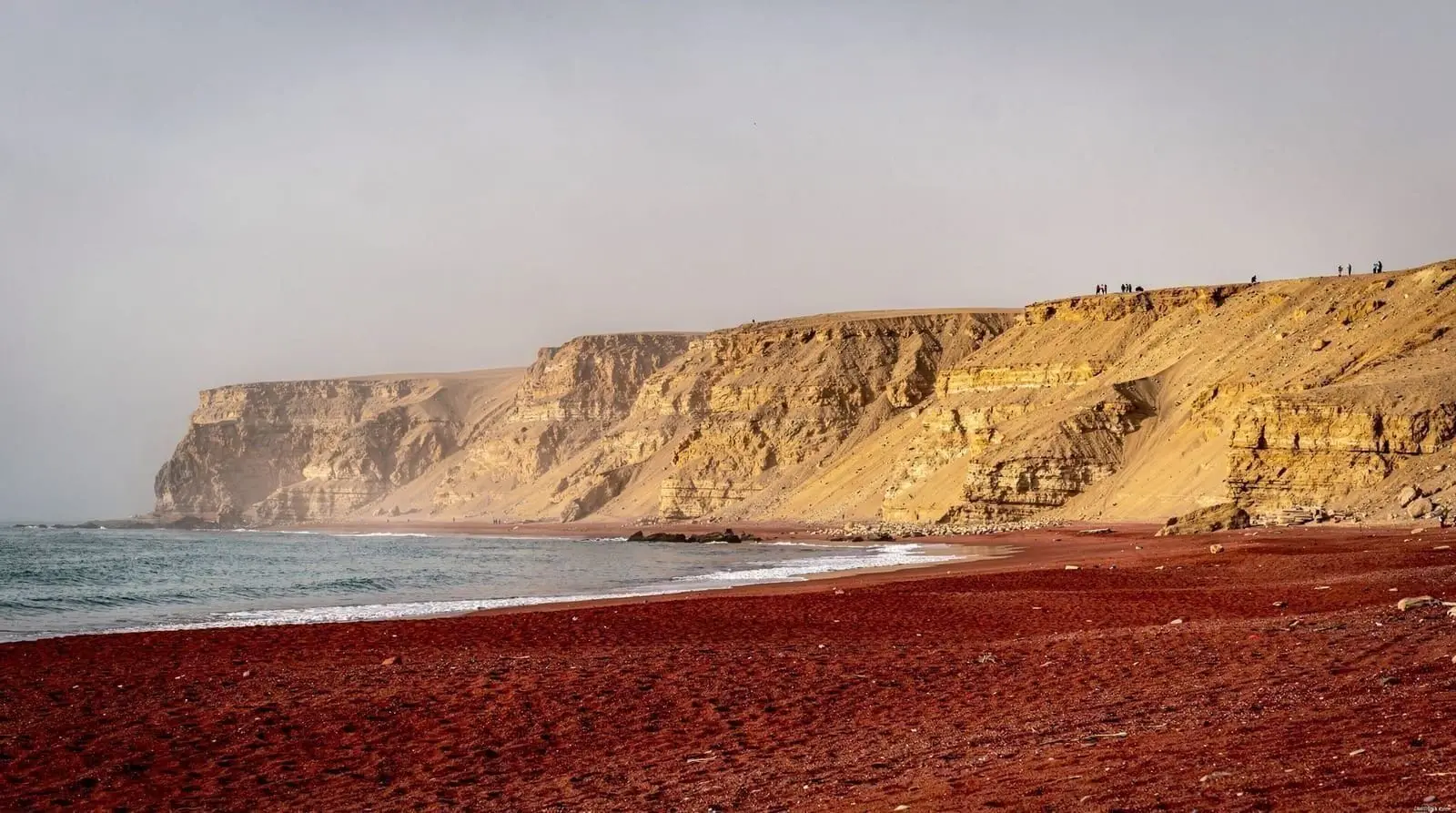
Playa Roja, the red beach, is the visual signature of the reserve: a cove of deep red-pink sand created by eroded magmatic rock, framed by ochre cliffs and turquoise water. You view it from a clifftop platform rather than walking down (access to the sand is restricted to protect it). On a clear morning it is the most striking single sight in the reserve.
Lagunillas
Lagunillas is a sheltered bay with a wide, calm beach and a row of simple seafood restaurants serving ceviche, fried fish and the local catch straight from the small fishing boats. It is the natural lunch stop and the one place in the reserve where you can comfortably linger. Prices are reasonable for a captive-audience spot — expect S/25–40 for a ceviche.
Wildlife, honestly
You may see Chilean flamingos in the bay, Andean condors riding the thermals, the small desert fox (zorro costeño), Humboldt penguins, sea lions and a great many seabirds. But these are scattered across a huge area and sightings are a matter of luck and timing, not a guarantee. If close wildlife is your priority, the boat trip to the Ballestas Islands delivers far more reliably — see the full Paracas vs Ballestas comparison for which suits you.
Timing and how long to spend
A half-day — roughly three to four hours including travel — covers the interpretation centre, La Catedral, Playa Roja and a clifftop viewpoint comfortably. Add Lagunillas for lunch and you have a relaxed full morning into early afternoon. There is no need to budget a whole day; the reserve rewards a focused visit, not lingering.
The best window is from opening (around 08:00) until midday. Mornings are calmer, clearer and far less windy. The reserve is open and dry year-round, so weather is rarely a reason to cancel, though overcast coastal fog (garúa) can mute the colours in winter (June to September).
What to bring
- Sun protection — there is essentially no shade anywhere. Hat, sunglasses, high-SPF sunscreen.
- A windbreaker — the afternoon wind is no joke.
- Water — bring more than you think; it is desert.
- Cash — for the entry fee, lunch at Lagunillas and tips. Card acceptance is unreliable.
- A bag for your phone/camera — blowing sand gets everywhere.
Combining it with the islands
Because the Ballestas Islands boat trip runs first thing in the morning and the reserve fits the rest of the day, the two are almost always done together. A combined tour covers the boat, the reserve entry and transport for one price:
Paracas: Ballestas Islands & Paracas Reserve Full-DayThis is the efficient way to see everything Paracas offers in a single day, after which you can move on to Ica, the Huacachina dunes, or Nazca. The south coast two-day guide shows how to sequence it, and the Lima to Paracas and Nazca itinerary places it in a longer route from the capital.
Photography and what actually reads well in pictures
The reserve rewards photographers who arrive with realistic expectations about light rather than wildlife. The best images come from the clifftop overlook above Playa Roja in the first two hours after opening, when the low sun rakes across the red sand and the contrast between the cliffs, the beach, and the turquoise water is sharpest. By late morning the light flattens and a coastal haze often mutes the colours. La Catedral photographs best from slightly below the main viewpoint if the path allows it, catching the arch against the surf rather than a flat overhead angle. Bring a lens hood or at minimum keep your phone screen shaded — the glare off the pale desert sand is fierce even on an overcast day.
How this reserve compares with Peru’s other desert landscapes
Paracas is Peru’s most accessible coastal desert reserve, but it is not the only stark landscape on the south coast. The dunes at Huacachina offer a completely different desert experience — golden sand dunes for buggying and sandboarding rather than a rugged, wildlife-adjacent coastline — and the two make a natural one-two punch on a south-coast itinerary rather than a substitute for each other. Travellers who found Paracas’s flat clifftop landscapes compelling but want more physical engagement with the terrain tend to enjoy the dune-buggy adrenaline at Huacachina as a contrasting follow-up.
A less obvious comparison is Nazca, further south, where the desert’s flatness serves an entirely different purpose — as the canvas for the ancient geoglyphs rather than a coastal wildlife backdrop. Seeing both within the same south-coast trip gives a genuinely broad picture of how varied Peru’s desert coast actually is, from marine-fed cliffs to rolling dunes to line-etched pampa.
Frequently asked questions about Paracas National Reserve: an honest visitor's
How much does it cost to enter the Paracas National Reserve?
How do I get around the reserve?
What is there to see in the reserve?
How long do I need?
When is the best time to visit?
Top experiences
Bookable activities with verified prices and instant confirmation on GetYourGuide.

