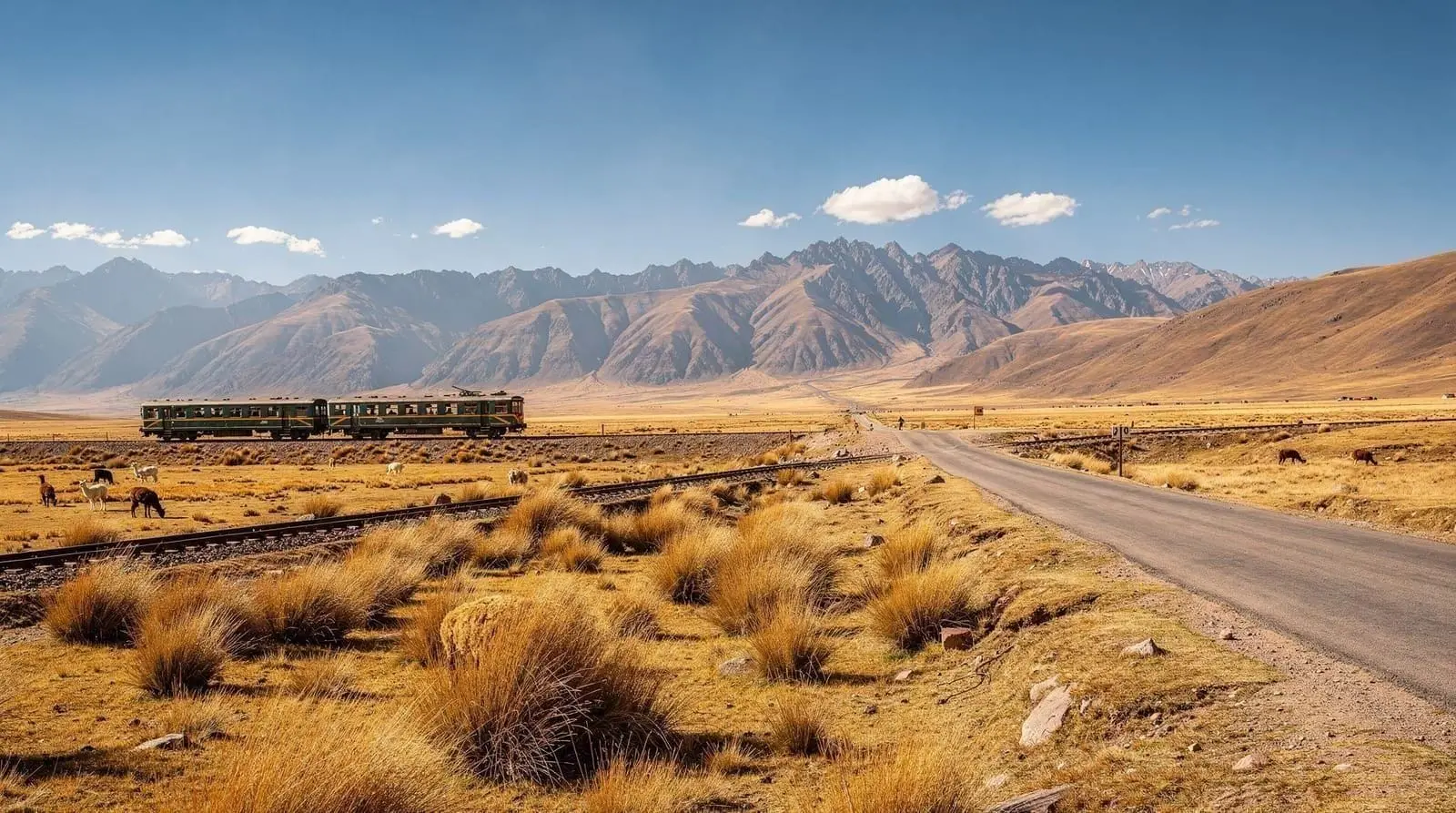
Cusco to Puno: the Route of the Sun, bus and train
Route of the Sun: Bus Trip from Cusco to Puno with Stops
What is the best way to get from Cusco to Puno?
The Route of the Sun tourist bus (about 10 hours, S/200–260 / roughly $55–70) is the standout choice: it stops at four major sites along the way and costs little more than a plain overnight bus. A direct regular bus takes 6–8 hours from around S/40, and the luxury Andean Explorer train is a scenic splurge.
Four ways to cross the altiplano
The 390 kilometres between Cusco and Puno look short on a map and feel long on the ground, because the road climbs onto the high altiplano and stays there. What makes this leg unusual is that the journey itself is a genuine attraction: the corridor is studded with Inca and colonial sites, and one specific service — the Route of the Sun tourist bus — has built its whole business around stopping at them.
That gives you four meaningfully different ways to get from Cusco to Puno, and the cheapest is rarely the best value here:
- The Route of the Sun tourist bus — a daytime sightseeing bus with four stops and lunch.
- A regular direct bus — the fast, cheap, no-frills option, day or overnight.
- The Andean Explorer luxury train — a scenic splurge for whom the journey is the point.
- Flying — via Juliaca airport, an hour from Puno, and rarely worth it for this leg.
This guide breaks down all four with 2026 prices in soles and dollars, schedules, and the honest trade-offs, so you can match the journey to the trip you are actually taking.
| Distance | 390 km across the altiplano |
| Best pick | Route of the Sun tourist bus, ~10 hrs, S/200–260 |
| Cheapest | Regular direct bus, 6–8 hrs, from S/35 |
| Splurge | Andean Explorer train, ~10 hrs, several hundred $ |
| High point | La Raya pass, ~4,335 m |
The four options side by side
| Option | Duration | Price | Sightseeing |
|---|---|---|---|
| Route of the Sun bus | ~10 hrs | S/200–260 ($55–70) | 4 guided stops + lunch |
| Regular direct bus | 6–8 hrs | S/35–120 ($9–32) | None (window views only) |
| Andean Explorer train | ~10 hrs | Several hundred $ | Scenic, luxury dining |
| Flight (via Juliaca) | Half a day+ | Varies | None, and rarely worth it |
The Route of the Sun: the standout choice
If you have time for a full day on the road, the Route of the Sun (Ruta del Sol) is the option most travellers are happiest with afterwards. It is a tourist bus that leaves Cusco in the morning and reaches Puno in the early evening, roughly 10 hours later, with four guided stops that you would otherwise never see:
- Andahuaylillas — the “Sistine Chapel of the Andes,” a small 17th-century church with an astonishing painted interior.
- Raqchi — the Inca Temple of Wiracocha, with its towering central wall, plus surrounding storehouses.
- La Raya pass — the route’s high point at about 4,335 m, the watershed between the Cusco valley and the Titicaca basin, with snow-capped peaks and a roadside market.
- Pukara — a pre-Inca site and small museum known for its stone carvings and the ceramic “bulls of Pukara.”
A buffet lunch is usually included around the midpoint. The genius of the format is the maths: it costs only a little more than a comfortable seat on a plain overnight bus, but it converts a transfer into a sightseeing day. You arrive in Puno having actually seen the altiplano rather than having slept through it.
Prices in 2026 run roughly S/200–260 (about $55–70) including the stops, guide, and lunch, but excluding the site entrance fees at Raqchi and Pukara (a few soles each, paid on the day). Departures are typically around 07:00–07:30 from Cusco, arriving Puno around 17:00–18:00.
The Route of the Sun bus trip from Cusco to Puno with stops bundles the whole day — transport, bilingual guide, the four site visits, and lunch — into a single booking, which removes the guesswork of arranging the stops yourself. It is the option to choose if you want the journey to count as sightseeing.
The regular direct bus: fast and cheap
If you just want to get to Puno without the stops, regular intercity buses do the run in 6 to 8 hours for a fraction of the tourist-bus price. They leave from Cusco’s Terminal Terrestre and arrive at Puno’s terminal, a short taxi from the lakeside centre.
The operators are the usual southern-Peru names — Cruz del Sur, Tepsa, Julsa, Power, and others. Fares depend on seat class:
- Budget semi-cama: S/35–55 (about $9–15)
- Cama / premium lines: S/70–120 (about $19–32)
There are both daytime and overnight departures. The overnight is tempting for saving a hotel night, but Puno is best entered in daylight (the lake views on approach are part of the appeal), and the route is short enough that a daytime bus does not cost you much. If you take a budget line, you get none of the guided stops — you simply pass Raqchi and La Raya through the window.
For the full glossary of Peruvian bus classes and how to book safely, the Peru bus travel guide is the companion reference.
The Andean Explorer train: the scenic splurge
PeruRail runs the Andean Explorer, a luxury sleeper-style train between Cusco and Puno (and on to Arequipa on certain routings). It is one of South America’s celebrated rail journeys, with an observation car, a dining car, and panoramic windows across the altiplano. The day journey to Puno takes around 10 hours.
It is also expensive — several hundred US dollars for the day journey, and well into four figures for the multi-day sleeper version. This is not transport in the practical sense; it is the experience itself, aimed at travellers for whom the train is a highlight of the whole trip rather than a way to move between two cities. If that is you, it delivers. If you want sightseeing value, the Route of the Sun bus shows you more actual sites for a small fraction of the cost.
Flying: usually the wrong call
Puno has no commercial airport. The nearest is Inca Manco Cápac International Airport in Juliaca (JUL), about an hour’s drive north of Puno. Flights connect Juliaca mainly with Lima, not directly with Cusco in any convenient way — a Cusco–Juliaca itinerary almost always routes through Lima, turning a short hop into a half-day detour.
For the Cusco–Puno leg specifically, flying makes little sense: by the time you taxi to Cusco’s airport, fly to Lima, connect to Juliaca, and drive an hour to Puno, you have spent as long as the bus and far more money, and seen none of the altiplano. Flying into Juliaca is sensible only if you are arriving from elsewhere in Peru. For the wider domestic air picture, see the Peru domestic flights guide.
Altitude on this route: a real gain
Unlike the descent toward Arequipa, going to Puno means going up. Puno sits at 3,830 m on the shore of Lake Titicaca — over 400 m higher than Cusco — and the road crosses La Raya at about 4,335 m. If you have already spent several days acclimatising in Cusco, you will probably handle the gain fine, but it is real:
- Drink water steadily through the journey.
- Go easy on your first evening in Puno; do not arrive and immediately march around.
- Coca tea is offered everywhere and helps mildly.
- The Route of the Sun’s stop at La Raya is brief, so the high pass is not a sustained exposure — but you will feel the thin air if you jog up to the viewpoint.
This is one reason most itineraries do Cusco before Puno: you arrive at the lake already adjusted.
Which option suits which traveller
Take the Route of the Sun if you: want the journey to double as sightseeing, have a full day to spare, and like the idea of arriving in Puno already steeped in altiplano history. Best overall value for the leg.
Take a regular direct bus if you: just want to get there cheaply and quickly, or are on a tight budget and have seen enough ruins for now.
Take the Andean Explorer if you: treat scenic rail as a bucket-list experience and have the budget for it.
Fly only if you: are arriving in the region from elsewhere in Peru rather than coming straight from Cusco.
What waits in Puno and on the lake
The reason most people make this journey at all is Lake Titicaca, the highest navigable lake in the world and home to the floating reed islands of the Uros and the weaving communities of Taquile and Amantaní. Puno itself is a working highland port town rather than a polished tourist city, but it is the launch point for every lake excursion.
Once you arrive, the classic outing is a boat trip to the islands. The full-day Lake Titicaca tour to Uros and Taquile covers the floating islands and the textile island of Taquile in one day, which is the standard introduction. Travellers who want to go deeper — including a homestay night with an island family — choose a two-day version that adds Amantaní island.
Timing your day on the Route of the Sun
If you take the Route of the Sun, a little knowledge of the day’s rhythm helps you enjoy it rather than endure it. The early start is real — pickups begin around 06:30–07:00 — so the night before is not the time for a late pisco session. Here is roughly how the day unfolds:
- First hour: out of Cusco onto the open altiplano, the landscape flattening into high grassland dotted with alpaca herds.
- Mid-morning (Andahuaylillas): the painted church, a short but memorable stop. Photography inside is usually restricted, so look rather than shoot.
- Late morning (Raqchi): the largest archaeological stop, with time to walk among the temple wall and storehouses.
- Midday (lunch + La Raya): a buffet lunch near the midpoint, then the high pass at 4,335 m with its snow peaks and a roadside handicraft market — the day’s scenic high point, literally.
- Afternoon (Pukara): the pre-Inca site and small museum, the last stop before the descent toward the Titicaca basin.
- Early evening: arrival in Puno as the lake comes into view.
Bring layers (La Raya is cold and windy even at midday), small soles for the site entrance fees and market, sunglasses and high-factor sunscreen (the altiplano sun is fierce), and water. The guided commentary is bilingual but the quality varies by operator, so the better-reviewed bookings are worth the small premium.
Tickets, terminals, and practical booking
A few logistics that smooth the whole leg:
- Buy bus tickets from the official company sites or a reputable agency rather than street touts. Cruz del Sur and Oltursa sell online; the Route of the Sun is sold through tour operators and many Cusco hostels.
- The Cusco terminal departure tax is a couple of soles, paid in cash at the gate — keep small change handy.
- The Andean Explorer is booked directly through PeruRail and should be reserved well ahead; it does not run daily.
- Puno’s terminal is a short, cheap taxi from the lakeside centre; agree the fare first (roughly S/8–12).
- For the train to Machu Picchu and onward southern legs, the Cusco destination page is the hub.
How this leg fits a southern Peru loop
Cusco, Puno, and Arequipa form the triangle of southern Peru, and most travellers do all three legs in some order. The common sequence is Cusco (for Machu Picchu) → Puno (for the lake) → Arequipa (for Colca), with each leg crossing a slice of the altiplano. The parallel Cusco to Arequipa transport guide covers the overnight bus on that leg, and there is a Colca Canyon trek that runs directly from Arequipa to Puno if you want to combine the two. To decide how much time each city deserves, the Cusco vs Arequipa comparison is a useful starting point, and the Peru bus travel guide covers the wider road network.
What to pack specifically for this leg
Whichever option you choose, the altiplano crossing has its own packing logic. Warm layers are essential regardless of season — La Raya pass at 4,335 m is cold and windy even at midday in the dry season. Sunglasses and high-SPF sunscreen matter more than travellers expect, since the thin air at altitude lets far more UV through than the mild temperature suggests.
Small soles cover the Raqchi and Pukara entrance fees on the Route of the Sun, plus the roadside market at La Raya if you want a souvenir. A light day pack rather than checking your main bag through separately keeps essentials (water, snacks, camera, meds) with you regardless of which service you take. And coca tea or coca candies, sold everywhere, genuinely help with the mild altitude gain as you approach Puno.
Booking windows and seasonal pricing
The Route of the Sun and Andean Explorer both run on more limited schedules than the regular bus network, so book further ahead for either — a couple of days minimum, more in June–August peak season when Cusco-region demand across all transport spikes. Regular direct buses run multiple daily departures and rarely sell out outside major Peruvian holidays, so same-day or next-day booking is usually fine. Prices on all options climb during Fiestas Patrias (late July) and the Christmas–New Year window; if your dates fall there, book everything a week or more ahead regardless of which option you choose.