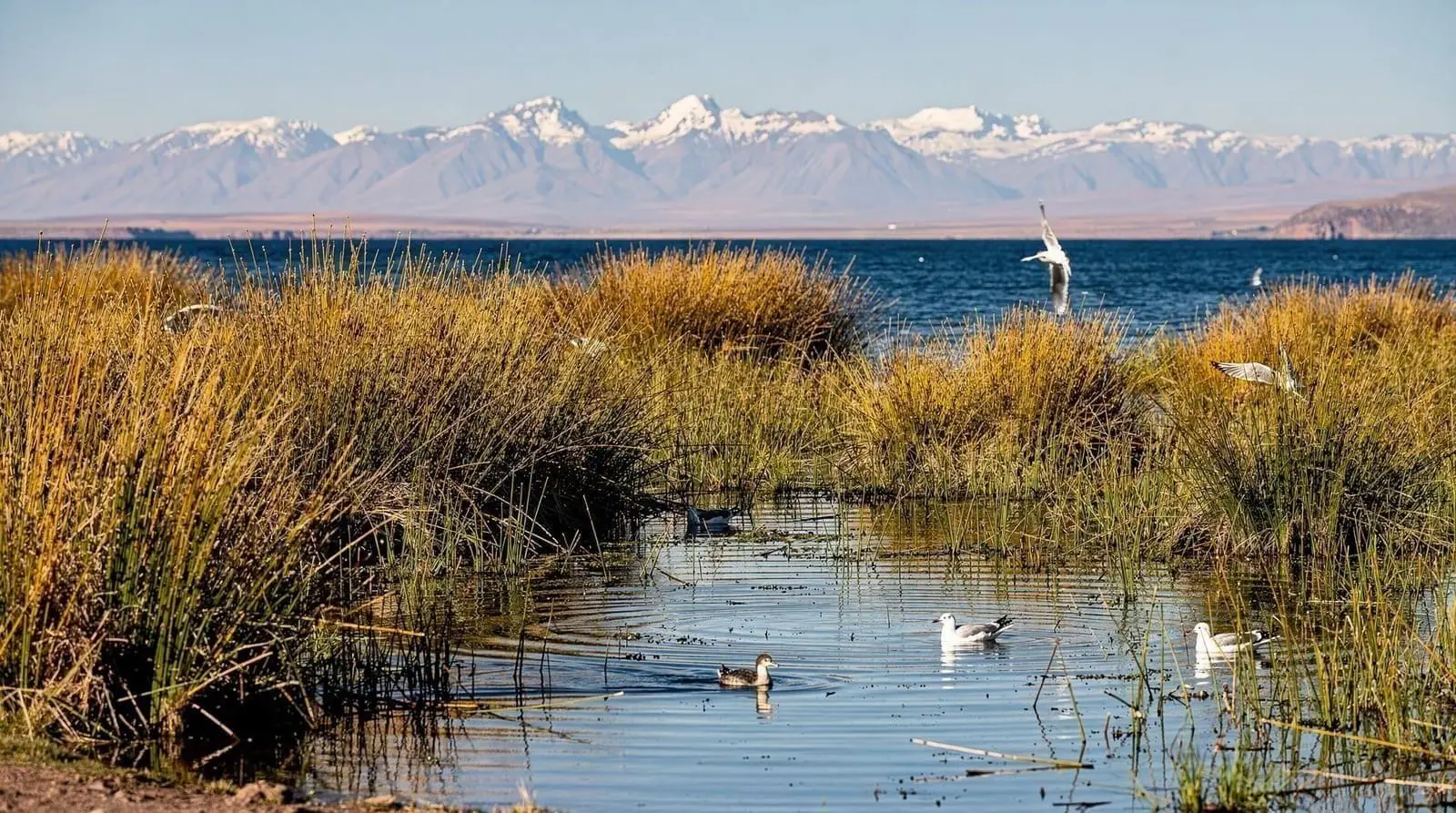
Lake Titicaca wildlife: birds, frogs and the high-altitude lake
Puno: Full-Day Tour of Lake Titicaca and Uros & Taquile
What wildlife can you see at Lake Titicaca?
Lake Titicaca shelters a remarkable set of high-altitude species, several found nowhere else: the flightless Titicaca grebe, the endangered Titicaca water frog, Andean gulls, Puna ibis, Chilean flamingos in the shallow bays, and migrating ducks among the totora reed beds. Early morning by boat through the reeds is the best time to see them.
A living lake most visitors never look at properly
Most people come to Lake Titicaca for the human story — the Uros families on their floating reed islands, the weavers of Taquile, the highest navigable lake in the world at 3,812 m. They photograph the islands, buy a textile, and motor back to Puno by lunchtime, never noticing that the water and reeds around them hold one of the strangest, most isolated ecosystems in South America.
That is a missed opportunity. Titicaca sits so high, so cold, and so cut off from other waters that evolution went its own way here. Several of its animals exist nowhere else on Earth — a flightless grebe, a giant aquatic frog, an endemic killifish. The reed beds are corridors for tens of thousands of waterbirds. If you slow down, take an early boat, and bring binoculars, the lake becomes a wildlife destination on a par with anything in the Andes. This guide is for travellers who want to see it that way.
| Where | reed channels near Puno, open water toward Taquile/Amantaní |
| Cost | included in standard boat tours, around $/tour varies |
| Time needed | half day standard, overnight for dawn/dusk windows |
| Getting there | boat from Puno, first departure ~6-7am |
| Best time | dry season (May-Sept) mornings for calmest water |
Why Titicaca’s wildlife is so unusual
Lake Titicaca formed in a high closed basin of the Altiplano, the vast plateau straddling Peru and Bolivia. For long stretches of geological time it had little connection to the rivers and lakes below, so the species trapped inside adapted to extreme conditions — thin air, near-freezing water, brutal UV — and diverged into forms found in this single basin. Biologists call this endemism, and Titicaca has it in abundance: dozens of endemic snails, several fish, the famous frog, and the grebe.
That isolation also makes the ecosystem fragile. Introduced trout and silverside have devastated native fish, gill nets drown grebes, and pollution from Puno’s growing shoreline stresses the whole system. Watching Titicaca’s wildlife is, unavoidably, watching a threatened place. That is part of why how you visit matters as much as what you see.
The headline species
The Titicaca water frog
The lake’s most famous animal is also its weirdest. The Titicaca water frog (Telmatobius culeus) lives its entire life underwater, never coming ashore, and breathes almost entirely through its skin — which hangs in extravagant baggy folds to maximise surface area for absorbing oxygen from the cold water. Those folds earned it the unkind nickname “scrotum frog.” It can exceed 30 cm with legs extended and is one of the largest exclusively aquatic frogs in the world.
It is also critically endangered, hit by harvesting for frog juice (sold as a folk tonic), pollution, and introduced predators. You are unlikely to see one casually from a tourist boat — they stay deep and rarely surface. But knowing it is down there, found nowhere else on the planet, changes how the lake feels. Some research-linked sites near Puno occasionally show captive specimens; avoid any operator who pulls wild frogs from the water for photographs.
The Titicaca grebe
The Titicaca grebe is a small, flightless diving bird with a rufous neck, restricted almost entirely to this lake. Flightlessness is the giveaway of long island-like isolation — it had no need to fly anywhere else. It hunts native fish by diving and tends to stay in open water near the reed margins. Endangered and declining, mainly because it drowns in fishing nets, a calm sighting from a boat is a quiet thrill rather than a guaranteed tick. Scan the open water just beyond the reed beds in the early morning.
Flamingos, ibis and the reed-bed birds
The shallow, marshy edges and connected lagoons host the more visible cast:
- Chilean flamingos wade the brackish shallows, especially in quieter bays and on the Bolivian shore — pink against the cobalt water, most active at dawn.
- Puna ibis, glossy dark birds with curved bills, probe the wet margins in flocks.
- Andean gulls and Andean lapwings patrol the open water and shoreline.
- Yellow-billed and speckled teal, Andean coots, and white-tufted grebes dabble and dive among the totora.
- Migrating ducks and waders pass through seasonally, swelling the numbers.
The dense totora reed beds are the engine of all this — nursery, larder and shelter. They are also, of course, the raw material of the Uros floating islands, which makes the relationship between people and habitat here unusually tangled.
Where and when to see it
When: Early morning is non-negotiable for serious watching. The first boats out of Puno, around 6 to 7 am, catch calm water, feeding birds, and soft light. By late morning the wind picks up, boat traffic increases, and the wildlife scatters. The dry season (May to September) gives the most settled mornings; see our best time to visit Peru guide for the wider seasonal picture.
Where: The reed channels between Puno and the Uros islands are the most accessible birding, threaded with grebes, coots and ducks. For a fuller wildlife day, the longer crossings toward Taquile and Amantaní pass through quieter water with better chances of open-lake species and flamingo bays. A standard guided day such as the full-day Lake Titicaca tour of Uros and Taquile gets you out onto the water and through the reeds, though its focus is cultural — tell your guide you want to watch birds and ask them to slow down through the reed channels.
For travellers prioritising wildlife and tranquillity over speed, an overnight option like the two-day Titicaca tour to Uros, Amantaní and Taquile puts you on the lake at dawn and dusk — the golden windows — instead of only in the busy midday hours. If your time is tight, the faster Uros and Taquile speedboat tour covers more water in less time, though the higher speed and engine noise make it less suited to careful watching.
Watching responsibly on a fragile lake
Because so much of Titicaca’s wildlife is endangered and endemic, your choices matter more here than at most destinations:
- Choose quiet operators. A boat that idles slowly through reed channels sees far more — and disturbs far less — than one that guns the engine for a tight schedule.
- Never reward frog handling. Walk away from any stop that produces a wild Titicaca frog for a photo. Demand for the spectacle drives the harvesting that is killing the species.
- Keep your distance from nesting birds in the reeds, especially flightless grebes and coots, which cannot easily escape a close boat.
- Don’t trample the totora. The reed beds are both habitat and the islanders’ livelihood. Stay on designated paths and platforms.
- Carry your rubbish out. Plastic and litter are a real and visible problem on the shoreline.
The single best thing you can do is travel slowly. The lake does not perform for a rushed half-day; it reveals itself to people who give it a calm early morning.
Pairing Titicaca wildlife with the rest of Peru
Lake Titicaca rewards travellers who already love high-altitude nature. If that is you, pair it with the Colca Canyon, where Andean condors ride the morning thermals — our Colca Canyon condors guide covers that experience. The scenic overland route from Cusco to Puno also passes wild Altiplano with vicuña and flamingo lagoons; see our Cusco to Puno transport guide for how to do it.
Together, condors at Colca, frogs and grebes at Titicaca, and vicuña on the high plains make a strong Andean-wildlife loop through southern Peru. Start with the Lake Titicaca destination page and Puno destination page to plan the logistics.
A practical kit list
At 3,812 m the conditions punish the unprepared. Bring:
- Binoculars — the single most useful item; 8x42 is ideal.
- A zoom lens if you photograph; birds rarely come close.
- Warm layers and a windproof jacket for the cold, exposed early-morning boat.
- Strong sunscreen, sunglasses and a hat — UV at this altitude over reflective water is fierce even when it feels cold.
- A field checklist or a bird app loaded offline; the Altiplano avifauna is distinctive and worth identifying.
Altitude itself is the quiet risk. Puno sits higher than Cusco, so arrive acclimatised. If you are coming straight up, read our notes on adjusting to elevation in the altitude sickness guide first.
The seasons of the lake
Titicaca’s wildlife shifts through the year, and timing your visit to the season as well as the time of day pays off. The dry season (May to September) brings the settled, windless mornings that make for the best boat-based watching, along with cold, crisp dawns and brilliant light over the water. This is the prime window for photography and for the calm conditions that let you drift quietly through the reed channels. The trade-off is that it is also the busiest tourist period, so the islands themselves are more crowded even if the open water is not.
The wet season (November to March) transforms the shoreline. Rain greens the Altiplano, the lagoons fill, and the marshy edges that flamingos, ibis and ducks favour expand — sometimes improving wetland birding even as it complicates boat trips. Afternoon storms are common, mornings are still the only reliable window, and the cold is less biting than in the dry season.
Migratory species pass through on their own schedules, swelling waterfowl numbers at the shoulders of the year. There is no single perfect month; the honest summary is dry season for calm water and reliable mornings, wet season for fuller wetlands and fewer crowds. Our best time to visit Peru guide sets this in the wider national context.
The Bolivian side and the wider basin
It is worth remembering that Lake Titicaca straddles a border — roughly the western and northern shores are Peruvian, the eastern and southern Bolivian. The wildlife does not recognise the line, and some of the quietest flamingo bays and richest shallows lie on the Bolivian side near Copacabana and the Isla del Sol.
Most travellers based in Puno stay on the Peruvian shore, which has plenty to offer, but anyone making a longer Andean loop that crosses into Bolivia can extend their lake wildlife considerably. The Peruvian shore’s strengths are the dense reed beds near Puno — superb for grebes, coots and ducks — and the open-water crossings toward Taquile and Amantaní where the endemic and open-lake species appear.
Beyond the main lake, the connected smaller waters and the surrounding Altiplano add to the picture. The wet meadows (bofedales) and lagoons of the high plains around Titicaca hold their own birdlife, and the overland approach from Cusco crosses country where you may spot vicuña, the wild ancestor of the alpaca, grazing the puna grasslands. Treating the whole journey as part of the wildlife experience — rather than just the boat trip — turns a single lake outing into a broader high-Andes nature trip.
How a wildlife-focused day differs from the standard tour
The typical Titicaca day tour is built around culture and pace: a quick run through the reeds to the Uros, a longer crossing to Taquile for lunch and a textile demonstration, and back to Puno by mid-afternoon. It is a fine introduction, but it is optimised for ticking off islands, not for watching animals. A wildlife-focused version of the same day looks different in a few deliberate ways.
First, you take the earliest possible departure, before the bulk of the boats and the rising wind. Second, you ask your skipper to idle slowly through the reed channels rather than power through them, pausing where birds are feeding. Third, you spend less energy on shopping stops and more on the open-water stretches and the marshy bays where grebes, flamingos and waterfowl concentrate. Fourth, you carry the right kit — binoculars and a long lens — and you accept that good wildlife watching is quiet and patient rather than busy.
None of this requires a specialist tour, though a naturalist guide helps if birds are your priority. It mostly requires choosing an operator willing to slow down and telling them clearly what you want. The reed beds and bays reward exactly the kind of unhurried attention that the standard island-hopping schedule discourages — which is why so many visitors leave Titicaca having seen the islands but not really the lake.
Building a wider high-Andes wildlife itinerary
Titicaca is one stop on what could be a genuinely rich high-altitude nature loop through southern Peru. The vicuña herds around Ausangate graze the puna grasslands at similar elevations to Titicaca’s shores — see the Ausangate trek guide and the Ausangate lakes day trip for how to combine trekking with sightings, and the Vinicunca vs Palccoyo vs Ausangate comparison if you are weighing which high-altitude area suits your schedule.
Add Colca Canyon’s condors — our Colca Canyon condors guide covers the morning viewpoint — and you have three distinct high-Andes wildlife experiences within a single southern Peru route, most efficiently sequenced through the 10-day Cusco and Titicaca itinerary.
Frequently asked questions about Lake Titicaca wildlife: birds, frogs and the high-altitude lake
Are there really giant frogs in Lake Titicaca?
Can you see flamingos at Lake Titicaca?
What is the best time of day for birdwatching on Titicaca?
Is the Titicaca grebe endangered?
Do the Uros floating islands harm the wildlife?
What should I bring for wildlife watching at Titicaca?
Can I combine Titicaca wildlife with other Andean nature sights?
Top experiences
Bookable activities with verified prices and instant confirmation on GetYourGuide.
