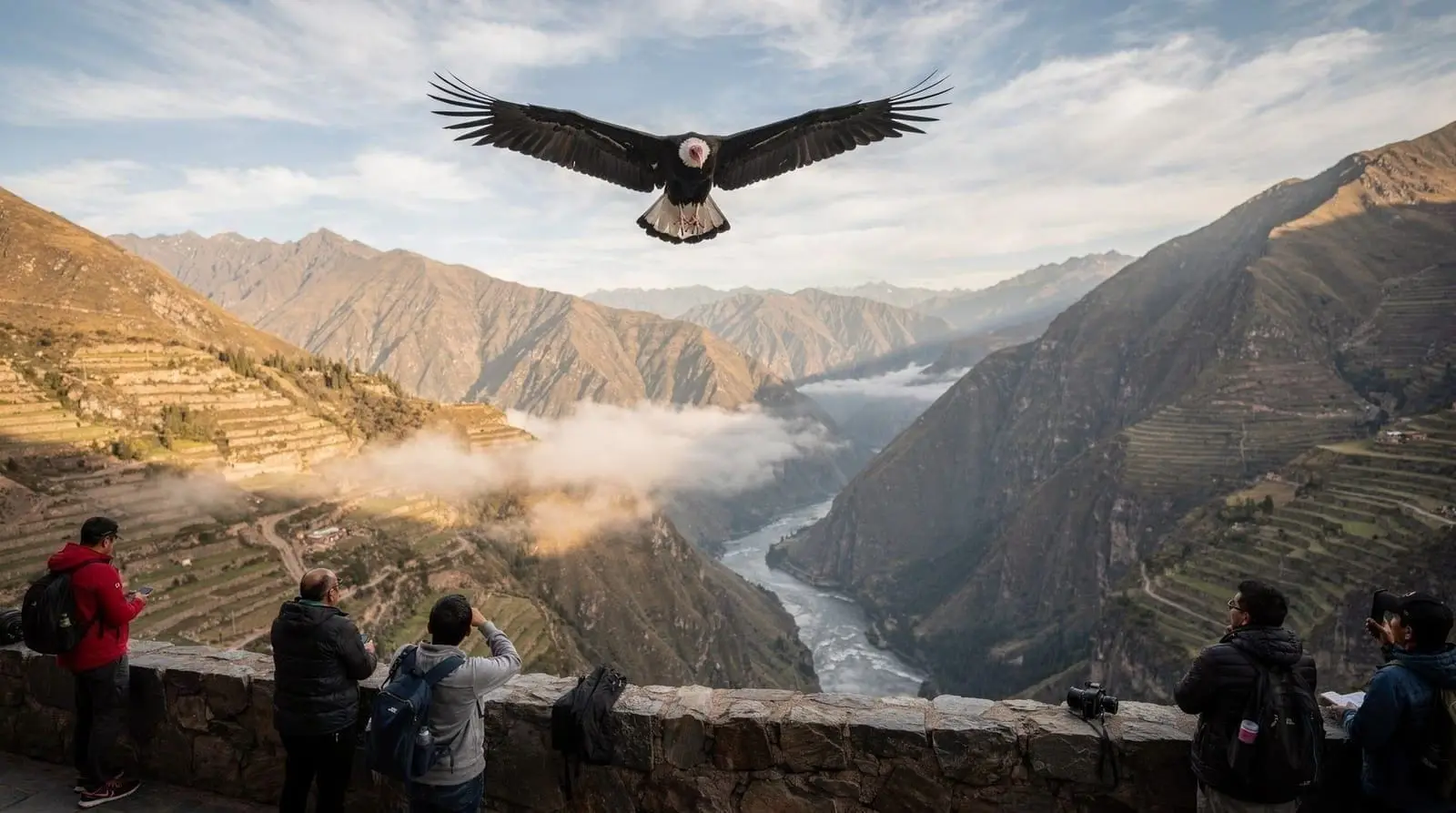
Colca Canyon condors: where, when, and how to actually see them
Full-Day Colca Canyon Tour from Arequipa
What is the best time to see condors at Colca Canyon?
Aim to be at the Cruz del Cóndor viewpoint between 8:00 and 9:30 a.m., when rising thermals lift the Andean condors out of the gorge. Sightings are most reliable from May to early December and far less certain in the wet months of January to March.
Why people drive through the night for a bird
The Andean condor is one of the largest flying birds on earth, with a wingspan that reaches 3.2 m (over 10 ft). It does not flap so much as it hangs, riding columns of warm air with barely a twitch of those enormous black-and-white wings. At Colca Canyon — one of the deepest gorges in the world, more than twice the depth of the Grand Canyon at its lowest point — the geography produces exactly the conditions condors need. The morning sun heats the canyon walls, thermals rise, and the birds lift out of their roosts on the cliffs to begin the day’s soaring.
That is the whole reason a steady stream of travellers sets an alarm for the small hours and endures a long, cold drive: to stand at a viewpoint called Cruz del Cóndor and watch these birds rise from below, sometimes passing within a few metres of the rim. When it works, it is genuinely one of the great wildlife moments in South America. When it does not — and it sometimes does not — you have spent a long morning looking at an empty gorge. This guide is about tilting the odds in your favour and being honest about what you can control and what you cannot.
| Where | Cruz del Cóndor, ~50 km / 1 hr past Chivay |
| Cost | S/70 boleto + around S/90-300 tour |
| Best window | 8:00-9:30 a.m., May-early December |
| Time needed | Full day (14-16 hrs) or 2 days/1 night |
| Getting there | Tour from Arequipa (own transport not recommended) |
The single most important fact: timing
Condor viewing is governed by thermals, and thermals are governed by the sun. The birds are inactive while the air is cold. As the morning warms, usually from around 8:00 a.m., the rising air lets them launch and soar; activity typically peaks between 8:00 and 9:30 a.m. and tapers off through late morning as the birds drift away to forage. There is sometimes a smaller late-afternoon window around 4:00 to 5:00 p.m., but the morning flight is by far the more reliable show.
This timing is why tours from Arequipa leave so absurdly early. A full-day round trip departs around 3:00 a.m. to cover the roughly 4 to 5 hours of mountain road and reach Cruz del Cóndor before the birds get going. If you stay overnight in Chivay or one of the Colca valley villages, you face a far gentler drive of about 90 minutes to two hours to the viewpoint, arriving rested rather than wrecked.
Where Cruz del Cóndor actually is
Cruz del Cóndor is a marked viewpoint on the canyon rim about 50 km (a touch over an hour by road) past Chivay, the main town of the Colca valley. It sits at roughly 3,700 m (12,140 ft), perched where the gorge plunges more than 1,000 m to the Colca river below. The viewpoint itself is a paved platform with railings, a small cluster of stalls selling alpaca knitwear and snacks, and — on a busy dry-season morning — a great many other people.
That last point matters. Cruz del Cóndor is no secret, and in high season (June to August) several tour buses arrive within the same hour, leaving the platform shoulder-to-shoulder. If you want a quieter experience, ask your guide about Mirador Achachiwa or other pullouts along the rim, where condors also pass and the crowd thins to a handful. Many full-day itineraries stop at one of these as well; if yours does not, it is a fair question to raise.
Day trip versus overnight: the honest trade-off
There are two basic ways to do Colca, and the difference is mostly about how much suffering you are willing to absorb.
The full-day trip leaves Arequipa around 3:00 a.m., reaches Cruz del Cóndor for the morning flight, stops at a viewpoint or two, sometimes adds the Chivay hot springs and a buffet lunch, and returns to Arequipa by evening — a 14 to 16 hour day, much of it on the road. It is cheaper and ticks the box in 24 hours, but you arrive at the canyon exhausted and at altitude, which is not a comfortable combination. The full-day Colca Canyon tour from Arequipa is the standard version of this, and it is fine if your schedule is genuinely tight.
The two-day trip spends a night in Chivay or a village like Yanque, which solves two problems at once: you sleep at altitude before the early canyon morning, and you reach the viewpoint after a short drive instead of an all-night marathon. The pace also leaves room for the terraced villages, the Patapampa pass with its view of volcanoes, and the thermal baths. The two-day classic Colca Canyon tour covers this comfortably. If you are heading onward to Lake Titicaca afterwards, the two-day Colca trek ending in Puno threads the canyon into the route so you do not double back to Arequipa.
The honest verdict: if you can spare the night, take the two-day option. The extra cost buys you a rested body, better acclimatisation, and a far higher chance of enjoying rather than enduring the morning.
Money: the boleto and what tours include
Colca has its own entrance ticket, the boleto turístico del Valle del Colca, and it is completely separate from the Cusco boleto turístico. For foreign visitors it costs S/70 (about $19); rates are lower for Andean Community nationals and Peruvians. The ticket is checked at a control point on the way into the valley, and it funds local conservation and infrastructure. Bring it in cash, in soles — card payment is unreliable at the booth.
What a tour price does and does not include varies, so read the fine print:
- Usually included: round-trip transport, a guide, and entry to the morning condor stop.
- Sometimes included: the S/70 boleto, breakfast, lunch (often a buffet in Chivay), and the Chivay hot-springs entry (around S/15 to S/20).
- Rarely included: tips, drinks, and any extra activities like a longer canyon hike.
A rock-bottom full-day quote often excludes the boleto and meals, so the real total creeps up. Ask exactly what is covered before booking, and budget the boleto on top unless the operator confirms it is included.
Acclimatisation: do not arrive straight from sea level
The road to Colca climbs high. The Patapampa pass (Mirador de los Volcanes) tops out at around 4,910 m (16,110 ft), higher than Cusco, higher than Rainbow Mountain’s trailhead, higher than most travellers have ever been. Even Chivay sits at about 3,630 m. If you fly into Arequipa (2,335 m) from the Peruvian coast and immediately bolt up to Colca, you are stacking a big altitude jump onto a sleep-deprived early start.
Give yourself at least a night or two in Arequipa first, drink water steadily, go easy on alcohol, and consider the same precautions you would for Cusco. The mate de coca handed out at the Patapampa stop helps mildly. If you have already acclimatised in the Andes — for instance after a Cusco-and-Sacred-Valley stretch — you will handle Colca far better. For the broader picture on adjusting, see the Cusco acclimatization plan and our notes on altitude versus the Sacred Valley.
What else the canyon offers
The condors are the headline, but the Colca valley rewards a slower look. The pre-Inca terraces stepping down the valley walls are still farmed today, some of the oldest continuously cultivated land in the Americas. The villages — Yanque, Maca, Pinchollo — keep colonial churches and a strong Collagua and Cabana identity, visible in the embroidered hats local women wear. The Chivay hot springs (La Calera) are a genuine pleasure after a cold morning, with thermal pools around 38°C.
For more active travellers, multi-day treks descend to the canyon floor and the oasis village of Sangalle, a green pocket with basic lodges and a swimming pool at the bottom of a punishing switchback trail. That is a serious hike at altitude and a different trip from the viewpoint day; do not assume a standard tour includes it.
Where Colca fits a Peru trip
Colca pairs naturally with Arequipa, the elegant white-volcanic-stone city that serves as its gateway, and it slots neatly between Arequipa and Lake Titicaca for travellers heading toward Puno and Bolivia. A common southern-Peru sequence runs Cusco and the Sacred Valley, then Puno and Titicaca, then Colca, and finally Arequipa before flying out — by which point you are thoroughly acclimatised and the canyon’s altitude is a non-issue. For routing ideas across the whole country, browse /itineraries/ and the two-week Peru itinerary guide.
Condor sighting odds by season
| Months | Weather | Sighting odds |
|---|---|---|
| May-early December (dry season) | Clear, cold mornings | Good to reliable |
| June-August | Clear but coldest, busiest | Good, most crowded |
| Late December-April (wet season) | Cloud, rain, fewer thermals | Poor to unpredictable |
| January-March | Heaviest rain | Weakest odds of the year |
The pattern is straightforward: thermals need sun, and the wet months simply produce less of it in the morning window that matters. If your trip dates fall in January to March, treat the condor sighting as a bonus rather than a certainty, and enjoy the terraces, villages, and hot springs regardless of what the sky does.
Frequently asked questions about Colca Canyon condors: where, when, and how to actually see them
Are condor sightings at Cruz del Cóndor guaranteed?
How much does it cost to visit Colca Canyon?
Is a day trip enough to see the condors?
How high is Cruz del Cóndor?
Can you see condors anywhere other than Cruz del Cóndor?
What months have the worst chance of condor sightings?
Do I need a guide, or can I drive to Cruz del Cóndor independently?
Top experiences
Bookable activities with verified prices and instant confirmation on GetYourGuide.

