El Brujo and the Lady of Cao
El Brujo archaeological complex near Trujillo and the tattooed Lady of Cao — a female Moche ruler. Museum, friezes, prices and how to visit.
Trujillo: El Brujo Complex Archaeological Tour
Quick facts
- Location
- ~60 km north of Trujillo, near Magdalena de Cao
- Civilisation
- Moche, with earlier and later layers
- Highlight
- Tomb of the Lady of Cao (discovered 2006)
- Time needed
- ~4 hours round-trip from Trujillo
The tomb that rewrote Moche history
For most of the twentieth century, archaeologists assumed Moche society was ruled by men — warrior-priests who presided over the sacrifices depicted on temple walls. Then, in 2006, a team excavating the Huaca Cao Viejo at the El Brujo complex opened an unlooted tomb and found the elaborately wrapped, remarkably preserved body of a young woman. She had been buried around 400 CE with war clubs, gold ornaments, spear throwers, and crowns — the trappings of power, not of a consort. Her forearms were tattooed with serpents and spiders. The Señora de Cao, the Lady of Cao, became one of the most important Peruvian discoveries since the Lord of Sipán, and the clearest evidence yet that women held political and religious authority among the Moche.
| Where | ~60 km north of Trujillo, near Magdalena de Cao |
| Time needed | ~4 hours round-trip from Trujillo (half day) |
| Cost | Around S/15 (USD 4), museum included |
| Getting there | Organised tour (easiest) or private taxi, ~S/120–180 round trip |
| Best time | May–November (cooler, drier coastal weather) |
El Brujo sits about 60 km north of Trujillo near the village of Magdalena de Cao, well off the standard Chan Chan day-trip loop. That distance keeps it quiet: you can often have the friezes and the excellent on-site museum largely to yourself. For travellers who have already seen the Huacas de Moche and Chan Chan and want one more layer of north-coast archaeology, this is the one to add.
What the El Brujo complex actually is
El Brujo (“the Wizard,” a name that long predates the modern excavations) is not a single monument but a ceremonial complex occupied across several thousand years. Three main structures sit on a low platform overlooking the Pacific:
- Huaca Prieta, the oldest, is a preceramic mound whose lower layers date back roughly 5,000 years — one of the earliest sites of monumental construction and cotton cultivation on the Peruvian coast.
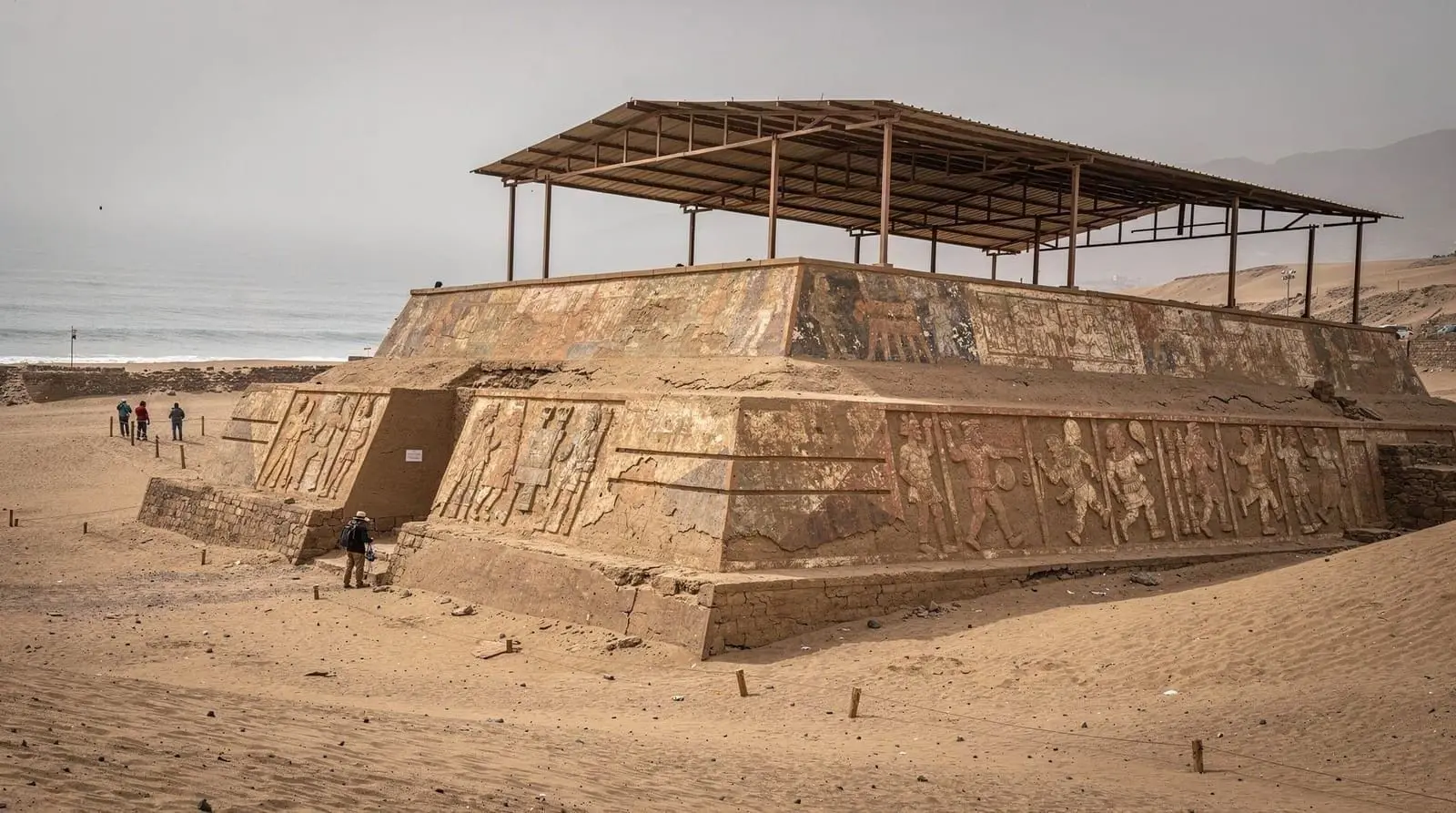
- Huaca Cao Viejo, the Moche temple, is the centrepiece. Its facade carries painted and relief friezes comparable to those at the Huaca de la Luna — files of warriors, bound prisoners, dancers, and the recurring decapitator deity — and it was inside this structure that the Lady of Cao was found.
- Huaca El Brujo itself is a third, less-excavated mound nearby.
The setting matters too. Cao Viejo stands almost on the edge of the ocean, and the wind, light, and sound of the surf give the visit an atmosphere the inland sites lack. Standing on the platform with the Pacific visible beyond the desert plain, it is easier here than at almost any other Moche site to picture the temple as its builders would have experienced it — a ceremonial centre facing the sea that sustained the civilisation through fishing and irrigation alike.
Cao Viejo follows the same building logic as the Huaca de la Luna at the Huacas de Moche: successive temples stacked on top of one another over centuries, each sealed inside the next, so that excavation peels back the layers like a ruined cake. The exposed facades show the familiar Moche register system — bands of figures climbing the wall — including dancers holding hands, files of bound captives, and the decapitator deity clutching a tumi knife and a severed head. Conservation here has been careful enough that substantial original colour survives, particularly reds and ochres, which makes the comparison with the better-known Luna friezes genuinely instructive.
A little Moche context
The Moche flourished along the northern Peruvian coast from roughly 100 to 800 CE, centuries before the Inca and entirely unconnected to them. They left no writing but recorded their world in astonishingly detailed ceramics and monumental adobe architecture, and they were skilled metallurgists and irrigation engineers who farmed the desert by channelling its rivers. Their religion centred on a cycle of warfare, ritual capture, and human sacrifice that is depicted again and again on temple walls and pottery — and, as the burials at the Huaca de la Luna and at Cao Viejo confirm, actually carried out.
What makes the Lady of Cao so significant is that she complicates the standard picture of who ran this society. The sacrificial iconography is dominated by male warrior-priests, and for decades the tombs that matched the imagery — most famously the Lord of Sipán near Chiclayo — were male. The discovery of a woman buried with comparable martial regalia forced a rethink: the Moche elite included powerful women, and authority on this coast was not a purely male affair.
Since 2006 archaeologists have identified further high-status female Moche burials elsewhere on the north coast, suggesting the Lady of Cao was not a singular anomaly but evidence of a genuine pattern of female rulership that the surviving iconography — created and controlled largely by men — simply failed to record. It is a useful reminder that monumental art tells you what a society wanted to project, not necessarily the whole truth of who held power.
The Lady of Cao and the Museo Cao
The Museo Cao, built into the site and opened in 2009, is the reason this trip rewards the extra driving. It is purpose-built, well-lit, and clearly explained, and it tells the story of the discovery alongside the objects recovered. The star exhibits are the funerary regalia — gold nose ornaments, a crown, the war clubs and spear throwers — and reconstructions of the elaborate textile bundle in which the body was wrapped.
The mummified remains of the Lady of Cao herself are displayed in a controlled environment, along with a facial reconstruction showing how she may have looked: a woman who died young, possibly in her twenties, perhaps from complications of childbirth given the evidence. Her tattoos, preserved on the skin, are visible in the displays. The museum does a good job of placing her in context without overstating the case, and it ranks among the best small archaeological museums in Peru.
The tattoos deserve a closer look. Both forearms and parts of her hands and feet were marked with serpents, spiders, and abstract designs in a dark pigment — imagery that overlaps with the supernatural figures painted on the temple walls she presided over. Whether the tattoos were marks of status, of religious office, or of something else entirely is still debated, but they are among the very few surviving examples of Moche body art and a haunting personal detail in what is otherwise a story told through gold and adobe.
The burial bundle in which she was wrapped contained more than twenty layers of cloth and a series of metal objects, and a sacrificed adolescent girl was interred alongside her, presumably as a companion in death — a chilling reminder of how power and sacrifice were intertwined in Moche belief.
Allow at least 45 minutes for the museum plus an hour for the Huaca Cao Viejo friezes and platform.
The museum’s design deliberately keeps the atmosphere subdued — low lighting, careful spacing between display cases — which makes it one of the more contemplative archaeological museums in Peru rather than a crowded showcase. Signage is in Spanish and English throughout, but a guide still adds considerably more than the panels alone, particularly around the symbolism of the tattoos and the burial goods.
Trujillo: El Brujo Complex Archaeological TourPractical information
Entrance and hours. El Brujo is open daily, typically from around 09:00 to 16:00 (last entry mid-afternoon); confirm locally, as opening can vary off-season. Entry for foreign adults runs in the region of S/15 (about USD 4), with the museum included. Bring small soles in cash — card payment is unreliable this far from the city.
Guides. As at the other Moche sites, a guide brings the friezes to life and is sometimes required for the temple circuit. English-speaking guides are scarcer here than at Chan Chan, so an organised tour with a guaranteed English guide is the surest way to get full value from the visit. If you do arrange your own Spanish-speaking guide on arrival, confirm they can walk you through the museum’s Lady of Cao exhibits as well as the outdoor friezes, since the two halves of the visit reward different kinds of explanation.
Conditions. The site is exposed, coastal, and windy, with strong sun and almost no shade. Hat, sunscreen, water, and closed shoes are sensible. There are basic facilities at the museum but few services in Magdalena de Cao itself, so bring what you need.
Photography. Photos are generally permitted at the outdoor Huaca Cao Viejo friezes, but the museum galleries housing the Lady of Cao’s remains and the most fragile textiles typically restrict flash or ban photography outright — follow the posted signage in each room rather than assuming the outdoor rules apply inside.
Is it worth the extra distance? An honest take. El Brujo is genuinely further and harder to reach than the Trujillo cluster, and if your time on the north coast is limited to a single day, the Huacas de Moche plus Chan Chan is the higher-priority pairing — they are closer, easier, and cover both major civilisations. El Brujo earns its place on a second day, or for travellers with a real interest in Moche history who want the human story of the Lady of Cao and a site they will likely have largely to themselves. If you only have time for one Moche temple, make it the Huaca de la Luna; if you have time for two, El Brujo is the rewarding addition.
Getting to El Brujo from Trujillo
This is the part that puts some people off, and the reason most visitors go with a tour. El Brujo lies roughly 60 km north of Trujillo near Magdalena de Cao, off the Panamericana, and there is no convenient direct public transport to the gate.
- Organised tour: The standard and easiest option. Half-day trips from Trujillo cover the round trip, the entrance, and an English guide, and typically run about 4 hours door to door. Some itineraries combine El Brujo with Huanchaco on the way back.
- Independent (combi + taxi): You can take a combi toward Chocope or Chicama on the Panamericana and then a local taxi or mototaxi the remaining distance to the site — workable for confident, Spanish-speaking travellers but fiddly and time-consuming.
- Private taxi for the day: Hiring a taxi from Trujillo for the round trip costs roughly S/120–180 (USD 32–48) depending on waiting time, and gives you flexibility on timing.
Cruise passengers sometimes reach El Brujo from the nearby port of Salaverry; dedicated shore-excursion tours pair it with Huanchaco.
| Option | Cost | Time | Best for |
|---|---|---|---|
| Organised half-day tour | Tour price + S/15 entry | ~4 hours | Most travellers; guaranteed English guide |
| Private taxi for the day | S/120–180 round trip + S/15 entry | ~4 hours, flexible | Small groups, flexible timing |
| Combi + local taxi | Cheapest, a few soles + taxi fare | Longer, less predictable | Confident Spanish speakers |
How El Brujo fits the north-coast story
El Brujo completes the Moche picture you start building at the Huacas de Moche. Both sites have painted temple friezes and the same iconography, but El Brujo adds the human story of an identified individual — and a powerful woman at that. Together with the Lord of Sipán near Chiclayo, the Lady of Cao forms the pair of great Moche royal tombs that transformed our understanding of who held power on this coast.
A logical two- to three-day north-coast circuit runs the Trujillo sites and El Brujo first, then continues to Chiclayo for Sipán and the Túcume pyramids. The Moche and Chimú civilisations guide sets out the chronology, and the northern Peru route guide suggests how to pace it without rushing.
Trujillo: The Sorcerer and the Lady of CaoFrequently asked questions about El Brujo and the Lady of Cao
Who was the Lady of Cao?
She was a high-status Moche woman, buried around 400 CE at the Huaca Cao Viejo with war clubs, gold regalia, and crowns — symbols of rulership previously assumed to belong only to men. Her tattooed remains, discovered in 2006, are among the best-preserved Moche bodies ever found and provided strong evidence that women held political and religious power in Moche society.
Is El Brujo worth visiting if I have already seen Chan Chan?
Yes, if you have the time and an interest in Moche history. Chan Chan is the much later Chimú capital, while El Brujo is a Moche (and older) ceremonial complex with painted friezes and the unique story of the Lady of Cao. The excellent Museo Cao and the near-empty site make it rewarding for those wanting to go beyond the headline ruins.
How do I get to El Brujo from Trujillo?
El Brujo is about 60 km north of Trujillo near Magdalena de Cao, with no convenient direct public transport. Most visitors take a half-day organised tour (around 4 hours round-trip) that includes transport and an English guide. Alternatives are a private taxi for the day (S/120–180) or a combi to Chocope/Chicama followed by a local taxi.
How much does it cost and how long does it take?
Entry for foreign adults is around S/15 (USD 4), including the Museo Cao; bring cash in small soles. Allow roughly 4 hours for the round trip from Trujillo, including about an hour and a half at the site and museum.
What else is at the El Brujo complex besides the Lady of Cao?
The complex spans thousands of years. Huaca Prieta is a preceramic mound up to 5,000 years old; Huaca Cao Viejo is the Moche temple with painted friezes where the Lady of Cao was found; and the on-site Museo Cao displays the tomb’s gold regalia, textiles, and the mummified remains themselves.
Is the Lady of Cao the same as the Lord of Sipán?
No, but they are closely related discoveries. Both were elite Moche burials that reshaped understanding of north-coast society. The Lord of Sipán was found near Chiclayo in 1987, and the Lady of Cao at El Brujo in 2006. Seeing both, along with the Huacas de Moche, gives the fullest picture of Moche power and ritual.
Top experiences
Bookable activities with verified prices and instant confirmation on GetYourGuide.

