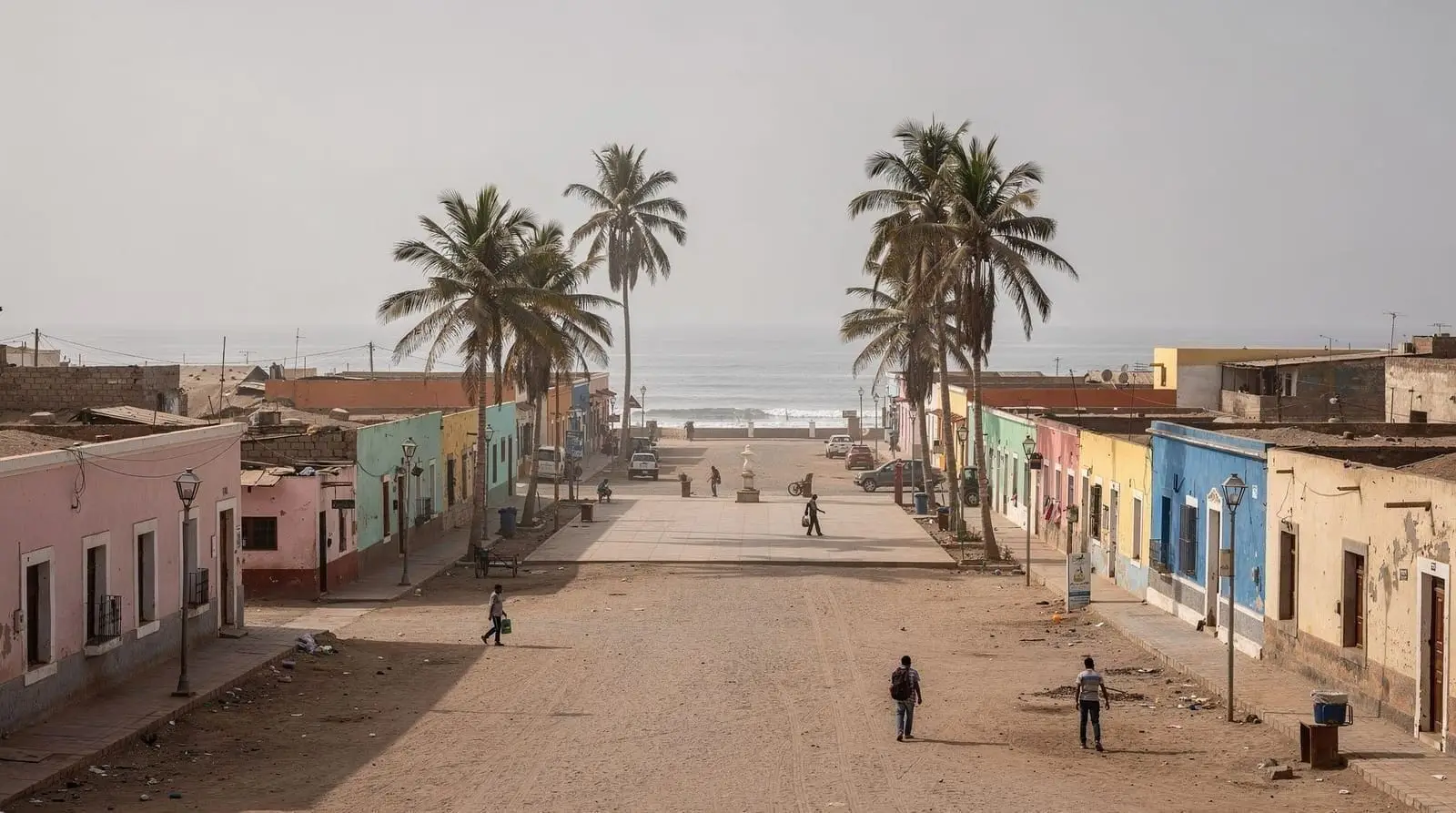
Pisco
An honest guide to Pisco on Peru's south coast — the 2007 earthquake, the San Andrés airport for Nazca flights, and why most travellers stay in Paracas.
Nazca Lines Flight from Pisco Airport
Quick facts
- Location
- South coast, ~230 km south of Lima
- Best for
- Transit hub, Nazca flights from San Andrés
- Nearest base
- Paracas, 15 minutes south
- Airport
- San Andrés (Capitán FAP Renán Elías Olivera)
- Note
- Heavily damaged in the 2007 earthquake
Pisco is a working coastal town about 230 km south of Lima that most travellers pass through rather than stay in, and it is worth being honest about why. It shares its name with Peru’s national grape brandy — though the spirit is distilled across the wider south coast, not only here — and it once had a handsome colonial plaza. Then, on 15 August 2007, a magnitude 8.0 earthquake struck just offshore and devastated the town, killing hundreds, flattening much of the centre and collapsing the San Clemente church during evening mass.
Pisco has rebuilt slowly and unevenly in the years since, and the result is a place that functions more as a transit hub and service town than a destination. That said, it has two genuinely useful roles for visitors: it is the cheaper, less polished neighbour of Paracas, and it has an airport from which you can fly over the Nazca Lines without trekking all the way south.
| Where | South coast, ~230 km south of Lima, 15 min from Paracas |
| Cost | Cheaper lodging than Paracas; Nazca flight ~$120–145 |
| Time needed | Transit stop or one night at most |
| Getting there | Bus from Lima (Cruz del Sur/Oltursa), ~3.5–4hrs |
| Best time | April–November, dry and calmer coast |
The 2007 earthquake and the town today
You cannot understand Pisco without the earthquake. The 2007 quake lasted nearly two minutes and reduced large parts of the town to rubble; the collapse of the San Clemente church on the Plaza de Armas, packed with worshippers, became the defining tragedy of the disaster. Reconstruction has been protracted, hampered by funding problems and the sheer scale of the damage, and even now you will see vacant lots, half-finished buildings and a plaza that has not fully recovered its former character.
This matters for travellers in two ways. First, it tempers expectations: Pisco is not a charming colonial showpiece, and arriving expecting one leads to disappointment. Second, it is part of why most independent travellers base themselves 15 minutes south in Paracas instead, where the seafront, restaurants and boat docks are concentrated. Pisco rewards a more practical kind of visit — understanding its recent history, using its transport links, sleeping cheaply — rather than sightseeing.
San Andrés airport and the Nazca flights
Pisco’s most useful asset for visitors is its airport, the Capitán FAP Renán Elías Olivera field in the neighbouring district of San Andrés. It is the most northerly departure point for flights over the Nazca Lines, which makes it a clever option if you are already on the upper south coast and want to see the geoglyphs without the long bus ride down to Nazca town.
Nazca Lines Flight from Pisco AirportThe trade-off is the same as for any northern departure: the flight from Pisco covers more distance to reach the figures than one from Nazca itself, so it costs more and takes longer in the air. But for travellers based in Pisco or Paracas on a tight schedule, the saving in ground travel — you skip three-plus hours of bus each way — often outweighs the higher fare. Fly in the morning when the desert air is stable, take motion-sickness medication beforehand, and expect possible weather delays, exactly as you would from any Nazca departure.
Pisco as a budget base for the Ballestas
The other practical reason to stop in Pisco is money. Accommodation here runs noticeably cheaper than in tourist-focused Paracas, so budget travellers sometimes sleep in Pisco and make the short hop south for the Ballestas Islands boat tour. A taxi from Pisco to the Paracas boat dock takes about 15 minutes and costs S/15–20; colectivos run the same route for a few soles if you are not in a hurry.
From Paracas: Ballestas Islands Boat Ride TourThe catch is the early start. The Ballestas boats leave in the early morning, so staying in Pisco means an earlier alarm and a taxi before dawn to make the first departures. For most people the convenience of sleeping in Paracas, a five-minute walk from the dock, is worth the higher room rate. If you are counting every sol, though, Pisco works.
Pisco vs Paracas as a base
| Pisco | Paracas | |
|---|---|---|
| Cost | Noticeably cheaper lodging | Higher, tourist-priced |
| Distance to Ballestas dock | 15 min taxi | 5 min walk |
| Atmosphere | Working town, still rebuilding | Seafront, restaurants, geared to visitors |
| Nazca flight access | San Andrés airport on-site | Same airport, 15 min transfer |
| Best for | Tight budgets, early flights | Almost everyone else |
For most travellers the extra room cost in Paracas is worth it simply for proximity to the boat dock and the better food options; the Paracas complete guide covers that side in depth. Pisco earns its keep mainly as a cheaper fallback or a genuine transit stop rather than a place to linger.
The pisco sour and the town’s namesake spirit
Despite lending its name to Peru’s national drink, Pisco town is not the centre of pisco production today — that distinction belongs to the bodegas around Ica, a short hop south, which offer proper tastings and tours. In Pisco itself you can still find decent pisco sours at ordinary local bars, generally cheaper than the tourist-priced versions in Paracas or Lima, though without the vineyard setting. If pisco tasting is a priority on your south-coast route, treat Pisco town as a curiosity and save the dedicated bodega visits for Ica, covered in the Ica vineyards and pisco guide and the pisco sour guide.
Getting there and moving on
Pisco sits just off the Panamericana Sur and is a standard stop on the long-distance bus routes between Lima and the south. Major lines such as Cruz del Sur and Oltursa serve Pisco from their Lima terminals, with the journey taking around three and a half to four hours. From Pisco’s bus terminals, onward connections fan out across the south coast:
- To Paracas: 15 minutes by taxi (S/15–20) or colectivo.
- To Ica and Huacachina: about an hour south by colectivo or bus.
- To Nazca: roughly three to three and a half hours further south, or simply fly the lines from San Andrés airport instead.
Because Pisco is a junction rather than an endpoint, many travellers only set foot here long enough to change vehicles. That is a perfectly reasonable way to treat it.
Where Pisco fits in a south-coast trip
In the classic Lima-to-Nazca desert circuit, Pisco is the gateway to the upper south coast — the point where you leave the Panamericana and head for the sea. Most itineraries treat it as a brief transit stop on the way to Paracas and the Ballestas Islands, then continue to the Ica wine valley, the Huacachina dune oasis, and finally the Nazca Lines. Its main strategic value is the San Andrés airport, which lets travellers on the upper coast see the geoglyphs without committing to the full southern leg.
For planning the full route, see the itineraries hub and the south-coast guides. To compare the Nazca flight departures and Ballestas packages, the tours hub lays them out side by side, and the broader things to do page covers the region’s activities.
Practical planning
Where to stay. Pisco has functional budget hostels and small hotels near the centre and the bus terminals. For anything more than a transit night, most travellers prefer Paracas. If you do stay, pick somewhere close to where your morning transport leaves from.
Eating. Being a fishing port, Pisco has decent, cheap ceviche away from the tourist mark-ups of Paracas. Look for cevicherías where locals eat at lunchtime, when the catch is freshest. As ever, avoid places quoting prices only in dollars.
Safety and feel. Pisco is an ordinary Peruvian working town; take the usual coastal-city precautions with bags and phones, especially around bus terminals. It is not a polished tourist enclave, which is part of its character.
Best months. April to November brings the driest, calmest weather on the coast. December to March is hotter and windier, with the paracas wind kicking up sand in the afternoons.
Frequently asked questions about Pisco
Is Pisco worth visiting?
As a destination in its own right, not especially — the 2007 earthquake erased much of its old charm and reconstruction is incomplete. Its value is practical: a budget base near the Ballestas Islands and an airport for Nazca Lines flights. Most travellers stay in nearby Paracas instead.
Can you fly over the Nazca Lines from Pisco?
Yes. San Andrés airport, just outside Pisco, is the most northerly departure point for Nazca overflights. It costs more and takes longer in the air than flying from Nazca itself, but it saves you the long bus journey south if you are based on the upper coast.
Should I stay in Pisco or Paracas?
Paracas is the better base for almost everyone — it is right by the Ballestas boat dock, has the seafront restaurants, and is geared to visitors. Stay in Pisco only if you are on a tight budget and don’t mind an early taxi to catch the morning boats.
What happened to Pisco in 2007?
A magnitude 8.0 earthquake struck offshore on 15 August 2007, killing hundreds, destroying much of the town centre and collapsing the San Clemente church during mass. Rebuilding has been slow, and the town still shows the damage in vacant lots and unfinished construction.
How do I get from Pisco to Paracas?
It is about 15 minutes by taxi (S/15–20) or a few soles by colectivo. The Ballestas boats leave Paracas early in the morning, so allow for a pre-dawn start if you sleep in Pisco.
Is the pisco brandy made in Pisco?
The spirit takes its name from the area but is distilled across the wider south coast, including the Ica valley, which has the best-known bodegas. You will find pisco and pisco sours everywhere on the coast, not only in the town itself.
Top experiences
Bookable activities with verified prices and instant confirmation on GetYourGuide.

