South Valley day trip: Tipón, Pikillacta and Andahuaylillas
Is the South Valley worth a day trip from Cusco?
Yes, if you want Inca and pre-Inca sites without crowds. The Valle Sur strings together Tipón's masterful Inca water terraces, the sprawling Wari city of Pikillacta, and the lavishly painted colonial church at Andahuaylillas, all within about 45 km of Cusco. Tipón and Pikillacta are on the boleto turístico; Andahuaylillas charges a small separate fee. It is a half- to full-day outing far quieter than the Sacred Valley.
The valley most visitors skip
Almost everyone who comes to Cusco pours northwest into the Sacred Valley — Pisac, Ollantaytambo, the train to Machu Picchu. Far fewer turn southeast, down the road toward Puno, into the Valle Sur. That asymmetry is the South Valley’s whole appeal: the same depth of Inca and pre-Inca history, a fraction of the crowds, and a trio of sites that together tell a wider story than the Sacred Valley alone. You get peak Inca hydraulic engineering at Tipón, a vast Wari city that predates the Incas by centuries at Pikillacta, and a colonial church at Andahuaylillas so densely painted it is nicknamed the Sistine Chapel of the Andes.
The loop covers roughly 45 km from Cusco and fits comfortably into a half to full day. This guide walks through each stop, the real entry logistics — including which sites the boleto turístico covers and which it does not — how to get there independently or on a tour, and where to eat the cuy the valley is famous for. The whole area is detailed at the South Valley destination page.
| Distance | ~25-40 km southeast of Cusco (Tipón/Pikillacta/Andahuaylillas) |
| Time needed | Half day (2 sites) to full day (all three plus lunch) |
| Cost | Tipón + Pikillacta on boleto turístico; Andahuaylillas ~S/15 cash |
| Getting there | Taxi/tour easiest; colectivo from Terminal Terrestre for budget |
| Best time | Morning for clear light, before afternoon rain in wet season |
Tipón: Inca water engineering at its finest
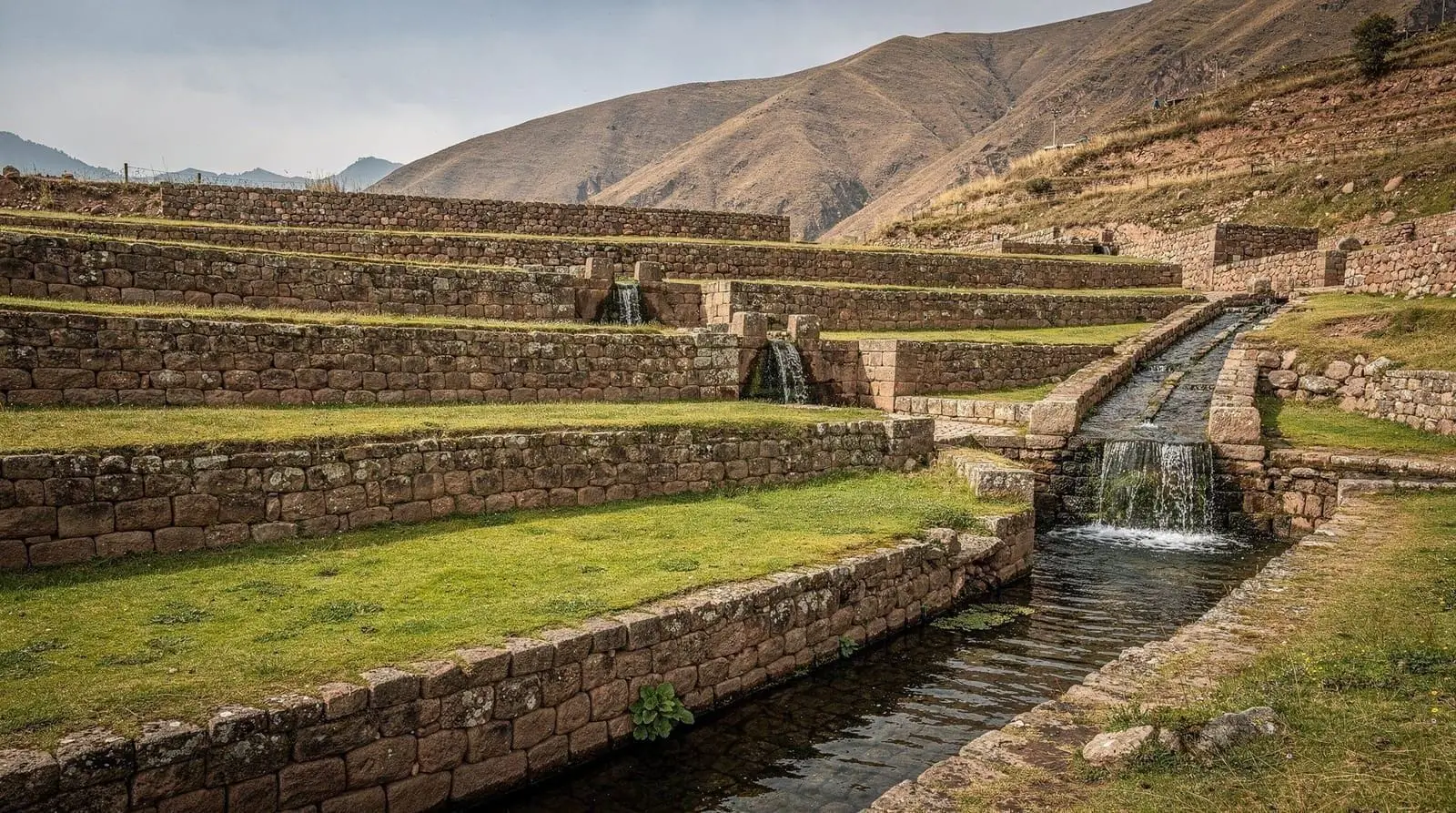
Tipón, about 25 km southeast of Cusco and a touch higher at around 3,560 m, is the quiet star of the South Valley. Where most Inca sites impress with the scale of their stonework, Tipón impresses with what the stone does: it channels water. A series of agricultural terraces is fed by a system of stone canals, fountains and aqueducts so precisely cut that they still run clear, centuries on, with the flow split and recombined across the slope in a way that has made the site a pilgrimage for engineers and archaeologists.
It was almost certainly a royal estate and a ceremonial water sanctuary rather than ordinary farmland — the craftsmanship is too fine, the water features too deliberate. Allow 60-90 minutes, and budget energy for the climb: the terraces ascend steeply, and at this altitude even a fit visitor will feel it. There is an upper sector and a long Inca canal that fewer people walk to, worth the extra effort if you have legs and lungs.
Tipón is included on the boleto turístico, so you do not buy a separate ticket here. The full boleto runs S/130 (about $35) and covers sixteen sites over ten days; if the South Valley is your main outing, check whether a partial circuit covers what you plan to see. The mechanics are laid out in the boleto turístico explained guide.
Pikillacta: the Wari city before the Incas
A few kilometres further on lies Pikillacta, and it resets your sense of Andean history. This is not an Inca site — it is Wari, built by the highland empire that dominated southern Peru from roughly 600 to 1000 CE, centuries before the Incas rose. Pikillacta was a planned administrative city, a rigid grid of hundreds of two- and three-storey rectangular buildings spread across some 50 hectares, its walls once plastered and, in places, white.
Walking it is a different experience from an Inca site: less spectacular masonry, but a startling sense of urban scale and order from a civilisation most visitors have never heard of. The geometric precision of the layout — long straight streets, repeated identical compounds — is the point. Nearby, the Wari also built the Rumicolca gate, a massive wall straddling the valley that the Incas later reused, a neat illustration of how each Andean culture built on the last.
Pikillacta is also on the boleto turístico, covered by the same ticket as Tipón. It sees a fraction of the foot traffic of any Sacred Valley ruin, so you will often have stretches of the ancient grid to yourself. For broader context on how these sites fit together, see the Cusco archaeological sites overview.
Andahuaylillas: the Sistine Chapel of the Andes
The third stop changes register entirely. The town of Andahuaylillas, about 40 km from Cusco, holds the modest-looking 16th- and 17th-century church of San Pedro Apóstol — plain adobe outside, overwhelming within. Almost every interior surface is painted: a gilded baroque ceiling, walls of murals, an early colonial organ, and inscriptions in Spanish, Latin, Quechua, Aymara and Puquina that record the Jesuit project of evangelising the Andes in their own languages. The nickname “Sistine Chapel of the Andes” is tourist-board hyperbole, but the density and quality of the painting genuinely justify the stop.
Critically, Andahuaylillas is not on the boleto turístico. It charges its own entry of roughly S/15, payable in cash, and the fee supports the church’s conservation. Photography is usually restricted inside to protect the pigments. If you have appetite for more, the nearby churches at Huaro and the Templo de Canincunca form a “baroque route” of similarly painted Andean interiors, each with a small separate fee.
Getting there: tour, taxi or public transport
You have three realistic ways to do the South Valley, and the right one depends on your budget and patience.
On a guided tour is the simplest. The South Valley is a less common itinerary than the Sacred Valley, so it is not always offered as a daily group departure, but Cusco operators run it and it removes all the timing and ticket logistics. Browse current options on the tours hub; if a dedicated South Valley group tour is not running on your dates, a half-day private trip with a driver-guide is the usual alternative.
By hired taxi gives you control and is excellent value split between two to four people. A round trip from Cusco taking in Tipón, Pikillacta and Andahuaylillas, with the driver waiting at each, typically runs S/120-200 for the car depending on negotiation and waiting time. Agree the full route and the wait time before you set off, and pay in soles. Fare-setting tips are in the Cusco taxi and money tips guide.
By public transport is the cheapest and slowest. Colectivos and buses bound for Urcos depart from near Cusco’s Terminal Terrestre and drop passengers on the main road below each site for a few soles. From the road you walk or take a mototaxi up to Tipón (a notable climb) and into Andahuaylillas, and flag the next passing colectivo to move on. It works for unhurried independent travellers but eats the day; most people are happier in a taxi.
A scheduling note: because Tipón sits slightly above Cusco and involves an uphill walk, save the South Valley for your second or third day rather than your arrival day, once you have begun to acclimatise. The reasoning is the same as for any high site around Cusco — see the altitude sickness guide.
Eating in the valley: cuy at Tipón
Tipón village, below the ruins, is the cuy capital of the Cusco region. A cluster of family-run quintas serves cuy al horno — guinea pig roasted whole in a wood oven — and this is where Cusqueño families drive out at weekends to eat it. A whole cuy runs roughly S/45-70, often served with potatoes and stuffed with herbs, and the setting is far more authentic and better value than the tourist restaurants ringing Cusco’s Plaza de Armas. Order on arrival, as it takes time to roast. If cuy is not for you, the same quintas do roast pork and trout. There is more on the dish and its cultural weight in cuy and Andean food.
Adding the baroque route and Huaro
If a single church whets your appetite, the South Valley quietly offers more of the same. Andahuaylillas is the headline of what local guides call the Ruta del Barroco Andino — the Andean Baroque Route — a string of modest 16th- and 17th-century churches whose plain exteriors hide extravagantly painted interiors. The nearby village of Huaro holds the church of San Juan Bautista, its walls covered in unsettling murals of heaven and hell painted by the indigenous master Tadeo Escalante, a darker and stranger counterpoint to Andahuaylillas. A short way on, the small Templo de Canincunca sits above a lagoon with its own painted ceiling.
Each charges a small separate fee, none is on the boleto turístico, and together they make the South Valley as much a colonial-art outing as an archaeological one. Most travellers do not have time for all three churches plus Tipón and Pikillacta in a half day, so if the painted interiors interest you more than the ruins, weight the day toward the baroque route and treat the Inca and Wari sites as quick stops. If the ruins are your priority, see Andahuaylillas and skip Huaro and Canincunca for another trip.
Practicalities: timing, weather and what to bring
The South Valley is an all-year outing, but the experience shifts with the seasons. The dry months of May to September give clear skies and dusty roads; the wet season of November to March turns the valley greener but brings afternoon downpours that can make Tipón’s terraces slippery and the church visits a welcome dry refuge. Mornings are generally clearest in either season, so an early start pays off — it also gets you to Tipón’s quintas in time for a long lunch.
Bring cash in soles: the boleto covers Tipón and Pikillacta, but Andahuaylillas and the other churches take cash at the door, and Tipón village’s cuy quintas rarely take cards. Pack sun protection and water for the exposed walk up Tipón’s terraces, and a light layer for the churches, which stay cool. There is little in the way of formal facilities at Pikillacta, so use the toilets in Tipón or Andahuaylillas village. Photography is restricted inside the painted churches to protect the pigments, so plan to simply look rather than shoot there.
How the South Valley fits your Cusco days
The South Valley pairs naturally with the rest of a Cusco trip. It is an ideal acclimatisation-friendly outing for day two or three, before the bigger exertions of Rainbow Mountain or a trek, and it complements rather than duplicates the Sacred Valley circuit to the northwest. Travellers heading on to Puno and Lake Titicaca can even fold Tipón and Pikillacta into the start of the overland journey, since they sit on the same road. For the full menu of outings from the city, see best day trips from Cusco.
South Valley vs the other big Cusco day trips
If you are choosing between day trips rather than doing all of them, it helps to know how the South Valley stacks up. The Sacred Valley has the marquee Inca sites (Pisac, Ollantaytambo) and is the busier, more photographed circuit; Rainbow Mountain is a full-day high-altitude push for the famous striped peak; the South Valley is quieter, shorter, and mixes Inca, Wari and colonial history in one loop.
Travellers with only one spare day usually pick the Sacred Valley or Rainbow Mountain first and save the South Valley for a second or third day trip, once they want variety over another headline sight. See best day trips from Cusco for the full comparison across all the options.
A realistic half-day version if time is short
If a full day is not available, a tighter half-day version still works: Tipón alone, or Tipón plus Pikillacta, can be done in about three to four hours round trip by taxi, skipping Andahuaylillas and the baroque churches. This suits travellers squeezing the South Valley in around a Sacred Valley trip or a Machu Picchu departure, at the cost of missing the painted church that many visitors rate as the most memorable single stop. If you can only pick one site on a tight schedule, Tipón rewards the effort most — its water engineering is unlike anything else near Cusco, and it is included on the boleto turístico you likely already hold.