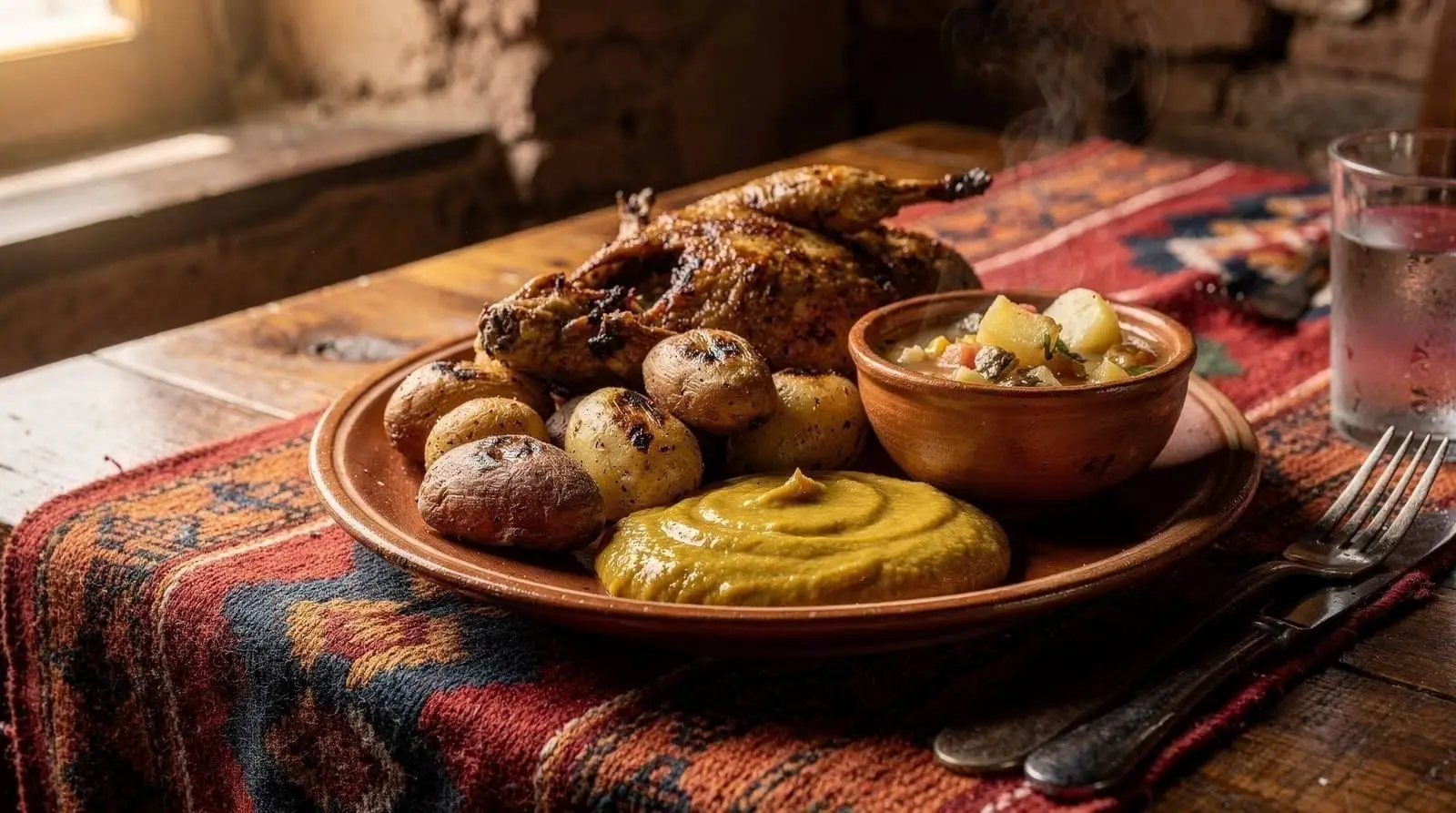
Cuy and Andean food: an honest eater's guide to highland Peru
Cusco: San Pedro Market and Peruvian Cooking Class
What is cuy and should I try it?
Cuy is roasted or fried guinea pig, a ceremonial Andean dish eaten in Peru for thousands of years. It tastes like rich, gamey dark poultry with crisp skin and little meat for the price (S/45–70 whole). Try it once for the experience, but order ahead and set expectations: it is bony, not a value meal.
Eating in the Andes on its own terms
Highland Peruvian food makes more sense once you understand the conditions that produced it. The Andes are cold, high, and dry, and for millennia people fed themselves on what survives at 3,000-plus metres: dozens of varieties of potato, hardy grains like quinoa and kiwicha, freeze-dried tubers (chuño), and the small animals that could be raised in a courtyard — chief among them the guinea pig. This is peasant and ceremonial cooking, built for fuel and feast days, and it eats very differently from the celebrated coastal seafood that made Lima famous.
That difference catches travellers out. Someone who has read about Peru being a top food destination arrives in Cusco expecting ceviche on every corner and instead finds soups, roasts, and potatoes. Both Perus are real; they are just different cuisines shaped by altitude and the sea. This guide is about the highland one — what cuy actually is, what else is worth ordering, what things cost in soles, and where the tourist traps hide.
| Signature dish | Cuy (roast guinea pig), S/45–70 whole |
| Best value | Set-lunch menú, S/10–18 |
| Where to learn it | Market-to-table cooking class in Cusco |
| Vegetarian-friendly? | Limited — ask for quinoa/potato dishes |
| Safest cheap eats | Busy stalls inside San Pedro market |
Cuy: the famous dish, honestly assessed
What it is and where it comes from
Cuy is guinea pig, domesticated in the Andes for more than 5,000 years and still raised in kitchens across the highlands. It is not a novelty laid on for tourists; it is a genuine ceremonial dish, served at weddings, festivals, and family celebrations, and rich in cultural meaning. You will see it on the famous colonial painting of the Last Supper in Cusco Cathedral, where the disciples are gathered around a roasted cuy — a small act of Andean appropriation of a European scene.
It comes two main ways: cuy al horno (roasted whole) and cuy chactado (flattened and fried under a stone until the skin crackles). Both are typically served whole, sometimes with the head and feet attached, which is the moment many first-timers blink.
What it actually tastes like — and the honest verdict
The flavour is good: rich, gamey, somewhere between dark chicken and rabbit, with genuinely excellent crisp skin. The problem is the ratio. There is very little meat on a guinea pig relative to the bone, so you work hard with your fingers for modest reward, and at S/45–70 ($12–19) for a whole one it is among the worst-value dishes in the highlands by weight of meat.
So the honest advice: try it once, for the experience and the tradition, not because it is a great meal. Order it ahead — it takes 30–45 minutes to prepare and many places need notice. Share it between two. And if you find the whole-animal presentation hard, ask whether they will plate it portioned. Restaurants like Pacha Papa in San Blas do a respectable clay-oven version in a pleasant courtyard; village restaurants in Tipón, south of Cusco, are locally famous for cuy if you want it where Cusqueños go for it.
What else to eat in the highlands
Cuy gets the headlines, but the everyday highland table is where the real eating is — and most of it is cheaper and more satisfying.
Alpaca
Lean, dark, faintly sweet red meat, lower in fat than beef and increasingly common on menus as alpaca steak (S/30–45) or in stir-fries. It is the easiest “exotic” Andean protein to enjoy, with none of cuy’s awkwardness. Cooked rare to medium it is genuinely good.
The soups
Highland cooking lives in its soups, and they are the warming antidote to cold Cusco nights. Caldo de gallina (hen broth with noodles and a quarter chicken) is the classic restorative, S/8–14 and a meal in itself. Chairo is a thick, hearty soup of meat, vegetables, and chuño. A bowl of soup is also the gentlest thing to eat while your appetite is still flattened by the altitude — a real concern your first day or two, as the altitude sickness in Cusco guide explains.
Potatoes, corn, and the staples
Peru grows thousands of potato varieties, and the highlands are where you meet them: purple, yellow, waxy, floury, freeze-dried. Papa a la huancaína (boiled potato in a creamy, mildly spicy cheese-and-ají sauce) is a standard starter. Choclo con queso — a cob of giant-kernelled Andean corn with a slab of fresh cheese — is the iconic Sacred Valley snack, sold at viewpoints for a few soles. Rocoto relleno, a stuffed spicy pepper, brings the heat.
The crossover dishes
Some Peruvian staples appear everywhere, highlands included. Lomo saltado — beef stir-fried with onion, tomato, and chips in a soy-spiked sauce — is the national comfort dish and reliably good. Chicharrón (fried pork) and anticuchos (grilled beef-heart skewers, better than they sound) round out the savoury everyday eating.
For the full national picture, including the coastal seafood and the dishes you will meet in Lima, see the broader Peruvian food guide.
Where and how to eat well, cheaply
The set-lunch menú
The single best value in the highlands is the almuerzo menú — a fixed lunch of soup, a main, and a drink for S/10–18 in everyday restaurants a block or two off the Plaza de Armas. This is how locals eat midday, and it consistently beats the touristed plaza restaurants on both price and honesty.
San Pedro market
San Pedro market is the cheapest sit-down eating in the centre and a crash course in the ingredients. The juice stalls blend fresh frutado combinations for S/6–10; the cooked-food counters do a caldo or a plate of the day for S/8–12. Pick a stall with high turnover and food cooked in front of you. It is also the best place to start understanding what is on every menu afterwards.
Reading a Cusco menu with confidence
A first-timer’s menu in Cusco can look like a wall of unfamiliar words, but a handful of terms cover most of it: saltado means stir-fried (as in lomo saltado); relleno means stuffed (rocoto relleno); a la huancaína signals the creamy cheese-and-ají sauce; chactado or al horno describes how cuy is prepared; and novoandina flags a modern, higher-priced reinterpretation rather than a traditional plate. Spotting these words lets you predict roughly what is coming and what it will cost, even in a restaurant with no English menu.
Novoandina, if you want to splurge
At the other end, Cusco’s ambitious kitchens reinterpret highland ingredients with modern technique — the novoandina movement. Chicha por Gastón Acurio brings the famous chef’s regional Cusqueño cooking to a handsome space near the plaza (S/60–110 a head); Cicciolina and MAP Café are long-running favourites. These are real splurges, not traps, as long as you go in expecting tasting-menu prices.
Learn it by cooking it
The most useful food half-day in Cusco, especially early in your stay, is a market-to-table cooking class. You learn what the unfamiliar tubers, grains, and ajís actually are before you cook a few dishes yourself, which makes every subsequent menu legible. The San Pedro market tour and Peruvian cooking class pairs a guided walk through the market stalls with hands-on cooking, so you connect the raw ingredient to the finished plate.
If you would rather skip the market and go straight to the kitchen, the three-hour Peruvian cooking class in Cusco is a tighter, cooking-focused option. Either one is a better introduction to Andean food than reading a menu and guessing.
The tourist traps to sidestep
Honesty means naming the cons:
- Plaza balcony pricing. The restaurants on the arcades around the Plaza de Armas charge roughly double for the view. Walk one block off the square and prices halve for the same dishes.
- The “free” chocolate or pisco workshop. Touts hand out flyers for free tasting workshops that turn into hard-sell shopping stops. The ChocoMuseo on Calle Garcilaso is a legitimate, transparent operation; treat unsolicited street offers with suspicion.
- Cuy as a value meal. Anywhere advertising a cheap cuy “menu” is likely cutting the portion to a sliver. Real cuy costs what it costs; a suspiciously cheap one is barely a taste.
- Tour-bundled buffet lunches. Sacred Valley and city tours often include a buffet at an inflated per-head rate. The food is rarely the highlight; if you can, eat where the locals do instead.
Drinks of the highlands
Eating in the Andes comes with its own drinks worth knowing. Chicha morada is the ubiquitous non-alcoholic one — a deep-purple sweet drink boiled from dark corn with pineapple, cinnamon, and clove, served everywhere and safe to order with confidence. Its cousin chicha de jora, a lightly fermented corn beer, is the ancient ceremonial drink of the Andes; you will spot rural homes selling it under a red plastic bag or flower on a pole, and it is an acquired, sour taste best sampled with curiosity rather than thirst.
The famous cocktail is the pisco sour — pisco grape brandy shaken with lime, syrup, egg white, and bitters — but a word of altitude caution: alcohol hits harder at 3,400 m, and a celebratory pisco sour on your first night in Cusco is a classic way to compound the headache of acclimatising. Save it for a day or two in. Mate de coca, the coca-leaf tea offered free in hotel lobbies, is the everyday highland drink; it helps mildly with altitude symptoms and is legal and normal in Peru, though it can trigger a positive drug test for cocaine metabolites for a few days afterwards. Coffee lovers will find Peru grows excellent beans, increasingly served as proper espresso in Cusco’s better cafés rather than the old instant-Nescafé default.
A note on the altitude and your appetite
One thing nobody warns you about: the altitude flattens your appetite, sometimes for the first couple of days. Dishes you would normally devour suddenly feel like too much, and that is entirely normal — the body diverts energy to adjusting and digestion takes a back seat. This is precisely why the soup-forward, light-eating advice for arrival matters as much for enjoyment as for health. Forcing down a heavy cuy dinner on your first night, when your stomach is already unsettled by the elevation, is the surest way to put yourself off the dish for life.
The practical sequence is to lean on broths, juices, and the lighter set-lunch menús while you acclimatise, then ramp up to the bigger plates — the alpaca steaks, the cuy, the novoandina tasting menus — once your appetite returns, usually by day two or three. The altitude sickness in Cusco guide covers why this happens and how to manage it, and the best time to visit Cusco guide notes which seasons bring the best market produce.
How food fits your Cusco days
Plan your eating around the altitude and your itinerary. Eat light and soup-forward for the first day or two while you acclimatise; save the cuy and the big novoandina dinners for once your appetite returns. Use the San Pedro market and the set-lunch menús for honest, cheap fuel between sightseeing, and treat one cooking class or one splurge dinner as a deliberate cultural highlight rather than an everyday cost. For when to come for the best market produce and festival food, the best time to visit Cusco guide lays out the seasons.
Vegetarians, tipping, and other practicalities
Highland cooking is meat-heavy by tradition, but vegetarians eat reasonably well if they ask specifically. Papa a la huancaína, choclo con queso, quinoa soups, and plain rice-and-vegetable versions of the set menú are usually available if you ask the kitchen to leave out the meat; novoandina restaurants are generally better at accommodating this than budget market stalls, which often cook a single meat-based broth for the day. Vegans have a harder time, since cheese and eggs appear everywhere, so confirm ingredients rather than assume.
Tipping is not automatic in Cusco the way it is in North America: a service charge is sometimes already added at nicer restaurants (check the bill), and where it is not, 10% for good service is generous and appreciated rather than expected. Market stalls and set-lunch menús are not tipped. Water safety is worth restating plainly: stick to bottled or boiled water and skip ice from uncertain sources for your first few days, since a stomach upset on top of altitude adjustment is a miserable combination.
Frequently asked questions about Cuy and Andean food: an honest eater's guide to highland Peru
What does cuy taste like?
How much does cuy cost in Cusco?
Is Andean food spicy?
What should I eat in Cusco besides cuy?
Is street and market food safe in Cusco?
What is novoandina cuisine?
Are there vegetarian options for Andean food?
Do you tip in Cusco restaurants?
Top experiences
Bookable activities with verified prices and instant confirmation on GetYourGuide.
