Luxury Cusco guide: the best hotels, tables and private experiences
From Cusco: Sacred Valley VIP Full-Day Group Tour
What does a luxury trip to Cusco involve?
Luxury in Cusco means restored colonial and convent hotels like Belmond Monasterio, Palacio del Inka and Inkaterra La Casona; oxygen-enriched rooms to soften the 3,400 m altitude; fine novoandina dining; private guided days in the Sacred Valley and at Machu Picchu; and the Hiram Bingham luxury train. Spend wisely — some upgrades transform the trip, others are pure markup.
Spending well, not just spending more
Cusco does luxury unusually well because it has the raw material for it: 500-year-old convents and colonial mansions converted into hotels, a serious fine-dining scene built on Andean ingredients, and a landscape that rewards private, well-paced touring. But it is also a place where premium spending can be wasted — on markups that add convenience without real value, or on “VIP” experiences that are barely different from the standard ones at twice the price.
This guide is for travellers with the budget to travel comfortably and the sense to want it spent well. It covers the hotels actually worth the rate, where fine dining delivers, which private experiences justify the premium, and — just as important — where the markup is hollow. It is written in the same honest spirit as the rest of this site: luxury should buy you genuine quality, smoother altitude, and time, not just a higher invoice. For the budget end of the spectrum, see our Cusco on a budget guide and Peru trip cost guide.
| Hotels | $400-900+/night (Belmond, Inkaterra, Palacio del Inka) |
| Private guide + vehicle | around $200-400/day |
| Hiram Bingham train | several hundred USD each way |
| Best base first | Sacred Valley (lower altitude) before Cusco |
| Book ahead | Months for Sanctuary Lodge, Hiram Bingham, June-August |
The hotels that earn their rate
Cusco’s best hotels share a theme: they occupy historic buildings in or near the historic centre, and the good ones address altitude directly.
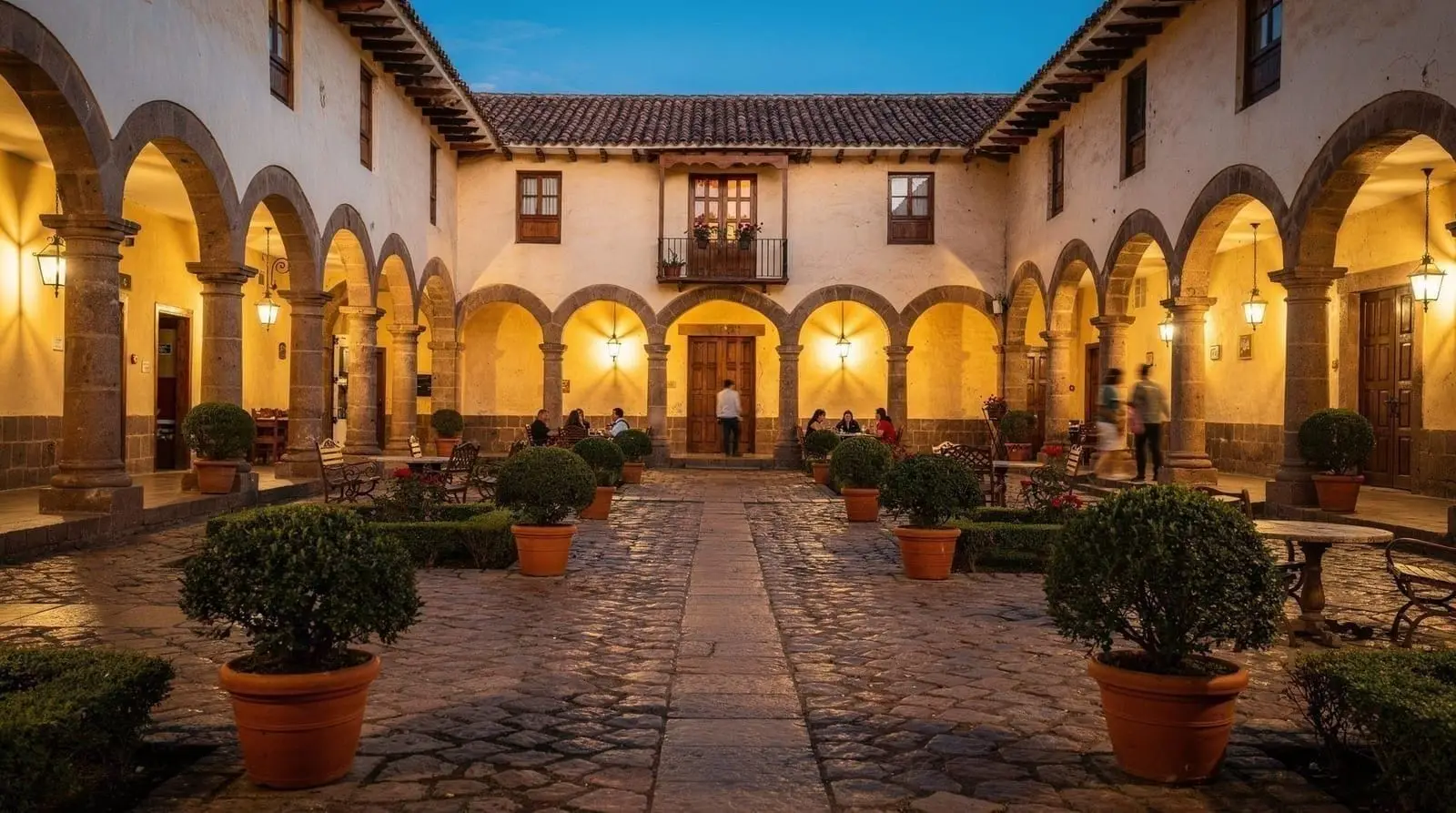
Belmond Hotel Monasterio. A 16th-century seminary built around a stone courtyard with a 300-year-old cedar tree, beside the Plaza de Armas. Its signature feature is enriched-oxygen rooms that lower the effective altitude as you sleep — a genuinely useful luxury at 3,400 m, not a gimmick. This is the classic grande dame of Cusco.
Belmond Palacio Nazarenas. The Monasterio’s quieter, all-suite sibling next door — a former convent and palace, the only hotel pool in central Cusco, butler service, and the same oxygen system. The more contemporary, intimate choice.
Inkaterra La Casona. A small Relais & Châteaux property in a restored 16th-century manor on a private courtyard, with just a handful of suites, fireplaces and heated floors. The most boutique and personal of the top tier.
Palacio del Inka, a Luxury Collection Hotel. Across from Qorikancha, a converted colonial mansion with a strong spa and a more classic five-star feel.
JW Marriott El Convento Cusco. Built into a former convent with excavated Inca walls on display in the public areas, plus oxygen-enrichment options and reliable international-brand service.
Whatever you choose, prioritise two things: a central location so you are not commuting on tired, altitude-stressed legs, and oxygen enrichment or at least altitude support, because sleeping better at 3,400 m is the single most valuable thing a Cusco hotel can do for you. Read our Cusco acclimatisation plan to understand why that matters so much.
Where luxury travellers should eat
Cusco’s high-end dining leans into novoandina cooking — Andean ingredients reimagined with modern technique. The standouts:
- Cicciolina (Calle Triunfo 393, upstairs) — a long-running favourite for refined tapas and pasta in a beamed colonial room. Reliable, atmospheric, popular with discerning regulars.
- Chicha por Gastón Acurio — celebrity chef Gastón Acurio’s regional Cusqueño restaurant near the plaza, polished but rooted in local dishes; budget S/60–110 a head.
- MAP Café — set in a glass cube within the courtyard of the Museo de Arte Precolombino in San Blas, a tasting-menu destination for a special evening.
- Limo and Uchu — strong choices for Peruvian-Japanese (nikkei) and grilled Andean meats respectively, both on the plaza.
For the fuller picture, including value picks and the tourist-trap balcony restaurants to avoid, see our dedicated best restaurants in Cusco guide. One luxury experience that punches above its price is a private market-to-table cooking session: the San Pedro market tour and Peruvian cooking class teaches you the ingredients behind every menu you will read afterwards, and is more memorable than another tasting menu.
Private experiences worth paying for
This is where luxury spending genuinely transforms a Cusco trip. The principle: a good private guide buys you time, pacing and access — three things that matter enormously at altitude and at busy sites.
Private Sacred Valley days. Rather than a shared minibus on a fixed loop, a private day through the Sacred Valley lets you linger at Maras and Moray, time the light at Pisac, eat at a destination restaurant like the celebrated Mil near Moray, and skip the coach-tour rhythm. An upgraded small-group option like the Sacred Valley VIP full-day tour sits between standard and fully bespoke, with better vehicles, smaller numbers and a slower pace.
Premium Machu Picchu visits. A knowledgeable private guide at Machu Picchu reads the site for you, manages your timed-entry circuit, and paces you so you are not gasping up stairs. The Machu Picchu entry with exclusive guided experience shows the kind of elevated guided product worth choosing over a self-guided ticket. Pair it with a stay at the Belmond Sanctuary Lodge — the only hotel at the gates — for the coveted early and late hours when the day crowds are gone.
A private city tour. Even in Cusco itself, a private guide turns the layered Inca-on-colonial stonework into a story. The Qorikancha and Sacsayhuamán city tour can be booked privately for a slower, more personal version that spares your acclimatising body the booth queues and steep climbs.
The Hiram Bingham train
The most overtly luxurious single experience in the region is the Belmond Hiram Bingham, the premium train from the Sacred Valley to Aguas Calientes for Machu Picchu. It includes a multi-course brunch or dinner, live Andean music, an open-bar observation car with a viewing platform, and guided entry to the citadel. It is a beautiful, unhurried way to travel — and several times the price of the standard Vistadome.
The honest verdict: it is worth it if the journey itself is part of what you are paying for — a celebration, a honeymoon, a once-in-a-lifetime trip where the train is an event, not just transport. If you mainly want a comfortable ride and your spend is better directed at the hotel or guiding, the Vistadome (PeruRail) and IncaRail’s premium classes deliver a fine experience at a fraction of the cost. Don’t let the brand pressure you into the Hiram Bingham if your luxury priorities lie elsewhere.
Where the luxury markup is hollow
In the spirit of honest planning, here is where premium spend often buys little:
- Hotel airport transfers are frequently marked up well above the S/20–30 a marked airport taxi or app ride costs. The convenience is real on a queasy arrival day, but know you are paying for it.
- In-house tour desks sometimes resell standard day trips at a steep premium with the word “VIP” attached and little material upgrade. Compare what is actually different before booking through the concierge.
- Dynamic currency conversion at hotels and restaurants — always pay in soles, never in dollars at the offered rate, which is consistently worse than the bank rate.
- The most expensive cuy or pisco “experiences” aimed at tourists rarely beat a great meal at a serious restaurant. Spend on Cicciolina or MAP Café, not on a hard-sell tasting near the plaza.
The pattern: pay up for sleep quality, time and expertise (oxygen rooms, private guides, a great lodge), and stay frugal on commodity logistics (transfers, SIM cards, standard tickets resold at a markup).
A model luxury week
A well-paced premium Cusco trip might run:
- Fly in mid-morning and transfer straight down to a Sacred Valley lodge — sleeping lower than Cusco is the smartest possible start for acclimatisation.
- Two nights in the valley, a private Maras–Moray–Pisac day, an excellent lunch, and gentle activity while your body adjusts.
- Train to Machu Picchu, ideally the Vistadome or Hiram Bingham, a night at the Sanctuary Lodge or Inkaterra in Aguas Calientes, and a private dawn visit to the citadel.
- Up to Cusco for two or three nights at an oxygen-enriched hotel, a private city tour, fine dining, and a relaxed pace.
This sequence puts the altitude in the right order, fronts your hardest day (Machu Picchu) after you have adjusted, and spends the money where it counts. See the Cusco destination page for the on-the-ground detail.
Luxury lodges in the Sacred Valley
For many high-end travellers the Sacred Valley is where the most rewarding nights are spent — and not only because sleeping lower than Cusco eases acclimatisation. The valley hosts some of the region’s most distinctive luxury hotels, set among farmland, ruins and the Urubamba river at a gentler 2,800–2,900 m.
The standouts include explora Valle Sagrado, an all-inclusive lodge with a strong guided-excursion programme and a spa; Tambo del Inka, a Luxury Collection resort in Urubamba with its own private train station for departures toward Machu Picchu; Inkaterra Hacienda Urubamba, a contemporary lodge with mountain views and the operator’s strong sustainability record; and Sol y Luna, a Relais & Châteaux property of individual casitas with a celebrated restaurant and a foundation supporting local children.
Basing the first nights of a luxury trip down in the valley rather than up in Cusco is a recommendation worth taking seriously. You get superb hotels, easier breathing while you adjust, immediate access to the valley’s ruins and markets, and a short onward train to Machu Picchu — all before you head up to Cusco’s higher elevation. It is the single most comfortable way to begin a high-Andes trip, and the lodges are good enough to be a destination in their own right rather than a staging post.
Spa, wellness and slowing down
Altitude makes rest a genuine luxury, and Cusco’s best hotels have built around that. Several of the top properties — Palacio del Inka, the Belmond hotels, the Sacred Valley lodges — run serious spas offering Andean-inflected treatments using local ingredients like muña herb, Andean salt and alpaca-wool wraps, alongside conventional massage and thermal facilities. After a hard trek or a long day of altitude and stairs, a spa afternoon is one of the more justifiable indulgences here, doing real physical good rather than merely feeling plush.
Wellness in Cusco also means giving yourself permission to go slowly, which is itself a form of luxury the budget traveller rarely affords. A well-paced premium trip builds in unstructured time — a morning reading in a sunny colonial courtyard, a long lunch, an early night in an oxygen-enriched room — precisely because rushing at 3,400 m is both unpleasant and counterproductive. The travellers who get the most from Cusco at the top end are the ones who treat time and rest as the headline purchases, with the sights arranged around them rather than the reverse.
Shopping: alpaca, textiles, and where quality actually comes from
Luxury travellers often want to bring something home, and Cusco’s shopping scene has a genuine high end worth knowing about. Baby alpaca and vicuña textiles are the headline purchase — vicuña, from a wild, protected relative of the alpaca, is among the most expensive natural fibres in the world and is sold legally only through a handful of licensed outlets, so buy vicuña only from a reputable, established shop that can show provenance.
For alpaca, the difference between genuine baby alpaca and synthetic-blend “alpaca” sold at market stalls is significant; feel the fibre (it should be notably soft and slightly warm to the touch) and expect to pay accordingly — a proper baby alpaca scarf or wrap runs well above street-stall prices. Sol Alpaca and a handful of boutiques around the historic centre and in the better hotels are reliable for quality. For textiles with real cultural weight, look for pieces from weaving cooperatives in the Sacred Valley, such as those around Chinchero, where traditional natural-dye techniques are documented and the money flows back to the weaving communities rather than a middleman.
Wine, cigars, and the finer bar scene
Beyond pisco, Cusco’s better hotel bars and a small number of dedicated spots have built out a more serious drinks programme in recent years. Several top hotels stock a genuine, well-curated wine list featuring Peruvian and Chilean labels alongside the expected international names, useful for a proper dinner pairing rather than the usual pisco-sour-only tourist bar.
A handful of cigar lounges have appeared attached to the higher-end hotels, offering a quiet, warm space to sit out after dinner at altitude — a small luxury that also happens to suit Cusco’s cool evenings. None of this is essential to a great Cusco trip, but for travellers who care about it, asking your hotel concierge about their wine list or an after-dinner lounge is worth doing rather than assuming the options do not exist outside Lima.
Booking and budgeting a luxury trip
A realistic luxury Cusco budget depends heavily on choices, but for orientation: the top hotels run from roughly $400 to $900-plus a night, a private full-day guide and vehicle from around $200 to $400, the Hiram Bingham train several hundred dollars each way, and fine-dining tasting menus from S/250 upward per head. None of it is cheap, and the gap between a thoughtful luxury trip and an extravagant one is wide. Our Peru trip cost guide puts these figures in context against mid-range and budget alternatives.
The booking discipline matters as much as the budget. The fixed, scarce elements — the Sanctuary Lodge, the Hiram Bingham, the best Sacred Valley lodges, and Machu Picchu’s timed-entry tickets — sell out months ahead in the June-to-August high season, so secure those first and build the rest around them.
Work with a reputable operator or book directly with the hotels and rail companies rather than through opaque resellers, pay in soles wherever possible to avoid poor conversion rates, and resist the concierge’s pressure to upsell standard day trips as VIP experiences. Done well, a luxury Cusco trip buys you better sleep at altitude, expert private guiding, and unhurried time in extraordinary surroundings — which is exactly what the premium should deliver.
Frequently asked questions about Luxury Cusco guide: the best hotels, tables and private experiences
What are the best luxury hotels in Cusco?
Why do Cusco luxury hotels offer oxygen in the rooms?
Is the Hiram Bingham train worth it?
Where should I stay for luxury near Machu Picchu?
Is luxury travel in Cusco worth the money?
Where should I buy genuine alpaca or vicuna textiles in Cusco?
Top experiences
Bookable activities with verified prices and instant confirmation on GetYourGuide.


