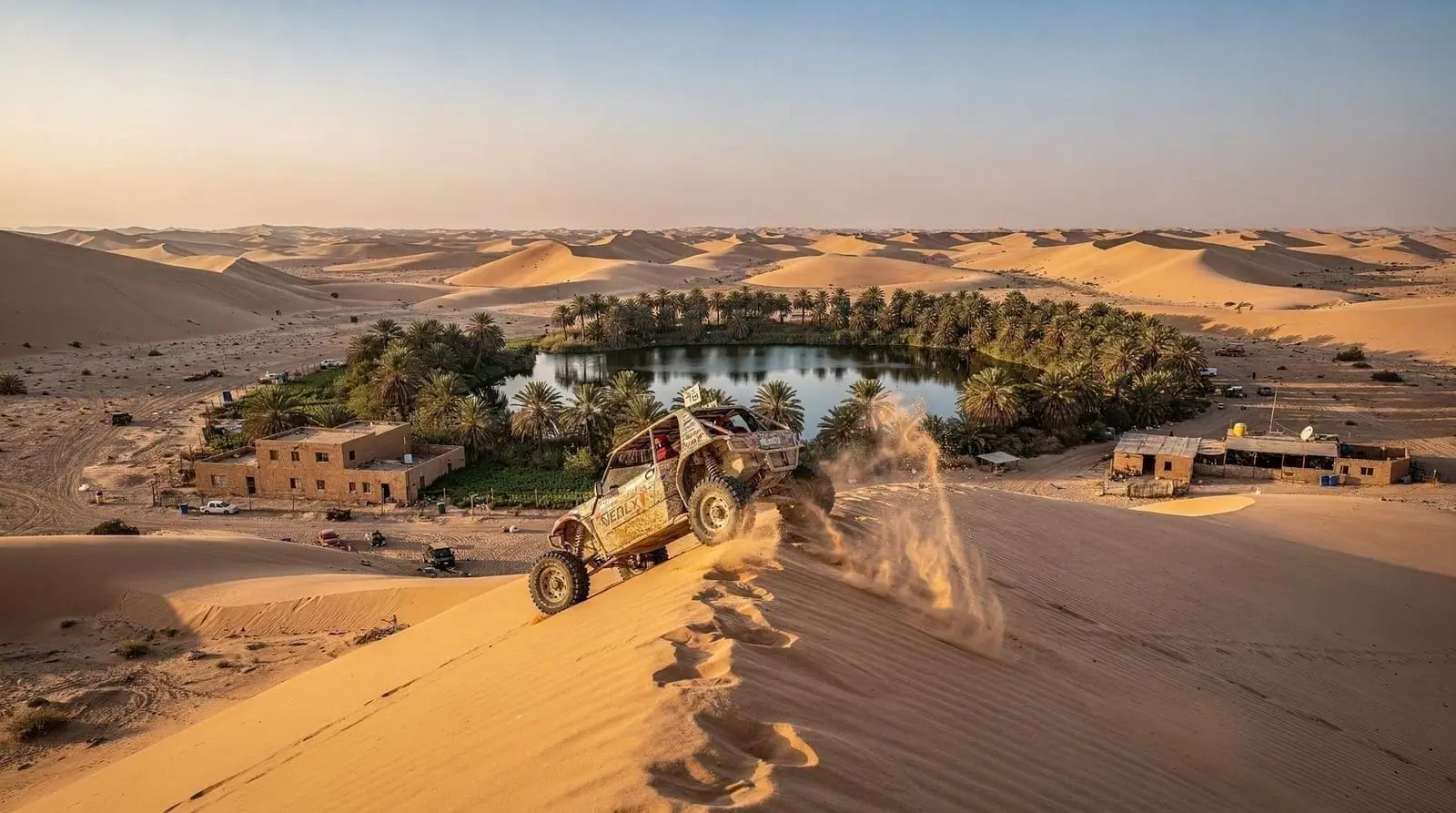
Huacachina dune buggy guide
Huacachina: Sandboarding and Dune Buggy Tour at Sunset
What is the Huacachina dune buggy tour like?
A roll-caged sand buggy charges up and over the dunes like a rollercoaster, stopping so you can sandboard down the slopes, then parks on a high dune for sunset before racing back in the dark. It runs about 1.5 to 2 hours and costs roughly S/60 to S/100 per person.
The dune buggy ride is the reason most people come to Huacachina, and it lives up to the hype better than the oasis itself does. A driver straps you into a roll-caged sand-rail buggy, guns it up a 100-metre dune, drops over the crest, and proceeds to throw the machine around the desert like a fairground ride for the next hour and a half — punctuated by stops to sandboard down ever-bigger slopes and a pause on a high ridge to watch the sun set over an endless sea of sand. It is loud, dusty, fast, occasionally terrifying, and genuinely one of the most fun things on Peru’s south coast.
This guide is the practical companion: what it costs, exactly how it goes, what to wear, how rough it really is, the safety realities, and how to pick an operator that does not cut corners. For the wider oasis and where it fits a trip, see the Huacachina guide.
| Where | Huacachina oasis, 5 km from Ica |
| Cost | around S/60–100 per person ($16–27) |
| Time needed | 1.5–2 hours |
| Best time | Late afternoon sunset departure (~16:00–17:00) |
| Booking | Through your hostel or an established agency, not the cheapest tout |
What the ride is actually like
A standard buggy seats around 8 to 12 people in tiered bench rows behind a roll cage, with the driver up front. Once you leave the oasis ring, the driver heads straight up the dunes and the rollercoaster begins: steep climbs, stomach-dropping descents down the back of crests, and tight banked turns that fling sand and passengers sideways. This is not a gentle scenic drive — it is deliberately thrilling, and the drivers play it up.
Between the bursts of driving, the buggy stops at suitable slopes for sandboarding. The usual format is straightforward: the driver waxes a wooden board, you lie on it head-first, grip the front, lift your toes, and slide down the dune — sometimes fast. The slopes get progressively bigger through the tour, the last often a long, steep run. Some operators also offer standing sandboarding (strapped in like a snowboard) on gentler dunes, which is harder and needs a bit of balance.
The tour finishes with the buggy parked on a high dune for sunset — the genuine highlight, a 360-degree view of dune ridges turning gold and pink — before a dark, fast drive back to the oasis. Total run time is about 1.5 to 2 hours.
Cost and timing
Expect to pay roughly S/60 to S/100 per person (about $16 to $27 USD) for the standard sunset buggy-and-sandboard combo, plus a small Huacachina entrance/dune fee collected separately. Prices climb on Peruvian holiday weekends and vary with operator and how full the buggy is.
Take the late-afternoon departure — typically around 16:00 to 17:00 depending on season. The sand is cooler underfoot for sandboarding, the light is far better for photos, and you get the sunset payoff. Midday tours exist but the sand is scorching, the light is flat, and you miss the best part. Some operators run a picnic version that adds food on the dunes:
Huacachina: Sandboarding and Dune Buggy Tour at SunsetThe combined Ica-or-Huacachina pickup option is convenient if you are basing in Ica rather than the oasis itself:
From Ica or Huacachina: Dune Buggy at Sunset & SandboardingWhat to wear and bring
Sand gets into absolutely everything — this is the single most important thing to internalise.
- Closed shoes, not sandals; you will be walking and climbing on hot, deep sand.
- Clothes you do not care about. They will fill with sand. Long sleeves and trousers actually help against sun and abrasion on the slide.
- Sunglasses (essential against blowing sand) and sunscreen.
- A buff, scarf or bandana for your nose and mouth — the buggy kicks up a lot of dust.
- Water, and a bag that closes securely for valuables; loose items fly out.
- Camera caution: sand and good cameras do not mix. Bring a phone in a case or a rugged/action camera, secured with a strap, and accept the risk — or leave the nice gear at the hostel.
A change of clothes for afterwards is welcome, because you will be carrying half a dune home with you.
What the booking includes, and what it does not
Read the inclusions before you pay, because “S/60” and “S/100” can buy quite different tours.
- Always included: the buggy ride, a board, and a driver who waxes the board and shows the position.
- Usually separate: the small Huacachina entrance/dune fee, collected apart from the tour price.
- Sometimes included, sometimes not: hotel or hostel pickup, especially if you are based in Ica rather than the oasis (the combined Ica-or-Huacachina pickup option below handles this).
- The picnic variant adds food and drink on the dunes, which is pleasant on a longer tour but pushes the price toward the top of the range.
- Photos/video are generally up to you — few standard tours include a dedicated photographer.
The honest baseline is this: a fair shared sunset tour with a licensed operator sits around S/60 to S/80 plus the dune fee. Paying meaningfully less usually means a tired vehicle or an overloaded buggy; paying more buys the picnic, a smaller group, or door-to-door pickup rather than a better ride.
How rough is it, really?
Rough enough to take seriously. The climbs and drops jolt your neck and lower back, and the banked turns throw you against the seatbelt and your neighbours. For most healthy travellers this is part of the fun, but:
- If you have serious back, neck or spinal problems, think twice — the impacts are real.
- Pregnant travellers should skip it.
- Motion sickness can strike on the relentless climbs and drops; the same defences as any motion sickness apply (medication beforehand, eyes on the horizon).
- Brace your neck on the big descents and keep your arms inside the cage.
The buggies have roll cages and seatbelts — use the belt, and make sure it actually latches. Drivers know the dunes intimately, which is reassuring, but they also drive for thrills, so it is an intense ride by design.
Choosing a good operator
This is the honest-planner part. Most Huacachina buggy operations are fine, but standards vary, so:
- Book through your hostel/hotel or an established agency rather than the cheapest tout, and check recent reviews for vehicle condition and driver conduct.
- Confirm the buggy has working seatbelts and a sound roll cage before you get in. If a vehicle looks neglected, decline.
- Avoid the rock-bottom price. A buggy tour that badly undercuts the rest is saving money somewhere — usually maintenance.
- Make sure boards are provided and waxed and that the driver demonstrates the sandboarding position before the first run.
- Beware operators who overload the buggy beyond its seats; a packed, sagging vehicle is neither safe nor comfortable.
A reputable sunset tour at a fair price is the goal, not the absolute cheapest seat.
Sandboarding technique that actually works
The standard lying-down format needs nerve, not skill, but a few small things make it faster, safer and more fun:
- Lie head-first, chest down, and grip the front edge of the waxed board with both hands. Keep your elbows tucked.
- Lift your toes and forefeet off the sand — dragging them is the most common way beginners slow themselves into a stop halfway down. Drag the tops of your feet lightly only if you genuinely need to brake.
- Look down the slope, not at the sand right in front of you, to keep a straight line.
- Let the driver re-wax between runs. A freshly waxed board is dramatically faster; an unwaxed one barely moves on the gentler slopes.
- For standing (snowboard-style) sandboarding, keep your knees bent, weight slightly back, and start on the gentle slope the operator points you to. It is genuinely harder than the lying-down version and most people are content with the latter.
Expect the slopes to grow through the tour, with the final run often a long, steep descent that picks up real speed. That progression is deliberate — it eases beginners in before the big one.
Capturing the ride without ruining your gear
Sand is the enemy of every camera, so plan how you will shoot before you leave the oasis:
- A phone in a sealed case or a rugged action camera on a wrist strap is the right tool. Leave a bare DSLR behind.
- For the buggy driving, mount or hold the camera low and braced; the ride is too violent for steady framing, so lean into the motion-blur energy rather than fighting it.
- For sandboarding, ask a fellow passenger to film from the top or bottom of the slope while you ride — self-filming head-first on a moving board rarely ends well.
- The sunset stop is the money shot. That is when you have a stable footing on the high dune and the best light of the day, so save battery and lens-wiping for then.
- Wipe and seal everything afterward. Sand works into buttons and ports; a quick clean before it migrates saves a ruined device.
Pairing it with the rest of Huacachina and Ica
The buggy is a late-afternoon activity, which leaves the rest of the day open. The natural daytime pairing is Ica’s pisco and wine bodegas — tastings at vineyards like Tacama and El Catador make an easy morning or early-afternoon counterpoint to the dunes. See the Ica vineyards and pisco guide and the pisco drink-and-town guide. For everything else about staying at the oasis — beds, food, costs, getting there — the Huacachina guide has it.
Huacachina: Picnic, Dune Buggy Ride and SandboardingWhen to go and weather realities
The desert is dry and sunny essentially year-round, so the buggy tours run in every season — there is no true off-period. What changes is the heat and the wind. From November to March the days are hottest, which makes the midday slots genuinely punishing and reinforces why the late-afternoon departure is the one to take; nights cool off pleasantly. From April to October the days are milder and equally reliable. The only real disruptor in any month is strong wind, which can whip sand hard enough to make a ride unpleasant or prompt an operator to shorten or briefly delay tours. Outright cancellation is rare. Whatever the season, the sunset slot wins on sand temperature, light and the payoff view.
After the ride
You will come back coated in sand — it gets into hair, ears, pockets and every seam of your clothing. Plan for it: have a change of clothes ready, shower promptly before the sand migrates through your room, and shake everything out outdoors rather than over a bathroom floor. This is also when to clean and reseal any camera or phone you took on the dunes, before grit works into the buttons and ports. Then the natural close to the evening is a drink and a meal — eaten a street back from the lagoon, where prices are reasonable, rather than on the overpriced waterfront. If you have an early bus the next day, lay everything out the night before; digging sandy gear out of a bag at dawn is nobody’s idea of a good start.
Riding with children or a nervous first-timer
The dune buggy is a genuine thrill ride, and operators vary in how they handle that with families and nervous riders. Most stables will ask about ages and comfort level before departure and can moderate the driving style somewhat — gentler climbs, slower descents, fewer of the sharpest banked turns — if you ask directly before setting off, though the ride will still be bumpier than a scenic drive.
There is no fixed minimum age universally enforced, but very young children and anyone prone to serious motion sickness should sit this one out or ask for the mildest possible driving style. For a nervous adult first-timer, sitting toward the middle of the buggy rather than the front or very back row reduces the sharpest jolts, and telling the driver upfront that it is your first ride tends to get a slightly gentler pace. Sandboarding is entirely optional at every stop, so anyone who wants to skip a run can simply stay in the buggy.
Group size matters too: a fuller buggy tends to ride slightly heavier and a touch more stable over the drops, while a lighter load bounces more. If you are booking for a mixed group of confident and nervous riders, mention it when booking — some operators can split a large group across two buggies with different driving styles rather than forcing everyone into one pace, which is worth the small extra coordination for a group where tolerances genuinely differ. Seating near the middle of the row also helps anxious riders more than the choice of buggy itself.
How it fits a south-coast trip
The dune buggy slots into the standard circuit at the Ica / Huacachina stage — after Paracas and the Ballestas, before the run south to Nazca. A clean evening plan is to arrive at the oasis in the afternoon, take the sunset buggy tour, stay over, and continue the next day. The south coast 2-day guide and the Lima-to-Paracas-Nazca itinerary sequence the whole loop; browse packaged versions on the tours hub or build a route on the itineraries hub.
Standard sunset combo vs the picnic version
Most operators offer two versions of essentially the same ride, and it is worth knowing which you are booking:
| Standard sunset combo | Picnic version | |
|---|---|---|
| Length | 1.5–2 hours | Longer, often 2.5–3 hours |
| Price | S/60–100 | Toward the top of the range or above |
| Includes | Buggy, board, driver | Adds food and drink on the dunes |
| Best for | Most travellers, one-night stops | Couples or groups wanting a slower, longer outing |
Neither is objectively better — the standard combo is the efficient, better-value default for a one-night Huacachina stop, while the picnic version suits travellers with a second night who want to linger on the dunes rather than head straight back for dinner.
Frequently asked questions about Huacachina dune buggy
How much is the Huacachina dune buggy tour?
Is sandboarding in Huacachina hard?
Is the dune buggy ride safe?
What should I wear and bring?
What time is the best dune buggy tour?
Top experiences
Bookable activities with verified prices and instant confirmation on GetYourGuide.
